
Patent CN112155279B
Updated October 30, 2026Lightweight Air Cushion Shoe with Automatic Gas Circulation
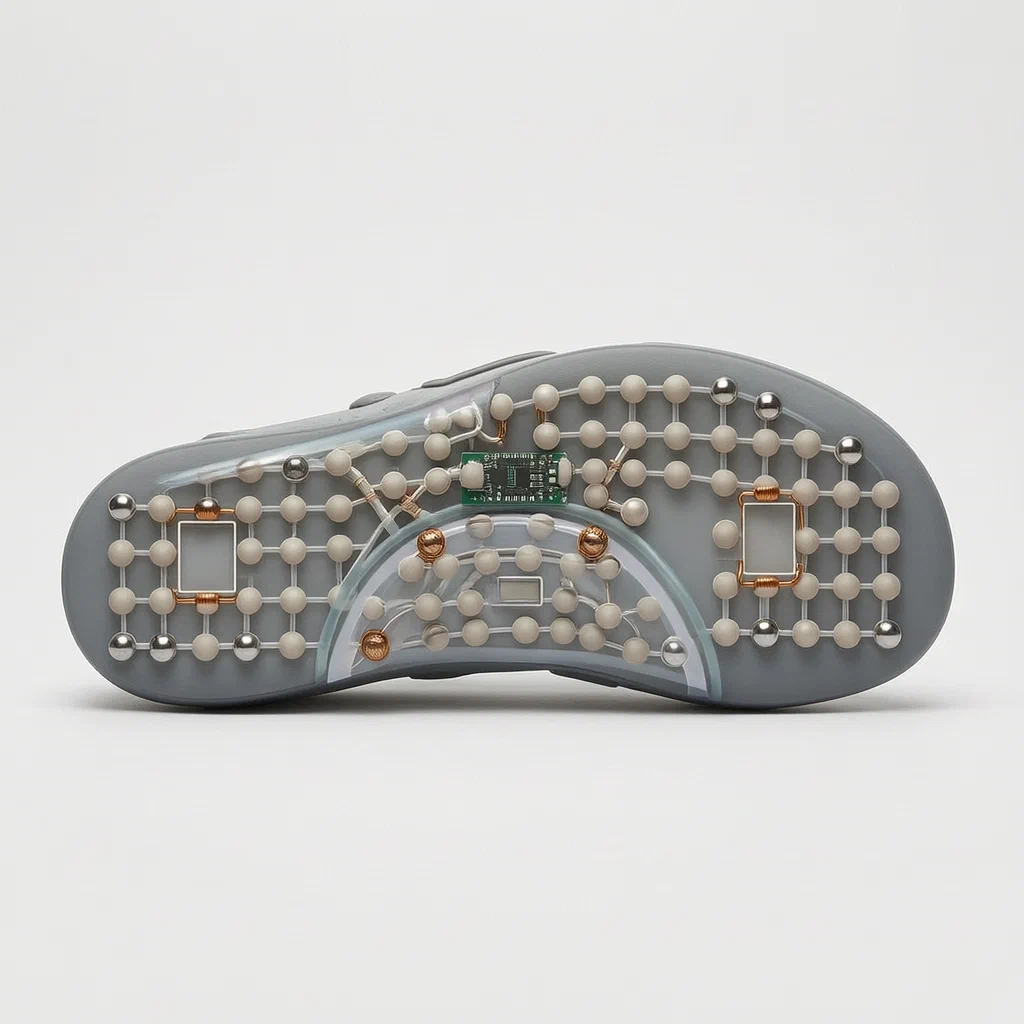
Standard air-cushion soles trap gas in sealed pockets that compress but do not adapt as the foot rolls through a stride. This design divides the sole into three zones—front, arch, and rear—each holding a matrix of rubber gas capsules linked by pipelines. When a zone takes weight, gas flows through the pipelines into less-pressurized capsules. Between the zones, ventilation pipelines contain metal balls controlled by electromagnetic coils. Pressure sensing chips in each zone send data to a single chip microcomputer, which energizes the coils to open or close the inter-zone pipelines according to the walking phase. The result is a sole that contracts and expands dynamically underfoot. Power for the microcomputer comes from four power generation capsules mounted on the sides of the shoe, where a magnetic ball rocks inside an induction coil during walking to produce current stored in a small lithium battery.
- China invention patent - in force
- No filings outside China
- Footwear technology
- Rubber gas capsules, coils, microcomputer, lithium battery
Splat! What let you down?
🫧
Matrix gas capsules
Rubber capsules arranged in a matrix across three sole zones expand and contract to redistribute gas underfoot.
🔀
Controlled gas circulation
Coils and metal balls in the pipelines open or close gas flow between zones based on pressure data.
⚡
Self-powered electronics
Power generation capsules with rocking magnetic balls harvest energy from walking to charge a lithium battery.
📡
Sensor-driven adjustment
Pressure sensing chips and a gyroscope feed data to a single chip microcomputer that directs the airflow.
Bring this product to market
- ✓ Patent vetted China-only family and legal status checked
- 2 Product brief · now How it works, uses and options written up
- 3 Prototype First samples for buyers to review
- 4 Pilot run Small first batch for launch customers
- 5 Volume production Repeat orders at scale
Buyer interest
– of 100 buyers needed to start prototyping
One click, no sign-up. Each vote is one real visitor, and products with the most interest go to prototyping first.
Build team: no members yet. Need a partner, co-funding or skills to build this? Join and we introduce the team once it forms.
The problem
Conventional air-cushion shoes rely on sealed gas pockets that compress under load but cannot transfer air to other parts of the sole. When a person walks, the heel strikes first, then the weight rolls to the arch and finally pushes off the forefoot. Sealed pockets absorb some impact, yet they remain static; the gas stays trapped where it was filled. Over long periods of standing or walking, this lack of adaptation can leave certain areas over-compressed while others remain too firm. Additionally, adding electronic sensors and pumps to a shoe typically requires external charging or heavy batteries, which conflicts with the goal of keeping footwear light.
The solution
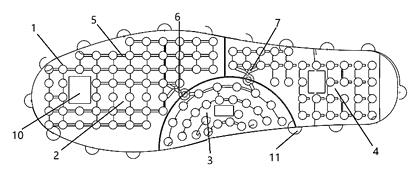
This patent describes a sole built from three distinct areas—a front sole area (2), an arch area (3), and a rear sole area (4)—each populated with multiple rubber gas capsules (1) arranged in a matrix. The solution addresses both dynamic support and self-contained power:
- Intra-zone circulation. Rubber ventilation pipelines I (5) connect the gas capsules (1) within each individual area. When one capsule is compressed by body weight, gas flows through these pipelines into neighboring capsules that carry less pressure, allowing the rubber material to flex and distribute the load evenly across that zone.
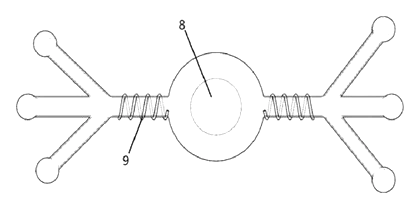
- Inter-zone control. Ventilation pipeline II (6) connects the front sole area (2) to the arch area (3), and ventilation pipeline III (7) connects the arch area (3) to the rear sole area (4). Inside these connecting pipelines sit metal balls (8) surrounded by coils (9).
- Smart actuation. A pressure sensing chip (10) in each area measures the stress applied to the sole. A single chip microcomputer (12) receives this data, along with acceleration and movement readings from an internal gyroscope. Based on the combined signals, the microcomputer energizes specific coils (9) to generate a magnetic field that moves the metal balls (8), thereby opening or closing the pipelines between zones.
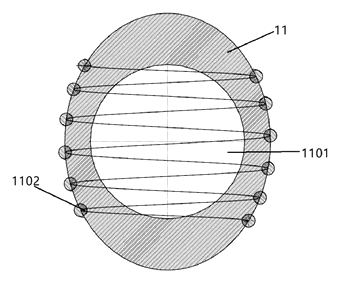
- Self-generated power. Four power generation capsules (11) are mounted on the sides of the shoe, two on each side. Inside each capsule, a small magnetic ball (1101) rocks back and forth as the wearer walks, cutting across an induction coil (1102) wound on the inner wall. This motion converts mechanical energy into electrical current, which is stored in a small, lightweight lithium battery to run the microcomputer, sensors, and coils.
Who it is for
- Athletic footwear brands seeking a sole system that actively redistributes cushioning during running or training without adding heavy external batteries.
- Work and uniform shoe manufacturers that supply footwear for workers who stand or walk on hard surfaces all day and need adaptive underfoot support.
- Casual and lifestyle shoe labels looking to differentiate their product lines with visible, functional technology embedded directly into the midsole.
- Orthopedic footwear developers interested in a platform that uses sensor data to adjust sole firmness dynamically, subject to their own testing and regulatory pathways.
How it works
The main parts
| No. | Part | What it does |
|---|---|---|
| 1 | Gas capsule | Rubber chamber filled with gas; arranged in a matrix across the sole. |
| 2 | Front sole area | Zone under the toes and ball of the foot. |
| 3 | Arch area | Zone under the midfoot. |
| 4 | Rear sole area | Zone under the heel. |
| 5 | Ventilation pipeline I | Rubber tube connecting gas capsules within the same area. |
| 6 | Ventilation pipeline II | Connects the front sole area (2) to the arch area (3). |
| 7 | Ventilation pipeline III | Connects the arch area (3) to the rear sole area (4). |
| 8 | Metal ball | Sits inside pipelines II and III; moves to block or allow gas flow. |
| 9 | Coil | Wraps around the pipeline; when electrified, creates a magnetic field to move the metal ball (8). |
| 10 | Pressure sensing chip | Detects stress in each area using an elastic element and resistance strain gauge. |
| 11 | Power generation capsule | Side-mounted unit containing a magnetic ball (1101) and induction coil (1102) to generate electricity. |
| 12 | Single chip microcomputer | Processes sensor data and controls the coils (9). |
Operating steps
- Walking begins. As the foot strikes the ground, the pressure sensing chips (10) detect the force distribution across the front, arch, and rear areas. Simultaneously, the gyroscope measures the shoe’s acceleration and movement.
- Local gas shift. Within the loaded zone, the compressed gas capsules (1) push air through ventilation pipeline I (5) into adjacent, less-pressurized capsules, softening the immediate impact.
- Microcomputer decision. The single chip microcomputer (12) analyzes the pressure and gyroscope data. If the data indicates that gas should move between zones—for example, shifting air from the heavily loaded rear sole area (4) toward the arch area (3) during heel strike—it sends a signal to the corresponding coil (9).
- Pipeline opens or closes. The energized coil (9) generates a magnetic field that pulls or pushes the metal ball (8) inside ventilation pipeline II (6) or III (7). This action opens the path for gas to circulate between the areas, or closes it to trap gas where support is needed.
- Continuous power. With every step, the magnetic balls (1101) rock inside the power generation capsules (11), inducing current in the coils (1102) to keep the lithium battery charged.
Applications
Daily commuting and urban walking
Commuters who walk several miles a day on pavement experience repetitive heel and forefoot impacts. The automatic gas circulation shifts cushioning to match the rolling gait, reducing the localized bottoming-out common in standard foam or static air soles.
Warehouse and retail work environments
Employees in warehouses or retail stores stand on concrete floors for extended shifts. By continuously adjusting the gas volume under the arch and heel based on real-time pressure data, the sole helps maintain consistent support throughout the workday.
Light athletic training
For gym workouts, aerobics, or court sports involving frequent changes in direction, the gyroscope and pressure sensors react to sudden accelerations. The microcomputer adjusts the inter-zone valves rapidly to stabilize the foot during lateral movements.
Travel and tourism footwear
Travelers need lightweight shoes that perform well over varied terrain without requiring chargers. The self-powering side capsules harvest energy from normal walking, eliminating the need to plug in the shoes at a hotel.
Casual lifestyle sneakers
Brands targeting the lifestyle market can integrate this visible technology into chunky or transparent sole designs. The matrix arrangement of the gas capsules offers a distinct visual pattern that appeals to consumers looking for functional aesthetics.
Where it is less suitable
- Heavy mountaineering boots. Rigid shanks and thick outsoles required for technical climbing may restrict the flexibility needed for the gas capsules to compress and expand effectively.
- Minimalist barefoot shoes. The inclusion of microcomputers, coils, and batteries adds thickness and structure that contradicts the zero-drop, ultra-thin philosophy of barefoot footwear.
- Water-intensive environments. While the patent mentions rubber materials, submerging electronic components like the microcomputer and coils in deep water requires sealing solutions not detailed in the document.
Frequently asked questions
How does the air move inside the sole?
The sole is split into front, arch, and rear areas, each holding a matrix of rubber gas capsules connected by pipelines. When you step down, pressure sensors tell a microcomputer which zone is loaded. The microcomputer activates coils that move metal balls inside the pipelines, opening paths for the gas to flow toward areas that need more support.
Does the shoe need to be charged?
No external charger is described in the patent. Four power generation capsules are mounted on the sides of the shoe. Inside each, a small magnetic ball rocks back and forth as you walk, passing through an induction coil to generate electricity, which is stored in a small internal lithium battery.
What happens if the electronics fail?
The patent does not specify a manual override. However, the gas capsules themselves are made of flexible rubber and are physically connected by pipelines. Even without electronic valve control, the basic compression and expansion of the rubber would still provide passive cushioning.
Can the capsule layout be changed for different shoe sizes?
Yes. The patent states that the gas capsules are arranged in a matrix, and the number of capsules is set according to the size and shape of each area. Capsules near the edge of the sole can also change shape to follow the contour of the shoe.
Is the shoe heavy because of the electronics?
The design focuses on being lightweight. The battery is specified as a small lithium cell chosen for its low weight and high storage capacity, and the power generation capsules have a diameter smaller than the sole thickness. Exact weights are set in design and confirmed on prototypes.
How durable are the rubber gas capsules?
The patent notes the capsules are made of rubber with a certain degree of flexibility to allow gas expansion. Specific cycle life or abrasion resistance numbers are not provided; these parameters are confirmed on prototypes during material testing.
Can this design be made and sold in the US?
The patent was filed only in China and has no US counterpart, so it does not restrict making or selling the design in the United States. However, the patent remains in force in China until at most 2040-10-06 (if annual fees are paid), meaning production in China requires the owner’s permission. Because active footwear technology is heavily patented globally, we recommend a freedom-to-operate check before volume production.
Are you affiliated with the patent owner?
No. IP2M is an independent design and manufacturing service working from the public patent document.
Request a quote
Click Request a Quote below to see our email address - copy it, or open your email app with a ready-made message. Please mention patent CN112155279B in the subject.
Helpful details to include:
- Your company and channel (athletic brand, work shoe manufacturer, casual footwear label)
- Target sizes and gender/age group
- Upper material preferences and outsole traction needs
- Performance goals for cushioning and electronic response
- Estimated quantity and target price
- Timeline - when you would like samples and the first shipment
You can also reach us at (332) 203-9997.
Explore this product
Interested in building this?
Tell us your target market, quantity and timeline. We reply with options for prototyping, small-batch runs or volume production.
Send your inquiry to
Please put CN112155279B in the subject line and tell us your company, country, estimated quantity and timeline.
Prefer to talk? Call (332) 203-9997.
More product-ready patents
All Apparel & Accessories patents →
Apparel & Accessories
Stacked Zipper with Teeth That Mesh Top-to-Bottom
Zipper whose two identical tooth rows mesh on top of each other, closed by a simplified slider.
Patent CN205795062U
Apparel & Accessories
Impact-Resistant Glove with a 3D-Printed Lattice Layer
Work glove with a 3D-printed lattice impact layer, TPU knuckle guards and a light mounting area.
Patent CN213785583U
Apparel & Accessories
Massage Insole with Spring-Back Silicone Nubs and a Removable Top Layer
Layered insole: silicone nubs rise through a removable perforated top sheet and sink under each step.
Patent CN208286505U
Apparel & Accessories
Heel-Less Carbon Plate Running Shoe Sole for Forefoot Strikers
Running sole for forefoot strikers: no ground-touching heel, winged carbon plate between two midsoles.
Patent CN216723354U
Apparel & Accessories
Waterproof Magnetic Zipper Stop That Snaps the Two Halves Together
Separating-zipper stop with sealed magnets: pin and box snap together one-handed, safe in rain and wash.
Patent CN215075936U
Apparel & Accessories
Left-Right Specific Soccer Socks: Grip for the Plant Foot, Touch Pads for the Kicking Foot
Soccer socks knitted as a left-right pair: grip zones for the plant foot, pads for the kicking foot.
Patent CN212728807U
Browse by category
- Apparel & Accessories (22)
- Baby & Kids (16)
- Bags & Luggage (9)
- Bath & Personal Care (16)
- Car Accessories (10)
- Furniture, Bedding & Storage (12)
- Garden & Outdoor (18)
- Health & Wellness (8)
- Home, Kitchen & Cleaning (24)
- Lighting (12)
- Packaging & Containers (6)
- Pet Products (6)
- Phone & Camera Accessories (4)
- Retail Display (13)
- School, Office & Art (19)
- Sports & Recreation (25)
- Tools & Workshop (27)
- Toys & Games (12)
This page is based on the public patent document CN112155279B, assigned to Gaomi City meen shoemaking Co.,Ltd.. IP2M is an independent manufacturing service and is not affiliated with, endorsed by or licensed by the patent owner. Images marked as concept renderings are illustrations, not photos of an existing product. Patent status information is provided for reference only and is not legal advice; confirm freedom to operate for your market before production. Full disclaimer.