At a glance
| Patent number | CN112155279B (application CN202011067415) |
| Type | China invention patent (发明专利) - protects product shape, structure and method |
| Original title | Light-weight air cushion shoe with automatic air circulation function (一种轻量式气体自动循环的气垫鞋) |
| Patent owner | Gaomi City meen shoemaking Co.,Ltd. |
| Inventors | Not announced |
| Filing date | 2020-10-06 |
| Grant date | 2021-11-02 |
| Status (China) | In force in China until at most 2040-10-06 (if annual fees are paid) |
| Patent family | Chinese filings only - no US, European, Japanese, PCT or other filings listed |
| Cited by | 0 later documents |
| Source | Google Patents (search for CN112155279B) |
What the claims cover, in plain language
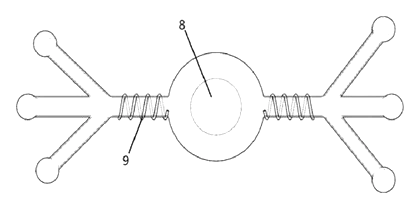
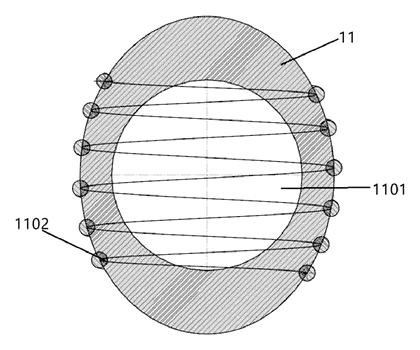
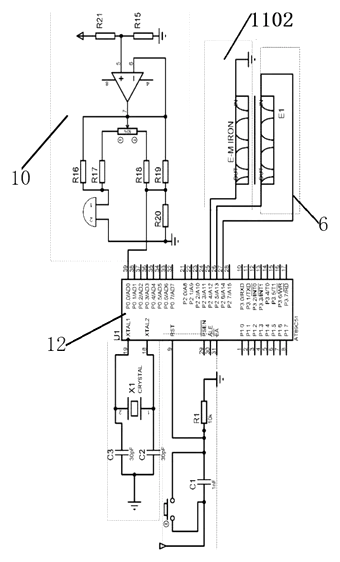
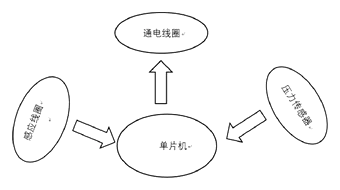
Claim 1 describes a lightweight air cushion shoe comprising a sole divided into a front sole area, an arch area, and a rear sole area. Each area contains multiple gas capsules arranged in a matrix. Ventilation pipeline I connects the gas capsules within each area. Ventilation pipeline II connects the front sole area to the arch area, and ventilation pipeline III connects the arch area to the rear sole area. Metal balls sit inside pipelines II and III, surrounded by coils. A pressure sensing chip in each area detects stress, and a single chip microcomputer receives this data to control the coils, which generate a magnetic field to move the metal balls and open or close the pipelines. Power generation capsules on the shoe sides contain a magnetic ball and an induction coil; walking causes the magnetic ball to rock and cut the magnetic induction lines, generating current stored in a lithium battery to power the system. A gyroscope inside the sole provides acceleration and movement data to the microcomputer.
This is a simplified reading for orientation only. The legal scope is defined by the exact claim wording in the official Chinese document.
What this means for US production
This patent was filed only in China and is currently in force in China until at most 2040-10-06 (if annual fees are paid). It has no US or other foreign counterpart. Because it is active in China, making or selling this specific shoe design in China needs the owner’s permission.
Two points to settle early:
- Other patents may exist. Active air-cushion and smart footwear technologies are covered by numerous patents held by major global athletic brands. Even though no foreign patents cite this specific Chinese document, a freedom-to-operate (FTO) review focusing on electronically controlled sole valves and kinetic energy harvesting in footwear is essential before launching in the US.
- Electronic component durability. Embedding coils, microcomputers, and batteries inside a flexible shoe sole subjects them to repeated bending, moisture, and impact. Material selection and encapsulation methods must be validated through extensive wear testing.
Customization and manufacturing
What can be customized
| Area | Options |
|---|---|
| Upper material | Mesh, synthetic leather, knit, or TPU overlays |
| Sole geometry | Capsule size, matrix density, and edge shaping to fit different shoe lasts |
| Pipeline routing | Diameter and placement of intra-zone and inter-zone ventilation pipelines |
| Electronics tuning | Microcomputer thresholds for pressure and gyroscope triggers |
| Battery capacity | Size of the lithium cell to balance weight and operational duration |
| Outsole tread | Rubber compound and lug pattern for traction |
Things to plan for (US market)
- FCC regulations. The single chip microcomputer and associated circuitry emit radio frequencies if wireless features are added, or fall under unintentional radiator rules; FCC compliance testing applies to electronic modules in consumer goods.
- California Proposition 65. Materials used in the upper, rubber capsules, and battery components must be screened for listed chemicals.
- UN 38.3. The integrated lithium battery must pass UN 38.3 transport testing requirements for shipping finished shoes internationally.
- CPSC guidelines. If the shoe is sized and marketed for children aged 12 and under, it falls under Consumer Product Safety Improvement Act (CPSIA) requirements for lead and phthalates.
How a project runs
- Inquiry - target demographic, sizing range, performance goals, and estimated volumes.
- Design - last development, sole matrix layout, pipeline routing, and PCB design for the microcomputer and power circuits.
- Prototype - 3D-printed or hand-assembled sole units to test gas flow dynamics, sensor accuracy, and power generation output.
- Pilot run - injection molding of rubber capsules, assembly of electronic modules, and wear-testing by human subjects to refine algorithm thresholds.
- Production - mass molding of sole components, PCB assembly, battery integration, upper stitching, and final lasting.
Quantities & timeline
Manufacturing requires precision molds for the rubber gas capsules and pipelines, custom tooling for the shoe upper, and assembly lines capable of integrating delicate electronic components into flexible soles. UN 38.3 battery certification and FCC testing add time before the first shipment. Send us your target sizes, upper materials, performance requirements, quantity and target price and we will reply with options.
Patent drawings
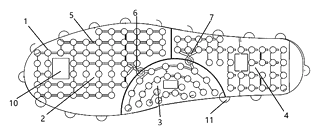
Drawings reproduced from the public patent document for reference.