At a glance
| Patent number | CN112401461B (application CN202011574567) |
| Type | China invention patent (发明专利) - protects product method and structure |
| Original title | Thermos cup with cushion for field use (一种野外使用带坐垫保温杯) |
| Patent owner | Ningbo University of Technology |
| Inventors | Zhu Xuxia |
| Filing date | 2020-12-28 |
| Grant date | 2024-02-06 |
| Status (China) | In force - valid until at most 2040-12-28, subject to payment of annual fees |
| Patent family | Chinese filings only - no US, European, Japanese, PCT or other filings listed |
| Cited by | 0 later documents |
| Source | Google Patents (search for CN112401461B) |
What the claims cover, in plain language
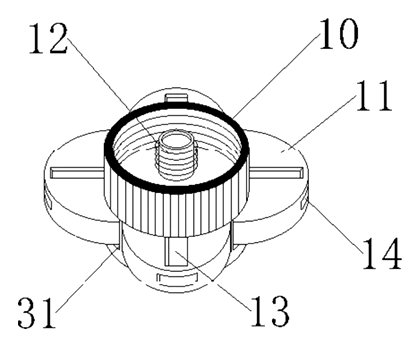
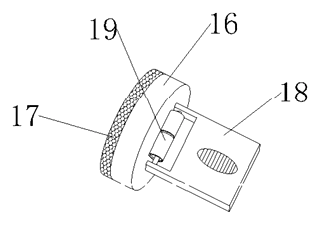
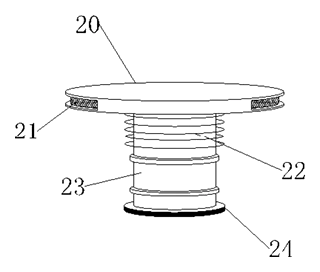
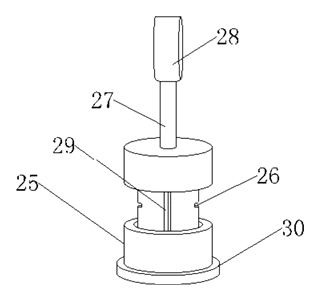
Claim 1 defines a thermos cup comprising a cup body (1), a cup cover (10), a sliding block (16), an inner bottom plate (20), and a telescopic rod (25). Key structural features include a base (6) fixed to the bottom of the cup body, featuring four through grooves (8) that house stress plates (7) with hand buckles (9). The cup cover similarly houses second stress plates (11) with second hand buckles (14). These plates slide out to increase the surface area of the base and lid. Internally, the sliding block (16) interacts with a round groove (4) on the cup body. It uses a hinge (19) and pulling plate (18) to move the inner bottom plate (20). A magnet (17) on the block attracts a second magnet (21) on the inner plate to lock its position against a spring (12) and piston (23) assembly. The telescopic rod (25) in the lid holds a stirring spoon (28).
Claims 2-8 specify details such as the spiral opening (2) for the lid, the specific arrangement of the sliding rails (29) and clamping grooves (26) on the telescopic rod, the material of the rubber cushion (24) (1cm thickness), and the interaction between the piston and the round hole in the base to ensure the cup remains sealed when adjusted.
This is a simplified reading for orientation only. The legal scope is defined by the exact claim wording in the official Chinese document.
What this means for US production
This patent was filed only in China and is currently in force. Making or selling this specific design in China requires the owner’s permission. Since there are no US patents in this family, the design itself is not protected by patent law in the United States. However, similar functional concepts in outdoor gear may be covered by other existing patents.
Two points to settle early:
- Other patents may exist. Multi-functional outdoor containers and collapsible seats are competitive fields. Companies like YETI, Hydro Flask, or specialized camping gear manufacturers may hold patents on similar mechanical structures for expanding bases or internal dividers. A freedom-to-operate (FTO) review is recommended before mass production in the US market.
- Material Safety. The mechanism involves moving parts inside a food-contact vessel. Ensuring that the magnets, springs, and sliding blocks do not contaminate the water or harbor bacteria is a critical engineering challenge.
Customization and manufacturing
What can be customized
| Area | Options |
|---|---|
| Capacity | Standard sizes (e.g., 500ml, 750ml, 1L) with adjusted internal divider travel range. |
| Plate Material | Stainless steel, aluminum, or reinforced polymer for the stress plates. |
| Insulation | Double-wall vacuum stainless steel or single-wall with foam lining. |
| Finish | Powder coating, matte black, camo patterns, or brushed metal. |
| Mechanism | Magnetic strength tuning for easier/harder slider operation; different spoon types. |
| Grip | Rubberized coatings on hand buckles for better traction. |
Things to plan for (US market)
- FDA 21 CFR - Food contact materials. All parts touching the water (inner plate, magnets, piston seals) must be FDA-compliant for repeated food contact.
- CPSC Requirements - General consumer product safety rules apply. Sharp edges on deployed plates must be rounded. Stability tests should verify the seat function does not fail unexpectedly.
- Proposition 65 (California) - Screening of plastics and metals for lead, cadmium, and phthalates.
- ASTM Standards - While no specific ASTM standard exists for “thermos seats,” general durability testing for camping gear (e.g., ASTM F1637 for folding chairs) can inform load-bearing requirements for the plates.
How a project runs
- Inquiry - Target capacity, desired seat load rating, and aesthetic preferences.
- Design Engineering - Refining the slider-magnet interface to prevent water leakage and ensure smooth operation. Designing molds for the complex base/lid plates.
- Prototyping - 3D printed or CNC machined samples to test the deployment mechanism and sealing integrity.
- Testing - Cycle testing the sliders, load testing the seat function, and hygiene checks on internal parts.
- Production - Injection molding for plastic components, stamping for metal plates, vacuum flask assembly, and final integration.
Quantities & timeline
The complexity lies in the precision fit of the sliding block within the round groove and the alignment of the magnets. Tooling for the base and lid with integrated grooves requires high-precision CNC machining. Expect 3-4 months for mold development and initial sampling. Send us your target capacity, material preferences, and estimated order volume and we will reply with options.
Patent drawings
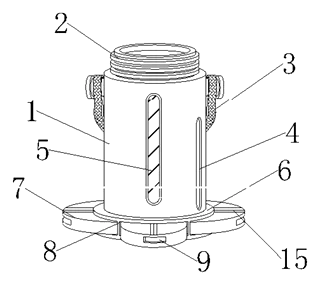
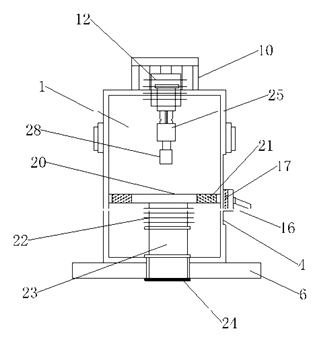
Drawings reproduced from the public patent document for reference.