At a glance
| Patent number | CN112619116B (application CN202011222175) |
| Type | China invention patent (发明专利) - protects product shape, structure, and method |
| Original title | Multi-functional ski chair for disabled persons (一种多功能残疾人用滑雪椅) |
| Patent owner | Wenzhou University |
| Inventors | Sang Guoqiang |
| Filing date | 2020-11-05 |
| Grant date | 2022-04-19 |
| Status (China) | Lapsed - terminated for non-payment of annual fees (recorded 2024-06-25) |
| Patent family | Chinese filings only - no US, European, Japanese, PCT or other filings listed |
| Cited by | 0 later documents |
| Source | Google Patents (search for CN112619116B) |
What the claims cover, in plain language
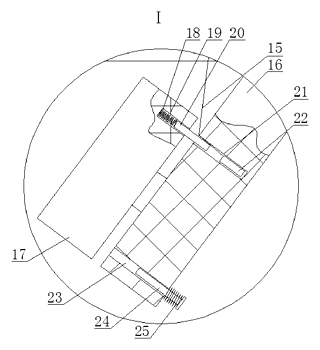
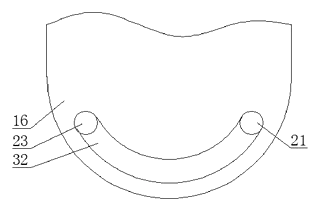
Claim 1 describes a ski chair comprising a seat with a rectangular groove on its back. Inside the groove, a C-shaped plate moves laterally and carries a rack. This rack meshes with a gear rotatably mounted on the seat. Two spring telescopic rods hinge to the gear and extend down to a support plate below the seat. The support plate holds a snowboard. Additional spring telescopic rods connect the seat to the support plate and the support plate to the snowboard. An anti-tip mechanism involves pressure plates, springs, wire ropes, and ejector pins that release inclined support plates when the C-shaped plate is pushed sideways.
Claim 2 specifies that the rectangular groove and the C-shaped plate have sliding grooves and sliders to ensure smooth lateral movement.
Claim 3 adds that the pressure plates also have sliding blocks fitting into the groove’s sliding channels.
Claim 4 details that the main support rod is itself a telescopic rod with an annular plate and a fourth spring connecting it to the seat bottom.
Claim 5 notes a second annular plate on the support rod where the first spring telescopic rods attach.
Claim 6 describes a specific path for the ejector pin, involving a blind hole connected to a through-hole via an arc-shaped groove.
This is a simplified reading for orientation only. The legal scope is defined by the exact claim wording in the official Chinese document.
What this means for US production
This patent was filed only in China and has lapsed, so it no longer restricts anyone in China either. It has no US or other foreign counterpart.
Two points to settle early:
- Other patents may exist. Adaptive skiing equipment is a specialized field with various existing patents covering steering mechanisms, suspension systems, and safety locks. A freedom-to-operate (FTO) review is recommended to check for active US patents related to rack-and-pinion steering or automatic anti-tip devices in sit-skis.
- Safety Standards. Unlike general furniture, sports equipment for disabled persons must meet rigorous safety standards. Compliance with ASTM F2568 (standard specification for sit-skis) or similar international standards is critical for market entry.
Customization and manufacturing
What can be customized
| Area | Options |
|---|---|
| Frame Material | Aluminum extrusion or high-strength steel tubing |
| Seat and Backrest | Molded plastic shell with EVA foam padding |
| Steering Ratio | Gear diameter and rack pitch to adjust sensitivity |
| Suspension | Spring rate and stroke length of telescopic rods |
| Base Width | Snowboard dimensions for stability vs. maneuverability |
| Finish | Powder coating colors, UV-resistant plastics |
Things to plan for (US market)
- ASTM F2568 - Standard Specification for Sit-Skis. Covers structural integrity, restraint systems, and performance requirements.
- CPSC Regulations - General consumer product safety rules apply, including labeling and hazard warnings.
- Material Safety - Plastics and foams should be tested for toxicity and flammability if applicable under state laws like California Prop 65.
How a project runs
- Inquiry - Define target user profile, load capacity, and desired steering sensitivity.
- Design - Finalize geometry of the rack-gear interface, anti-tip trigger points, and suspension rates.
- Prototype - Build functional samples using machined frames and 3D-printed housings for testing.
- Testing - Conduct impact tests, fatigue cycles, and field trials on snow to verify stability and steering response.
- Production - Tool injection molds for plastic parts, cut and weld aluminum frames, assemble mechanical linkages.
Quantities & timeline
Tooling for injection-molded nylon components and custom aluminum extrusions takes time. Mechanical assemblies require precision alignment of gears and shafts. Send us your specifications, quantity estimates, and target launch date and we will reply with options.
Production notes
Tooling and process
Injection molding is likely required for the C-shaped plate, gear housing, and seat shell. Aluminum extrusion typically forms the main support rods and frame. Stamping may be used for metal brackets and racks.
Cost drivers
Weight is typically a primary cost driver due to material usage in the frame. The number of molds needed for plastic components and the complexity of machining aluminum joints also affect costs. Fastener count influences assembly time.
Prototyping path
3D-printed parts are typically the first step for the steering mechanism to test fit and function. Use a machined aluminum frame for initial durability tests. Impact test samples should be built before finalizing tooling.
What we would change before tooling
The alignment tolerance of the gear and rack should likely be verified to ensure smooth operation without binding. Confirm the spring rates for the anti-tip mechanism to prevent premature deployment or failure to lock.
Common failure points
Cracking under impact is a risk for plastic housings. Bolt loosening can occur due to vibration. Shaft and bearing alignment errors may cause steering lag. Spring fatigue could reduce shock absorption effectiveness over time.
Patent drawings
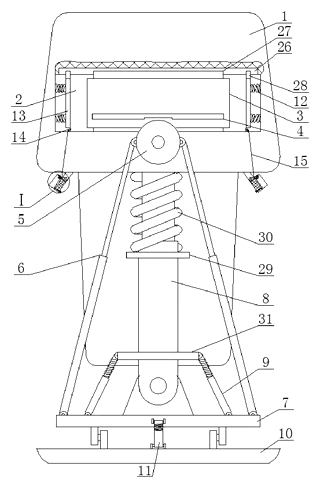
Drawings reproduced from the public patent document for reference.