
Patent CN112776867B
Updated October 27, 2026Folding Frame for Baby Strollers with Sliding Wheel Linkage
Many stroller frames require several separate steps to fold: releasing a latch, pushing down the handlebar, then collapsing the legs one by one. This design ties those movements together through a single linkage. A handheld carrying handle connects to a rotating element that pivots around its own axis toward the longitudinal direction of the base frame. As the handle turns, a connecting rod group pulls the wheel frame, which rides on sliders inside slots in the base frame, drawing the wheels inward. The result is a stroller that folds into a smaller overall volume with one continuous motion. The seat, if fitted, rotates synchronously with the rotating element, and can be mounted facing forward or backward using a dovetail groove connection on the rotating member.
- China invention patent - in force
- No filings outside China
- Baby strollers & carriages
- Metal tubing, plastic joints, sliding linkages
Splat! What let you down?
🔄
Single-motion folding
Turning the carrying handle rotates an element that pulls the wheel frame along the base via a connecting rod group.
🛞
Sliding wheel frame
The wheel frame uses sliders inside slots on the base frame to retract inward, reducing the folded size.
🔒
Integrated lock
A folding control mechanism locks the rotating member when unfolded; the handle acts as the release.
💺
Reversible seat
The seat mounts on a dovetail connection on the rotating element and can face forward or backward.
Bring this product to market
- ✓ Patent vetted China-only family and legal status checked
- 2 Product brief · now How it works, uses and options written up
- 3 Prototype First samples for buyers to review
- 4 Pilot run Small first batch for launch customers
- 5 Volume production Repeat orders at scale
Buyer interest
– of 100 buyers needed to start prototyping
One click, no sign-up. Each vote is one real visitor, and products with the most interest go to prototyping first.
Build team: no members yet. Need a partner, co-funding or skills to build this? Join and we introduce the team once it forms.
The problem
When parents fold a stroller to load it into a car trunk or carry it up stairs, they often deal with multiple independent latches and loose parts. The handlebar drops, but the leg tubes stay spread out. The wheels remain at their full running width, keeping the folded package bulky. A frame that requires several distinct actions increases the chance of pinched fingers and makes it difficult to manage the fold while holding a child.
The solution
This patent describes a folding framework that links the rotation of the handle directly to the retraction of the wheel frame.
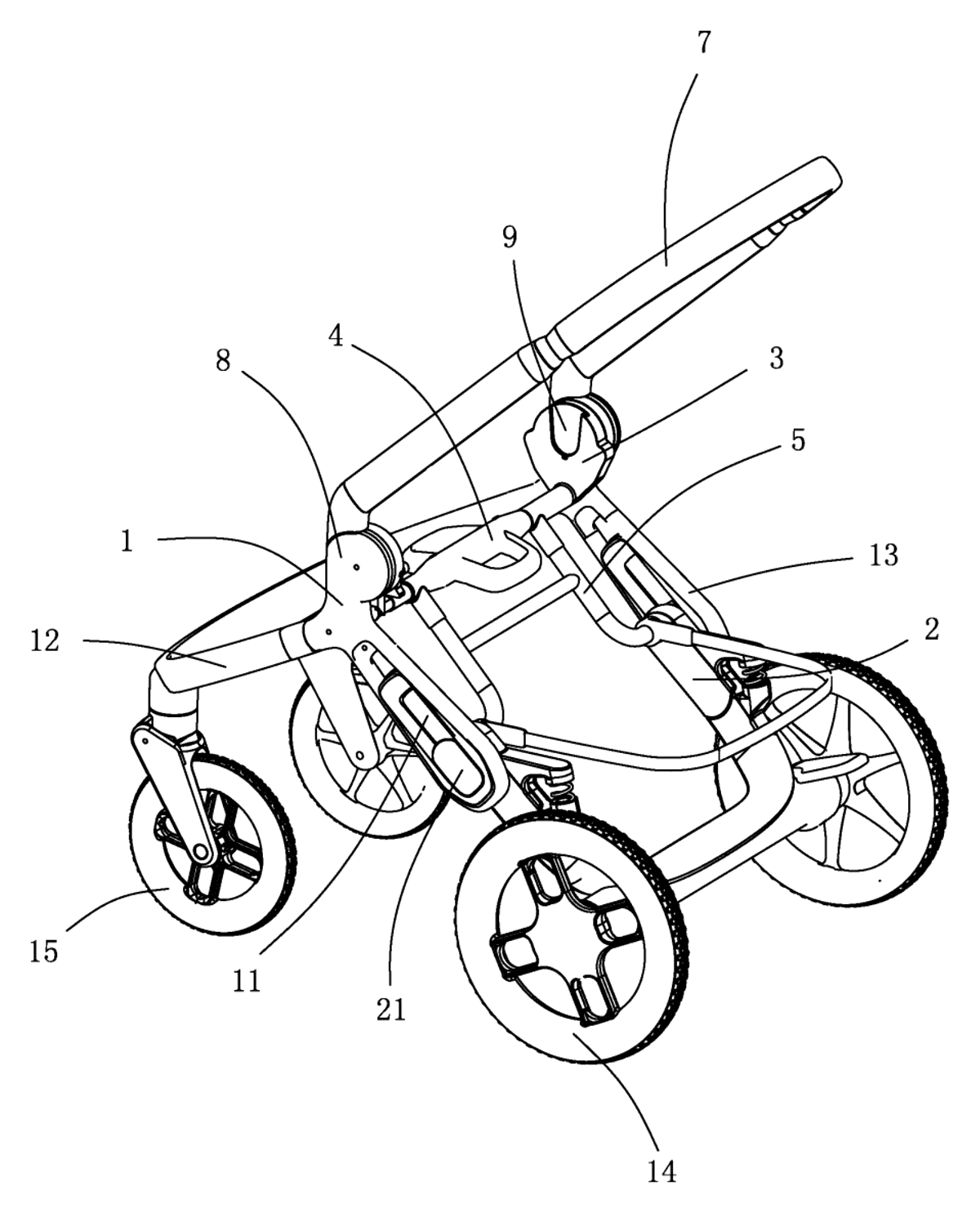
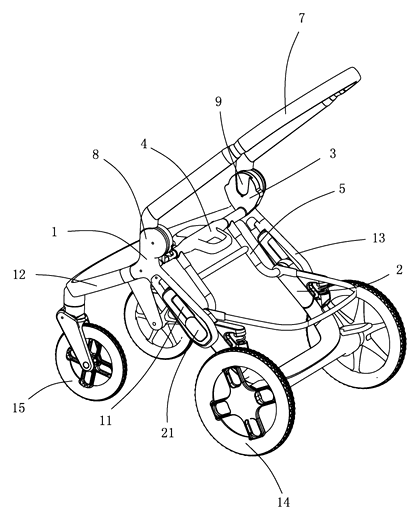
- A base frame (1) forms the main structure, containing a sliding slot (11).
- A wheel frame (2) carries the wheels and has a wheel frame sliding block (21) that fits into the sliding slot, allowing it to move back and forth along the base frame.
- A rotating element (3) is mounted on the base frame so it can pivot around its own axis toward the longitudinal direction of the base frame.
- A handheld carrying handle (4) is connected to the rotating element.
- A connecting rod group (5) sits between the handle and the wheel frame. When the handle and rotating element turn relative to the base frame, the connecting rod group drives the wheel frame to slide and stretch on the base frame, unfolding or folding it.
- A folding control mechanism locks the rotating member on the base frame when the stroller is open. The handle itself acts as the operating member to unlock it.
Who it is for
- Stroller brands looking for a frame mechanism that reduces the folded footprint without adding complex cables or secondary levers.
- Amazon private-label sellers who need a straightforward folding stroller design that is easy to demonstrate in listing videos and simple for buyers to operate.
- Wholesalers of juvenile products supplying retailers that prioritize compact storage for urban customers living in apartments.
- OEM stroller factories seeking licensed or reference frame architectures to build upon for their own brand lines.
How it works
The main parts
| No. | Part | What it does |
|---|---|---|
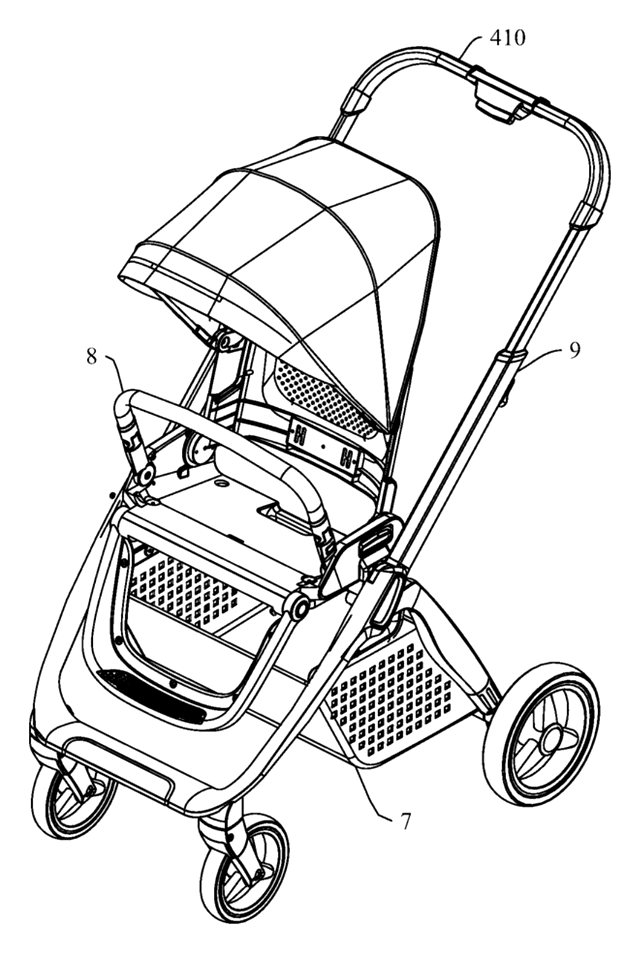
| 1 | Base frame | Main structural tube; contains the sliding slot (11), front leg (12) and rear leg (13). |
| 2 | Wheel frame | Holds the first wheel set (14); slides on the base frame via the sliding block (21). |
| 3 | Rotating element | Pivots on the base frame; carries the seat connecting portion (9). |
| 4 | Handheld carrying handle | Drives the rotating element; operates the folding control mechanism. |
| 5 | Connecting rod group | Links the handle or rotating element to the wheel frame to slide it. |
| 6 | Seat | Mounts on the rotating element; includes seat portion (61) and backrest portion (62). |
| 7 | Push handle | Fixed to the rotating element; folds close to the wheel frame. |
| 8 | Folding joint | Connects the front leg, rear leg and push handle for synchronous rotation. |
| 9 | Seat connecting portion | Dovetail groove on the rotating element for forward or backward seat mounting. |
| 11 | Sliding slot | Channel in the base frame guiding the wheel frame sliding block. |
| 14, 15 | First and second wheel sets | Wheels on the wheel frame and the base frame legs. |
| 21 | Wheel frame sliding block | Slider on the wheel frame riding inside the sliding slot. |
Operating steps
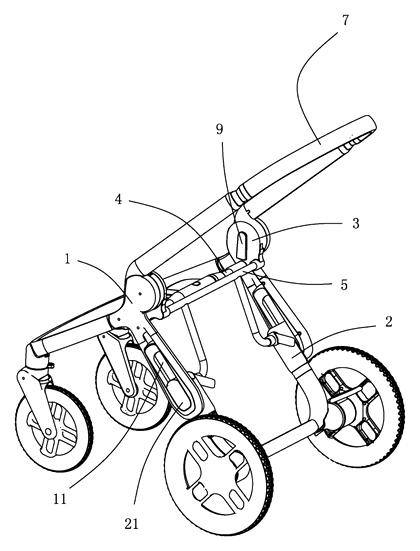
- Unlock - The user grips the handheld carrying handle (4), which acts as the operating member of the folding control mechanism, releasing the lock on the rotating element (3).
- Rotate - The user turns the handle, causing the rotating element to pivot around its axis toward the longitudinal direction of the base frame (1).
- Link - The connecting rod group (5), connected either to the handle or directly to the rotating element, transfers this rotation into linear motion.
- Slide - The wheel frame sliding block (21) moves inside the sliding slot (11), pulling the wheel frame (2) and its first wheel set (14) inward along the base frame.
- Collapse - If present, the seat (6) rotates synchronously with the rotating element. The push handle (7) also rotates closer to the wheel frame via the folding joint (8).
- Carry - Once fully collapsed, the reduced overall volume allows the parent to lift the stroller by the carrying handle. To unfold, the steps are reversed.
Applications
Urban apartment living
Parents storing strollers in small entryways or closets need the smallest possible folded size. By sliding the wheel frame inward along the base frame rather than just hinging the legs, this mechanism shrinks the footprint significantly. The carrying handle doubles as the fold release, leaving one hand free.
Car trunk loading
Fitting a stroller into a compact car trunk often means wrestling with protruding wheels. Because the wheel frame retracts into the base frame’s profile, the folded shape is more rectangular. The synchronized seat rotation prevents the seat fabric from catching on the frame during the fold.
Public transit and travel
Navigating buses or trains requires quick folding and carrying. The single-motion linkage allows a parent to collapse the frame while standing. The integrated carrying handle provides a secure grip immediately after folding, without needing to find a separate strap.
Forward and rear-facing use
Buyers frequently switch seat orientation depending on the child’s age. The rotating element features a seat connecting portion with a dovetail groove structure, allowing the seat to be installed facing forward or backward. The folding action works identically in both orientations.
Where it is less suitable
- Jogging strollers - large fixed wheels and rigid frames designed for running stability do not use sliding wheel retraction.
- Double or tandem strollers - the patent describes a single-seat framework; adapting the sliding slot and linkage for two seats side-by-side would require substantial redesign.
- Umbrella strollers - ultra-lightweight umbrella folds rely on a different scissor-hinge geometry rather than a sliding base track.
Frequently asked questions
How does the wheel frame fold?
The wheel frame has a sliding block that fits into a slot on the base frame. When you turn the carrying handle, a connecting rod group pulls the wheel frame, making it slide inward along the base frame instead of just hinging downward.
Can the seat face both ways?
Yes. The rotating element has a seat connecting portion shaped as a dovetail groove. The seat can be installed facing forward or backward on this connection, and it rotates synchronously with the frame when folding.
Does the handle lock automatically when opened?
The patent describes a folding control mechanism that locks the rotating member onto the base frame when the wheel frame is unfolded. The carrying handle itself acts as the operating member to release this lock for folding.
How much weight can the frame hold?
The patent does not specify a maximum load. Weight capacity is determined by the tube diameter, wall thickness, slider material and joint strength, which are set in design and confirmed on prototypes during ASTM F833 testing.
Is the connecting rod attached to the handle or the rotating part?
The patent covers both configurations. In one embodiment, the connecting rod group is connected directly to the carrying handle. In another, it is connected to the rotating element. Both achieve the same sliding action.
What happens to the push handle when folding?
A push handle is fixedly connected to the rotating element. As the rotating element turns to fold the frame, the push handle rotates closer to the wheel frame, tucking neatly into the collapsed profile.
Can this design be made and sold in the US?
This patent was filed only in China and is in force in China until at most 2041-03-12 (if annual fees are paid). It has no US counterpart, so it does not restrict making or selling the design in the United States. However, stroller frames are covered by many other active US patents, so we recommend a freedom-to-operate check before volume production.
Are you affiliated with the patent owner?
No. IP2M is an independent design and manufacturing service working from the public patent document.
Request a quote
Click Request a Quote below to see our email address - copy it, or open your email app with a ready-made message. Please mention patent CN112776867B in the subject.
Helpful details to include:
- Your company and channel (stroller brand, Amazon seller, juvenile wholesaler, OEM factory)
- Target folded dimensions and unfolded wheelbase
- Wheel sizes and axle configuration
- Seat interface requirements (existing seat molds or new design)
- Frame material preference (aluminum or steel) and finish
- Estimated quantity and target price
- Timeline - when you would like prototypes and the first shipment
You can also reach us at (332) 203-9997.
Explore this product
Interested in building this?
Tell us your target market, quantity and timeline. We reply with options for prototyping, small-batch runs or volume production.
Send your inquiry to
Please put CN112776867B in the subject line and tell us your company, country, estimated quantity and timeline.
Prefer to talk? Call (332) 203-9997.
More product-ready patents
All Baby & Kids patents →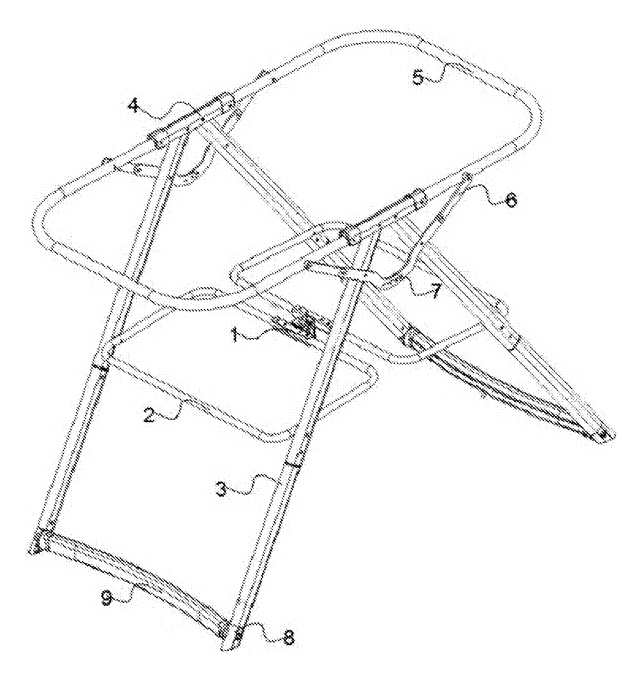
Baby & Kids
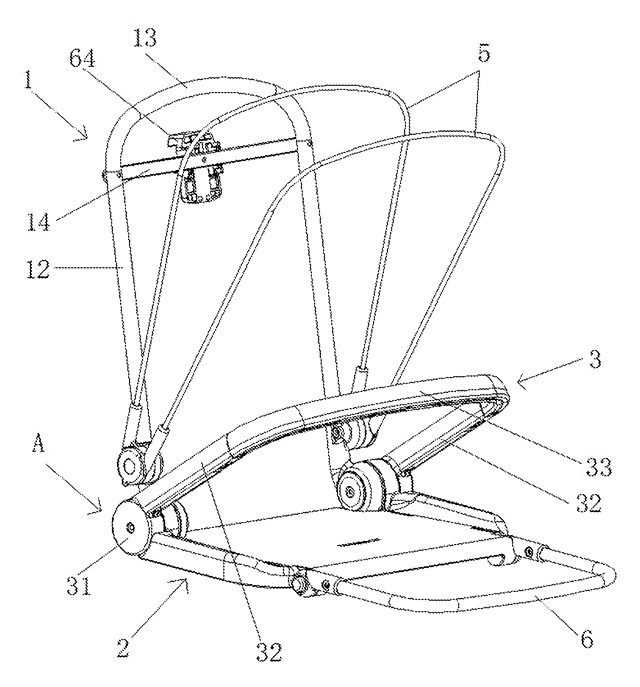
Portable Folding Rocking Bassinet Frame
Rocking bassinet frame that folds flat: telescopic hub, folding rails, two-part legs, curved rockers.
Patent CN206910143U
Baby & Kids
Stroller Seat with Linked Fold-Away Armrest
Stroller seat whose armrest unlocks and folds automatically when the backrest is folded forward.
Patent CN206856772U
Baby & Kids
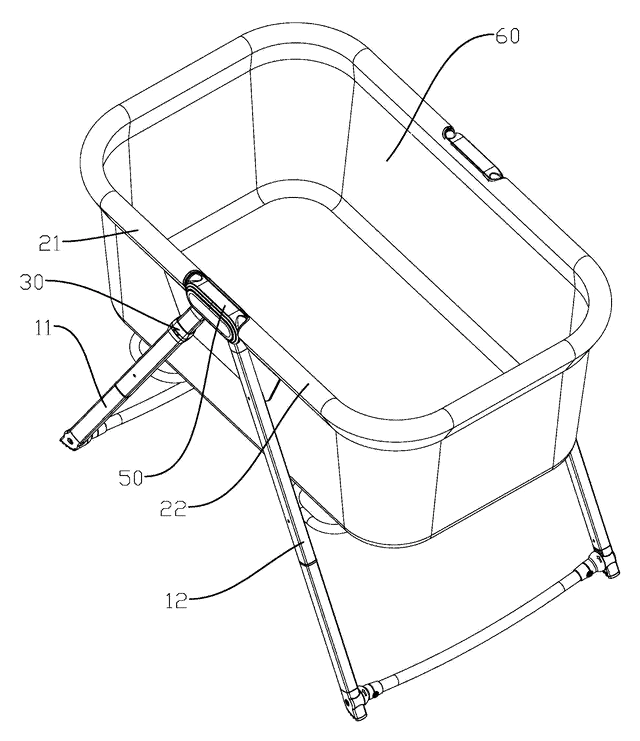
One-Motion Folding Baby Crib with Linked Frame
Portable baby crib whose top rails fold down automatically as the A-frame legs are closed.
Patent CN207202585U
Baby & Kids
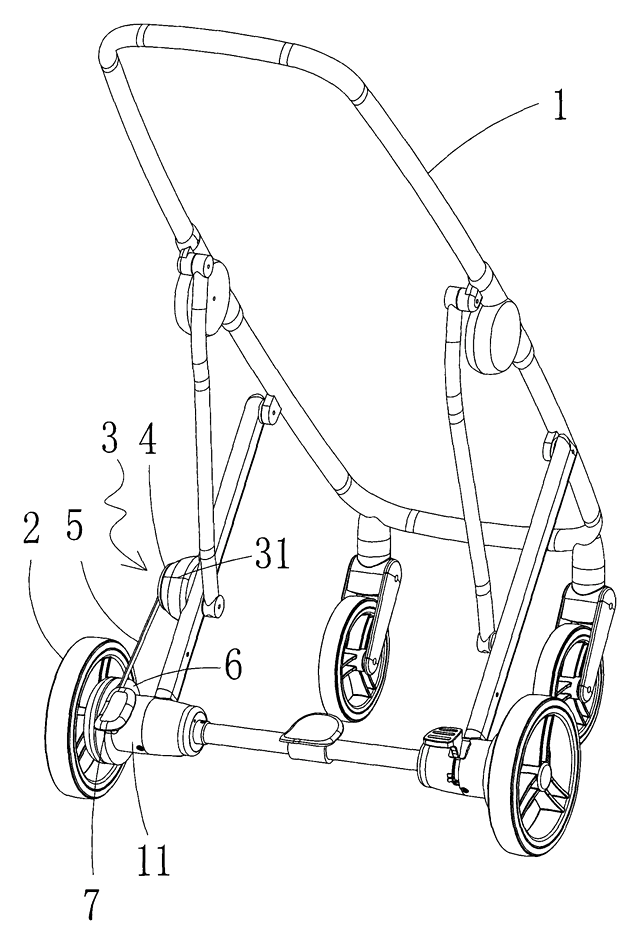
Motorized Rocking Stroller That Rocks by Turning Its Wheels
Baby rocker or stroller whose motor turns the wheels back and forth; a clutch switches to pushing.
Patent CN208119238U
Baby & Kids
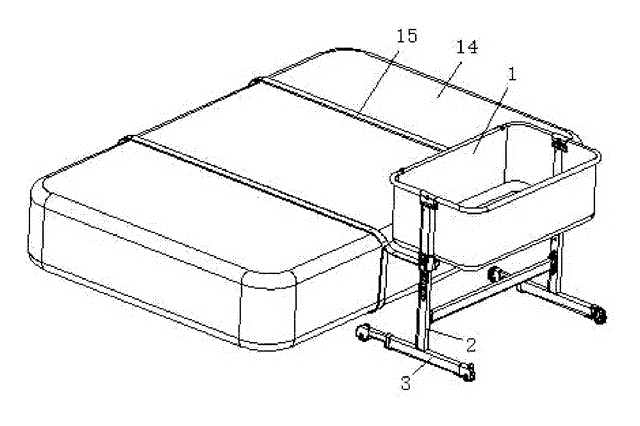
Bedside Crib Base with Spring-Loaded Telescoping Caster Legs
Bedside crib feet with spring-loaded sliding casters: wide when alone, short to sit flush at the bed.
Patent CN207168269U
Baby & Kids
Compact-Fold Stroller with a Four-Bar Side Frame and Telescoping Handle
Stroller with four-bar side frames: handle and rear leg fold onto the front leg, handle telescopes.
Patent CN213799844U
Browse by category
- Apparel & Accessories (22)
- Baby & Kids (16)
- Bags & Luggage (9)
- Bath & Personal Care (16)
- Car Accessories (10)
- Furniture, Bedding & Storage (12)
- Garden & Outdoor (18)
- Health & Wellness (8)
- Home, Kitchen & Cleaning (24)
- Lighting (12)
- Packaging & Containers (6)
- Pet Products (6)
- Phone & Camera Accessories (4)
- Retail Display (13)
- School, Office & Art (19)
- Sports & Recreation (25)
- Tools & Workshop (27)
- Toys & Games (12)
This page is based on the public patent document CN112776867B, assigned to Guangdong Roadmate Group Co Ltd. IP2M is an independent manufacturing service and is not affiliated with, endorsed by or licensed by the patent owner. Images marked as concept renderings are illustrations, not photos of an existing product. Patent status information is provided for reference only and is not legal advice; confirm freedom to operate for your market before production. Full disclaimer.