At a glance
| Patent number | CN112896076B (application CN202110339249) |
| Type | China invention patent (发明专利) - protects product structure and method |
| Original title | Lightweight double-layer battery box with stepping function for commercial vehicles (一种商用车用轻量化双层带上车踏步功能电瓶箱) |
| Patent owner | China National Heavy Duty Truck Group Jinan Power Co Ltd |
| Inventors | Teng Yongqi, Lang Hua, Shi Shiwei, Ma Shenglong, Feng Qifei, Ning Jiapeng, Xu Jingjie, Yang Yi, Su Yayun |
| Filing date | 2021-03-30 |
| Grant date | 2023-02-03 |
| Status (China) | In force - valid until at most 2041-03-30, provided annual fees are paid |
| Patent family | Chinese filings only - no US, European, Japanese, PCT or other filings listed |
| Cited by | 4 later documents |
| Source | Google Patents (search for CN112896076B) |
What the claims cover, in plain language
Claim 1 - A lightweight double-layer battery box for commercial vehicles comprising a main frame, side panels, and securing hardware. The main frame is stamped from high-strength steel into an L-shape with reinforcement grooves. Side panels are riveted to the frame. Batteries are held in two layers: the lower layer uses limiters bolted to the frame, and the upper layer rests on a corrugated tray. Pressure plates, connected via threaded hooks, clamp the batteries. An integrated boarding step is bolted to the frame’s base. Injection-molded plastic covers enclose the unit, secured by hand-tightened studs.
This is a simplified reading for orientation only. The legal scope is defined by the exact claim wording in the official Chinese document.
What this means for US production
This patent was filed only in China and is currently in force. Making or selling this specific design in China requires the owner’s permission. It has no US or other foreign counterpart.
Two points to settle early:
- Other patents may exist. Automotive battery enclosures and integrated step designs are a competitive field. While no foreign patents citing this one were found in our check, independent US patents may cover similar structural combinations. A freedom-to-operate (FTO) review is recommended before volume production in the US.
- Material Specifications. The patent specifies “high-strength steel” and “lightweight materials” without defining exact grades. US buyers must specify automotive-grade steel (e.g., HSLA) and UV-stable polymers (ABS/PC) to meet durability standards not explicitly detailed in the patent text.
Customization and manufacturing
What can be customized
| Area | Options |
|---|---|
| Dimensions | Length, width, and height to fit specific chassis rails |
| Battery Count | Configuration for 2, 4, or 6 batteries per layer |
| Step Height | Adjustment of the casting mold for different cab heights |
| Cover Material | Choice between ABS or PC based on impact requirements |
| Fasteners | Standard vs. stainless steel bolts for corrosion resistance |
| Wiring Ports | Number and location of grommet holes for harnesses |
Things to plan for (US market)
- FMVSS / SAE Standards: Ensure the boarding step meets slip-resistance and load-bearing requirements for commercial vehicles.
- SAE J1455: Environmental testing for electronic/electrical components under hood or exterior exposure.
- RoHS / REACH: Compliance for plastics and adhesives if exporting to regions with strict chemical regulations.
- DOT Regulations: General safety compliance for vehicle components installed on public roads.
How a project runs
- Inquiry - Specify chassis model, battery dimensions, and quantity.
- Design - CAD modeling of the frame stamping dies and injection molds.
- Prototype - 3D-printed fit checks and soft-tooling samples.
- Pilot Run - Assembly of stamped frames and molded covers; vibration testing.
- Production - Mass stamping, molding, and final assembly line integration.
Quantities & timeline
Tooling for the main frame requires progressive stamping dies. The covers require injection molds. The boarding step requires casting dies. Lead times depend on mold complexity. Send us your specifications, estimated quantity, and target price and we will reply with options.
Production notes
Tooling and process
The main frame typically requires aluminum machining for the L-shaped profile. Injection molding is used for the covers, likely employing ABS or PC resins. The boarding step is usually cast zinc for strength-to-weight ratio.
Cost drivers
Tooling complexity is typically the primary cost factor, especially for the machined frame fixtures. Heat-resistant material grade for the plastics adds cost but is necessary for engine bay proximity. Packaging for oversized frames also impacts logistics expenses.
Prototyping path
Initial prototypes involve 3D-printed fit checks in a vehicle mockup. Functional samples of the machined frame are typically produced using soft tooling. Adhesive trials may be conducted if bonding replaces riveting in custom variants.
What we would change before tooling
We would verify thread engagement depth on the fixed blocks to ensure fastener torque consistency. Wall thickness and joint design of the molded covers should be reviewed to prevent deformation in cabin heat.
Common failure points
Rattle at joints is a risk if tolerance fits are loose. Edge hardness and wear on the boarding step must be monitored. Battery compartment security relies on proper latch alignment; poor fit at gaps can compromise protection.
Patent drawings
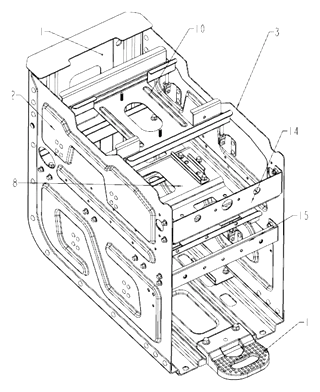
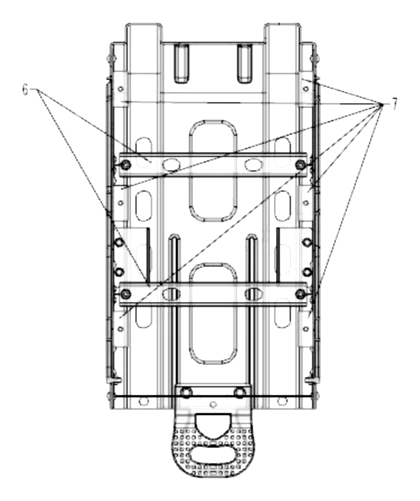
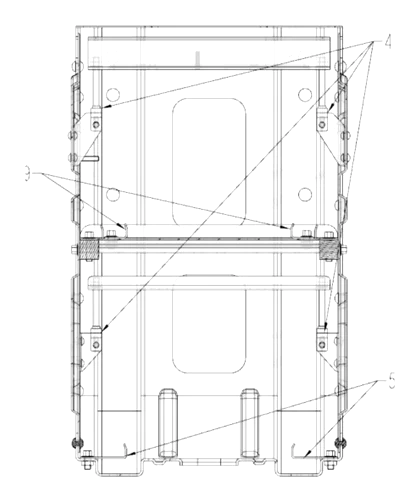
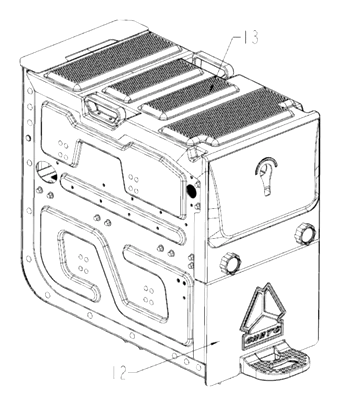
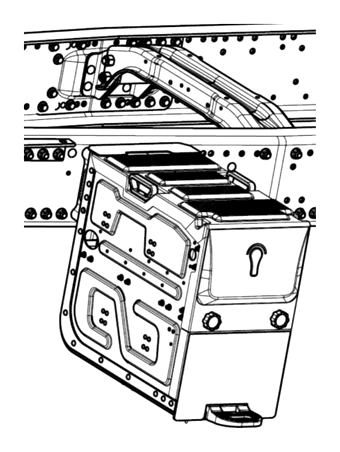
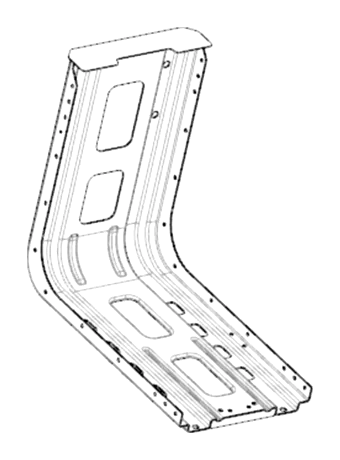
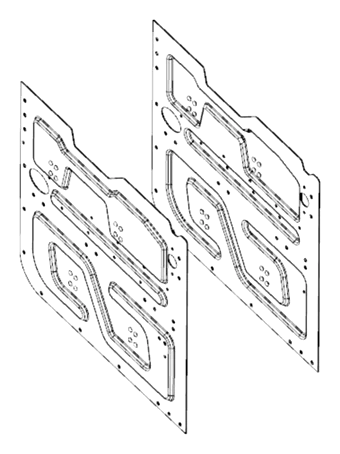
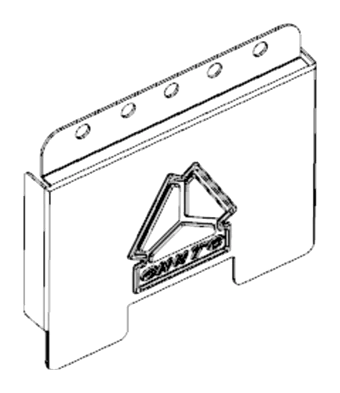
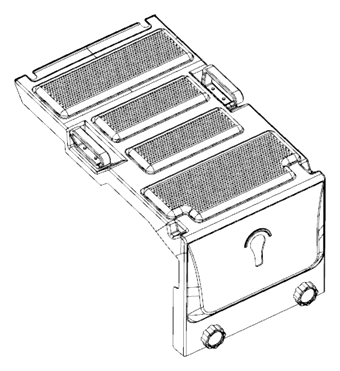
Drawings reproduced from the public patent document for reference.