
Patent CN112957750B
Updated October 28, 2026Track Toy Parking Overload Protection Assembly with Lifting Lugs
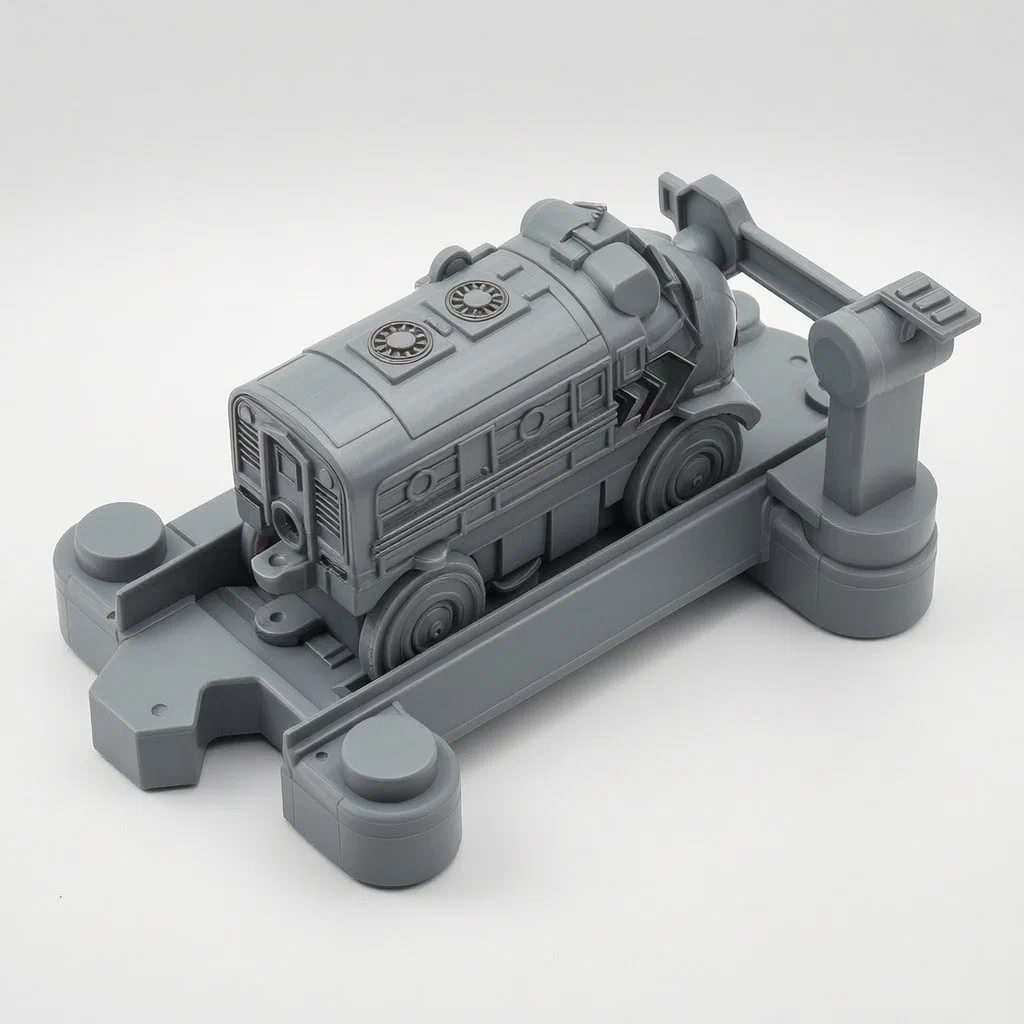
Motorized track toys often stall when a car reaches a dead end or a closed gate. If the drive wheels keep gripping the track while the body cannot move forward, the motor draws excess current and overheats. This assembly solves that problem mechanically. A blocking member stops the toy vehicle at a set point on the track. At the same time, lifting lugs molded into the track surface push up against the bottom of the car's shell. This support raises the driving wheels just enough to reduce their friction with the track. The motor keeps running, the wheels spin freely or make only intermittent contact, and the car gently rocks back and forth or side to side until the blocking member moves out of the way. Because the protection relies on simple raised bumps rather than electronic sensors or slip clutches, the structure stays compact and production costs remain low for home, board-game, club, or teaching use.
- China invention patent - in force
- No filings outside China
- Home, club & teaching track toys
- Mechanical motor overload protection
Splat! What let you down?
🛑
Blocking member
Stops the toy vehicle at a designated spot on the track, shifting between a blocking position and a passing position.
⬆️
Lifting lugs
Raised bumps on the track surface contact the car's bottom shell to support it when stopped.
⚙️
Motor protection
Support from the lugs reduces wheel friction, allowing the motor to keep running without stalling or overheating.
🎲
Simple structure
Relies on molded track geometry instead of electronic sensors or mechanical clutches, keeping parts count low.
Bring this product to market
- ✓ Patent vetted China-only family and legal status checked
- 2 Product brief · now How it works, uses and options written up
- 3 Prototype First samples for buyers to review
- 4 Pilot run Small first batch for launch customers
- 5 Volume production Repeat orders at scale
Buyer interest
– of 100 buyers needed to start prototyping
One click, no sign-up. Each vote is one real visitor, and products with the most interest go to prototyping first.
Build team: no members yet. Need a partner, co-funding or skills to build this? Join and we introduce the team once it forms.
The problem
Motorized toy cars running on tracks frequently encounter situations where they must stop temporarily, such as waiting at a crossing, pausing at a station, or queuing behind another vehicle. When the car’s body is physically prevented from moving forward but the internal motor continues to receive power, the driving wheels press hard against the track surface. This locked-rotor condition forces the motor to draw high current, generating heat that can damage the windings, drain the battery rapidly, or wear down the wheel treads. Traditional solutions often add electronic current limiters or complex mechanical slip clutches inside the vehicle. These additions increase the part count, require precise assembly, and raise the manufacturing cost of what is meant to be an accessible item for home, board-game, club, or teaching use.
The solution
This patent describes a mechanical approach built directly into the track geometry to protect the motor during a pause.
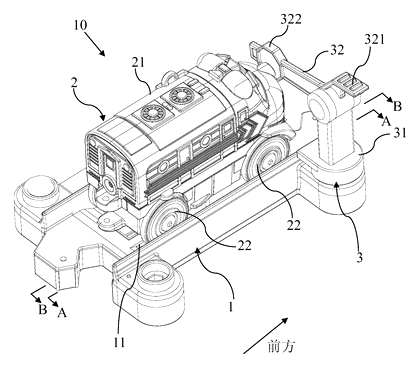
- A blocking member (3) is placed on the track (1). It operates in two states: a blocking position that stops the toy vehicle (2), and a passing position that allows the vehicle to continue forward.
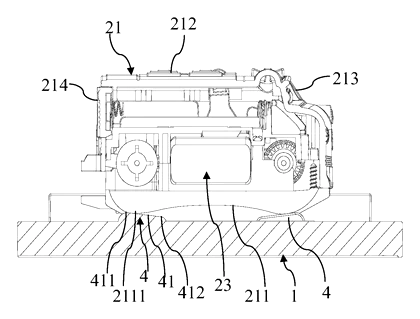
- The track surface includes at least one lifting lug (4), whose upper surface sits higher than the normal running surface of the track.
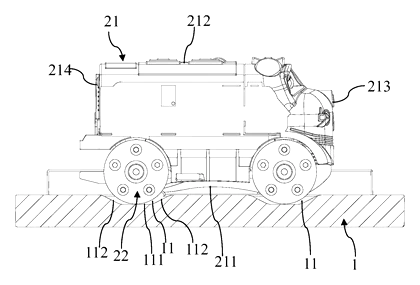
- The toy vehicle consists of a shell (21), driving wheels (22), and an internal motor (23) fixed inside the shell that drives the wheels. The shell has a flat bottom surface (211) facing the track.
- When the blocking member stops the vehicle, the lifting lugs contact the bottom surface of the shell. This physical support lifts the shell slightly, reducing the downward pressure and friction between the driving wheels and the track.
- With the friction reduced, the motor can continue to run. The wheels spin freely or make only intermittent contact with the track, causing the vehicle to rock gently back and forth or left and right.
- When the blocking member shifts to the passing position, the vehicle lowers back onto its wheels and resumes normal forward travel.
Who it is for
- Toy brands developing track sets looking for a reliable, low-cost way to prevent motor burnout during parking sequences or traffic jams in home and club play environments.
- Educational and STEM kit makers who need a clear, visible example of mechanical overload protection to teach basic engineering principles to students.
- Board game publishers incorporating motorized pieces into tabletop games, requiring components that can idle safely without draining batteries between turns.
- Wholesalers sourcing durable track toys aiming to reduce warranty returns caused by stalled motors and overheated batteries in standard toy cars.
How it works
The main parts
| No. | Part | What it does |
|---|---|---|
| 1 | Track | Provides the running path; contains wheel accommodating grooves and lifting lugs. |
| 2 | Toy vehicle | The moving unit containing the shell, wheels, and motor. |
| 3 | Blocking member | Stops the vehicle from passing; switches between blocking and passing positions. |
| 4 | Lifting lug | Raised bump on the track that contacts the shell bottom to support the vehicle. |
| 11 | Wheel accommodating groove | Recesses in the track where the driving wheels sit when the vehicle is paused. |
| 21 | Shell | Outer housing of the toy vehicle. |
| 211 | Bottom surface | Lower face of the shell that rests on the lifting lugs when blocked. |
| 22 | Driving wheel | Wheels connected to the lower end of the shell, driven by the motor. |
| 23 | Motor | Fixed inside the shell; rotates the driving wheels. |
Operating steps
- Normal running - The toy vehicle travels along the track with the driving wheels resting fully on the track surface, powered by the continuously running motor.
- Approaching the block - The vehicle reaches the location of the blocking member, which is currently in its blocking position.
- Parking and lifting - The blocking member contacts at least a part of the shell, stopping forward motion. Simultaneously, the driving wheels drop into the four wheel accommodating grooves. The lifting lugs, positioned diagonally between the front and rear grooves, push up against the bottom surface of the shell.
- Overload protection - Supported by the lifting lugs, the shell is raised. The driving wheels lose continuous heavy friction with the track floor. The motor keeps running, and the vehicle shakes slightly forward and backward or left and right, making only intermittent contact with the track.
- Release - The blocking member moves away to the passing position. The shell lowers off the lifting lugs, the wheels regain full traction, and the vehicle continues forward.
Applications
Home track play
Children setting up motorized track circuits at home often create dead ends or intersections where cars pile up. Without protection, a stalled car quickly drains its batteries or burns out its motor. The lifting lugs allow the lead car to idle safely at the blockage while the motor runs, preventing damage during extended play sessions.
Board game integration
Tabletop racing or logistics board games sometimes use small motorized vehicles to automate movement between phases. When a piece must wait for a player’s turn, it parks at a station. The mechanical blocking member holds the piece in place while the lifting lugs ensure the motor does not overheat during the wait, preserving battery life for the duration of the game.
Club and hobby layouts
Hobby clubs running shared track layouts need equipment that withstands continuous operation. Vehicles frequently queue at scenic stations or loading zones. By using this assembly, club members do not need to manually switch off each car’s power when it reaches a parking zone, as the track geometry handles the mechanical load reduction automatically.
Teaching and STEM demonstrations
Educators demonstrating basic physics and engineering concepts use this setup to show how mechanical design can solve electrical problems. Students observe how raising the center of gravity via the lifting lugs changes the friction coefficient on the wheels, allowing them to understand torque, current draw, and motor protection without needing complex circuit diagrams.
Where it is less suitable
- High-speed competitive racing tracks - The lifting lugs and grooves are designed for parking and low-speed idling, not for maintaining maximum velocity through curves.
- Heavy die-cast model vehicles - The lifting lugs support the plastic shell; significantly heavier metal bodies may require larger lugs or different structural support to achieve the necessary lift.
- Tracks requiring flush, smooth surfaces - The protruding lifting lugs alter the track profile, making this unsuitable for scale-model train tracks where realistic, unbroken rail profiles are mandatory.
Frequently asked questions
How does the track protect the motor without electronics?
When the blocking member stops the car, the lifting lugs on the track push up against the flat bottom of the car’s shell. This slight lift takes the weight off the driving wheels, reducing their friction with the track. The motor can keep spinning the wheels without fighting a heavy load, preventing the current spike that causes overheating.
Does the car stop completely when it hits the block?
The car stops moving forward, but the motor keeps running. Because the shell is supported by the lifting lugs, the wheels spin with minimal resistance, and the car gently rocks back and forth or side to side against the blocking member until the path clears.
What happens when the blocking member opens?
The blocking member shifts to its passing position, moving out of the way. The car’s shell lowers off the lifting lugs, the driving wheels press firmly back onto the track surface, and the motor’s torque pushes the car forward again.
Can this work with any motorized toy car?
The car must have a flat bottom surface designed to interface with the specific lifting lugs, and the wheels must align with the track’s accommodating grooves. Dimensions for both the shell and the lugs are set in design and confirmed on prototypes to ensure proper lifting and stability.
Are the lifting lugs adjustable?
According to the patent, the lifting lugs are formed on the track. Their height and diagonal placement between the front and rear wheel grooves are fixed geometric features molded into the track section.
Is this suitable for children’s toys?
Yes, the design is intended for track toys used in home, board-game, club, or teaching environments. Any production for the US market must comply with applicable toy safety standards regarding small parts, mechanical hazards, and materials.
Can this design be made and sold in the US?
The patent was filed only in China and is in force in China until at most 2041-03-17 (if annual fees are paid). It has no US counterpart, so it does not restrict the design in the US. However, other companies hold later US patents in the track toy field - see Patent & Production - so we recommend a freedom-to-operate check before volume production.
Are you affiliated with the patent owner?
No. IP2M is an independent design and manufacturing service working from the public patent document.
Request a quote
Click Request a Quote below to see our email address - copy it, or open your email app with a ready-made message. Please mention patent CN112957750B in the subject.
Helpful details to include:
- Your company and channel (toy brand, educational kit publisher, board game maker, wholesaler)
- Target age group and intended use (home play, club, teaching)
- Track layout concept and approximate dimensions
- Vehicle size, shell material, and motor type (voltage/battery preference)
- Blocking member preference (manual, spring-loaded, or automated)
- Estimated quantity and target price
- Timeline - when you would like prototypes and the first shipment
You can also reach us at (332) 203-9997.
Explore this product
Interested in building this?
Tell us your target market, quantity and timeline. We reply with options for prototyping, small-batch runs or volume production.
Send your inquiry to
Please put CN112957750B in the subject line and tell us your company, country, estimated quantity and timeline.
Prefer to talk? Call (332) 203-9997.
More product-ready patents
All Toys & Games patents →
Toys & Games
Stretch-to-Fit Toy Remote with Drone Storage
Toy drone remote with slide-out handles for any hand size, a phone clamp and built-in drone storage.
Patent CN205412243U
Toys & Games
Magnetic Tile Racks for Ultra-Thin Travel Mahjong
Magnetic rack frames that hold ultra-thin mahjong tiles upright and fold into the set's carrying box.
Patent CN207169017U
Toys & Games
X-Braced Square Magnetic Building Tile with Locating-Post Shell
Square magnetic building tile: open X-brace frame, corner-lug magnets, two shells aligned by posts.
Patent CN105963988B
Toys & Games
Card-Thin Magnetic Travel Mahjong and Chess Sets with Magnet Racks
Pocket mahjong and chess sets: thin magnetic-powder tiles, finger magnet picker and fold-out magnetic racks.
Patent CN206896783U
Toys & Games
Inflatable Baby Climbing Mat with a Bumpy Hump and a Ramp Obstacle
Inflatable crawling mat: a bumpy rounded hump and a sloped ramp on a stiffened air base.
Patent CN108905229B
Toys, Games & Puzzles
Ring-Layout Automatic Card Shuffler with Electromagnetic Box Coupling
Ring-layout card shuffler that sweeps stacks between boxes via electromagnetic coupling.
Patent CN209564602U
Browse by category
- Apparel & Accessories (22)
- Baby & Kids (16)
- Bags & Luggage (9)
- Bath & Personal Care (16)
- Car Accessories (10)
- Furniture, Bedding & Storage (12)
- Garden & Outdoor (18)
- Health & Wellness (8)
- Home, Kitchen & Cleaning (24)
- Lighting (12)
- Packaging & Containers (6)
- Pet Products (6)
- Phone & Camera Accessories (4)
- Retail Display (13)
- School, Office & Art (19)
- Sports & Recreation (25)
- Tools & Workshop (27)
- Toys & Games (12)
This page is based on the public patent document CN112957750B, assigned to Guangdong Aofei Industrial Co Ltd, Alpha Group Co Ltd, Guangzhou Alpha Culture Co Ltd. IP2M is an independent manufacturing service and is not affiliated with, endorsed by or licensed by the patent owner. Images marked as concept renderings are illustrations, not photos of an existing product. Patent status information is provided for reference only and is not legal advice; confirm freedom to operate for your market before production. Full disclaimer.