At a glance
| Patent number | CN112957750B (application CN202110285333) |
| Type | China invention patent (发明专利) - protects product shape, structure and method |
| Original title | Track toy parking overload protection subassembly (一种轨道玩具停车过载保护组件) |
| Patent owner | Guangdong Aofei Industrial Co Ltd, Alpha Group Co Ltd, Guangzhou Alpha Culture Co Ltd |
| Inventors | Zou Caiyuan |
| Filing date | 2021-03-17 |
| Grant date | 2023-04-18 |
| Status (China) | In force in China until at most 2041-03-17 (if annual fees are paid) |
| Patent family | Chinese filings only - no US, European, Japanese, PCT or other filings listed |
| Cited by | 7 later documents |
| Source | Google Patents (search for CN112957750B) |
What the claims cover, in plain language
Claim 1 covers a track toy parking overload protection assembly comprising a track, a toy vehicle, and a blocking member capable of stopping the vehicle. The track has at least one lifting lug whose upper surface is higher than the track itself. The toy vehicle has a shell, driving wheels rotatably connected to the shell, and a motor fixed inside the shell that drives the wheels. The shell has a bottom surface facing the track. When the vehicle is in a state of pause, the blocking member is in its blocking position, contacting the shell. At the same time, the lifting lug contacts the bottom surface of the shell to support it, allowing the wheels to keep rotating continuously. Under this support, the vehicle intermittently collides with the blocking member. When the blocking member moves to its passing position, the vehicle continues forward. The claim further specifies four driving wheels and four wheel accommodating grooves on the track. Two lifting lugs are arranged diagonally between the front grooves and the rear grooves. The motor runs continuously, causing the vehicle to shake under the support of the lugs, placing the wheels in intermittent contact with the track.
Claim 2 adds that at least one of the multiple driving wheels maintains frictional or intermittent frictional contact with the track during rotation when the vehicle is paused. Claim 3 specifies that the driving wheels fall within the wheel receiving slots when the vehicle is in the suspended forward state. Claims 4 to 6 cover further details of the lifting lug placement and interaction.
This is a simplified reading for orientation only. The legal scope is defined by the exact claim wording in the official Chinese document.
What this means for US production
This patent was filed only in China and is in force in China until at most 2041-03-17 (if annual fees are paid). It has no US or other foreign counterpart. However, because it remains active in China, making or selling this specific track assembly in China needs the owner’s permission.
Two points to settle early:
- Other patents may exist. Mattel, Inc. and Takara Tomy are holders of later US and foreign patents in this field (citing this document, e.g., US12296278B1 and JP7411053B1), indicating active patenting around track toy mechanisms. A freedom-to-operate (FTO) review covering track geometries, lifting mechanisms, and motorized toy parking systems is recommended before tooling.
- Lug height and wheel clearance. The exact dimensions of the lifting lugs and the depth of the wheel accommodating grooves must be set in design and confirmed on prototypes to ensure the shell lifts sufficiently without tipping the vehicle over during the rocking motion.
Customization and manufacturing
What can be customized
| Area | Options |
|---|---|
| Track layout | Straight sections, curves, intersections; length and radius to be confirmed in design |
| Lifting lug geometry | Height, shape, and diagonal spacing set in design based on the specific vehicle shell |
| Blocking member mechanism | Manual lever, spring-loaded gate, or electronically actuated barrier |
| Vehicle shell | Shape, size, and bottom surface profile tailored to fit the track grooves |
| Motor and gearing | Voltage, RPM, and gear ratio selected to match the target speed and rocking behavior |
| Colors and graphics | Track and vehicle finishes for retail packaging or educational kits |
Things to plan for (US market)
- CPSC 16 CFR 1500 / ASTM F963 - Standard consumer safety specification for toy safety, covering mechanical hazards, sharp edges, and small parts for children under three.
- FCC Part 15 - Required if the toy vehicle or track incorporates any radio-frequency components (e.g., remote control or Bluetooth); purely battery-powered DC motors generally do not trigger this unless they contain digital logic oscillating above 9 kHz.
- UN 38.3 - Mandatory testing for lithium batteries if the toy uses rechargeable lithium cells, required for shipping and sale.
- California Proposition 65 - Screening of plastics, paints, and battery components for listed chemicals.
How a project runs
- Inquiry - Define the track concept, vehicle size, target age group, and intended use (home play, education, board game).
- Design - Engineer the track profile, lifting lug coordinates, wheel groove depths, and blocking member kinematics. Select motor specifications.
- Prototype - Produce 3D-printed or machined samples to test the lifting action, rocking stability, and motor temperature during prolonged blocking.
- Pilot run - Manufacture a small batch using production-grade molds to verify assembly tolerances and conduct ASTM F963 pre-testing.
- Production - Injection molding for tracks and shells, motor assembly, quality inspection, and packaging.
Quantities & timeline
The track sections and vehicle shells require custom injection molds. The driving wheels and gears need separate precision tooling. The blocking member may require additional dies depending on whether it is a simple plastic flap or a multi-part mechanical gate. Safety testing under ASTM F963 and battery certification (if applicable) dictate the validation phase duration. Send us your track layout concept, vehicle dimensions, target age group, estimated quantity, and desired launch date, and we will reply with options.
Patent drawings
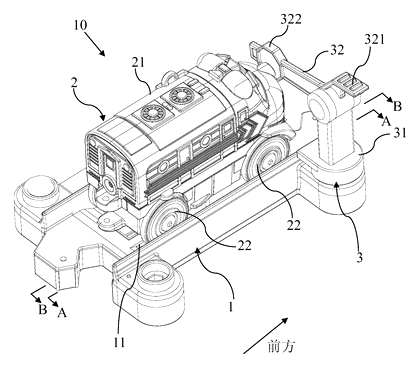
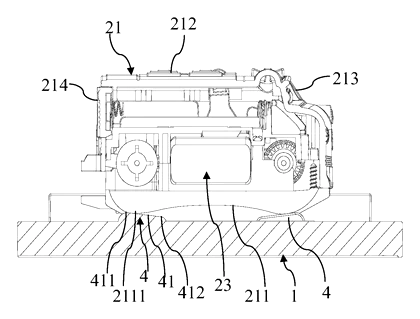
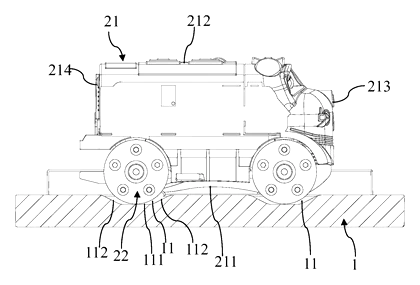
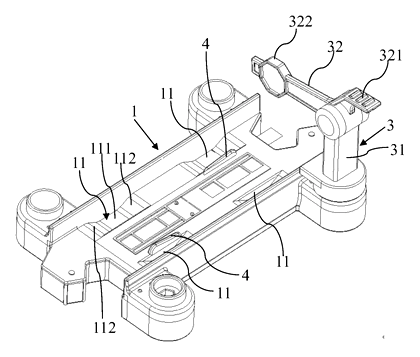
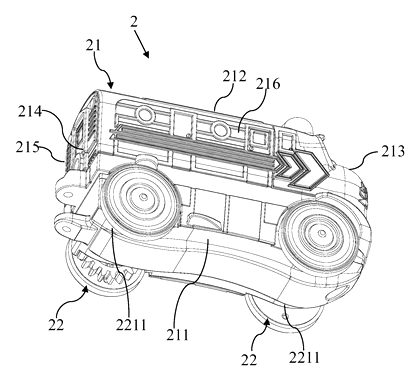
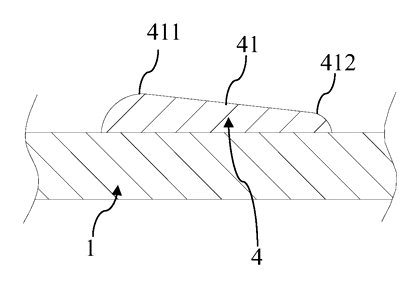
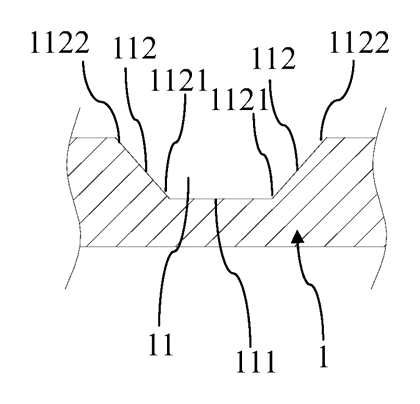
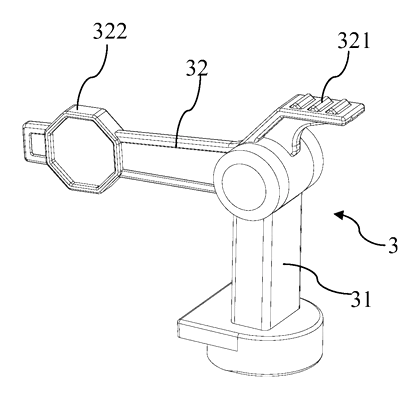
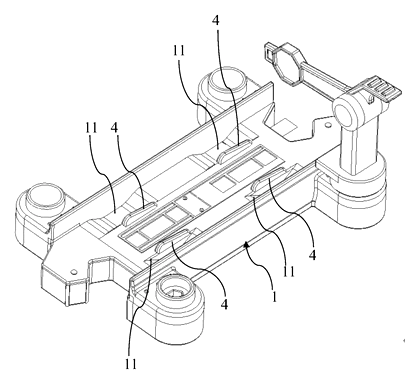
Drawings reproduced from the public patent document for reference.