
Patent CN112971479B
Updated November 3, 2026Automatic Light-Supplementing and Dust-Removing Clothing Display Rack
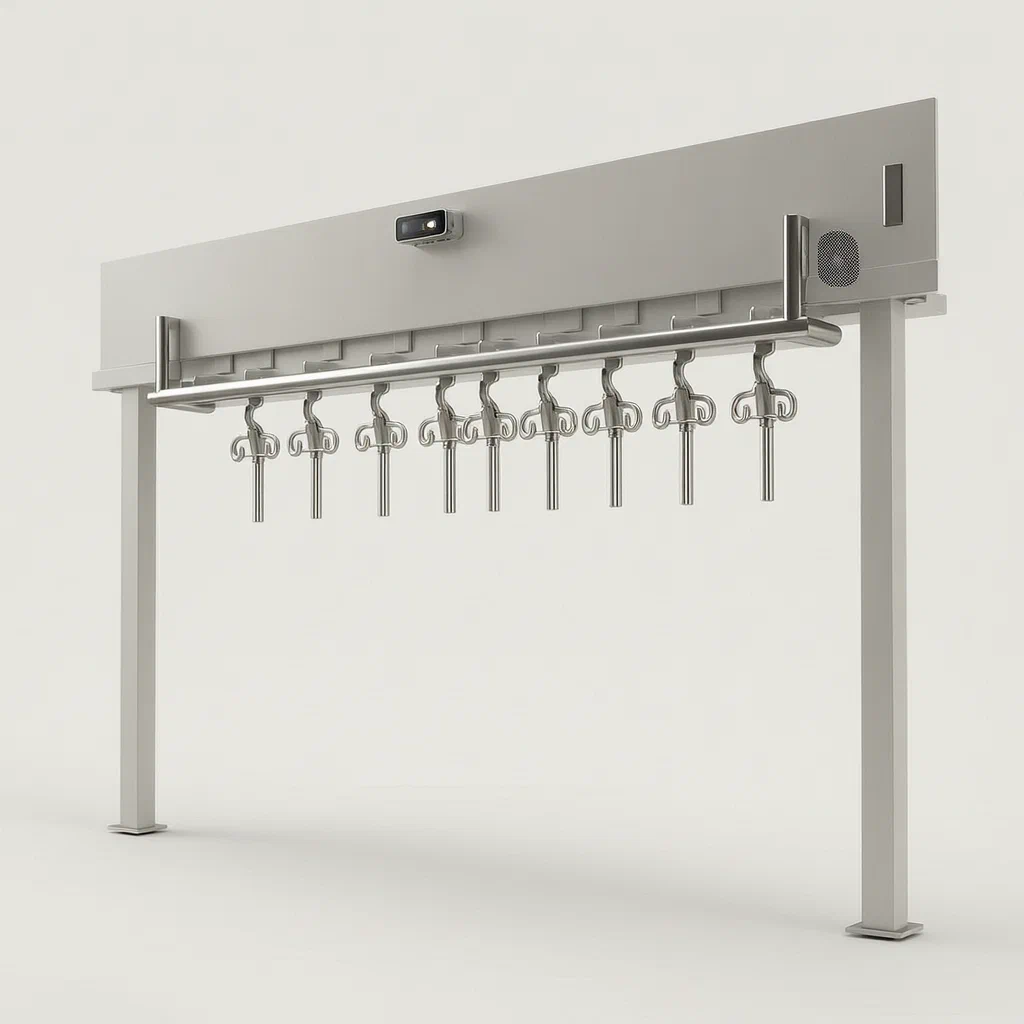
In busy retail environments, static clothing racks often suffer from poor visibility due to inadequate lighting and accumulate dust on hanging garments, which detracts from the merchandise appeal. This automated solution addresses these issues by integrating a single-chip microcontroller that manages multiple subsystems. When infrared sensors detect a customer standing in front of specific items, the system automatically turns on supplementary lights to highlight those garments. Simultaneously, if only one sensor detects presence, electromagnets activate to slide neighboring clothes away, creating physical space for the shopper to inspect the item closely. For maintenance, the rack features a driving structure that oscillates the hangers while a fan blows air through guide plates, effectively shaking off and blowing away dust from the fabric surfaces.
- China invention patent - in force
- No filings outside China
- Retail display equipment
- Microcontroller-controlled lighting and motors
Splat! What let you down?
💡
Auto Light Supplementing
Infrared sensors trigger supplementary lamps when customers approach specific garments.
↔️
Dynamic Space Adjustment
Electromagnets slide adjacent clothes away to create viewing space for the shopper.
🌬️
Automated Dust Removal
Motorized oscillation combined with directed airflow shakes off and blows away dust.
🤖
Central Control
A single-chip microcomputer coordinates lighting, movement, and cleaning systems.
Bring this product to market
- ✓ Patent vetted China-only family and legal status checked
- 2 Product brief · now How it works, uses and options written up
- 3 Prototype First samples for buyers to review
- 4 Pilot run Small first batch for launch customers
- 5 Volume production Repeat orders at scale
Buyer interest
– of 100 buyers needed to start prototyping
One click, no sign-up. Each vote is one real visitor, and products with the most interest go to prototyping first.
Build team: no members yet. Need a partner, co-funding or skills to build this? Join and we introduce the team once it forms.
The problem
Traditional clothing display racks in retail stores are passive structures. They rely entirely on store-wide ambient lighting, which can leave specific garments in shadow or looking dull, reducing their visual appeal to shoppers. Furthermore, garments hanging on open racks inevitably collect dust over time, requiring frequent manual cleaning by staff. There is also no mechanism to help customers view items comfortably; when a shopper focuses on one piece, surrounding garments often obstruct access or make it difficult to pull the item out for closer inspection. These limitations reduce the interactive potential of the display and increase maintenance labor costs.
The solution
This patent describes an active display system controlled by a central unit.
- Detection: Infrared sensors mounted on moving frames detect the presence of people near specific garments.
- Lighting: When sensors detect a person, the microcontroller activates a light-supplementing lamp mounted on the protection box to illuminate the area.
- Space Creation: If only one sensor detects a person, electromagnets inside the chutes attract sliding blocks, pulling the moving frame and its attached clothes away from the center, clearing space for the shopper.
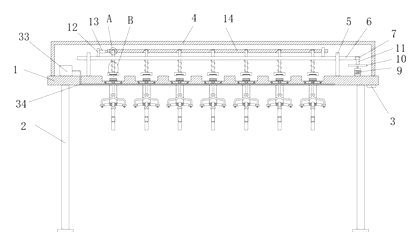
- Cleaning: A motor drives a turntable connected to sliding plates, causing the entire rack assembly to oscillate left and right. Simultaneously, a fan blows air through pipes and guide plates onto the swinging clothes, dislodging dust.
Who it is for
- High-end boutiques seeking to enhance customer interaction and product presentation through automated lighting and convenience features.
- Department stores managing large inventories where automated dust reduction can lower staffing requirements for maintenance.
- Trade show exhibitors who need eye-catching displays that dynamically engage visitors and keep garments looking pristine during multi-day events.
- Warehouse clubs displaying seasonal apparel where quick visibility and cleanliness are key to sales velocity.
How it works
The main parts
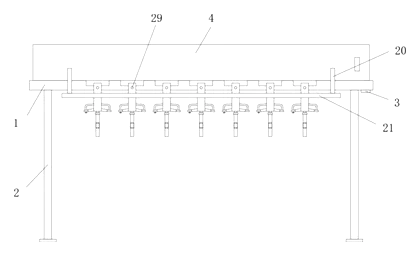
| No. | Part | What it does |
|---|---|---|
| 1 | Rack Body | Main structural frame supporting all components. |
| 3 | Single Chip Microcomputer | Central controller processing sensor inputs and driving actuators. |
| 21 | Light Supplementing Lamp | Provides focused illumination when triggered. |
| 29 | Infrared Sensors | Detect human presence near specific garment zones. |
| 27 | Electromagnets | Attract sliding blocks to move clothes aside for viewing space. |
| 24 | Sliding Block | Moves within the chute (23) under magnetic attraction. |
| 28 | Moving Frame | Holds the suspension rod and clothes; moves with the sliding block. |
| 9 | Motor | Drives the oscillation mechanism via a turntable. |
| 33 | Fan | Generates airflow for dust removal. |
| 35, 37 | Air Pipes and Discharge Pipe | Direct air flow onto the swinging clothes. |
Operating steps
- Customer Approach: A shopper stands in front of a garment. Infrared sensors (29) detect the body heat or reflection.
- Light Activation: The microcomputer (3) signals the light-supplementing lamp (21) to turn on, highlighting the product.
- Space Adjustment: If the system identifies a single focal point, it energizes the relevant electromagnet (27). The magnet attracts the sliding block (24), pulling the moving frame (28) and adjacent clothes sideways to clear obstruction.
- Dust Cleaning Cycle: Periodically, or upon command, the motor (9) rotates the turntable (10). Through the limiting holes, this drives the sliding plates (6) to reciprocate, shaking the clothes. The fan (33) activates simultaneously, blowing air through the discharge pipe (37) outlets (38) to carry away loosened dust.
Applications
Boutique Fitting Rooms
In small, high-value retail spaces, customers want to see how a garment looks under ideal conditions. The auto-light feature ensures the fabric color and texture are accurately represented, while the sliding mechanism prevents neighbors from blocking the mirror view, enhancing the try-on experience.
Trade Show Booths
Exhibitors need to draw attention to specific products among many. The dynamic lighting catches passersby’s eyes. The self-cleaning function keeps samples free of dust accumulated from foot traffic and HVAC systems throughout the event duration, maintaining a professional appearance without constant staff intervention.
Department Store Apparel Sections
Large floor areas have uneven lighting. This rack compensates for dark spots automatically. The space-clearing feature helps manage crowds; as one customer inspects an item, the rack opens up room, reducing congestion and improving safety in high-traffic zones.
Seasonal Pop-Up Stores
Temporary setups often lack sophisticated infrastructure. This standalone unit provides integrated lighting and maintenance capabilities, allowing brands to deploy premium-looking displays quickly without relying on the venue’s existing electrical or cleaning services.
Where it is less suitable
- Heavy Industrial Workwear: The oscillating mechanism may not provide sufficient force to clean stiff, heavy canvas materials effectively compared to dedicated industrial washers.
- Delicate Silk or Lace: While the cushion protects the frame, the mechanical vibration required for dust removal might be too aggressive for extremely fragile fabrics that require gentle handling.
- Low-Budget Retailers: The complexity of sensors, motors, and controllers makes this significantly more expensive than standard metal racks, offering diminishing returns for discount stores.
Frequently asked questions
How does the automatic lighting work?
The rack uses infrared sensors placed along the hanging bar. When a customer stands in front of a specific section, the sensors detect their presence and send a signal to the microcontroller, which then turns on the supplementary light for that area.
Does the rack really move the clothes away?
Yes. If the system detects a person at a specific spot, it activates an electromagnet near that location. This magnet pulls a sliding block, which shifts the moving frame and the clothes hanging on it to the side, creating empty space for the shopper to inspect the item without obstruction.
How is the dust removed?
The rack has two cleaning modes. First, a motor causes the entire hanging assembly to oscillate left and right, shaking loose dust. Second, a fan blows air through pipes and guide plates directly onto the clothes, carrying the dust away. This happens automatically or on a schedule.
What power source does it need?
The patent mentions a single-chip microcomputer controlling motors and lights, implying an electrical power source. Specific voltage or battery requirements are set in design and confirmed on prototypes. For US markets, it would likely need a standard AC adapter or internal battery pack meeting safety standards.
Is the movement noisy?
The design includes cushions on the clamping plates to reduce impact noise. However, motors and fans generate some sound. Noise levels depend on the specific motor and fan components selected during the design phase.
Can I customize the size?
Yes. The rack body dimensions, number of hanging positions, and placement of sensors can be adjusted. Customization involves modifying the sheet metal or extrusion profiles and potentially the PCB layout.
Can this design be made and sold in the US?
The patent is filed only in China and is in force there. It does not currently restrict production or sale in the US. However, smart retail fixtures are a competitive field, so we recommend a freedom-to-operate (FTO) review to ensure no other US patents cover similar automated display technologies.
Are you affiliated with the patent owner?
No. IP2M is an independent design and manufacturing service working from the public patent document.
Request a quote
Click Request a Quote below to see our email address - copy it, or open your email app with a ready-made message. Please mention patent CN112971479B in the subject.
Helpful details to include:
- Your company and channel (boutique chain, department store, trade show organizer)
- Dimensions (height, width, number of hangers)
- Features (lighting type, sensor sensitivity, dust removal frequency)
- Material preference (steel, aluminum, acrylic accents)
- Estimated quantity and target price
- Timeline - when you would like samples and the first shipment
You can also reach us at (332) 203-9997.
Explore this product
Interested in building this?
Tell us your target market, quantity and timeline. We reply with options for prototyping, small-batch runs or volume production.
Send your inquiry to
Please put CN112971479B in the subject line and tell us your company, country, estimated quantity and timeline.
Prefer to talk? Call (332) 203-9997.
More product-ready patents
All Retail Display patents →
Retail Display
Motorized Shelf Display That Presents a Product to Shoppers
Shelf unit that lifts a product over the price rail toward shoppers when a sensor detects them.
Patent CN215077184U
Retail Display
Portable Advertising Light Box with Spinning LED Display
Portable ad box whose spinning LED bars draw images and text; content changes by wireless or USB.
Patent CN207425291U
Retail Display
Automated Folding Store Shelf That Pushes Products Up to the Customer
Double-sided shelf for unmanned stores: folding tiers, screw pushers and lift cylinders present stock.
Patent CN109645754B
Retail Display
Motorized Rotating Display Pedestal with Lift Column, Info Screen and Clip-On Display Racks
Mobile pedestal: motorized rotating cube with lit faces and racks, electric lift column and info screen.
Patent CN208875862U
Retail Display
Thin Outdoor LED Video Wall Cabinet with Magnetic Modules and Tool-Free Locks
Thin outdoor LED wall cabinet: magnetic modules and rear body, rotary locks, finned rear cooling.
Patent CN205354557U
Store & Display
Magnetically Repositionable LED Advertising Panel
LED panel whose lamp beads slide to new positions via an external electromagnet.
Patent CN205487209U
Browse by category
- Apparel & Accessories (36)
- Baby & Kids (25)
- Bags & Luggage (15)
- Bath & Personal Care (25)
- Car Accessories (21)
- Furniture, Bedding & Storage (19)
- Garden & Outdoor (27)
- Health & Wellness (12)
- Home, Kitchen & Cleaning (40)
- Lighting (20)
- Packaging & Containers (10)
- Pet Products (9)
- Phone & Camera Accessories (7)
- Retail Display (21)
- School, Office & Art (30)
- Sports & Recreation (37)
- Tools & Workshop (46)
- Toys & Games (19)
This page is based on the public patent document CN112971479B, assigned to Hanjia Fujian Exhibition Technology Co ltd. IP2M is an independent manufacturing service and is not affiliated with, endorsed by or licensed by the patent owner. Images marked as concept renderings are illustrations, not photos of an existing product. Patent status information is provided for reference only and is not legal advice; confirm freedom to operate for your market before production. Full disclaimer.