
Patent CN112998486B
Updated November 5, 2026Rotating Storage Rack with Integrated Light Transmission Panels
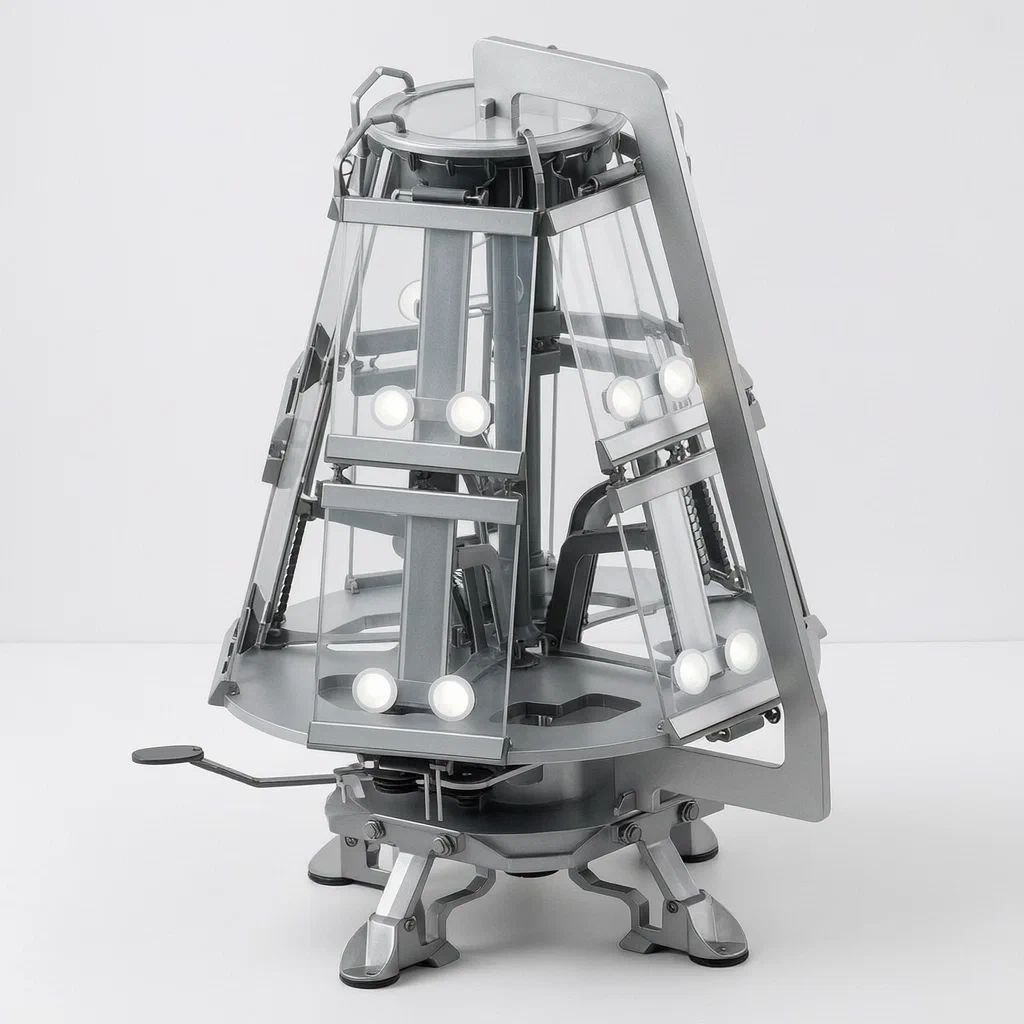
Static displays often fail to catch customer attention from all angles, especially when items are stacked or hidden behind opaque shelving. This rotating rack solves visibility issues by using light-transmitting panels combined with adjustable internal lighting. Instead of manual turning, a foot-operated lever engages a motorized drive system that rotates the display intermittently. This allows customers to view products from multiple angles without staff intervention. The translucent panels diffuse light evenly, highlighting contents while protecting them from direct glare. The modular frame structure supports various panel sizes, making it adaptable for different product dimensions in retail environments.
- China invention patent - active
- No filings outside China
- Retail & Exhibition Displays
- Aluminum extrusion, Acrylic forming, Motor assembly
Splat! What let you down?
💡
Adjustable Lighting
Lamps slide on guide rails to optimize illumination for different item heights.
🔄
Foot-Operated Rotation
A swing frame activates the motor, allowing hands-free intermittent rotation.
🔍
Translucent Panels
Hollow frames hold light-transmitting panels that diffuse light and show contents.
⚙️
Modular Drive
Belt and gear systems ensure smooth rotation of the central display column.
Bring this product to market
- ✓ Patent review Patent family and legal status reviewed in the relevant jurisdictions.
- 2 Product brief · now How it works, uses and options written up
- 3 Prototype First samples for buyers to review
- 4 Pilot run Small first batch for launch customers
- 5 Volume production Repeat orders at scale
Buyer interest
– of 100 buyers needed to start prototyping
One click, no sign-up. Each vote is one real visitor, and products with the most interest go to prototyping first.
Build team: no members yet. Need a partner, co-funding or skills to build this? Join and we introduce the team once it forms.
Patent Rights & Team Participation
Before joining a development team, participants should ensure they have the necessary rights or authorization to participate in the project.
Participation is generally appropriate where:
- You own the relevant patent rights or have obtained permission or a license from the rights holder.
- The relevant patent rights have expired or have been legally invalidated in the jurisdictions where the planned activities will take place.
- The planned development, manufacturing, and commercialization activities have been independently assessed and do not infringe applicable patent rights in the relevant jurisdictions.
Important: Being located outside a country where a patent is protected does not automatically exempt you from patent infringement risks. Patent rights may apply based on where development, manufacturing, use, sale, or import activities take place.
IP2M does not grant any patent license or authorization through team participation. Joining a project does not provide permission to use, manufacture, or commercialize patented technology.
The problem
Traditional static display racks often obscure products located in the back or lower shelves, requiring customers to physically move items to see them clearly. Opaque shelving blocks light penetration, creating dark spots that reduce visual appeal. Manual rotation of display units is labor-intensive for staff and inconsistent in speed, leading to uneven wear on mechanical parts. In high-traffic retail environments, fixed displays fail to capture attention from all viewing angles, resulting in missed sales opportunities for products that require multi-angle inspection. Additionally, standard racks lack integrated lighting solutions that can be adjusted for different product sizes, causing glare on glossy surfaces or insufficient illumination for textured items.
The solution
The patented design introduces a motorized rotating storage rack with light-transmitting panels and adjustable illumination. The core mechanism consists of a stationary mounting base supporting a rotatable pipe sleeve. This sleeve is driven by an internal belt-and-gear system activated by a foot-operated swing frame, eliminating the need for manual handling. Attached to the upper part of the sleeve is a first connecting disc, which holds multiple first hollow frames. These frames support second hollow frames containing translucent panels, creating a cylindrical display surface.
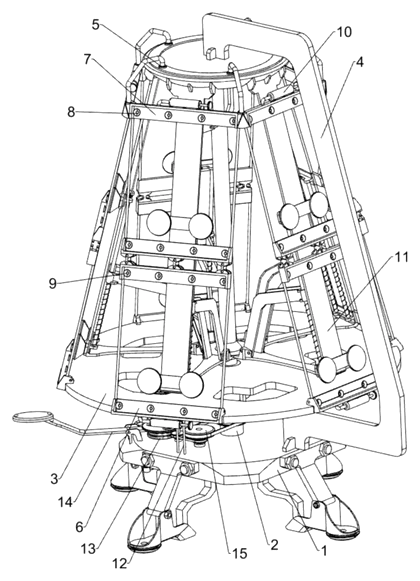
An illumination assembly is mounted on a fixed connecting frame adjacent to the rotating sleeve. This assembly includes a fixed tube passing through the sleeve, with guide plates extending outward. Lamps are attached to sliding frames that move along these guide plates, allowing vertical adjustment of light sources to match product heights. Elastic pieces provide tension for smooth sliding. A blocking assembly secures the rotating sleeve when not in use, using a clamping sleeve and pull rod mechanism. The drive assembly uses a reducing motor connected to a diamond-shaped rod and sleeve, engaging chucks and slide bars to transfer motion to the rotating shafts. This ensures intermittent rotation synchronized with the release of the foot pedal.
Who it is for
- Retail Chain Brands: Needing eye-catching, self-rotating displays for cosmetics, jewelry, or electronics that attract customers without staff assistance.
- Exhibition Booth Designers: Requiring modular, illuminated stands that showcase prototypes or samples from multiple angles during trade shows.
- Museum and Gallery Curators: Looking for controlled-rotation cases for artifacts where light diffusion protects sensitive materials while enhancing visibility.
- High-End Showroom Owners: Implementing interactive displays for luxury goods like watches or fashion accessories where dynamic presentation adds perceived value.
How it works
The main parts
| No. | Part | What it does |
|---|---|---|
| 1 | Mounting Base | Stationary foundation housing the drive motors and controls. |
| 2 | Pipe Sleeve | Central rotating column carrying the display frames. |
| 3, 6, 7 | Connecting Discs & Hollow Frames | Support structures for the translucent display panels. |
| 4 | Connecting Frame | Fixed arm holding the illumination assembly. |
| 5 | Rotating Frame | Upper structural element connecting the display panels. |
| 8, 9 | Suction Cups | Secure the translucent panels within the hollow frames. |
| 10 | Air-Pushing Assembly | Cylinders and pistons assisting panel positioning or sealing. |
| 11 | Illumination Assembly | Sliding lamps on guide rails for adjustable lighting. |
| 12 | Blocking Assembly | Clamping mechanism to lock the sleeve when stationary. |
| 13 | Slider Mechanism | Eccentric discs and shafts converting motor rotation to linear/clamping actions. |
| 14 | Drive Assembly | Foot-operated swing frame, motor, and gear train. |
| 15 | Rotating Assembly | Belts and pulleys transmitting power to the pipe sleeve. |
Operating Steps
- Activate Rotation: Press the foot-operated swing frame (141). This moves the third connecting disc (147) upward, compressing the second return spring (146).
- Engage Drive: The upward movement lifts the diamond-shaped sleeve (145), raising the second chuck (148). Slide rods (149) extend into clamping holes (1591) of the third chuck (159).
- Transfer Motion: As the third chuck rotates, its arc rack (1592) meshes with the transmission gear (155), driving the fourth rotating shaft (154). Belt pulleys transmit this motion to the third rotating shaft (151), which spins the pipe sleeve (2).
- Release Lock: Simultaneously, the second push rod (1593) pulls the locking rod (126), releasing the clamping sleeve (124) so the display can turn freely.
- Stop and Reset: When the foot pedal is released, springs reset the components. The arc rack disengages, stopping rotation. The blocking assembly re-engages to hold the display steady.
Applications
Cosmetic Retail Displays
Beauty counters use these racks to showcase lipsticks or perfumes. The translucent panels diffuse bright store lights, preventing harsh reflections on packaging while the slow rotation allows customers to see labels from all sides without touching the products.
Jewelry Showcases
High-end boutiques employ the rack for rings and necklaces. Adjustable sliding lamps focus light directly on specific tiers, enhancing sparkle. The intermittent rotation draws passersby’s eyes, increasing dwell time near the display case.
Trade Show Exhibits
Manufacturers bring prototypes to expos. The modular frame allows quick swapping of acrylic panels to fit different product sizes. Foot operation frees hands for handing out brochures while the exhibit rotates automatically to engage attendees.
Museum Artifact Cases
Curators display fragile textiles or paper items. The air-pushing assembly helps seal panels against dust. Soft, diffused light from the sliding lamps reduces UV exposure risk compared to direct spotlights, preserving delicate materials.
Where it is less suitable
- Heavy Industrial Parts: The load capacity is designed for lightweight consumer goods; heavy metal components would strain the belt drive and bearings.
- Outdoor Weather Exposure: The patent describes indoor mechanisms; acrylic panels and motor assemblies are not specified as weatherproof or UV-stabilized for long-term outdoor use.
- Silent Environment Requirements: While motorized, the gear and belt system produces some noise; libraries or meditation spaces may prefer silent magnetic levitation alternatives.
Patent & Production
At a glance
| Patent number | CN112998486B (application CN202110234300) |
| Type | China invention patent (发明专利) - protects method and structure |
| Original title | Storage rack with good light transmission visibility (一种透光板照射透光性视觉好的存放架) |
| Patent owner | Jiangxi Yuanzong Technology Co., Ltd. |
| Inventors | Zhou Yilong |
| Filing date | 2021-03-03 |
| Grant date | 2022-07-22 |
| Status (China) | Active - In force in China until at most 2041-03-03 (if annual fees are paid) |
| Patent family | Public record shows Chinese filings only - no US, European, Japanese, PCT or other filings listed |
| Cited by | 0 later documents |
| Source | Google Patents (search for CN112998486B) |
What the claims cover, in plain language
Claim 1 defines a storage rack featuring a mounting base with a rotatably connected pipe sleeve. A first connecting disc attaches to the sleeve, holding multiple first hollow frames. Second hollow frames connect between the first frames and a rotating frame, secured by suction cups. An air-pushing assembly is integrated into the hollow frames. An illumination assembly includes a fixed tube passing through the sleeve, with guide plates and sliding frames holding lamps. A blocking assembly uses a circular ring, connecting blocks, and a clamping sleeve on a guide rail to lock the sleeve. A slider mechanism employs eccentric discs and shafts linked to a reel and pull wires. A drive assembly features a foot-operated swing frame, a reducing motor, and a diamond-shaped rod/sleeve system that engages chucks and slide bars. A rotating assembly uses belt pulleys and flat belts to transmit motion from the motor to the pipe sleeve.
Claim 2 specifies that the air-pushing assembly comprises connecting pipes, cylinder bodies, pistons, and push rods mounted on the bottom of the first hollow frame and top of the second hollow frame.
Claim 3 states that the color of light emitted from the lamps on each first sliding frame is different from one another.
This is a simplified reading for orientation only. The legal scope is defined by the exact claim wording in the official Chinese document.
What this means for US production
This patent was filed in China and is currently active, meaning the owner has exclusive rights to make, use, or sell this specific technology within China. The public record shows no US or other foreign counterpart. Therefore, this Chinese patent does not restrict manufacturing or selling this design in the United States. However, because the technology involves mechanical rotation and electrical components, other patents may exist in the US covering similar display mechanisms.
Two points to settle early:
- Other patents may exist. Retail display rotations and motorized stands are common fields. Since there are no foreign patents citing this one, you must conduct a freedom-to-operate (FTO) review specifically for US patents related to motorized rotating displays and adjustable lighting racks before tooling.
- Component Sourcing. The design relies on specific belt-drive and foot-switch mechanisms. Ensure suppliers for the reducing motor and acrylic panels meet international safety standards if exporting globally.
Customization and manufacturing
What can be customized
| Area | Options |
|---|---|
| Panel Material | Clear acrylic, frosted glass, or polycarbonate sheets |
| Light Color | Single white, RGB LED strips, or warm/cool mix per Claim 3 |
| Rotation Speed | Adjusted via motor controller or gear ratio changes |
| Frame Size | Diameter and height of hollow frames for different product volumes |
| Base Finish | Powder-coated steel or brushed aluminum extrusion |
| Control Interface | Foot pedal sensitivity, remote start/stop options |
Things to plan for (US market)
- UL 60950 / UL 62368 - Safety standards for information technology equipment and audio/video devices; relevant for the motor and lighting control circuits.
- FCC Part 15 - Electromagnetic compatibility for electronic devices; required for the motor driver and any wireless controls.
- California Prop 65 - Warning requirements for certain chemicals in plastics and coatings used in retail fixtures.
- ADA Compliance - If installed in public spaces, ensure the foot pedal location and reach ranges meet accessibility guidelines.
How a project runs
- Inquiry - Specify panel dimensions, load weight, and desired light temperature.
- Design - Finalize gear ratios, motor selection, and acrylic forming tolerances.
- Prototype - Build cut-and-bent sample with temporary wiring for function test.
- Pilot Run - Assemble injection-molded parts and powder-coated frames; test durability.
- Production - Mass produce aluminum extrusions, acrylic panels, and assemble motors.
Quantities & timeline
Tooling costs depend on the complexity of the injection molds for the slider components and the precision of the gear machining. Aluminum extrusion dies are relatively low cost but require lead time for profile approval. Acrylic forming requires custom jigs. Send us your panel dimensions, target load capacity, light specifications, and estimated quantity and we will reply with options.
Production notes
Tooling and process
Likely processes include sheet metal fabrication for the base and connecting frames, aluminum extrusion for structural rigidity, and injection molding for the small plastic sliders and chucks. Acrylic forming is critical for the light-transmitting panels. Motor assembly involves integrating the reducing motor with the gear train.
Cost drivers
Number of parts typically drives assembly time, especially for the intricate slider and blocking assemblies. Sheet thickness affects material cost and weight. Surface finish quality on the aluminum and acrylic drives up processing time. Packaging volume increases shipping costs due to the rack’s height.
Prototyping path
Prototyping typically starts with a 3D model and load check to verify balance. Create a cut and bent sample of the metal frames to test fit. Perform a load test on the prototype to ensure the motor handles the weight. Conduct a flat-pack trial to assess assembly ease. Finally, proceed to tooling once the design is validated.
What we would change before tooling
We would likely simplify the foot-operated linkage to reduce part count and potential failure points. Spring fatigue is a concern in the return mechanisms; using higher-grade steel or alternative damping might improve longevity. Shaft and bearing alignment tolerance should be tightened to prevent wobble during rotation.
Common failure points
Insufficient load capacity could stall the motor or break belts. Tipping is a risk if the center of gravity shifts with heavy items. Coating scratches may occur during assembly of tight-fitting parts. Complex flat-pack assembly can lead to misalignment. Acrylic cracking is possible if stress concentrates at screw holes. Hinge boss and pivot wear can degrade over time with frequent foot operation.
Patent drawings
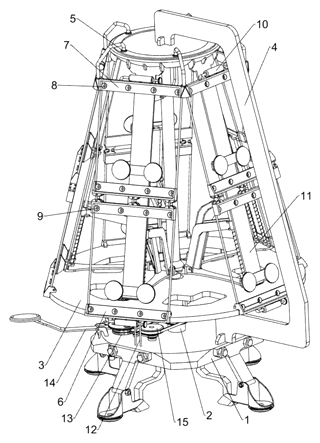
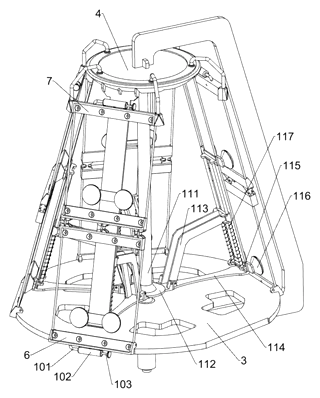
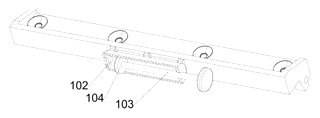
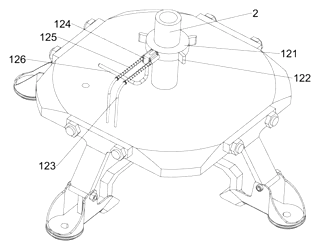
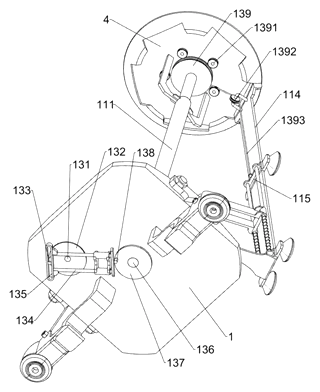
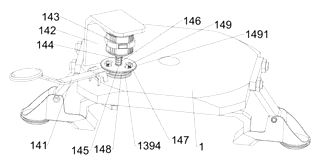
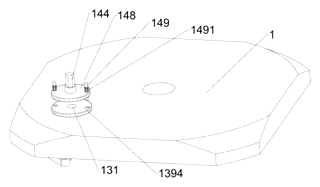
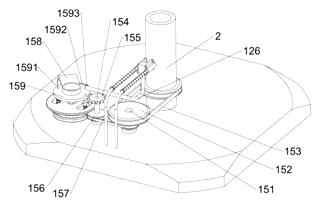
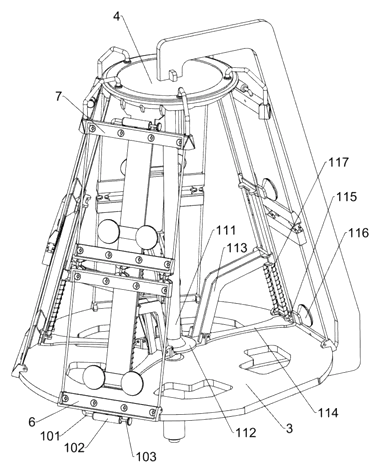
Drawings reproduced from the public patent document for reference.
Frequently asked questions
How does the foot switch operate the rotation?
The foot switch connects to a swing frame that mechanically engages the drive motor. When pressed, it lifts a diamond-shaped sleeve, causing slide bars to lock into a rotating chuck. This transfers power from the motor to the central pipe sleeve via belts and gears, rotating the display. Releasing the foot returns the mechanism to a locked position.
Can I adjust the brightness or color of the lights?
Yes. The lamps are mounted on sliding frames that move vertically along guide plates, allowing you to position the light source closer to or further from specific shelf levels. According to the patent, different colored lights can be used on separate sliding frames to create varied visual effects.
What materials are used for the display panels?
The patent describes “light-passing boards,” which typically refer to acrylic or polycarbonate sheets. These materials diffuse light evenly and allow visibility of stored items. The panels are held in place by suction cups within hollow metal frames, making them easy to replace or clean.
Is the rotation continuous or intermittent?
The design supports intermittent rotation. The foot-operated mechanism engages the drive for a set period or distance, then stops when the pedal is released. This prevents constant spinning and allows customers to pause and inspect items. Continuous mode can be achieved with modified control logic, though the patent emphasizes the step-by-step engagement.
How much weight can the rack hold?
The patent does not specify a maximum load rating. Load capacity depends on the motor torque, belt strength, and structural integrity of the aluminum frames. We recommend testing with actual product weights during the prototyping phase to confirm stability.
Can this design be made and sold in the US?
The patent was filed in China and is currently active there, but the public record shows no US counterpart. Therefore, this specific Chinese patent does not restrict manufacturing or selling this design in the United States. However, we strongly recommend a freedom-to-operate review to check for other US patents in the retail display field.
Are you affiliated with the patent owner?
No. IP2M is an independent design and manufacturing service working from the public patent document.
Request a quote
Click Request a Quote below to see our email address - copy it, or open your email app with a ready-made message. Please mention patent CN112998486B in the subject.
Helpful details to include:
- Your company and channel (retail brand, exhibition designer, museum curator, showroom owner)
- Dimensions (height, diameter) and estimated weight of products to be displayed
- Material preferences for panels (acrylic, glass, etc.) and finishes
- Lighting specs (color temperature, brightness, single vs. multi-color)
- Estimated quantity and target price
- Timeline - when you would like samples and the first shipment
You can also reach us at (332) 203-9997.
Page editor: Emily Zhang, Product Editor · IP2M
Last updated November 5, 2026. If something on this page looks wrong, email [email protected] and we will check it against the patent.
Interested in building this?
Tell us your target market, quantity and timeline. We reply with options for prototyping, small-batch runs or volume production.
Send your inquiry to
Please put CN112998486B in the subject line and tell us your company, country, estimated quantity and timeline.
Prefer to talk? Call (332) 203-9997.
More product-ready patents
All Retail Display patents →
Retail Display
Motorized Shelf Display That Presents a Product to Shoppers
Shelf unit that lifts a product over the price rail toward shoppers when a sensor detects them.
Patent CN215077184U
Retail Display
Portable Advertising Light Box with Spinning LED Display
Portable ad box whose spinning LED bars draw images and text; content changes by wireless or USB.
Patent CN207425291U
Retail Display
Automated Folding Store Shelf That Pushes Products Up to the Customer
Double-sided shelf for unmanned stores: folding tiers, screw pushers and lift cylinders present stock.
Patent CN109645754B
Retail Display
Motorized Rotating Display Pedestal with Lift Column, Info Screen and Clip-On Display Racks
Mobile pedestal: motorized rotating cube with lit faces and racks, electric lift column and info screen.
Patent CN208875862U
Retail Display
Thin Outdoor LED Video Wall Cabinet with Magnetic Modules and Tool-Free Locks
Thin outdoor LED wall cabinet: magnetic modules and rear body, rotary locks, finned rear cooling.
Patent CN205354557U
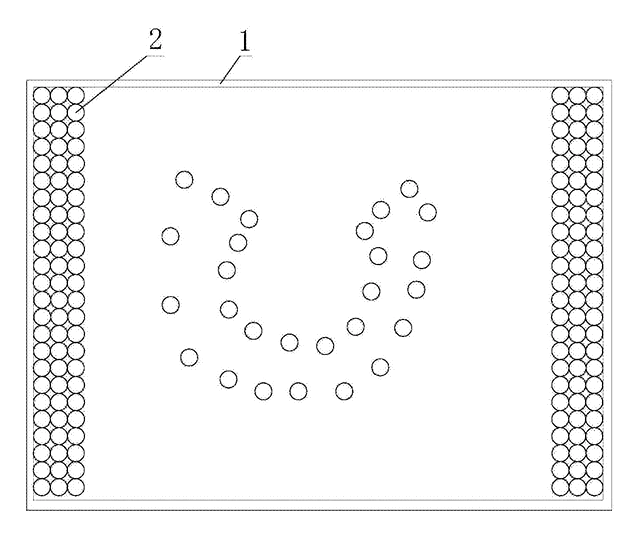
Store & Display
Magnetically Repositionable LED Advertising Panel
LED panel whose lamp beads slide to new positions via an external electromagnet.
Patent CN205487209U
Browse by category
- Apparel & Accessories (39)
- Baby & Kids (26)
- Bags & Luggage (15)
- Bath & Personal Care (26)
- Car Accessories (21)
- Furniture, Bedding & Storage (21)
- Garden & Outdoor (29)
- Health & Wellness (12)
- Home, Kitchen & Cleaning (43)
- Lighting (20)
- Packaging & Containers (10)
- Pet Products (10)
- Phone & Camera Accessories (8)
- Retail Display (22)
- School, Office & Art (30)
- Sports & Recreation (39)
- Tools & Workshop (48)
- Toys & Games (20)
This page is based on the public patent document CN112998486B, assigned to Jiangxi Yuanzong Technology Co., Ltd.. IP2M is an independent manufacturing service and is not affiliated with, endorsed by or licensed by the patent owner. Images marked as concept renderings are illustrations, not photos of an existing product. Patent status information is provided for reference only and is not legal advice; confirm freedom to operate for your market before production. Full disclaimer.