
Patent CN113090903B
Updated October 27, 2026Extendable Support Leg and Monopod with Single-Knob Locking
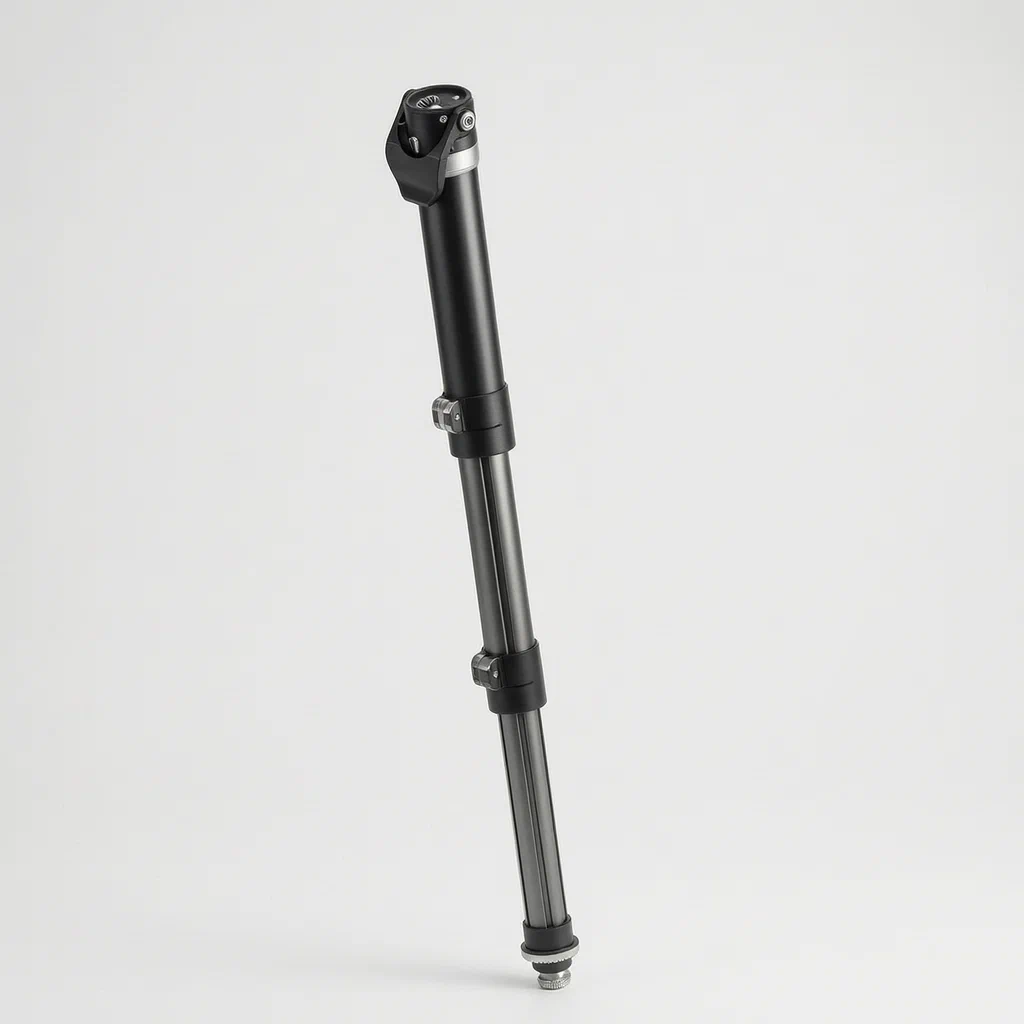
Standard monopods use twist collars or flip locks at every joint, forcing the user to work down the leg one clamp at a time to extend it and back up to collapse it. This design replaces that sequence with a single control assembly mounted on the top section. Turning the hand-piece rotates a transmission rod that runs inside the leg to expansion assemblies at each joint. Inside each assembly, a fixed seat threads onto a transmission seat; as they move together, an extrusion sleeve block presses angled surfaces against expansion blocks, driving them outward until their friction gaskets grip the inner tube wall. One turn locks or releases every joint simultaneously, keeping the outside of the leg smooth and free of protruding levers.
- China invention patent - in force
- No filings outside China
- Camera stands & mounts
- Internal transmission rod, expanding friction lock
Splat! What let you down?
🎛️
Single-knob control
A control assembly on the top section locks or releases every joint at once through an internal rod.
🔩
Expanding block lock
Expansion blocks are pushed outward by an extrusion sleeve block to grip the inner tube wall.
📏
Three telescoping sections
The second and third sections slide inside the first and second for adjustable length.
✨
Smooth exterior
All locking parts sit inside the tubes, leaving the outside free of twist rings or flip levers.
Bring this product to market
- ✓ Patent vetted China-only family and legal status checked
- 2 Product brief · now How it works, uses and options written up
- 3 Prototype First samples for buyers to review
- 4 Pilot run Small first batch for launch customers
- 5 Volume production Repeat orders at scale
Buyer interest
– of 100 buyers needed to start prototyping
One click, no sign-up. Each vote is one real visitor, and products with the most interest go to prototyping first.
Build team: no members yet. Need a partner, co-funding or skills to build this? Join and we introduce the team once it forms.
The problem
When photographers adjust a traditional monopod, they must loosen each twist collar or flip lever one by one, pull the sections to the desired height, and then retighten every joint individually. This takes both hands and several seconds, which matters when subjects move quickly or lighting changes between shots. Over time, external clamps collect dust, snag on clothing, and add bulk to the profile of the leg. Carrying a monopod with multiple protruding locks through crowded spaces or dense brush increases the chance of catching on obstacles.
The solution
This patent describes a support leg where all locking and releasing actions happen through one control point.
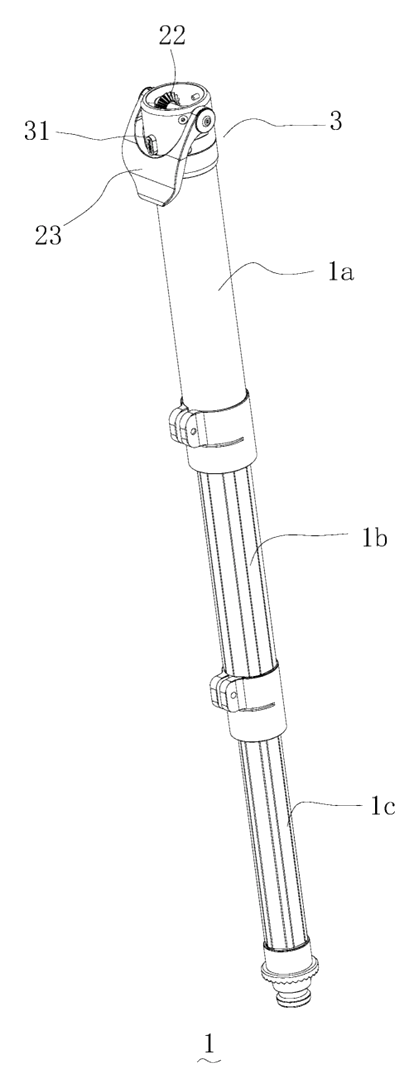
- A control assembly (3) sits on the first leg section (1a), the top tube the user holds.
- Turning the control assembly rotates a transmission rod (4) that runs down the inside of the leg.
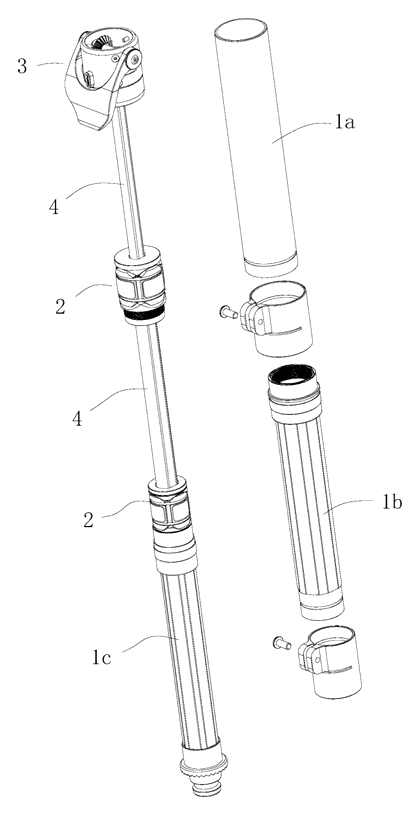
- At each joint—between the first and second leg section (1b), and between the second and third leg section (1c)—an expansion assembly (2) is mounted.
- Inside the expansion assembly, the rotating rod drives a transmission seat (5) relative to a fixed seat (7). Their threaded connection moves a pressing table (10) downward against an extrusion sleeve block (6).
- Angled surfaces on the sleeve block push expansion blocks (8) outward. Friction gaskets (11) on the blocks press firmly against the inner wall of the surrounding tube, locking the joint.
- Reversing the control pulls the transmission seat back, allowing elastic sleeves (9) to retract the expansion blocks, releasing all joints at once so the sections slide freely.
Who it is for
- Camera accessory brands looking to offer a monopod that adjusts faster than conventional twist-lock models.
- Wholesalers supplying photo retailers who need a distinct product feature to differentiate their catalog from standard aluminum legs.
- Amazon sellers in photography gear seeking a monopod design that appeals to users tired of multi-step locking routines.
- Video equipment manufacturers integrating a quick-adjust support leg into larger stabilizer or slider kits.
How it works
The main parts
| No. | Part | What it does |
|---|---|---|
| 1a, 1b, 1c | Leg sections | Telescoping tubes; 1b slides in 1a, 1c slides in 1b. |
| 2 | Expansion assembly | Locks and releases the joint by expanding outward. |
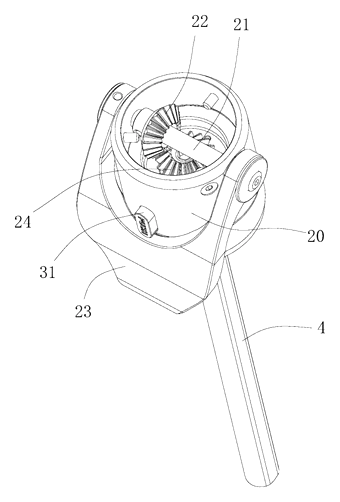
| 3 | Control assembly | Top-mounted knob and gears that drive the transmission rod. |
| 4 | Transmission rod | Runs inside the leg, linking the control to the expansion assemblies. |
| 5 | Transmission seat | Threaded part moved by the rod to actuate the sleeve block. |
| 6 | Extrusion sleeve block | Pushes the expansion blocks outward using angled surfaces. |
| 7 | Fixed seat | Threads onto the transmission seat; holds the expansion blocks. |
| 8 | Expansion blocks | Distributed around the fixed seat; press outward to lock. |
| 9 | Elastic sleeve | Rings around the expansion blocks to retract them when released. |
| 10 | Pressing table | Top of the transmission seat; pushes the extrusion sleeve block down. |
| 11 | Friction gasket | Rubber, plastic, or cloth pad on the expansion block for grip. |
Operating steps
- Turn the hand-piece on the control assembly (3) at the top of the first leg section (1a).
- The control bevel gear meshes with the transmission bevel gear on the transmission rod (4), spinning the rod.
- The rod rotates the transmission seat (5) inside the expansion assembly (2). Because the fixed seat (7) is threaded onto it, the transmission seat moves axially.
- The pressing table (10) pushes the extrusion sleeve block (6) downward. Balls in annular grooves allow smooth sliding contact between them.
- First and second extrusion inclined planes on the sleeve block and transmission seat wedge against abutting inclined planes on the expansion blocks (8), forcing them outward.
- The friction gaskets (11) press against the inner wall of the outer tube, locking the joint. Both joints lock simultaneously.
- Reverse the hand-piece to raise the transmission seat. The elastic sleeves (9), seated in accommodating grooves on the blocks, pull the expansion blocks inward, releasing the friction and allowing the sections to telescope.
Applications
Wildlife and sports photography
Photographers tracking fast subjects need to change shooting height instantly. With this leg, one turn of the top knob sets or releases the entire extension, eliminating the delay of working through multiple clamps while the subject moves out of frame.
Travel and hiking
Hikers carrying a monopod often navigate tight trails or crowded transit areas. A smooth exterior without protruding flip locks prevents the leg from snagging on backpack straps or branches during transport.
Event videography
Videographers moving between setups at weddings or conferences frequently adjust support height. The single-control mechanism allows rapid transitions without setting the camera down to manage individual joints.
Studio product shoots
Studio workers adjusting camera angles over a table benefit from a clean leg profile. The absence of external locking rings reduces the risk of bumping light stands or props positioned close to the camera.
Where it is less suitable
- Heavy cinema rigs - large video cameras may require wider-diameter legs or dual-column supports beyond the scope of this three-section design.
- Tripods needing independent leg angles - this patent covers a single support leg; adapting it to a multi-leg tripod requires separate splay mechanisms.
- Ultra-budget disposable supports - the internal transmission rod, bevel gears, and machined seats add manufacturing steps compared to a basic friction tube.
Frequently asked questions
How does one knob lock the whole leg?
Turning the control assembly at the top spins a transmission rod running inside the tubes. At each joint, the rod drives an expansion assembly where a threaded seat pushes an extrusion sleeve block against expansion blocks. The blocks spread outward, pressing friction gaskets against the inner tube wall to lock both joints simultaneously.
What stops the leg from slipping under a heavy camera?
The friction gaskets on the outer walls of the expansion blocks press directly against the inner surface of the surrounding leg section. The patent notes these gaskets can be rubber, plastic, or abrasion-proof cloth pads. The holding force depends on the gasket material, the angle of the extrusion surfaces, and the torque applied at the control knob, which are set in design / confirmed on prototypes.
Can the tubes be carbon fiber?
The patent describes the leg sections as tubes that slide inside one another and mentions friction gaskets, but does not restrict the tube material. Carbon fiber tubes are commonly used for monopods; the internal expansion mechanism would operate against the inner liner of the tube. Material choice is confirmed during the design phase.
How many sections does it have?
The patent embodiment shows three leg sections: a first (top) section holding the control assembly, a second section sliding inside the first, and a third section sliding inside the second. Expansion assemblies are placed at the joints for the second and third sections. The claims state “two or more leg sections,” so other counts are possible.
Is it faster to adjust than a twist-lock monopod?
Yes. The patent states that compared to the traditional mode of gradually locking and loosening multiple joints, this design realizes adjustment and locking in a simple, convenient, and quick manner because one control action operates all joints at once.
Does the outside of the leg have any clamps?
No. All locking components—the transmission rod, expansion assemblies, gears, and elastic sleeves—are housed inside the tubes. The exterior remains smooth, which the patent notes is favorable for appearance and avoids external protrusions.
Can this design be made and sold in the US?
The patent was filed only in China and is in force in China until at most 2041-03-31 (if annual fees are paid). It does not restrict making or selling the design in the US. However, camera support hardware is covered by various US patents held by other companies, so we recommend a freedom-to-operate check before volume production.
Are you affiliated with the patent owner?
No. IP2M is an independent design and manufacturing service working from the public patent document.
Request a quote
Click Request a Quote below to see our email address - copy it, or open your email app with a ready-made message. Please mention patent CN113090903B in the subject.
Helpful details to include:
- Your company and channel (camera brand, Amazon seller, wholesaler, video gear maker)
- Number of leg sections and target collapsed / extended lengths
- Tube material preference (aluminum, carbon fiber)
- Load capacity required
- Estimated quantity and target price
- Timeline - when you would like samples and the first shipment
You can also reach us at (332) 203-9997.
Explore this product
Interested in building this?
Tell us your target market, quantity and timeline. We reply with options for prototyping, small-batch runs or volume production.
Send your inquiry to
Please put CN113090903B in the subject line and tell us your company, country, estimated quantity and timeline.
Prefer to talk? Call (332) 203-9997.
More product-ready patents
All Phone & Camera Accessories patents →
Phone & Camera Accessories
Phone Clip Mount with Fold-Out Stand Leg
Phone clamp adapter with a ball-joint top, a dovetail base for tripod clamps and a fold-out desk leg.
Patent CN207394276U
Stands & Mounts
Manual Quick-Release Connector for Camera Equipment
Quick-release camera mount using a rotating driver and spring-loaded locking grooves.
Patent CN215294199U
Phone & Camera Accessories
Remote-Controlled Outdoor Photography Tripod with Movable Lens Mount
Motorized tripod with a remote-driven camera seat and a sliding multi-lens mount.
Patent CN118328254B
Travel & Outdoor Gear
Portable Drinking Water Bag with Outer Protection and One-Way Valve
Portable water bag with a protective outer bag, thin inner bag, and one-way valve.
Patent CN106388234B
Health & Wellness
Switchable Rotation Device for Handheld Massagers
Massage attachment mechanism that switches between locked and free-rotating positions.
Patent CN214968684U
Lighting
Truss-Type Foldable Desk Lamp with Longitudinal and Transverse Guide Adjustment
Foldable desk lamp with vertical and horizontal sliding guides and pneumatic locking.
Patent CN115127051B
Browse by category
- Apparel & Accessories (22)
- Baby & Kids (16)
- Bags & Luggage (9)
- Bath & Personal Care (16)
- Car Accessories (10)
- Furniture, Bedding & Storage (12)
- Garden & Outdoor (18)
- Health & Wellness (8)
- Home, Kitchen & Cleaning (24)
- Lighting (12)
- Packaging & Containers (6)
- Pet Products (6)
- Phone & Camera Accessories (4)
- Retail Display (13)
- School, Office & Art (19)
- Sports & Recreation (25)
- Tools & Workshop (27)
- Toys & Games (12)
This page is based on the public patent document CN113090903B, assigned to Dongguan Yangcong Network Technology Co ltd. IP2M is an independent manufacturing service and is not affiliated with, endorsed by or licensed by the patent owner. Images marked as concept renderings are illustrations, not photos of an existing product. Patent status information is provided for reference only and is not legal advice; confirm freedom to operate for your market before production. Full disclaimer.