At a glance
| Patent number | CN113498770B (application CN202110871954) |
| Type | China invention patent (发明专利) - protects product shape, structure and method |
| Original title | Inner closing pedal mousetrap (一种内关闭式踏板捕鼠笼) |
| Patent owner | Nanjing Chaotu Small And Medium Sized Enterprise Information Service Co ltd |
| Inventors | Chen Xiaofei |
| Filing date | 2021-07-30 |
| Grant date | 2023-05-23 |
| Status (China) | Lapsed - terminated for non-payment of annual fees (recorded 2025-07-25) |
| Patent family | Chinese filings only - no US, European, Japanese, PCT or other filings listed |
| Cited by | 0 later documents |
| Source | Google Patents (search for CN113498770B) |
What the claims cover, in plain language
Claim 1 - an inner closing pedal mousetrap comprising a cage body, a movable door (including a front door and a rear door), a pedal and a trigger mechanism. The movable doors are hinged at the rear end of the cage. The trigger mechanism includes a first trigger lever, a second trigger lever, a first return spring, a front trigger lever and a rear trigger lever, with the pedal fixedly connected to the first trigger lever. When the doors are open, the first trigger lever movably connects to the lower end of the second trigger lever, the front trigger lever abuts the front door, and the front door compresses a front return spring. When closed, the first trigger lever separates from the second trigger lever. A linkage device is arranged between the front door and the rear door.
Claim 2 - the linkage device includes a synchronous shaft, two linkage cables A and a knob. The synchronous shaft is on the inner side of the cage body, parallel to and above the first trigger lever. The cables wind around the shaft and attach to the front and rear doors. The knob is fixed to one end of the shaft on the cage side.
Claim 3 - the linkage device also includes a power storage spring with one-way storage on the knob. Without external force, the spring rotates the shaft back to its initial position, leaving the cables relaxed.
Claim 4 - alternatively, the linkage device includes a linkage cable B connecting the innermost sides of the front and rear doors, resting against the second trigger lever so it can be pressed down to drive the doors open.
Claim 5 - the first and second trigger levers are cylindrical and twisted as a whole, with equal horizontal cross-sectional areas. Their contact part is a horizontal plane; the first lever’s contact end has an arc A cross-section and the second lever has a matching superior arc B cross-section.
This is a simplified reading for orientation only. The legal scope is defined by the exact claim wording in the official Chinese document.
What this means for US production
This patent was filed only in China and is lapsed (terminated for non-payment of annual fees, recorded 2025-07-25), so it no longer restricts anyone in China either. It has no US or other foreign counterpart.
Two points to settle early:
- Other patents may exist. Shenzhen Visson Technology Co., Ltd. holds a later US patent application (US20250017193A1) citing this document, indicating ongoing patent activity in the rodent trap field. A freedom-to-operate (FTO) review covering inward-closing doors, pedal triggers and cable linkages is needed before tooling.
- Spring tension and cable routing. The force required to trip the pedal and the travel distance of the linkage cables must be tuned to the target rodent weight; these parameters are set in design and confirmed on prototypes.
Customization and manufacturing
What can be customized
| Area | Options |
|---|---|
| Cage material | Galvanized wire mesh, coated steel wire, or injection-molded plastic panels |
| Dimensions | Length, width and height to be confirmed in design based on target species |
| Door style | Solid panel or wire grid, inward-hinging |
| Linkage type | Synchronous shaft with cables and knob, or direct linkage cable B |
| Pedal size | Adjusted for sensitivity to different animal weights |
| Finish | Powder coating, galvanizing, or painted surfaces |
| Accessories | Bait clip, carrying handle, release latch for emptying |
Things to plan for (US market)
- EPA pest control device rules. A purely mechanical trap is a “device” under FIFRA rather than a registered pesticide: it does not need product registration, but the producing establishment must be EPA-registered (40 CFR 167), the label must not be false or misleading (40 CFR 156.10), and capture claims must stay within what the design supports.
- California Prop 65. Wire coatings, plastics and metal finishes must be screened for listed chemicals if sold in California.
- CPSC general requirements. While not a children’s product, sharp edges on wire mesh or stamped levers must be deburred to prevent injury during handling.
How a project runs
- Inquiry - target species, material preference, linkage type and estimated volumes.
- Design - CAD modeling of the cage frame, pedal geometry, lever arcs and cable routing.
- Prototype - 3D-printed levers and wire-bent cages for functional testing of the trigger release and door closure speed.
- Pilot run - small batch stamping and welding to verify assembly tolerances and spring tension.
- Production - wire forming or plastic molding, surface treatment, sub-assembly of the trigger mechanism, final assembly and packaging.
Quantities & timeline
Wire cages require custom welding jigs or bending dies for the frame, while plastic versions need injection molds for the body panels and levers. Stamping dies are needed for the pedal and trigger levers. Cycle testing of the return springs and cable wear tests take most of the validation phase. Send us your target species, preferred materials, linkage type, quantity and target price and we will reply with options.
Patent drawings
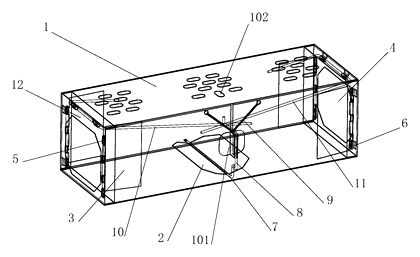
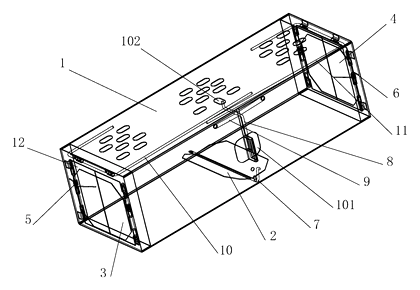
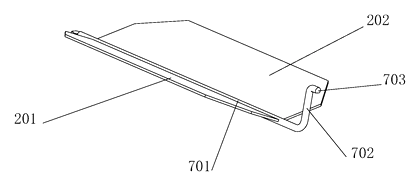
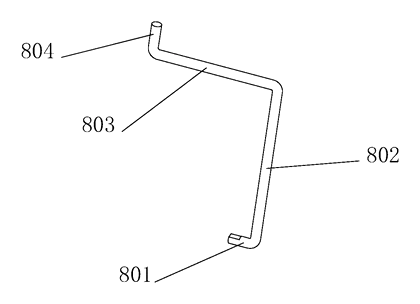
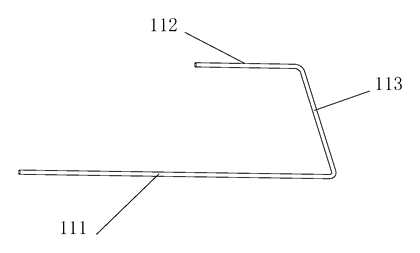
Drawings reproduced from the public patent document for reference.