At a glance
| Patent number | CN113615980B (application CN202110894747) |
| Type | China invention patent (发明专利) - protects product method and structure |
| Original title | Collapsible Table and Chair for Students (一种学生用折合式桌椅) |
| Patent owner | Jiangxi Smart Star Industry Co ltd |
| Inventors | Tao Huan |
| Filing date | 2021-08-05 |
| Grant date | 2022-06-07 |
| Status (China) | In force - valid until at most 2041-08-05, subject to payment of annual fees |
| Patent family | Chinese filings only - no US, European, Japanese, PCT or other filings listed |
| Cited by | 0 later documents |
| Source | Google Patents (search for CN113615980B) |
What the claims cover, in plain language
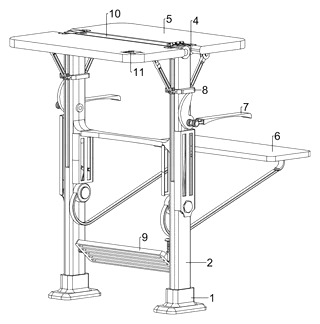
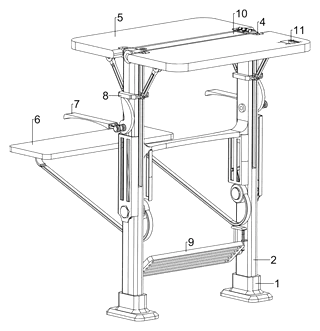
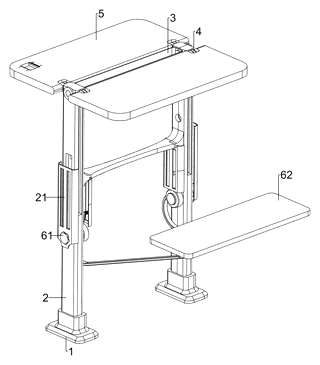
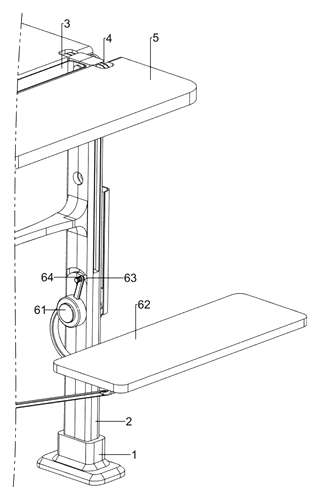
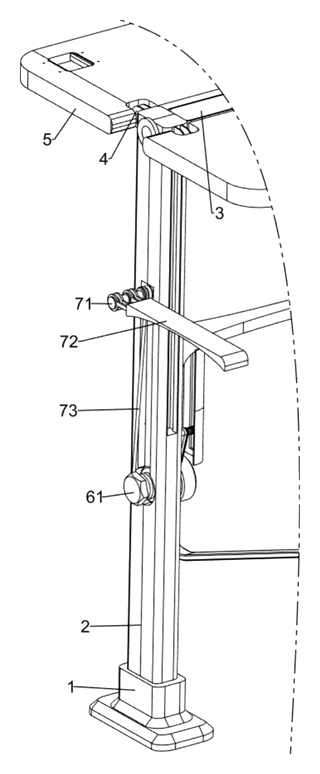
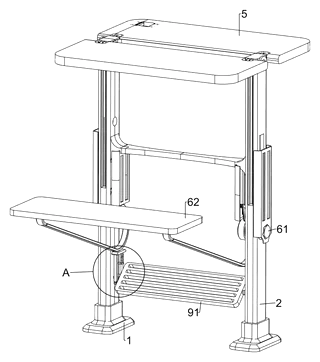
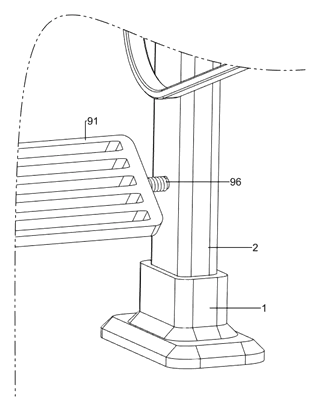
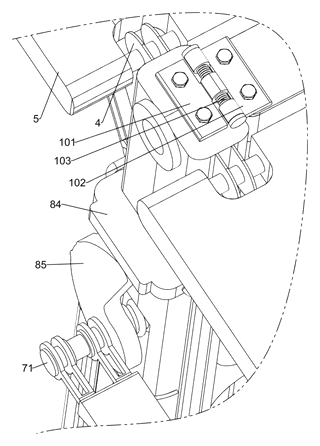
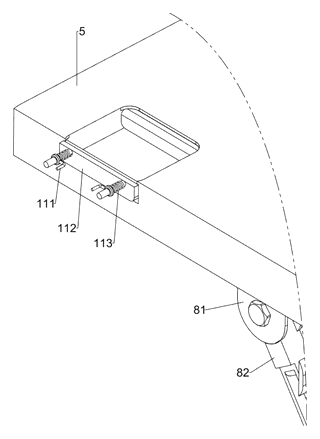
Claim 1 defines a student collapsible table and chair comprising a first supporter (1), first fixing rod (2), protection frame (21), placing box (3), first fixers (4), table plate (5), seat mechanism (6), arm support mechanism (7), folding lifting mechanism (8), and placement mechanism (9). The key structural relationships are:
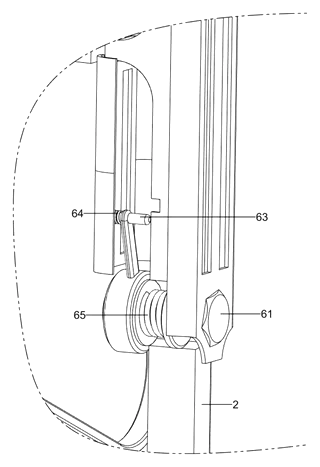
- The seat mechanism (6) is positioned between the fixing rod (2) and protection frame (21), utilizing first torsion springs (65) wound on first fixing shafts (61) and first springs (64) acting on clamping rods (63).
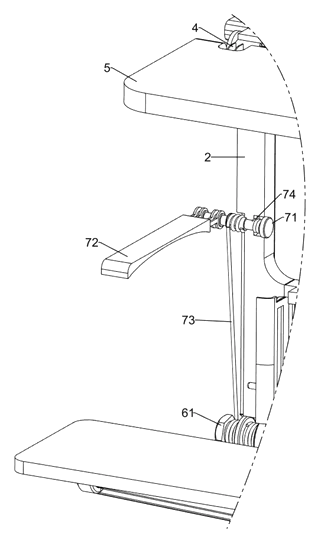
- The arm support mechanism (7) connects the seat to the rod via first rotating shafts (71) and first pull ropes (73) coupled with second torsion springs (74).
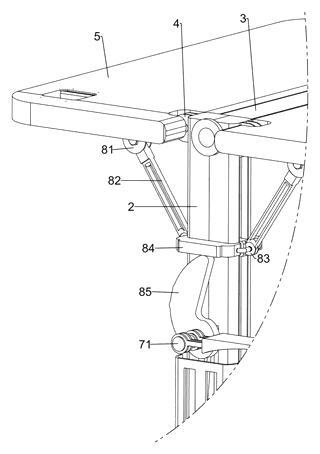
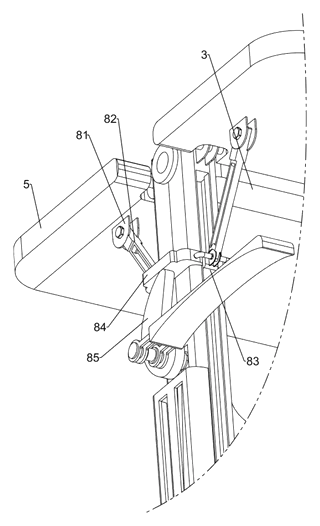
- The folding lifting mechanism (8) uses connecting blocks (84) and sliding lifters (83) to coordinate the vertical movement of the arms relative to the table plate (5).
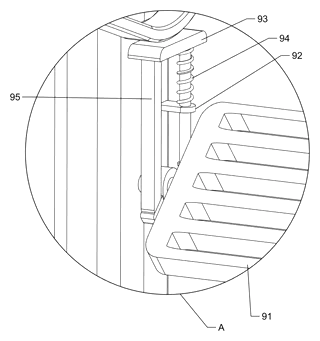
- The placement mechanism (9) features a foot placing frame (91) connected to a lower pressing frame (93) via a lower pressing rod (95) and a second spring (94).
This is a simplified reading for orientation only. The legal scope is defined by the exact claim wording in the official Chinese document.
What this means for US production
This patent was filed only in China and is currently in force. Making or selling this specific design in China requires the owner’s permission. However, since there are no US patents in this family, the design itself is not restricted by this specific patent number in the United States.
Two points to settle early:
- Other patents may exist. Educational furniture and folding mechanisms are a crowded field with many existing US patents regarding self-storing desks, flip-down seats, and modular classroom systems. A freedom-to-operate (FTO) review is essential before tooling to ensure no other US utility patents cover the specific combination of synchronized arm/seat folding or the spring-loaded footrest mechanism.
- Safety Standards Compliance. US market entry requires strict adherence to federal and state safety regulations for children’s products, which may influence material choices and structural tolerances beyond what is described in the patent.
Customization and manufacturing
What can be customized
| Area | Options |
|---|---|
| Materials | Steel types (cold-rolled vs. aluminum) for frame; plastic vs. wood laminate for table plate. |
| Spring Specifications | Torque rating of torsion springs and tension of pull ropes to adjust folding effort. |
| Dimensions | Height adjustments for primary vs. secondary school age groups; width of table plate. |
| Storage Features | Size and configuration of the placing box (3); addition of hooks or shelves. |
| Finishes | Powder coating colors, anti-microbial coatings for surfaces, edge banding styles. |
Things to plan for (US market)
- ASTM F1235 - Standard Consumer Safety Specification for Portable Tables for Children. While this is a fixed unit, similar durability and tip-over logic applies.
- ANSI/BIFMA X5.1 - General Purpose Office Chairs Tests. If marketed as general seating, cycle testing for the folding mechanism is critical.
- CPSC Guidelines - Sharp edges, pinch points, and entanglement hazards must be minimized, especially for younger students.
- California Prop 65 - Screening of finishes and plastics for lead, cadmium, and phthalates.
How a project runs
- Inquiry - Define target age group, dimensions, and volume requirements.
- Design Adaptation - Engineer the spring rates and linkage geometry for US safety standards.
- Prototype - Build functional models to test folding cycles and load-bearing stability.
- Pilot Run - Conduct third-party lab testing for durability and chemical safety.
- Production - Metal stamping/welding, powder coating, injection molding for plastic parts, final assembly.
Quantities & timeline
Manufacturing involves precision welding of the central rod assembly, custom winding of torsion springs, and careful assembly of the rope-and-pulley-like linkage. Tooling for the table plate and protective frames requires molds. Testing cycles for the folding mechanism typically take several weeks to validate longevity. Send us your target dimensions, material preferences, quantity estimates, and desired certification level and we will reply with options.
Patent drawings
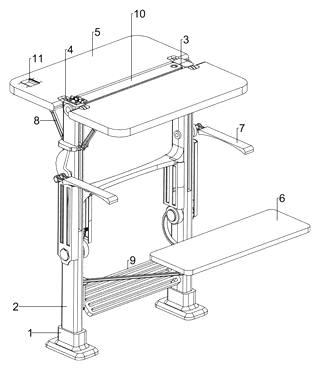
Drawings reproduced from the public patent document for reference.