
Patent CN113635356B
Updated November 7, 2026Portable Body Hair Cutter with Integrated Illumination and Skin-Guiding Frame
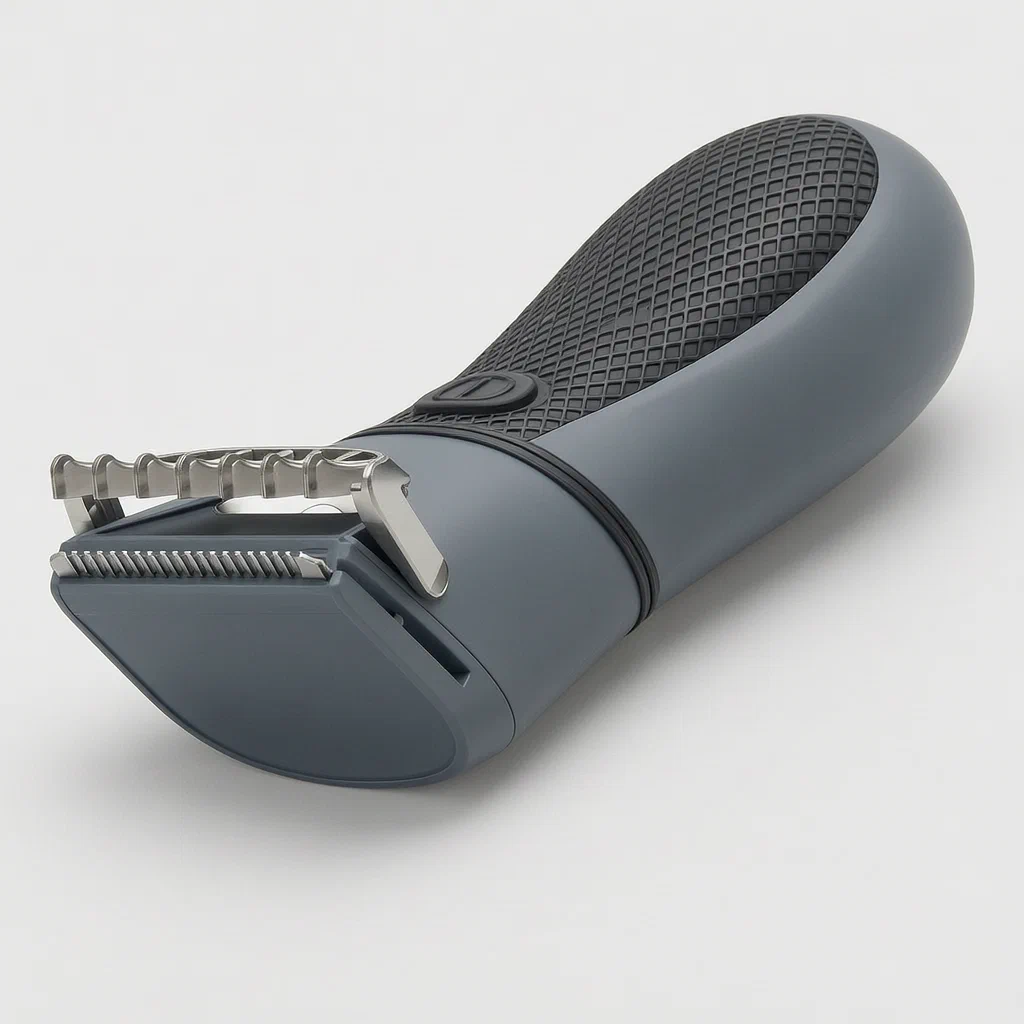
Shaving body hair often involves blind spots and loose skin, leading to nicks or missed patches. This design integrates a rotating guide frame that flattens skin folds before the blades engage, while a built-in mirror and lamp illuminate the area from angles the eye cannot see directly. By combining mechanical skin tensioning with optical assistance, the trimmer reduces friction and enhances visibility for safer, more effective grooming.
- China invention patent - active
- No filings outside China
- Personal care & grooming
- Motor-driven reciprocating blades, plastic housing, silicone grip
Splat! What let you down?
💡
Mirror-Illuminated View
A built-in lamp and reflector direct light to the skin, letting users see the cut area via the mirror surface.
🔄
Rotating Skin Guide
A frame on a pivot presses ahead of the blades to flatten skin folds and reduce friction during use.
⚙️
Eccentric Drive
A motor and eccentric shaft convert rotation into the reciprocating motion of the movable blade.
🛡️
Arc-Tipped Teeth
Static blade tips are rounded to minimize irritation when the guide frame contacts the skin.
Bring this product to market
- ✓ Patent review Patent family and legal status reviewed in the relevant jurisdictions.
- 2 Product brief · now How it works, uses and options written up
- 3 Prototype First samples for buyers to review
- 4 Pilot run Small first batch for launch customers
- 5 Volume production Repeat orders at scale
Buyer interest
– of 100 buyers needed to start prototyping
One click, no sign-up. Each vote is one real visitor, and products with the most interest go to prototyping first.
Build team: no members yet. Need a partner, co-funding or skills to build this? Join and we introduce the team once it forms.
Patent Rights & Team Participation
Before joining a development team, participants should ensure they have the necessary rights or authorization to participate in the project.
Participation is generally appropriate where:
- You own the relevant patent rights or have obtained permission or a license from the rights holder.
- The relevant patent rights have expired or have been legally invalidated in the jurisdictions where the planned activities will take place.
- The planned development, manufacturing, and commercialization activities have been independently assessed and do not infringe applicable patent rights in the relevant jurisdictions.
Important: Being located outside a country where a patent is protected does not automatically exempt you from patent infringement risks. Patent rights may apply based on where development, manufacturing, use, sale, or import activities take place.
IP2M does not grant any patent license or authorization through team participation. Joining a project does not provide permission to use, manufacture, or commercialize patented technology.
The problem
Standard body hair trimmers often struggle with two main issues: poor visibility in awkward positions (such as the back or underarms) and the tendency of loose or folded skin to bunch up against the blades. When skin folds are not flattened, the cutting teeth can pinch the skin rather than gliding over it, causing discomfort or minor cuts. Furthermore, without adequate lighting directed precisely at the contact point, users may miss hairs or accidentally press too hard because they cannot clearly see the boundary between the tool and the skin. Existing designs typically rely on external mirrors or simple guards that do not actively adjust the skin’s tension relative to the blade movement.
The solution
The patented device integrates a mechanical skin-tensioning system with an optical aid within a single handheld unit.
- Housing and Drive: The core is a housing containing a driving assembly. This assembly uses a motor connected to an eccentric shaft. As the motor rotates, the eccentric shaft moves within a transmission groove on the movable blade, causing the blade to oscillate back and forth rapidly.
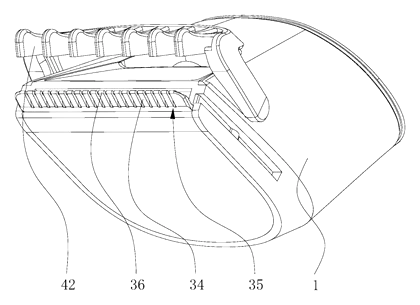
- Cutter Head Assembly: At the end of the housing sits the cutter head, comprising a static blade and the movable blade. The static blade has second cutting teeth with arc-shaped tips, while the movable blade has first cutting teeth. These interlock to create a shearing action.
- Rotating Guide Frame: Attached to the housing via a rotating shaft is a guide frame. This frame features hair guide teeth on its inner surface. During operation, the bottom surface of the guide frame’s end part contacts the skin before the blades do. Because it is mounted on a pivot, it can rotate slightly to conform to body contours, effectively pulling the skin taut and flattening wrinkles.
- Illumination Assembly: The housing includes a lighting lamp and a reflecting mirror surface. The lamp shines toward the mirror and the guide frame. Part of this light reflects off the mirror onto the skin area being shaved. This allows the user to view the specific cutting zone through the reflection, even if their line of sight is obstructed by the device itself or the angle of the limb.
Who it is for
- Personal Care Brands: Companies looking to differentiate electric shavers by adding ergonomic and visibility features for difficult-to-reach body areas.
- Amazon Sellers: Direct-to-consumer brands targeting the men’s grooming niche where “no-nick” and “visible shave” are high-priority search terms.
- OEM Manufacturers: Factories producing small household appliances who need a structured, patent-backed design for a new SKU in the wet/dry trimmer category.
- Wholesalers: Distributors seeking a product with clear functional advantages over basic foil shavers for retail display.
How it works
The main parts
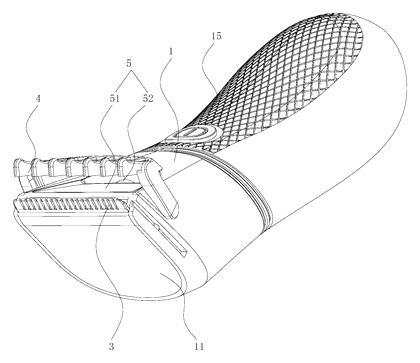
| No. | Part | What it does |
|---|---|---|
| 1 | Housing | Encloses the electronics and provides the grip; includes a silica gel film for anti-slip texture. |
| 2 | Driving Assembly | Motor (21) and eccentric shaft (22) generate the power output for blade movement. |
| 3 | Cutter Head | Movable blade (31) and static blade (32) with interlocking cutting teeth (33, 34). |
| 4 | Guide Frame | Rotates on a shaft (41); presses skin flat ahead of the blades using guide teeth. |
| 5 | Illumination | Lamp (52) and reflecting mirror surface (51) direct light to the skin for visibility. |
| 35 | Cutting Area | The gap where movable and static teeth shear hair; points toward the skin side of the guide frame. |
Operating Steps
- Activation: The user switches on the device, powering the motor.
- Blade Motion: The motor turns the eccentric shaft, which drives the movable blade in a reciprocating stroke inside its transmission groove. The first cutting teeth slide against the second cutting teeth of the static blade.
- Skin Contact: The user places the guide frame against the skin. The frame rotates slightly around its shaft, pressing the skin down. This action stretches the skin surface, removing folds and creating a flatter plane for the blades.
- Lighting: The internal lamp illuminates the mirror surface, which reflects light onto the stretched skin area. The user looks at the mirror to see exactly where the hair is being cut.
- Trimming: As the device moves along the body, the guide frame maintains tension on the skin while the blades shear the hair entering the gap between the tooth rows.
Applications
Back and Shoulder Grooming
Reaching the back is difficult visually and physically. The integrated mirror allows the user to see the reflection of the skin behind them, while the guide frame ensures the skin remains taut despite the awkward arm position, preventing pinches.
Underarm and Groin Areas
These regions have significant skin folds and sensitive contours. The rotating guide frame adapts to the curvature, flattening the skin locally so the blades glide smoothly without catching on wrinkles, reducing irritation in delicate zones.
Leg and Arm Hair Removal
For standard limbs, the device speeds up the process by maintaining consistent pressure. The illumination helps spot stray hairs that might be missed in dim bathroom lighting, ensuring a cleaner finish without needing a separate vanity mirror.
Travel and On-the-Go Use
The compact, self-contained nature of the device means no external lights or complex setups are required. It is suitable for quick touch-ups in hotel bathrooms or other environments where lighting conditions are suboptimal for precise grooming.
Where it is less suitable
- Head Shaving: While possible, dedicated rotary shavers or clippers with wider heads are generally faster for large, flat cranial surfaces.
- Facial Beards: The guide frame mechanism is optimized for body skin elasticity; facial stubble usually requires different blade geometry and guard heights for close styling.
- Very Thick Coarse Hair: High-power professional-grade clippers with larger motors may handle dense vegetation more efficiently than this compact consumer-focused design.
Patent & Production
At a glance
| Patent number | CN113635356B (application CN202110773895) |
| Type | China invention patent (发明专利) - protects method and structure |
| Original title | Portable body hair cutter (一种便捷式体毛刀) |
| Patent owner | Wenzhou Shengyi Electronic Technology Co ltd |
| Inventors | Wu Xiaodong |
| Filing date | 2021-07-08 |
| Grant date | 2023-10-13 |
| Status (China) | In force until at most 2041-07-08 (subject to payment of annual fees) |
| Patent family | Public record shows Chinese filings only - no US, European, Japanese, PCT or other filings listed |
| Cited by | 0 later documents |
| Source | Google Patents (search for CN113635356B) |
What the claims cover, in plain language
Claim 1 defines a portable body hair cutter comprising a housing, a driving assembly, a cutter head assembly, a guide frame, an illumination assembly, and a cutter head base. The driving assembly is inside the housing and outputs power to the movable blade. The cutter head has a movable blade with first cutting teeth and a static blade with second cutting teeth; their contacting surfaces form a cutting area. Crucially, the static blade teeth have arc-shaped ends acting as guides. The guide frame connects to the housing via a rotating shaft, positioning its end against the guide piece to maintain a gap from the blades. The illumination assembly includes a lamp and a reflecting mirror surface on the housing; light from the lamp hits the mirror and reflects onto the skin, allowing observation of the cutting area via the mirror. The cutter head base attaches to the static blade with fixing columns engaging hooks in the housing, one hook being removable via a reset mechanism.
Claims 2-8 add details such as parallel arrangement of cutting flank arrays, the use of a motor and eccentric shaft for drive transmission, directional orientation of guide points, inclusion of hair guide teeth on the frame, a torsion spring for the frame, specific spacing of static blade teeth (0.5mm to 1mm), and a silica gel film with anti-skid patterns on the housing.
This is a simplified reading for orientation only. The legal scope is defined by the exact claim wording in the official Chinese document.
What this means for US production
This patent was filed in China and is currently in force. The public record shows no US counterpart. Therefore, making or selling this specific design in China requires the owner’s permission. However, since there is no US patent, the design itself does not restrict manufacturing or sales in the United States based on this document alone.
Two points to settle early:
- Other patents may exist. Electric personal care devices are a crowded IP field. Major brands hold numerous patents on motor drives, blade geometries, and ergonomic handles. A freedom-to-operate (FTO) review is essential to ensure this design does not infringe on existing US patents held by competitors like Philips, Braun, or Conair.
- Component sourcing. The eccentric shaft and motor assembly must meet noise and vibration standards for US consumers; verify supplier specifications for these mechanical parts.
Customization and manufacturing
What can be customized
| Area | Options |
|---|---|
| Housing Material | ABS, PC, or nylon blends; color and texture options. |
| Silicone Grip | Shore hardness, pattern depth, and color of the anti-skid film. |
| Blade Geometry | Tooth pitch, material grade (stainless steel types), and coating (DLC, titanium). |
| Illumination | LED color temperature (warm/cool white), brightness levels, and battery integration. |
| Guide Frame | Rotation stiffness (spring rate), size of the contact surface, and flexibility of the pivot. |
| Power Source | Battery capacity (mAh), charging interface (USB-C vs. proprietary), and runtime targets. |
Things to plan for (US market)
- FCC Part 15 - If the device contains wireless components (e.g., Bluetooth for app connectivity), it must comply with FCC rules for unintentional radiators. Even without radio, electronic circuits must not emit excessive interference.
- FDA Registration - Electric shavers are Class I medical devices in the US. Manufacturers must register their facility and list the device with the FDA.
- UL/ETL Certification - For the battery charger and any AC adapter included, UL certification is highly recommended for retailer acceptance and liability protection.
- Proposition 65 - California requires warnings if certain chemicals (like phthalates in plastics or lead in solder) are present above safe harbor levels.
How a project runs
- Design Validation - CAD modeling of the housing, guide frame kinematics, and optical path for the mirror/lamp.
- Tooling Design - Mold flow analysis for the plastic housing and guide frame; die design for stainless steel blades.
- Prototyping - 3D printed housings for fit checks; sample blades for cutting performance tests.
- Certification Prep - Submit prototypes for EMC testing and safety reviews.
- Mass Production - Injection molding, blade stamping/grinding, motor assembly, and final packaging.
Quantities & timeline
Molds for the housing and guide frame are the primary lead time drivers. Blade grinding and heat treatment require specialized suppliers. Certification testing adds 4-6 weeks. Send us your target retail price, volume estimates, and desired feature set and we will reply with options.
Production notes
Tooling and process
The housing and guide frame likely require multi-cavity injection molds to manage cycle times. Stainless steel forming is used for the static and movable blades, followed by precision grinding to achieve the specified tooth geometry. Motor assembly involves press-fitting the eccentric shaft into the rotor housing.
Cost drivers
Material grade likely has the largest impact on cost, particularly for corrosion-resistant stainless steels and silicone of the specified grade for the grip. Plating grade and thickness on metal components add expense but enhance durability. Packaging complexity also contributes to landed costs.
Prototyping path
Initial validation should use 3D-printed housings to check the guide frame’s rotation range and the mirror’s viewing angle. Off-the-shelf seals and gaskets can be tested in early units. A water spray test sample is critical to verify the device’s resistance to moisture ingress at seams.
What we would change before tooling
Before locking tooling, we would recommend adjusting the wall thickness and joint design of the housing to prevent sink marks near the screw bosses. We would also refine the hinge boss and pivot wear characteristics of the guide frame to ensure long-term smoothness.
Common failure points
Water ingress at seams is a primary risk for wet-use devices. Hinge fatigue in the guide frame could lead to looseness over time. Motor mount cracking may occur if vibration is not dampened properly. Ensure spring fatigue rates are consistent across batches to maintain uniform skin tension.
Patent drawings
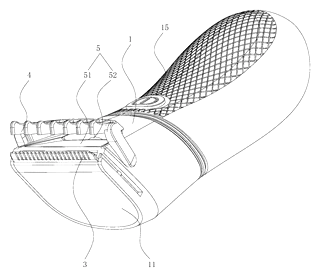
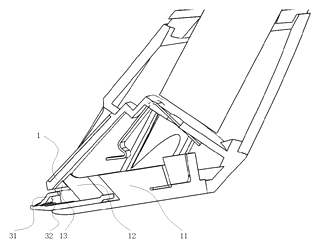
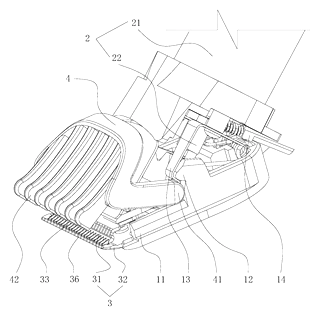
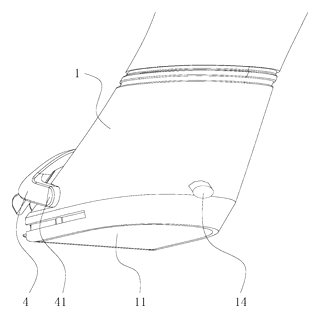
Drawings reproduced from the public patent document for reference.
Frequently asked questions
How does the guide frame help with shaving?
The guide frame is mounted on a rotating shaft and touches the skin before the blades do. As you move the device, the frame gently pulls the skin tight and flattens out wrinkles. This creates a smooth surface for the blades to glide over, reducing the chance of pinching loose skin.
Do I really need the built-in mirror?
Yes, especially for hard-to-see areas like the back or groin. The lamp shines light onto a reflective mirror surface, which bounces the light onto your skin. You can look at the mirror to see exactly where the hair is being cut, even if you can’t see the area directly with your eyes.
Is the blade sharp enough for thick hair?
The patent specifies a cutting area formed by interlocking movable and static teeth. While the design focuses on safety and visibility, the actual sharpness depends on the steel grade and grinding process selected during manufacturing. We can specify high-hardness stainless steel for better performance on coarse hair.
Can this be used in the shower?
The patent mentions a silica gel film for anti-skid purposes, but does not explicitly detail waterproofing ratings (IPX). To make it shower-safe, we would need to add proper sealing at all seams and joints during the design phase. Water ingress at seams is a known failure point we address in prototyping.
How long does the battery last?
Battery life depends on the capacity chosen for the housing and the efficiency of the motor. The patent does not specify a runtime. Typical values for similar devices range from 45 to 90 minutes per charge, but this is confirmed on prototypes based on the final battery selection.
Is it safe for sensitive skin?
The design aims to increase safety by flattening skin folds and using arc-shaped blade tips to reduce friction. However, individual skin reactions vary. The device is intended for general grooming; users with very sensitive skin or medical conditions should consult a dermatologist before use.
Can this design be made and sold in the US?
The patent was filed in China and is currently in force there. The public record shows no US counterpart, so this specific patent does not restrict making or selling the design in the US. However, other US patents may cover similar technologies. We recommend a freedom-to-operate check before launching to avoid infringement risks.
Are you affiliated with the patent owner?
No. IP2M is an independent design and manufacturing service working from the public patent document.
Request a quote
Click Request a Quote below to see our email address - copy it, or open your email app with a ready-made message. Please mention patent CN113635356B in the subject.
Helpful details to include:
- Your company and channel (personal care brand, Amazon seller, wholesaler)
- Target price and estimated quantity
- Feature preferences (battery type, charging port, color scheme)
- Compliance needs (FDA registration support, UL certification)
- Timeline - when you would like samples and the first shipment
You can also reach us at (332) 203-9997.
Page editor: Emily Zhang, Product Editor · IP2M
Last updated November 7, 2026. If something on this page looks wrong, email [email protected] and we will check it against the patent.
Interested in building this?
Tell us your target market, quantity and timeline. We reply with options for prototyping, small-batch runs or volume production.
Send your inquiry to
Please put CN113635356B in the subject line and tell us your company, country, estimated quantity and timeline.
Prefer to talk? Call (332) 203-9997.
More product-ready patents
All Bath & Personal Care patents →
Bath & Personal Care
Foot-Pedal Soap & Sanitizer Dispenser Stand
Hands-free, battery-free dispenser stand - step on a pedal to press the pump of any soap or sanitizer bottle.
Patent CN207461995U
Bath & Personal Care
Ear-Shaped Mask Strap Guard with Tension Adjuster
Ear-shaped silicone guard and strap-length adjuster that make ear-loop masks comfortable to wear for long hours.
Patent CN205456233U
Bath & Personal Care
Adjustable-Length Back Scrubber Strap with Push-Button Handles
Back-scrubber strap with push-button handles that set its length and a spring that keeps it taut.
Patent CN207041452U
Bath & Personal Care
Angled-Plate Hair Straightener
Flat iron with plates twisted 45-75° to the handle, a curling groove and rubber-capped tips.
Patent CN206137462U
Bath & Personal Care
Refillable Lipstick Case with Sealed Snap-In Refill Pods
Reusable twist-up lipstick case; sealed refill pods unlock at the top of the stroke for shade swaps.
Patent CN206909979U
Bath & Personal Care
Quick-Release Toilet Seat Hinge with a Push-Button Two-Strip Latch
Toilet seat hinge: drop the shaft onto a grooved post to lock; one push parks the latch open to lift it off.
Patent CN210370292U
Browse by category
- Apparel & Accessories (48)
- Baby & Kids (29)
- Bags & Luggage (17)
- Bath & Personal Care (32)
- Car Accessories (25)
- Furniture, Bedding & Storage (24)
- Garden & Outdoor (32)
- Health & Wellness (14)
- Home, Kitchen & Cleaning (50)
- Lighting (23)
- Packaging & Containers (12)
- Pet Products (11)
- Phone & Camera Accessories (9)
- Retail Display (25)
- School, Office & Art (36)
- Sports & Recreation (46)
- Tools & Workshop (54)
- Toys & Games (22)
This page is based on the public patent document CN113635356B, assigned to Wenzhou Shengyi Electronic Technology Co ltd. IP2M is an independent manufacturing service and is not affiliated with, endorsed by or licensed by the patent owner. Images marked as concept renderings are illustrations, not photos of an existing product. Patent status information is provided for reference only and is not legal advice; confirm freedom to operate for your market before production. Full disclaimer.