
Patent CN113842002B
Updated November 7, 2026Height-Adjustable Children's Play Fence with Anti-Slip Foam Pad
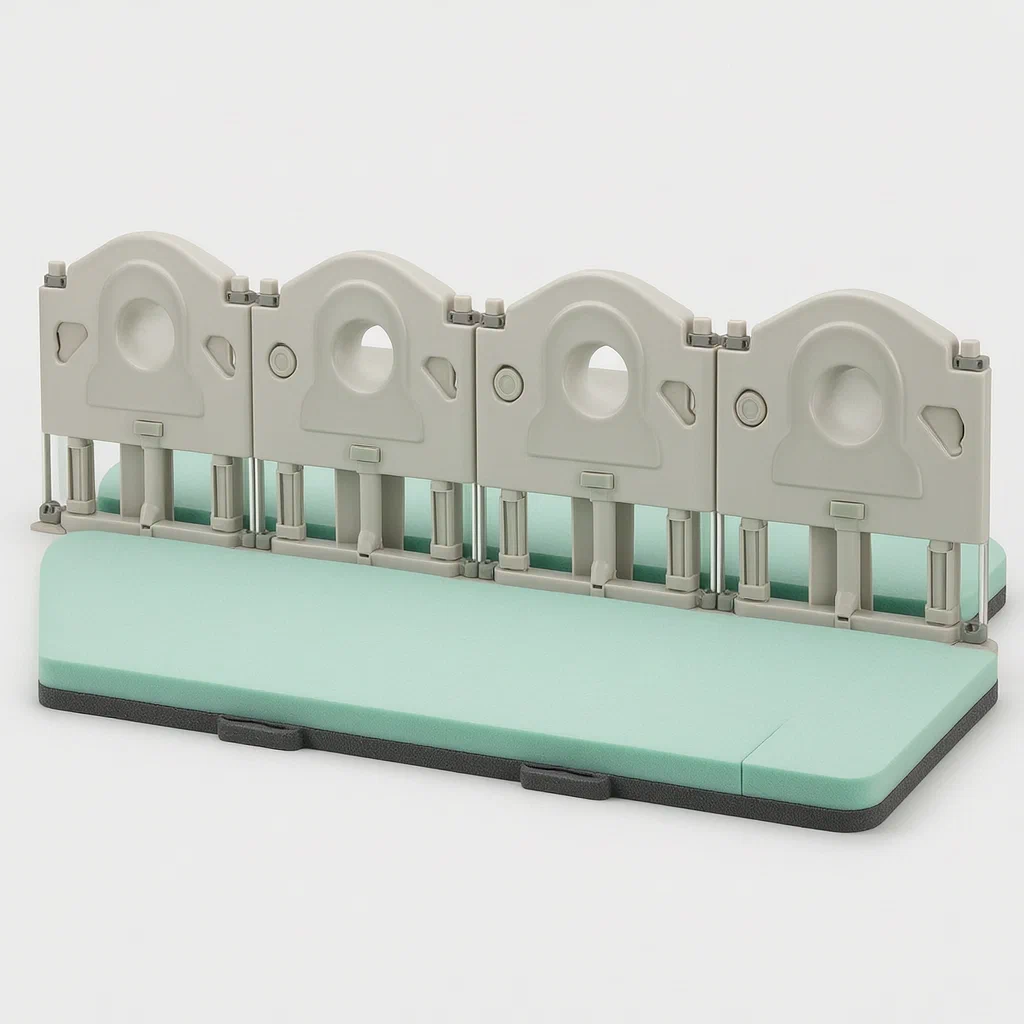
Standard play fences often suffer from mats that slide around underfoot, creating trip hazards, or fixed heights that become too low as toddlers learn to climb. This design solves both issues. The foam mat is anchored to the frame by elastic straps hidden in the base rail, keeping it flat and stable. Meanwhile, a threaded adjustment column allows parents to raise the upper fence section as the child grows, maintaining safety without buying a new enclosure.
- China invention patent - active
- No filings outside China
- Baby & Kids / Play Equipment
- Foam pads, steel/plastic rails, hook-and-loop fasteners
Splat! What let you down?
📏
Adjustable Height
The upper fence section slides up on a threaded column, growing with the child.
🧘
Anti-Slip Mat
Elastic bands anchor the foam pad to the base rail, stopping it from shifting.
🧼
Washable Layers
The top foam layer detaches via hook-and-loop tape for easy cleaning.
🔗
Tool-Free Assembly
Panels connect using spring-loaded pins that snap into mounting blocks.
Bring this product to market
- ✓ Patent review Patent family and legal status reviewed in the relevant jurisdictions.
- 2 Product brief · now How it works, uses and options written up
- 3 Prototype First samples for buyers to review
- 4 Pilot run Small first batch for launch customers
- 5 Volume production Repeat orders at scale
Buyer interest
– of 100 buyers needed to start prototyping
One click, no sign-up. Each vote is one real visitor, and products with the most interest go to prototyping first.
Build team: no members yet. Need a partner, co-funding or skills to build this? Join and we introduce the team once it forms.
Patent Rights & Team Participation
Before joining a development team, participants should ensure they have the necessary rights or authorization to participate in the project.
Participation is generally appropriate where:
- You own the relevant patent rights or have obtained permission or a license from the rights holder.
- The relevant patent rights have expired or have been legally invalidated in the jurisdictions where the planned activities will take place.
- The planned development, manufacturing, and commercialization activities have been independently assessed and do not infringe applicable patent rights in the relevant jurisdictions.
Important: Being located outside a country where a patent is protected does not automatically exempt you from patent infringement risks. Patent rights may apply based on where development, manufacturing, use, sale, or import activities take place.
IP2M does not grant any patent license or authorization through team participation. Joining a project does not provide permission to use, manufacture, or commercialize patented technology.
The problem
Children’s play pens and fences typically have two structural weaknesses. First, the floor mat—often made of soft foam—is not attached to the frame. When a toddler crawls, stands, or pulls themselves up, the mat slides or bunches up, creating an uneven surface that can cause trips or falls. Second, the height of the fence is usually fixed. As a child grows and learns to climb, a standard-height fence may become insufficient to keep them contained, forcing parents to replace the entire unit rather than adjusting it. Existing solutions either require complex mechanical locking systems for height adjustment, which add cost and failure points, or they simply lack any mechanism to secure the mat effectively.
The solution
This patent describes a modular fence system where the vertical position of the upper barrier is adjustable, and the floor covering is mechanically anchored to the base.
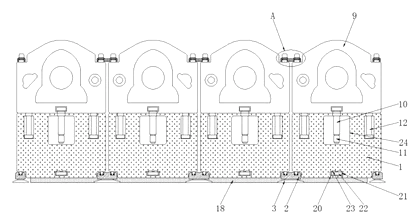
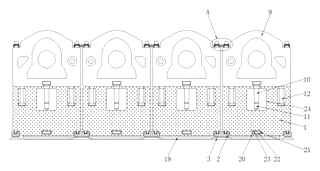
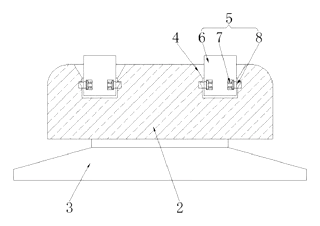
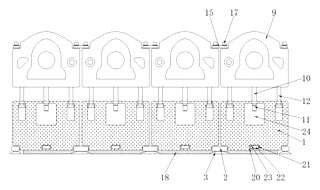
- Base Structure: The lower part of the fence (First Fence 1) sits on mounting blocks (2) equipped with suction cups (3) for ground stability.
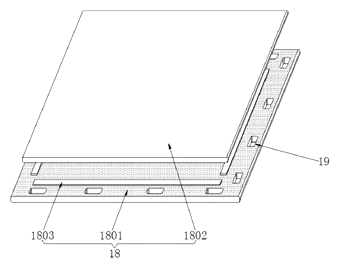
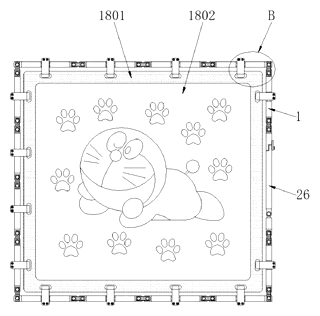
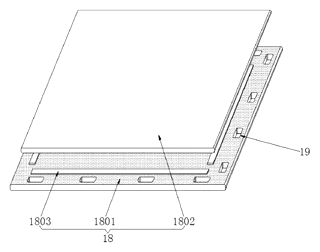
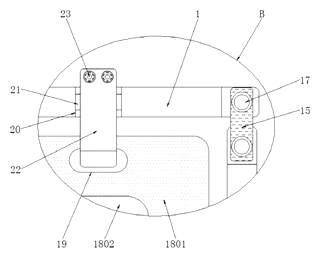
- Mat Anchoring: A foam pad combination (18) covers the interior. The lower foam pad (1801) has a mounting groove (19) along its edge. An elastic band (22) passes through this groove and hooks onto a fixing rod (21) located inside a long groove (20) running along the bottom of the fence panel. A push button (23) releases the tension, allowing the mat to be removed.
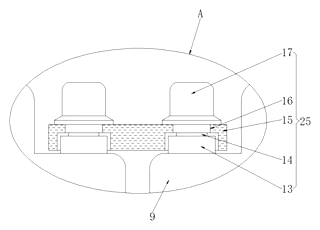
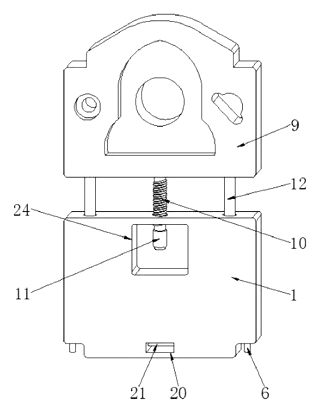
- Height Adjustment: The upper fence section (Second Fence 9) is connected to the lower section via fixed connecting rods (12) shaped like “T"s. These rods slide within the lower fence structure. A central threaded adjusting column (10) rotates, pushing the upper section upward relative to the lower section.
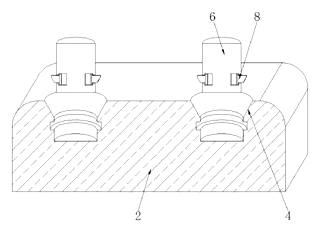
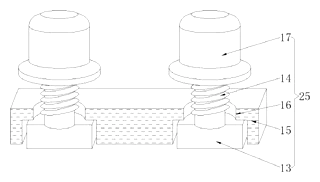
- Panel Connection: Individual fence panels connect to each other or to corner blocks using a spring-loaded insertion block (6). The block snaps into a connecting groove (4), allowing for tool-free assembly and disassembly.
Who it is for
- Baby Gear Brands looking to differentiate their playpen line with a “grow-with-me” feature that extends product lifecycle.
- Amazon Sellers who need a compact, flat-pack design that is easy to ship but offers high perceived value due to adjustability.
- Wholesalers targeting nurseries and daycare centers where hygiene (washable mats) and safety (non-slip floors) are critical purchasing criteria.
- OEM Manufacturers seeking a robust mechanical design that avoids expensive electronic components while providing functional versatility.
How it works
The main parts
| No. | Part | What it does |
|---|---|---|
| 1 | First Fence | The lower stationary frame; houses the mat anchoring system. |
| 2, 3 | Mounting Blocks & Suction Cups | Base feet that stabilize the fence on the floor. |
| 9 | Second Fence | The upper barrier section that moves vertically. |
| 10 | Adjusting Column | Threaded central post; rotation raises or lowers the upper fence. |
| 12 | Connecting Rods | T-shaped rods that guide the vertical movement of the upper fence. |
| 18 | Foam Pad Combination | Two-layer mat; lower layer anchors to frame, upper layer is removable. |
| 22 | Fixing Elastic Band | Straps that hook the mat to the frame’s internal groove. |
| 23 | Push Button | Releases the elastic band for mat removal. |
| 6, 7, 8 | Connection Mechanism | Spring-loaded pin and block for joining fence panels. |
Operating Steps
- Assembly: Connect individual fence panels using the spring-loaded insertion blocks (6) until a closed loop is formed. Attach mounting blocks (2) to the base.
- Mat Installation: Place the lower foam pad (1801) on the ground. Insert the ends of the elastic bands (22) into the long grooves (20) of the fence base until they click onto the fixing rods (21). The push button (23) remains accessible for later removal.
- Top Layer Attachment: Lay the upper foam pad (1802) over the lower one. It attaches via hook-and-loop fasteners (magic tape 1803), creating a seamless surface.
- Height Adjustment: To raise the fence, grip the anti-skid rubber block (11) at the bottom of the adjusting column (10) and rotate it. The threaded action pushes the upper fence section (9) up along the T-rods (12). To lower it, reverse the rotation.
Applications
Home Nurseries
Parents use the fence to create a safe play area for infants. The adjustable height ensures the enclosure remains effective as the child begins to pull up and attempt climbing, extending the usability of the product from newborn to toddler years.
Daycare Centers
Facilities require strict hygiene standards. The two-part foam mat allows staff to remove and wash the top layer daily without disturbing the anchored base layer, reducing maintenance time while ensuring a clean, non-slip surface for multiple children.
Travel and Visits
While the mechanism is robust, the tool-free connection blocks allow for quick disassembly. Families visiting relatives can set up a familiar, safe space quickly, knowing the mat won’t slide around on unfamiliar flooring types.
Pet Containment Areas
The sturdy frame and anchored mat make it suitable for small pet enclosures where animals might scratch or push against barriers. The non-slip mat protects the animal’s footing and keeps the enclosure tidy.
Where it is less suitable
- Outdoor Use: The suction cups and plastic/metal components are not described as weather-resistant or UV-stabilized, making it unsuitable for permanent outdoor installation.
- Heavy Climbing: While adjustable, the mechanical tolerance of the threaded column may not support the weight of older children attempting to climb out if the height is not maxed out.
- Rough Surfaces: The suction cup bases require smooth, hard floors for proper adhesion; carpeted or textured surfaces may compromise stability.
Patent & Production
At a glance
| Patent number | CN113842002B (application CN202111326025) |
| Type | China invention patent (发明专利) - protects product method and structure |
| Original title | A height adjustable children’s play fence that can prevent the foam pad from shifting (一种可防止泡沫垫发生偏移的高度可调式儿童游戏围栏) |
| Patent owner | Zhejiang Jike Industry And Trade Co ltd |
| Inventors | Hong Zhiwei |
| Filing date | 2021-11-10 |
| Grant date | 2024-08-20 |
| Status (China) | In force - valid until at most 2041-11-10, provided annual fees are paid |
| Patent family | Public record shows Chinese filings only - no US, European, Japanese, PCT or other filings listed |
| Cited by | 0 later documents |
| Source | Google Patents (search for CN113842002B) |
What the claims cover, in plain language
Claim 1 defines a height-adjustable child play pen comprising a first fence (lower section) and a second fence (upper section). The first fence uses mounting blocks with positioning suckers for ground attachment. The second fence forms a lifting structure above the first via fixed connecting rods with limiting effects. A foam pad combination includes a lower pad anchored to the first fence by a fixing elastic band inserted into a long groove, and an upper pad attached to the lower one via magic tape (hook-and-loop). The fence panels connect via a mechanism involving a fixed insertion block, a spring, and a limiting block. Height adjustment is achieved by rotating a threaded fixed adjusting column, which moves the second fence vertically along the connecting rods.
Claim 2 specifies that the fixed connecting rods have a “T” shape structure, forming a sliding construction with the first fence, arranged symmetrically on the left and right sides of the first fence.
This is a simplified reading for orientation only. The legal scope is defined by the exact claim wording in the official Chinese document.
What this means for US production
This patent was filed in China and is currently in force. The public record shows no US or other foreign counterpart. Making or selling this specific design in China requires the owner’s permission. However, because there is no US patent family member, the design itself does not appear to be restricted by this specific patent in the United States.
Two points to settle early:
- Other patents may exist. Baby playpens and gates are a heavily patented field in the US. Major brands hold numerous patents on folding mechanisms, mesh materials, and automatic locks. A freedom-to-operate (FTO) review is essential before launching in the US market to ensure you do not infringe on other US patents covering similar height-adjustment or mat-anchoring features.
- Mechanical Complexity. The threaded adjustment column and T-shaped sliding rods introduce moving parts that must withstand repeated use without binding or wearing down. Material selection and tolerance control are critical for longevity.
Customization and manufacturing
What can be customized
| Area | Options |
|---|---|
| Dimensions | Panel width, total diameter, and maximum height range |
| Materials | PP/ABS for frames, EVA/XPE foam for pads, nylon for elastic bands |
| Colors/Patterns | Injection molded colors or printed fabric covers for the top foam layer |
| Footprint | Number of panels (e.g., 6, 8, 10 sides) and base stabilizer size |
| Fasteners | Type of hook-and-loop tape (adhesive vs. sewn-in) and elastic strap thickness |
Things to plan for (US market)
- ASTM F1004 - Standard Consumer Safety Specification for Expansion Gates and Expandable Enclosures. This is the primary benchmark for US playpen/gate safety, covering entrapment, spacing, and strength.
- CPSC Guidelines - Compliance with general consumer product safety rules regarding small parts (if applicable to accessories) and lead/phthalate limits in plastics and paints.
- Proposition 65 - California warning requirements for certain chemicals potentially present in plastics or foam adhesives.
How a project runs
- Inquiry - Define target dimensions, material preferences, and quantity.
- Design - Finalize mold designs for the threaded column, T-rods, and panel connectors.
- Prototype - 3D print fit samples to test the sliding mechanism and mat anchoring.
- Pilot Run - Produce small batch for safety testing (ASTM F1004) and durability checks.
- Production - Injection molding for plastic parts, foam cutting/molding, and assembly.
Quantities & timeline
The core components (panels, connectors, adjusting columns) require precision injection molds. The foam pads require die-cutting or molding dies. The threaded mechanism demands tight tolerances to prevent wobble. Certification testing for ASTM standards takes significant time. Send us your specifications, target retail price, and estimated volume and we will reply with options.
Patent drawings
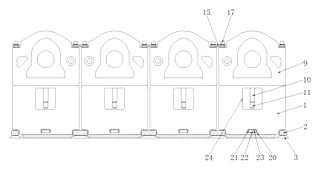
Drawings reproduced from the public patent document for reference.
Production notes
Tooling and process
Injection molding is likely required for the fence panels, mounting blocks, and the complex threaded adjusting column. Steel tube forming may be used if the internal reinforcement rods are metal, though the patent suggests plastic components. Foam molding or die-cutting processes will be needed for the lower and upper pad layers.
Cost drivers
Part count is moderate, but the precision required for the threaded column and T-slot sliding mechanism likely drives mold costs. Rounded edges on all plastic parts are mandatory for safety, adding complexity to the tooling. Material certification for baby-safe plastics (PP/ABS) and phthalate-free foams will increase procurement costs.
Prototyping path
We would typically start with a 3D-printed fit sample to verify the sliding action of the T-rods and the engagement of the spring-loaded pins. Create a small load sample to test the stability of the suction cups and the resistance of the elastic band anchoring. Conduct pinch-point tests on the gap between the upper and lower fence sections during adjustment.
What we would change before tooling
We would likely consider simplifying the threaded column mechanism if the current design proves difficult to mold with consistent thread pitch. Evaluate whether the push-button release for the elastic band needs a secondary lock to prevent accidental detachment by children. Verify that the “T” rod geometry provides sufficient lateral stiffness to prevent wobbling at maximum height.
Common failure points
Spring fatigue could lead to loose connections between panels over time. Thread engagement in the adjusting column may wear or strip if over-tightened. Pinch points between the sliding upper section and the static lower section pose a safety risk. Flammability of the foam pads must be tested against relevant standards. Small parts like the push buttons could detach if not securely molded.
Frequently asked questions
How does the foam pad stay in place?
The lower foam pad has elastic bands along its edge. These bands hook onto internal rods within the bottom rail of the fence. This creates tension that holds the mat flat against the floor, preventing it from bunching up when a child crawls or stands.
Can I really adjust the height?
Yes. The upper section of the fence slides vertically on T-shaped rods. By rotating a central threaded column, you can raise or lower the top barrier. This allows the fence to grow with the child, maintaining containment as they get taller and more mobile.
Is the mat washable?
The mat is two-layered. The top layer is attached to the bottom layer with hook-and-loop fasteners (Velcro-style). You can peel off the top layer for washing while leaving the anchored bottom layer in place. This makes daily cleanup easier.
Does it require tools to assemble?
No. The fence panels connect using spring-loaded insertion blocks. You align the panel and press the block into the mating groove until it clicks. The base mounts attach similarly. Disassembly is just as quick, making it portable for travel.
What safety standards does it meet?
The patent describes the structure, but final products must meet local regulations. For the US market, compliance with ASTM F1004 (Expansion Gates and Enclosures) is the typical benchmark. We recommend third-party testing to verify entrapment zones, strength, and material safety.
Can this design be made and sold in the US?
The patent was filed in China and is in force there. The public record shows no US counterpart for this specific patent. Therefore, this particular patent does not restrict manufacturing or sales in the US. However, playpen designs are subject to many other patents. We strongly recommend a freedom-to-operate (FTO) review before production to avoid infringing on other existing US intellectual property.
Are you affiliated with the patent owner?
No. IP2M is an independent design and manufacturing service working from the public patent document.
Request a quote
Click Request a Quote below to see our email address - copy it, or open your email app with a ready-made message. Please mention patent CN113842002B in the subject.
Helpful details to include:
- Your company and channel (baby gear brand, Amazon seller, wholesaler)
- Target dimensions (diameter, min/max height)
- Material preferences (plastic type, foam density, fabric options)
- Quantity and target landed cost
- Timeline - when you need prototypes and mass production
You can also reach us at (332) 203-9997.
Page editor: Emily Zhang, Product Editor · IP2M
Last updated November 7, 2026. If something on this page looks wrong, email [email protected] and we will check it against the patent.
Interested in building this?
Tell us your target market, quantity and timeline. We reply with options for prototyping, small-batch runs or volume production.
Send your inquiry to
Please put CN113842002B in the subject line and tell us your company, country, estimated quantity and timeline.
Prefer to talk? Call (332) 203-9997.
More product-ready patents
All Baby & Kids patents →
Baby & Kids
Portable Folding Rocking Bassinet Frame
Rocking bassinet frame that folds flat: telescopic hub, folding rails, two-part legs, curved rockers.
Patent CN206910143U
Baby & Kids
Stroller Seat with Linked Fold-Away Armrest
Stroller seat whose armrest unlocks and folds automatically when the backrest is folded forward.
Patent CN206856772U
Baby & Kids
One-Motion Folding Baby Crib with Linked Frame
Portable baby crib whose top rails fold down automatically as the A-frame legs are closed.
Patent CN207202585U
Baby & Kids
Motorized Rocking Stroller That Rocks by Turning Its Wheels
Baby rocker or stroller whose motor turns the wheels back and forth; a clutch switches to pushing.
Patent CN208119238U
Baby & Kids
Bedside Crib Base with Spring-Loaded Telescoping Caster Legs
Bedside crib feet with spring-loaded sliding casters: wide when alone, short to sit flush at the bed.
Patent CN207168269U
Baby & Kids
Compact-Fold Stroller with a Four-Bar Side Frame and Telescoping Handle
Stroller with four-bar side frames: handle and rear leg fold onto the front leg, handle telescopes.
Patent CN213799844U
Browse by category
- Apparel & Accessories (48)
- Baby & Kids (29)
- Bags & Luggage (17)
- Bath & Personal Care (32)
- Car Accessories (25)
- Furniture, Bedding & Storage (24)
- Garden & Outdoor (32)
- Health & Wellness (14)
- Home, Kitchen & Cleaning (50)
- Lighting (23)
- Packaging & Containers (12)
- Pet Products (11)
- Phone & Camera Accessories (9)
- Retail Display (25)
- School, Office & Art (36)
- Sports & Recreation (46)
- Tools & Workshop (54)
- Toys & Games (22)
This page is based on the public patent document CN113842002B, assigned to Zhejiang Jike Industry And Trade Co ltd. IP2M is an independent manufacturing service and is not affiliated with, endorsed by or licensed by the patent owner. Images marked as concept renderings are illustrations, not photos of an existing product. Patent status information is provided for reference only and is not legal advice; confirm freedom to operate for your market before production. Full disclaimer.