At a glance
| Patent number | CN114027591B (application CN202110266270) |
| Type | China invention patent (发明专利) - protects product shape, structure and method |
| Original title | Toggle unlocking buckle device (拨动解锁的扣具装置) |
| Patent owner | Lian Yang Plastic Shenzhen Co Ltd |
| Inventors | Li Qiuzong |
| Filing date | 2021-03-11 |
| Grant date | 2024-02-20 |
| Status (China) | In force in China until at most 2041-03-11 (if annual fees are paid) |
| Patent family | Chinese filings only - no US, European, Japanese, PCT or other filings listed |
| Cited by | 2 later documents |
| Source | Google Patents (search for CN114027591B) |
What the claims cover, in plain language
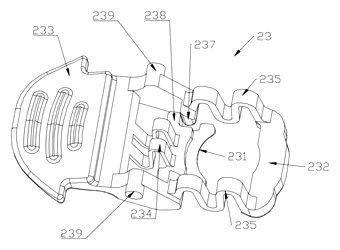
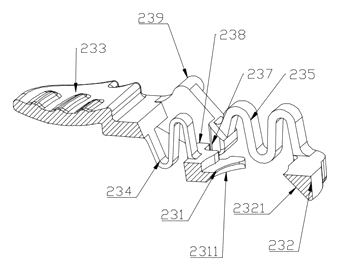
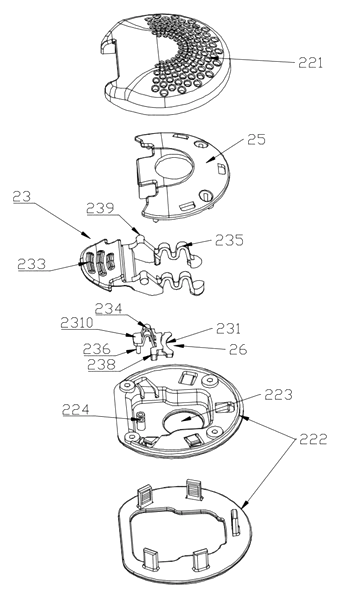
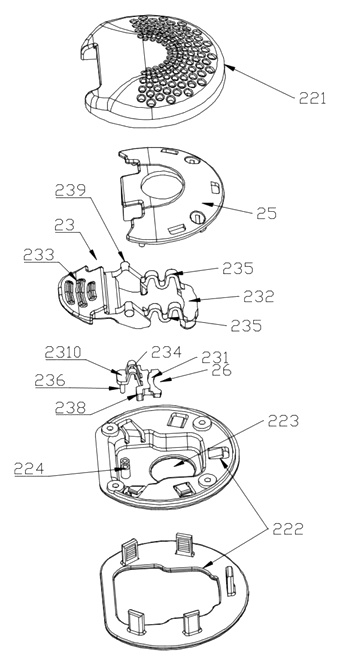
Claim 1 - A toggle unlocked buckle device with a first connecting module (10) having a convex lock tongue (11), and a second connecting module (20) having a fixing hole (223). The modules lock together along a locking direction and can separate. The second module contains an unlocking piece (23) that pivots within it, and a rigid locking part (231) that extends into the fixing hole range. When the lock tongue enters the hole, the locking part catches it. A rigid pushing part (238) sits on the locking part, and a pressing part (237) sits on the unlocking piece. Shifting the unlocking piece away from the first module causes the pressing part to push the pushing part, moving the locking part out of the fixing hole to release the lock tongue.
Claim 2 - A first elastic connection portion (234) at the end of the locking part remote from the fixing hole pushes the locking part back into place by elastic force. Claim 3 - The first elastic connection portion is integrally formed with the unlocking piece. Claim 4 - The opposite end of the first elastic connection portion is fixed to the housing (22) of the second module. Claim 5 - A coupling portion (2310) with a locking post (236) engages a locking hole (224) in the housing. Claim 6 - The unlocking piece has an exposed toggle portion (233); the pivot point lies between the toggle portion and the pressing part. Claim 7 - A second elastic connection portion (235) forces the unlocking piece to pivot back to reset. Claim 8 - An extrusion part (232) on the second elastic connection portion extends into the fixing hole range to assist separation.
This is a simplified reading for orientation only. The legal scope is defined by the exact claim wording in the official Chinese document.
What this means for US production
This patent was filed only in China and is currently in force there. Making or selling this exact buckle design in China needs the owner’s permission. It has no US or other foreign counterpart.
Two points to settle early:
- Other patents may exist. Fidlock Gmbh and MOPLAN, Studio za oblikovanje, d.o.o. hold later patents citing this document (WO2026008429A1 and EP4725354A1 respectively), indicating active patenting in the magnetic and mechanical buckle field globally. A freedom-to-operate (FTO) review covering toggle-release and magnetic-assist fasteners is necessary before US production or sales.
- Material selection and mold design. The patent mentions application to bags, helmets and shoes, which require different plastics or metals depending on stress and flexibility. Mold cavities must account for the rigid locking linkage and integral elastic portions.
Customization and manufacturing
What can be customized
| Area | Options |
|---|---|
| Dimensions | Overall size and lock tongue profile to be confirmed in design based on the target product |
| Materials | Plastics such as POM, nylon or polycarbonate; metal inserts for high-wear areas |
| Magnets | Inclusion, size and strength of magnets between the modules set in design |
| Elastic portions | Thickness and geometry of the integral elastic connection portions to tune reset force |
| Mounting | Screw holes, adhesive pads or fabric loops on the module housings |
| Colors and finish | Solid colors, two-tone molding or surface textures |
Things to plan for (US market)
- CPSC 16 CFR 1203 - if the buckle is used on bicycle helmets sold in the US, the entire helmet including the retention system must meet this standard.
- 16 CFR 1501 and 16 CFR 1500.48/1500.49 - if fitted to products for young children, small-parts, sharp-point and sharp-edge rules apply; the magnets must stay captive in their pockets so they cannot come loose and be swallowed.
- CPSIA Section 101 - lead content limits for products intended for children aged 12 and under.
- California Proposition 65 - material screening for restricted substances in plastics and magnets.
How a project runs
- Inquiry - define the target product (bag, helmet, shoe), required dimensions and quantity.
- Design - CAD modeling of the modules, locking linkage, elastic portions and magnet pockets.
- Prototype - 3D printing or soft tooling to verify the toggle motion, locking engagement and reset force.
- Pilot run - injection molds are cut; samples undergo cycle testing and pull-force verification.
- Production - mass injection molding, magnet insertion, assembly and quality inspection.
Quantities & timeline
The housing, unlocking piece and locking part require precision injection molds. If the elastic connection portions are integrally molded with the rigid parts, the mold design must balance flexibility and durability. Magnet insertion adds an assembly step. Certification tests depend on the final application. Send us your target product, dimensions, material preferences, estimated quantity and timeline and we will reply with options.
Patent drawings
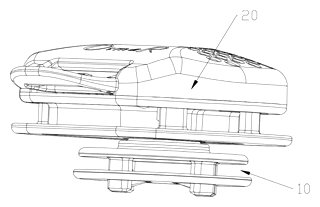
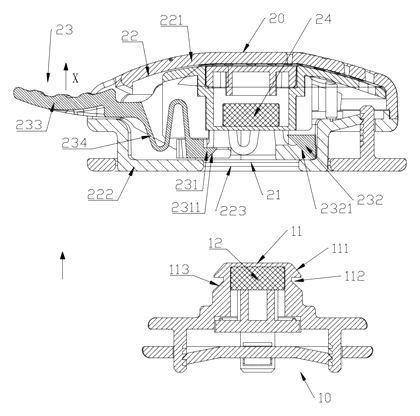
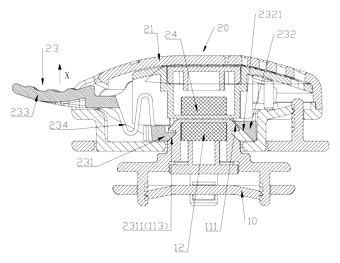
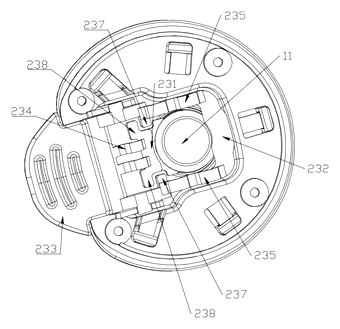
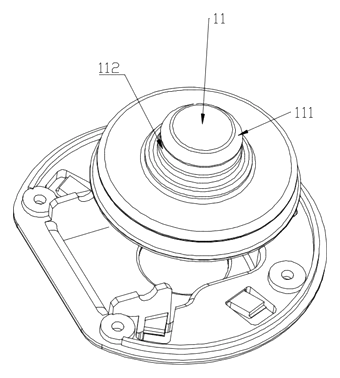
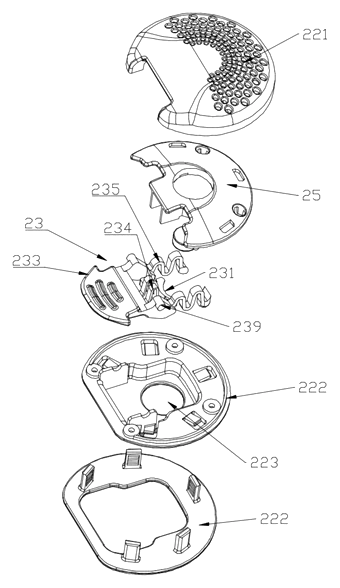
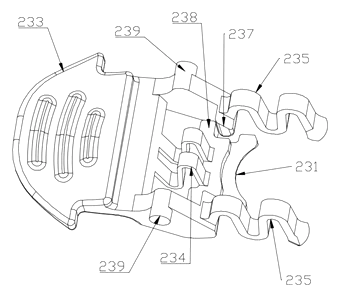
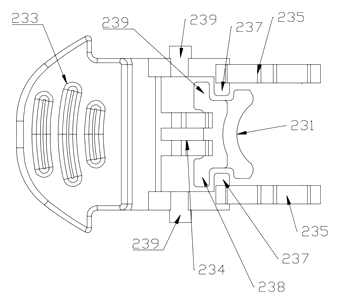
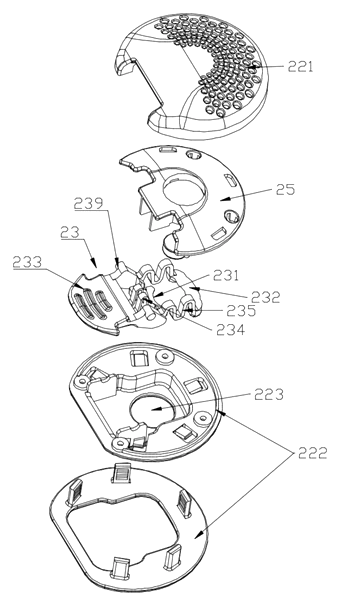
Drawings reproduced from the public patent document for reference.