
Patent CN114083921B
Updated November 5, 2026Motorized Bill Compaction and Angle Adjustment Storage Box
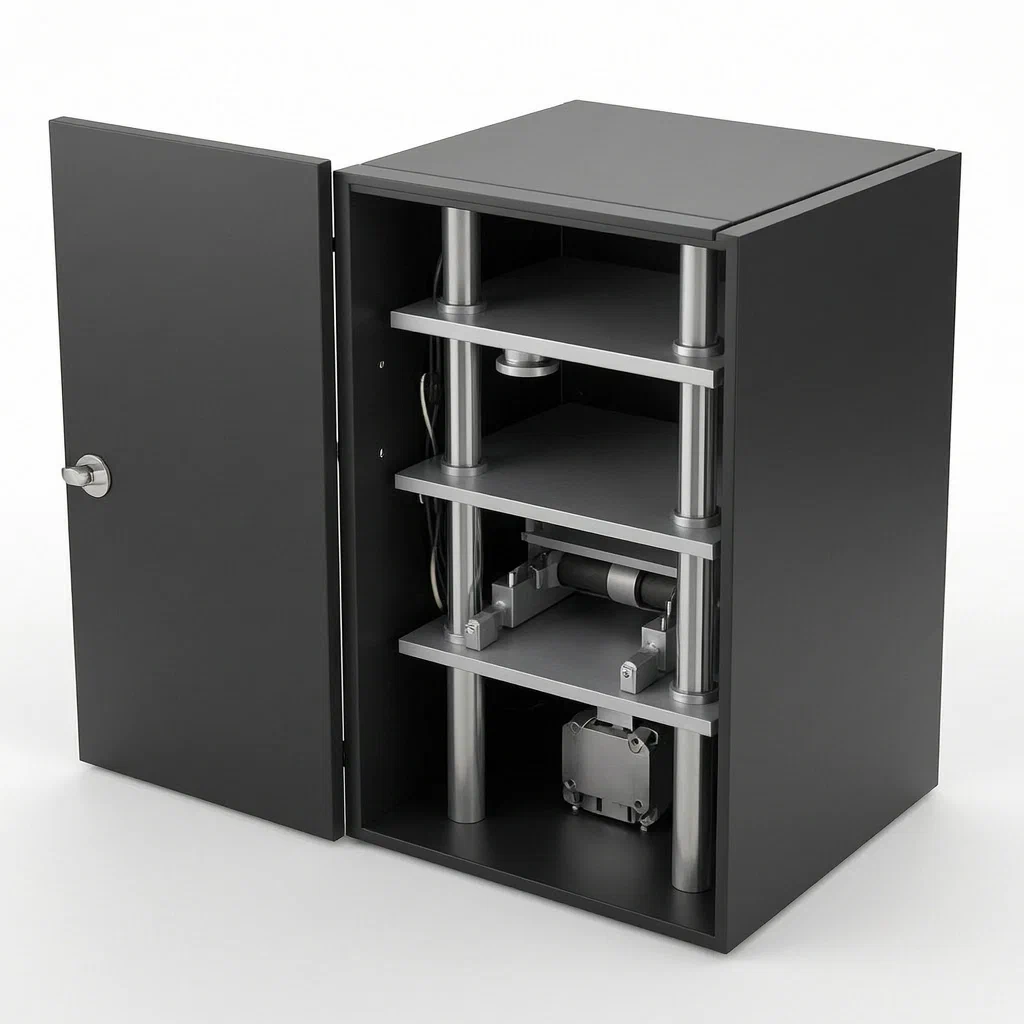
Loose receipts and invoices in garden finance departments often curl, jam, or become difficult to sort. This patent describes a storage box that solves this by combining mechanical compaction with adjustable viewing angles. A hydraulic rod drives a linkage system to flatten the bill stack securely. Simultaneously, a servo motor rotates a threaded screw to tilt the top plate, presenting the documents at an optimal angle for staff to read and retrieve without disturbing the underlying stack. The unit is enclosed in a lockable cabinet, ensuring security while maintaining organization.
- China invention patent - in force
- No filings outside China
- Office & Archive Equipment
- Hydraulic actuation, servo motor adjustment, metal/plastic housing
Splat! What let you down?
📉
Hydraulic Flattening
A telescopic rod drives a cross-frame linkage to compress and flatten bill stacks uniformly.
🔄
Angle Adjustment
A servo motor rotates a screw mechanism to tilt the top plate for easier document retrieval.
🔒
Secure Enclosure
The assembly fits inside a lockable cabinet door, protecting sensitive financial records.
⚙️
Leveling Rollers
An optional secondary assembly uses rollers to level and further compact the paper stack.
Bring this product to market
- ✓ Patent review Patent family and legal status reviewed in the relevant jurisdictions.
- 2 Product brief · now How it works, uses and options written up
- 3 Prototype First samples for buyers to review
- 4 Pilot run Small first batch for launch customers
- 5 Volume production Repeat orders at scale
Buyer interest
– of 100 buyers needed to start prototyping
One click, no sign-up. Each vote is one real visitor, and products with the most interest go to prototyping first.
Build team: no members yet. Need a partner, co-funding or skills to build this? Join and we introduce the team once it forms.
Patent Rights & Team Participation
Before joining a development team, participants should ensure they have the necessary rights or authorization to participate in the project.
Participation is generally appropriate where:
- You own the relevant patent rights or have obtained permission or a license from the rights holder.
- The relevant patent rights have expired or have been legally invalidated in the jurisdictions where the planned activities will take place.
- The planned development, manufacturing, and commercialization activities have been independently assessed and do not infringe applicable patent rights in the relevant jurisdictions.
Important: Being located outside a country where a patent is protected does not automatically exempt you from patent infringement risks. Patent rights may apply based on where development, manufacturing, use, sale, or import activities take place.
IP2M does not grant any patent license or authorization through team participation. Joining a project does not provide permission to use, manufacture, or commercialize patented technology.
The problem
In garden management and landscaping companies, financial departments handle large volumes of small paper bills, receipts, and invoices. These documents often accumulate in loose piles or standard file boxes. Over time, moisture, handling, and weight cause them to curl, stick together, or become disorganized. When staff need to retrieve a specific bill from a deep stack, they often disturb the entire pile, leading to misfiling or damage. Furthermore, reading small print on flat, tightly packed papers can be straining. There is a need for a storage solution that keeps documents flat, secure, and accessible without manual sorting every time a file is opened.
The solution
This patent describes a bill storage device specifically designed for garden financial accounting. The core solution integrates two mechanisms within a single box body:
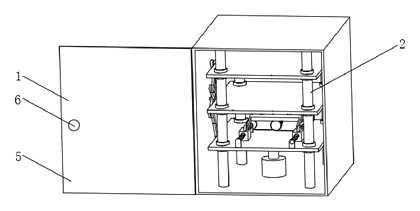
- Compaction Assembly: A hydraulic telescopic rod is fixed to the bottom of the box. As it extends, it pushes a first sliding plate upwards along a support rod. This movement drives a cross-type rotating frame (a scissor-like linkage). Because the middle of the frame is pinned to a fixed support, the extension causes the frame to contract horizontally, pushing down on the bill stack to flatten it firmly.
- Angle Adjustment Assembly: Mounted on the moving plate is a servo motor connected to a belt or gear connector, which turns an adjusting screw. A slider moves along this screw, causing a placing plate (the top surface where bills rest) to rotate around a hinge. This tilts the top layer of bills toward the user, making them easier to identify and remove without lifting the whole stack.
- Stability and Leveling: A second rotating frame mirrors the first to ensure stable vertical movement. An optional leveling assembly uses a second motor and screw to drive compression rollers, which smooth out any remaining wrinkles in the paper stack before final compaction.
Who it is for
- Landscape Architecture Firms: Offices that process high volumes of material receipts and contractor invoices requiring precise archival standards.
- Garden Management Departments: Municipal or private entities managing public parks where daily transaction logs must be kept flat and secure against environmental factors.
- Office Equipment Manufacturers: Brands looking to add a niche, automated document handling product to their catalog beyond standard shredders or binders.
- Financial Back-Office Providers: Companies offering outsourced bookkeeping services who need physical document retention solutions that prevent mixing and curling of client bills.
How it works
The main parts
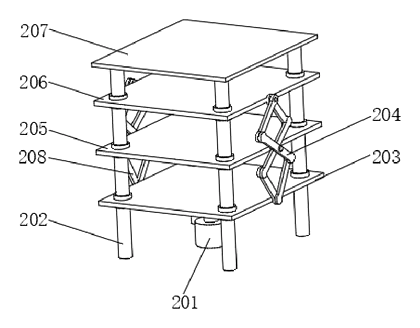
| No. | Part | What it does |
|---|---|---|
| 1 | Box Body | The outer enclosure; includes a lockable door. |
| 201 | Hydraulic Telescopic Rod | Primary actuator; extends to push the compaction frame. |
| 202 | Support Rod | Fixed guide rail for vertical sliding plates. |
| 203, 206 | Sliding Plates | Move up/down along the support rod; carry the frames. |
| 204, 208 | Rotating Frames | Cross-type linkages that convert vertical motion into horizontal clamping force. |
| 205 | Fixing Plate | Central pivot point connecting the frame to the support rod. |
| 301 | First Servo Motor | Drives the angle adjustment mechanism. |
| 303 | Adjusting Screw | Converts motor rotation into linear slider movement. |
| 305 | Placing Plate | The top surface holding the bills; tilts when the slider moves. |
| 4 | Leveling Assembly | Optional motor-driven rollers to smooth the paper stack. |
Operating Steps
- Loading: The user opens the lockable cabinet door and places a stack of garden financial bills onto the placing plate.
- Compaction Activation: The hydraulic telescopic rod extends. This pushes the first sliding plate upward. Due to the geometry of the rotating frame, this upward motion forces the frame to contract, pressing down firmly on the bill stack to flatten it.
- Angle Adjustment: To retrieve a specific bill, the operator activates the servo motor. The motor turns the adjusting screw, causing the slider to move. This movement rotates the connecting frame, tilting the placing plate forward.
- Retrieval: With the plate tilted, the top bills are visible and accessible. The user removes the needed document.
- Reset: The hydraulic rod retracts, releasing pressure. The motor reverses, returning the plate to a horizontal position. The next batch of bills can be added.
Applications
Landscape Contractor Offices
Contractors receive numerous small receipts for plants, soil, and labor. This device keeps these flat and organized in a secure cabinet, preventing loss during site visits or office moves.
Municipal Park Administration
Public garden departments handle vouchers for maintenance supplies. The locking feature ensures compliance with audit trails, while the flattening mechanism preserves the integrity of thermal paper receipts over long-term storage.
Event Planning Venues
Venues hosting outdoor weddings or corporate events manage many vendor invoices. Staff can quickly access specific bills by tilting the stack, reducing search time during busy post-event reconciliation periods.
Retail Garden Centers
Large nurseries process thousands of customer payment slips. This unit serves as a central drop-box that automatically compacts the slips, saving space and keeping the back-office counter tidy.
Where it is less suitable
- Heavy Industrial Documents: Designed for thin paper bills; not suitable for thick cardboard or bound ledgers.
- High-Speed Sorting Environments: The cycle time for hydraulic extension and motor tilting is slower than automated conveyor systems used in banks.
- Humid Outdoor Settings: The electronics (servo motors) and hydraulic seals require a controlled indoor environment to prevent corrosion or seal failure.
Patent & Production
At a glance
| Patent number | CN114083921B (application CN202111445989) |
| Type | China invention patent - protects product structure and method |
| Original title | Bill Storage Device for Garden Financial Accounting (一种园林财务会计用票据储存装置) |
| Patent owner | Zhongjiao Garden Shandong Co ltd |
| Inventors | Li Shengquan, Zhao Yunlong, Li Yingying, Du Yingnan |
| Filing date | 2021-11-30 |
| Grant date | 2022-09-16 |
| Status (China) | In force - valid until at most 2041-11-30 (if annual fees are paid) |
| Patent family | Public record shows Chinese filings only - no US, European, Japanese, PCT or other filings listed |
| Cited by | 0 later documents |
| Source | Google Patents (search for CN114083921B) |
What the claims cover, in plain language
Claim 1 - defines a bill storage device comprising a box body and a compaction assembly. The assembly includes a telescopic piece (hydraulic rod) and a support rod fixed to the box bottom. A first sliding plate connects to the telescopic piece and slides on the support rod. A first rotating frame (cross-type linkage) connects the sliding plate to a fixing plate (pinned to the support rod) and a second sliding plate. Extension of the rod causes the frame to contract, applying downward pressure. Additionally, an angle adjusting assembly is mounted on the first sliding plate. It uses a first driving piece (servo motor), a belt connecting piece, and an adjusting screw to move a sliding block. This block rotates a placing plate via a connecting frame, changing the angle of the stored bills. A pressing block is fixed to the fixing plate.
Claim 2 - adds a leveling assembly on the placing plate to assist the compaction assembly in flattening bills.
Claim 3 - details the leveling assembly: a second driving piece turns a leveling screw, moving a moving block and connecting rod to slide a clamping block. A compression roller inside the clamping block levels the bills.
Claim 4 - specifies that one side of the box has a rotatable chamber door with a lock.
This is a simplified reading for orientation only. The legal scope is defined by the exact claim wording in the official Chinese document.
What this means for US production
This patent was filed in China and is currently in force. Making or selling this specific design in China requires the owner’s permission. However, the public record shows no US counterpart. Therefore, this Chinese patent does not restrict manufacturing or sales in the United States based solely on this document.
Two points to settle early:
- Other patents may exist. Automated document handling and locking storage cabinets are competitive fields in the US. While this specific combination of hydraulic compaction and servo-tilt is unique here, related mechanisms in paper feeders or smart safes may have existing US IP. A freedom-to-operate (FTO) review is recommended before tooling.
- Electrical Safety Standards. Since the device uses servo motors and potentially mains-powered hydraulics, it must comply with US electrical safety regulations regardless of patent status.
Customization and manufacturing
What can be customized
| Area | Options |
|---|---|
| Capacity | Box dimensions scaled for different bill volumes (e.g., A4 vs. receipt size). |
| Actuation | Hydraulic rod stroke length and pressure settings; servo motor torque for angle range. |
| Materials | ABS/PP plastic housings for cost; Aluminum extrusion or stamped steel for durability. |
| Locking | Mechanical key locks, digital keypad, or RFID integration. |
| Interface | Manual buttons vs. app-controlled operation for the angle adjustment. |
| Finish | Powder coating, wood veneer, or industrial gray paint. |
Things to plan for (US market)
- UL 60950 / UL 62368 - Safety standards for information technology equipment if the controller is considered electronic.
- NEC (National Electrical Code) - Wiring and power supply compliance for any mains-connected components.
- CPSC General Requirements - If marketed to consumers, sharp edges and pinch points must be assessed under general product safety rules.
- FCC Part 15 - If wireless modules (Bluetooth/Wi-Fi) are added for remote control.
How a project runs
- Inquiry - Define capacity, bill types, and desired automation level.
- Design - Select motor/hydraulic specs, design linkage geometry, and layout PCBs.
- Prototype - Build functional mockups using off-the-shelf actuators and 3D-printed parts.
- Testing - Verify compaction force uniformity, angle repeatability, and lock security.
- Production - Mold plastic parts, stamp metal brackets, assemble electronics, and final QC.
Quantities & timeline
Molds for the custom-shaped sliding plates and frames will drive initial costs. Hydraulic cylinders and servo motors are typically sourced from standard component suppliers but may require custom mounting brackets. Lead times depend heavily on mold fabrication and electronic component availability. Send us your capacity requirements, material preferences, and estimated volume and we will reply with options.
Production notes
Tooling and process
Injection molding is likely required for the complex geometries of the sliding plates and rotating frames. Stamping or laser cutting would produce the support rods and structural brackets. Assembly involves snap-fits for plastic covers and screws for mechanical joints.
Cost drivers
The number of injection molds typically drives a large share of upfront costs. High-torque servo motors and reliable hydraulic cylinders are major component expenses. Packaging must protect the delicate linkage mechanisms during shipping.
Prototyping path
Start with a 3D-printed sample to validate the linkage kinematics. Off-the-shelf springs and linear guides are typically used for initial function tests. Once geometry is confirmed, proceed to a print trial for cosmetic parts before committing to steel tooling.
What we would change before tooling
We might simplify the belt connector to a direct-drive gear train to reduce assembly steps. Ensuring wall thickness consistency in the molded parts is critical to prevent warping that could jam the sliding plates.
Common failure points
Hinge fatigue is a risk due to repeated angle adjustments. Clip spring loss could occur if snap-fits are poorly designed. Sharp edges on stamped metal parts must be deburred to prevent paper tears or user injury. Thread engagement on the adjusting screw must withstand frequent cycling.
Patent drawings
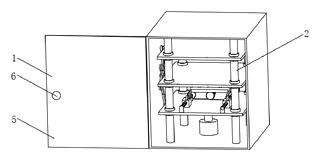
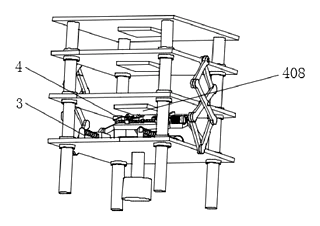
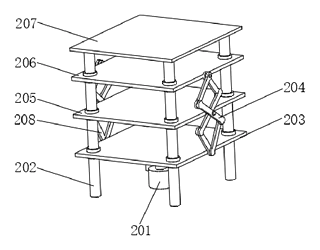
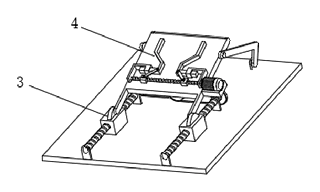
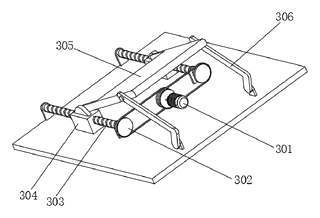
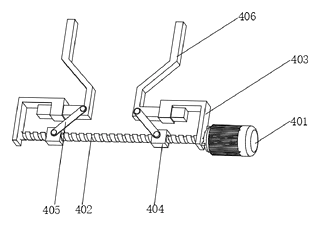
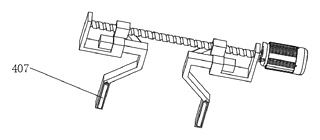
Drawings reproduced from the public patent document for reference.
Frequently asked questions
How does the bill flattening work?
A hydraulic telescopic rod extends from the bottom of the box. This pushes a series of linked plates and rotating frames upward. Because the frames are anchored in the center, extending the rod causes them to squeeze inward and downward, applying even pressure to the stack of bills to keep them flat.
Can I adjust the angle of the bills?
Yes. A servo motor turns a threaded screw, which moves a slider. This slider is connected to the top placing plate. When the motor runs, the plate tilts forward, bringing the top bills closer to eye level for easier reading and retrieval.
Is the device secure?
The patent describes a box body with a rotatable chamber door that includes a lock. This prevents unauthorized access to the financial documents inside. Additional security features like digital locks can be integrated during customization.
What sizes of bills can it hold?
The patent does not specify exact dimensions. The box size is determined by the design requirements for the specific type of garden financial bills you use (e.g., standard receipts, A4 invoices, or custom voucher sizes).
Does it require electricity?
Yes. The angle adjustment uses a servo motor, and the compaction uses a hydraulic system. Depending on the final design, this may require a mains power adapter or a rechargeable battery pack.
Will the hydraulic fluid leak?
Hydraulic systems are sealed. In a well-designed unit, leaks are rare. Regular maintenance checks on the cylinder seals are recommended to ensure long-term reliability.
Can this design be made and sold in the US?
The patent is filed in China and is currently in force there. However, the public record shows no US counterpart. This means the Chinese patent itself does not restrict manufacturing or selling this specific design in the US. Always conduct a freedom-to-operate check for other potential US patents in the office automation field.
Are you affiliated with the patent owner?
No. IP2M is an independent design and manufacturing service working from the public patent document.
Request a quote
Click Request a Quote below to see our email address - copy it, or open your email app with a ready-made message. Please mention patent CN114083921B in the subject.
Helpful details to include:
- Your company and industry (landscape firm, municipal department, office supplier)
- Bill types and average daily volume
- Desired capacity (number of bills or stack height)
- Power preference (mains, battery, or solar option)
- Locking mechanism (key, digital, or none)
- Estimated quantity and target price
- Timeline - when you would like samples and the first shipment
You can also reach us at (332) 203-9997.
Page editor: Daniel Chen, Product Research Editor · IP2M
Last updated November 5, 2026. If something on this page looks wrong, email [email protected] and we will check it against the patent.
Interested in building this?
Tell us your target market, quantity and timeline. We reply with options for prototyping, small-batch runs or volume production.
Send your inquiry to
Please put CN114083921B in the subject line and tell us your company, country, estimated quantity and timeline.
Prefer to talk? Call (332) 203-9997.
More product-ready patents
All School, Office & Art patents →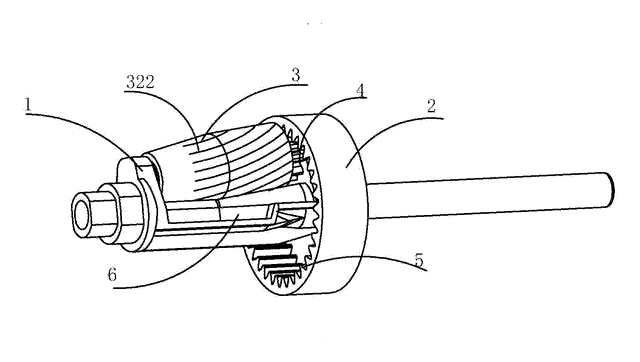
School, Office & Art
Long-Point Sketch Pencil Sharpener
Crank sharpener that cuts only the wood of sketch pencils, leaving a long, round lead about 30 mm long.
Patent CN207241257U
School, Office & Art
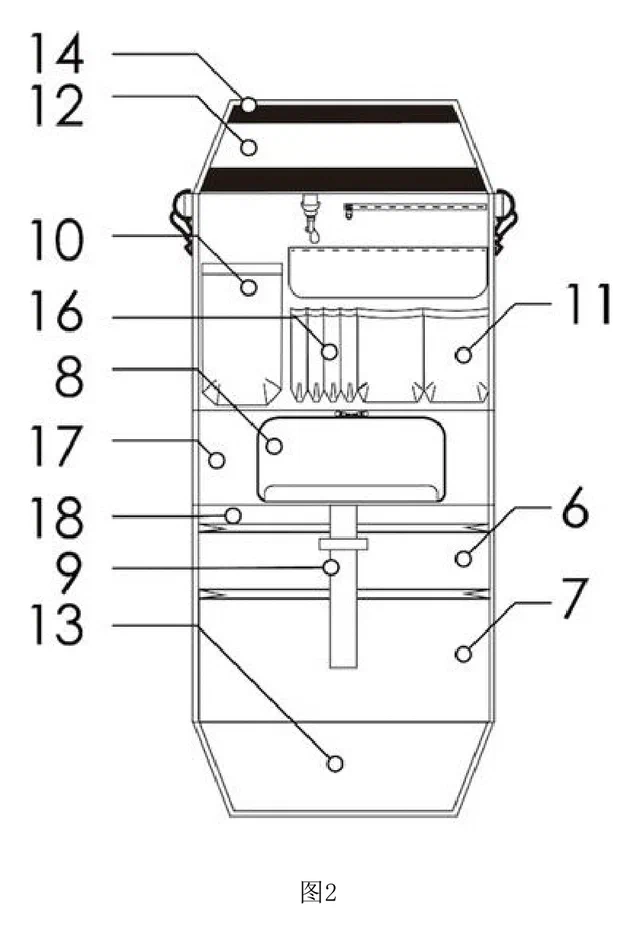
Fold-Out Desk Organizer Insert for School Backpacks
Backpack insert that unfolds into a hanging desk organizer for workbooks, stationery and a water bottle.
Patent CN209436546U
School, Office & Art
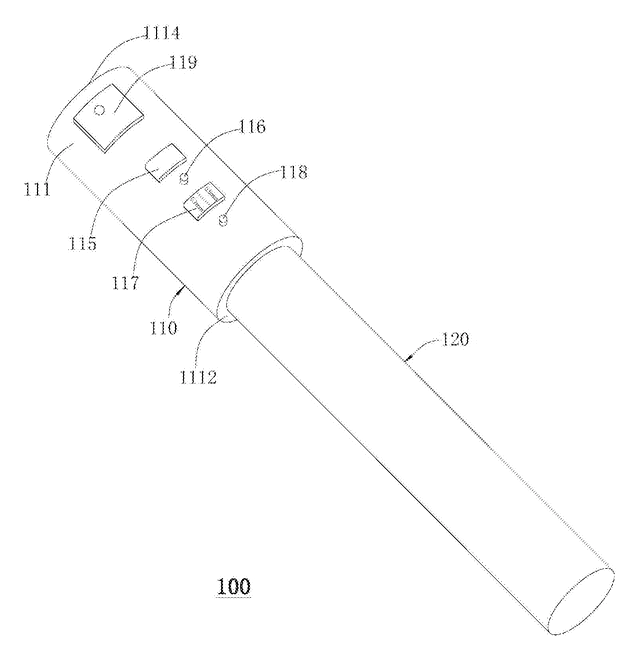
Smart Pencil Cap That Checks the Point with a Camera
Electronic pencil cap that photographs the point, measures it and reminds you to sharpen.
Patent CN106427302B
School, Office & Art
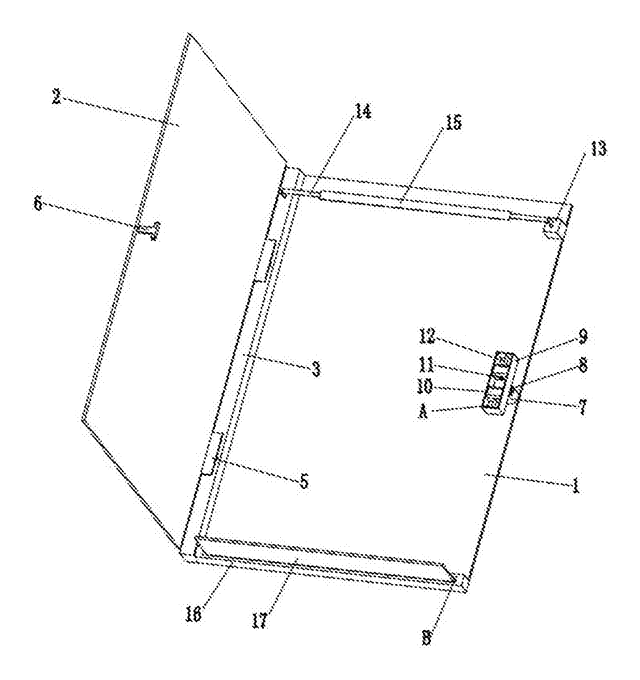
Expanding Clipboard Folder with Spring-Mounted Hinge and Catch
Hard folder whose spring-mounted hinge and catch let the cover clamp any thickness of paper.
Patent CN105667120B
School, Office & Art
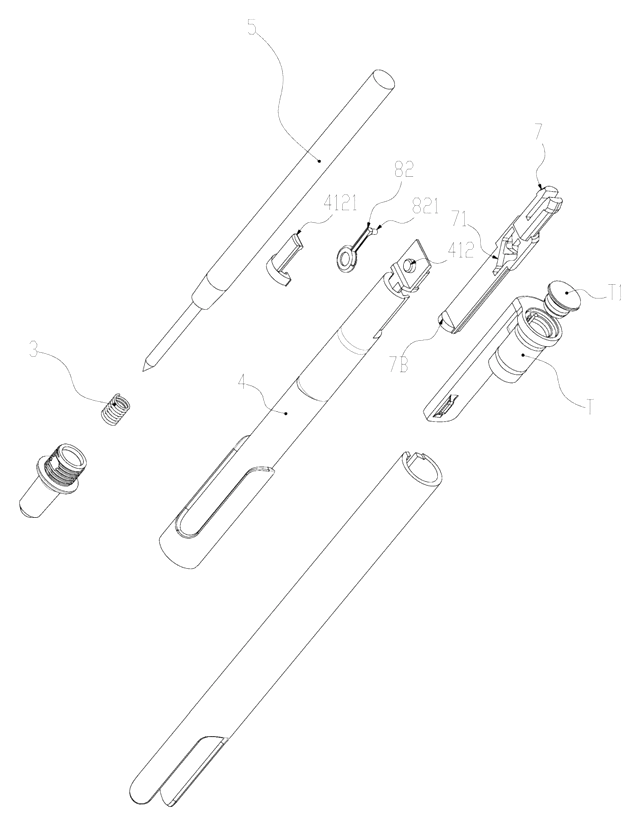
Slide-Action Retractable Pen with a Friction-Loaded Cam That Ignores Gravity
Slide-action retractable pen whose spring-pressed cam latch stays put whichever way the pen is held.
Patent CN217671900U
School, Office & Art
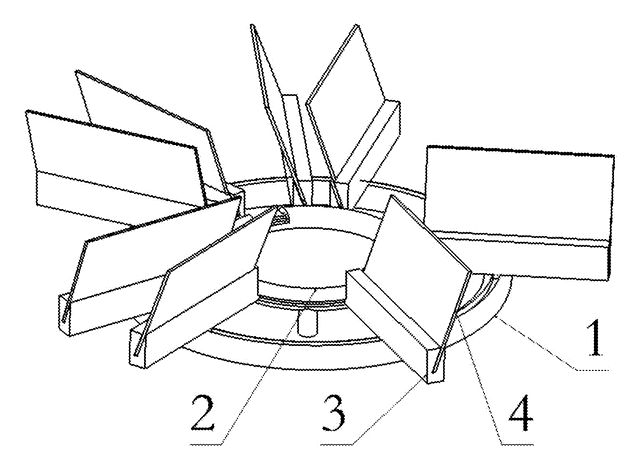
Carousel Business Card Holder with Rolling Card Trays on Twin Ring Tracks
Desk card holder: angled card trays roll on wheels around two concentric ring tracks and lift out.
Patent CN105774300B
Browse by category
- Apparel & Accessories (41)
- Baby & Kids (27)
- Bags & Luggage (15)
- Bath & Personal Care (28)
- Car Accessories (23)
- Furniture, Bedding & Storage (21)
- Garden & Outdoor (29)
- Health & Wellness (13)
- Home, Kitchen & Cleaning (44)
- Lighting (22)
- Packaging & Containers (11)
- Pet Products (10)
- Phone & Camera Accessories (8)
- Retail Display (23)
- School, Office & Art (32)
- Sports & Recreation (41)
- Tools & Workshop (50)
- Toys & Games (21)
This page is based on the public patent document CN114083921B, assigned to Zhongjiao Garden Shandong Co ltd. IP2M is an independent manufacturing service and is not affiliated with, endorsed by or licensed by the patent owner. Images marked as concept renderings are illustrations, not photos of an existing product. Patent status information is provided for reference only and is not legal advice; confirm freedom to operate for your market before production. Full disclaimer.