At a glance
| Patent number | CN114515078B (application CN202210130643) |
| Type | China invention patent (发明专利) - protects method and structure |
| Original title | Combined type folding table and chair for intelligent home (一种智能家居的组合式折叠桌椅) |
| Patent owner | Zhejiang Feiyi Intelligent Equipment Co ltd |
| Inventors | Zhang Chengwei |
| Filing date | 2022-02-12 |
| Grant date | 2022-09-13 |
| Status (China) | In force - valid until at most 2042-02-12, provided annual fees are paid |
| Patent family | Chinese filings only - no US, European, Japanese, PCT or other filings listed |
| Cited by | 0 later documents |
| Source | Google Patents (search for CN114515078B) |
What the claims cover, in plain language
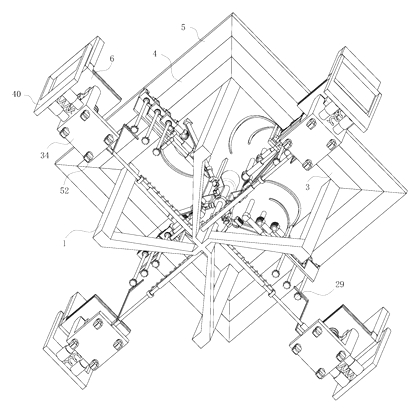
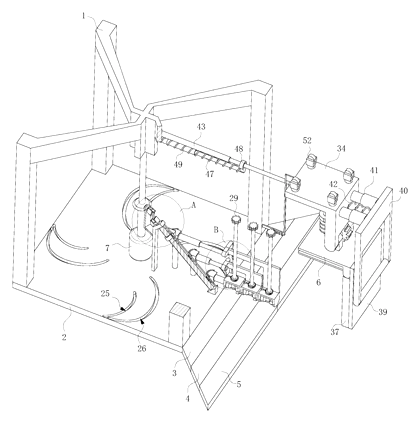
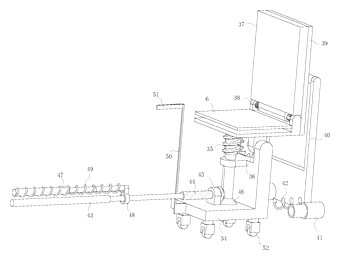
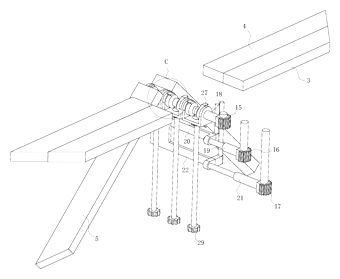
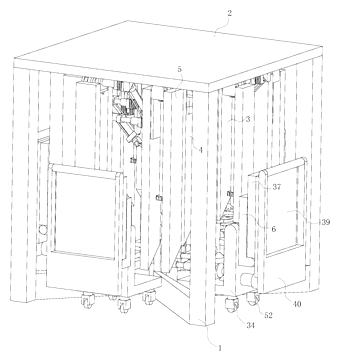
Claim 1 defines a folding table and chair combination comprising a support frame, a table plate, multiple folding plates (first, second, third), and seats.
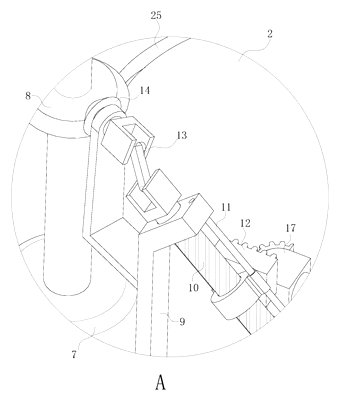
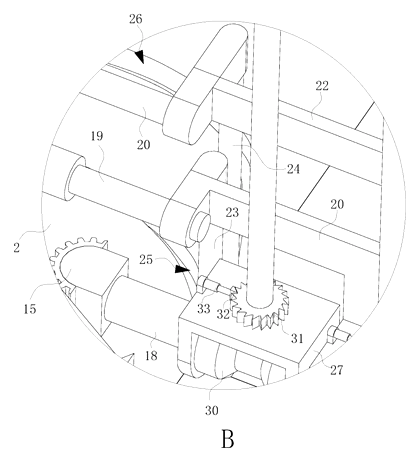
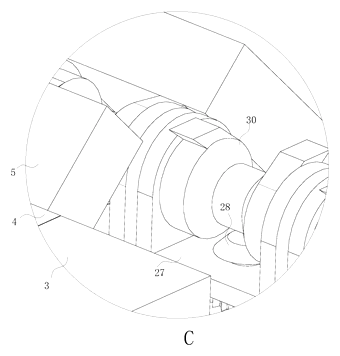
- A first folding mechanism uses a motor, bevel gears, universal joints, and self-locking threaded rods to unfold the plates in four directions (front, back, left, right).
- A second folding mechanism uses a worm and worm wheel to unfold the seats.
- Key feature: The mechanisms are linked such that when the plates unfold, the seats are pushed outward by equal distances, maintaining alignment with the table surface.
- Subsequent claims detail the specific arrangement of the torsion spring on the seat backrest and the baffle plate structure used to guide the seat movement.
This is a simplified reading for orientation only. The legal scope is defined by the exact claim wording in the official Chinese document.
What this means for US production
This patent was filed only in China and is currently in force. Making, using, or selling this specific mechanical arrangement in China would require permission from the patent owner. However, there is no corresponding US patent.
Two points to settle early:
- Other patents may exist. Smart furniture and motorized mechanisms are a crowded field. While this specific combination of worm-drive seats and bevel-gear plates is patented in China, similar functional concepts may be covered by existing US patents regarding adjustable desks or robotic furniture. A freedom-to-operate (FTO) review is recommended before launching in the US market.
- Mechanical Complexity. The synchronization between the table expansion and seat movement relies on precise gear ratios. Any deviation in manufacturing tolerance could cause binding or misalignment, affecting both function and safety.
Customization and manufacturing
What can be customized
| Area | Options |
|---|---|
| Dimensions | Closed footprint and max expanded surface size |
| Materials | Wood veneer, laminate, or metal for the table plates; fabric or leather for seats |
| Drive System | Voltage (12V/24V DC), motor type (stepper vs. standard DC), control interface (app, voice, button) |
| Capacity | Number of folding plates (2-side, 4-side) and number of seats (1-4) |
| Finish | Color matching, texture, and edge banding styles |
Things to plan for (US market)
- UL 962 / ANSI/BIFMA X5.5: Safety standards for furniture stability and durability. Moving parts require pinch-point analysis.
- Electrical Safety: If powered by mains electricity, UL certification for the adapter/motor driver is required. Low-voltage systems must still meet basic electrical safety norms.
- California Prop 65: Screening of materials (plastics, adhesives, finishes) for listed chemicals.
- Children’s Product Safety: If marketed for kids’ rooms, ASTM F963 and CPSIA lead/phthalate limits apply.
How a project runs
- Inquiry - Define target dimensions, load capacity, and desired automation level.
- Design - CAD modeling of the gear train and linkage to ensure smooth synchronization.
- Prototype - Build a functional model to test motor torque, noise levels, and pinch-point safety.
- Pilot Run - Manufacture a small batch for durability testing (cycle life of gears and threads).
- Production - Injection molding for gears/housings, CNC cutting for plates, final assembly and QC.
Quantities & timeline
Tooling for the custom gear housings and injection molds for the seat bases will take 8-12 weeks. The motor and electronics can be sourced from standard suppliers. Cycle testing is critical to verify the self-locking nature of the threaded rods under repeated use. Send us your dimensions, material preferences, quantity, and target price and we will reply with options.
Patent drawings
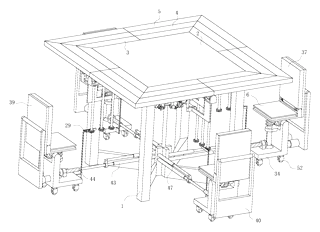
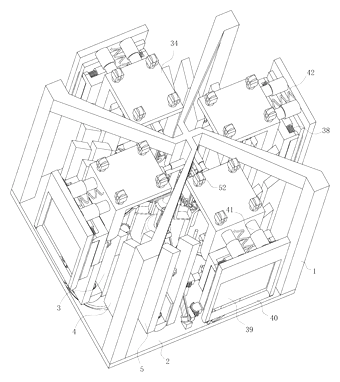
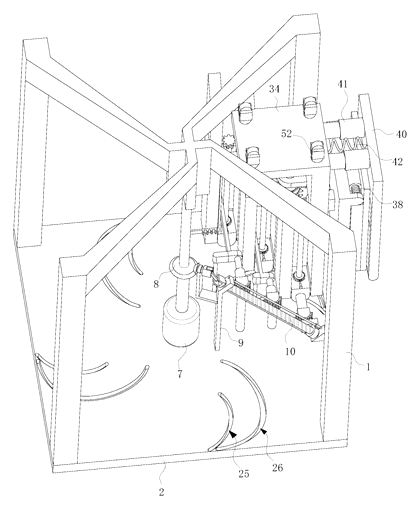
Drawings reproduced from the public patent document for reference.