
Patent CN114534243B
Updated November 5, 2026Intelligent Dual-Rocker Gamepad with Adaptive Airflow and Palm Massage
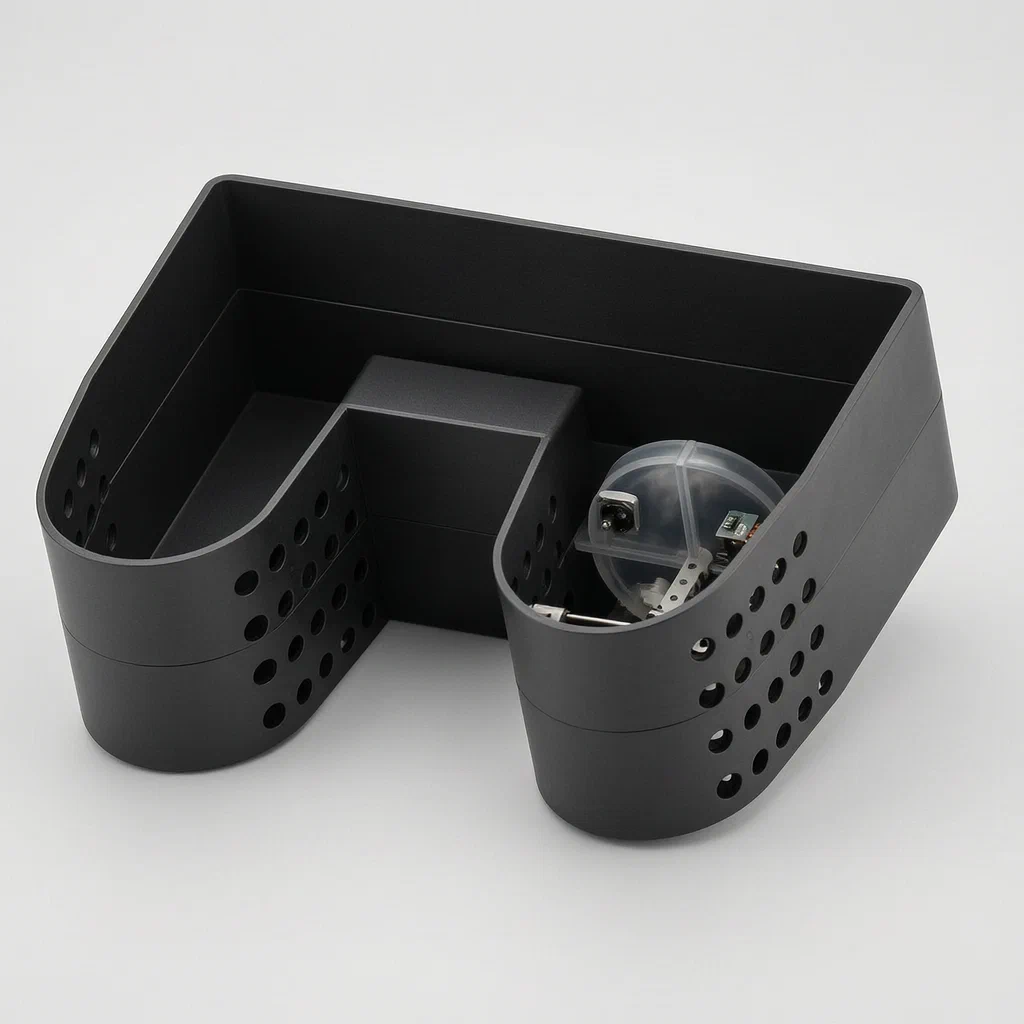
Standard controllers often cause sweaty palms during long gaming sessions, leading to slippage and discomfort. This patent describes a gamepad housing with integrated ventilation and massage features. Inside the grip wall, a motor spins a perforated circulating pipe. A piston assembly, driven by the same motion but regulated by a separate motor, pressurizes air into the pipe so it escapes through vents in the hand-hold area. Crucially, the system is adaptive: as the user grips harder, a pressure-sensitive rheostat detects the force and signals a controller to increase the piston speed, boosting airflow exactly when sweating is most likely. The rotating pipe also drives a gear-linked sliding rod that extends from the shell to massage the palm, relieving fatigue.
- China invention patent - active
- No filings outside China
- Gaming accessories
- Motor-driven airflow and mechanical massage
Splat! What let you down?
💨
Adaptive Airflow
Ventilation speed increases automatically as the user grips the handles tighter.
🖐️
Palm Massage
A gear-driven sliding rod extends from the grip to massage the palm during use.
⚙️
Dual-Motor System
One motor drives the air circulation; a second regulates the pressure based on feedback.
🔧
Integrated Structure
The ventilation and massage mechanisms share the central circulating pipe for compactness.
Bring this product to market
- ✓ Patent review Patent family and legal status reviewed in the relevant jurisdictions.
- 2 Product brief · now How it works, uses and options written up
- 3 Prototype First samples for buyers to review
- 4 Pilot run Small first batch for launch customers
- 5 Volume production Repeat orders at scale
Buyer interest
– of 100 buyers needed to start prototyping
One click, no sign-up. Each vote is one real visitor, and products with the most interest go to prototyping first.
Build team: no members yet. Need a partner, co-funding or skills to build this? Join and we introduce the team once it forms.
Patent Rights & Team Participation
Before joining a development team, participants should ensure they have the necessary rights or authorization to participate in the project.
Participation is generally appropriate where:
- You own the relevant patent rights or have obtained permission or a license from the rights holder.
- The relevant patent rights have expired or have been legally invalidated in the jurisdictions where the planned activities will take place.
- The planned development, manufacturing, and commercialization activities have been independently assessed and do not infringe applicable patent rights in the relevant jurisdictions.
Important: Being located outside a country where a patent is protected does not automatically exempt you from patent infringement risks. Patent rights may apply based on where development, manufacturing, use, sale, or import activities take place.
IP2M does not grant any patent license or authorization through team participation. Joining a project does not provide permission to use, manufacture, or commercialize patented technology.
The problem
During extended gaming sessions, players often experience sweaty palms due to heat and stress, which can reduce grip security and comfort. Standard controllers rely on passive materials like rubber coatings, which do not actively cool the hand. Furthermore, static gripping positions can lead to muscle fatigue and reduced blood circulation in the hands over time. There is a need for a controller design that actively manages moisture and provides physical relief to the user’s hands without adding excessive bulk or complexity that interferes with standard controls.
The solution
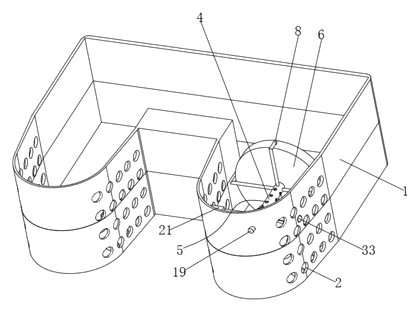
- The shell (1) forms the main body of the gamepad, with specific vents (2) located on the inner walls of the hand-holding positions.
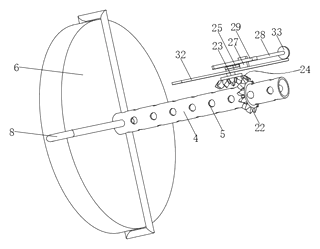
- Inside the shell, a first motor (3) is fixed to the inner wall. Its output shaft connects to a circulating pipe (4), which rotates.
- The circulating pipe has multiple air outlets (5) on its surface. As it spins, these outlets align with the external vents (2).
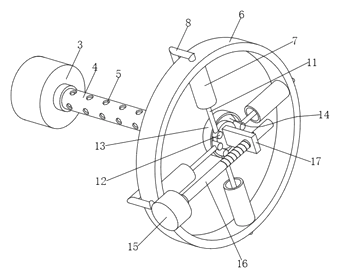
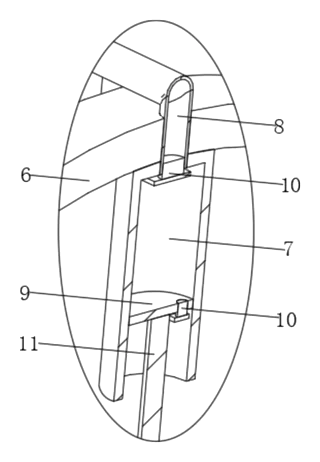
- A conveying component pressurizes air into the pipe. It consists of a cylinder body (6) attached to the pipe end, containing piston cylinders (7) with piston plates (9) that slide back and forth.
- Exhaust pipes (8) connect the pistons to the circulating pipe. One-way valves (10) ensure air flows only into the pipe.
- An adjusting component controls the piston movement. A second motor (15) turns a screw rod (16) that moves a sleeve block (17) and a moving block (13).
- The moving block interacts with an annular groove (14) and sliding columns (12) connected to the piston rods. The geometry of the groove causes the piston speed to vary, changing the air pressure.
- An auxiliary component senses grip force. A rheostat (31) on a support plate (30) is pressed by a pressing block (19) linked to a conductive clamp (18). As the user squeezes the handle, the resistance changes, signaling a controller (21) to adjust the second motor’s speed.
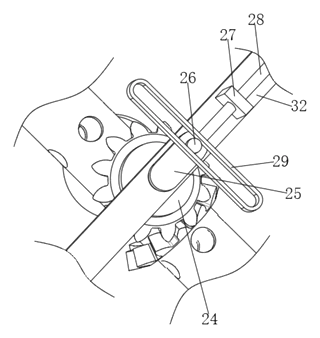
- A massage component uses the rotation of the circulating pipe. A first conical gear (22) on the pipe meshes with a second conical gear (24) on a rotating shaft (23).
- This shaft drives a rotating plate (25) and a fixed column (26), which slides a rod (28) in and out of the shell through a slot, providing a tactile massage action.
Who it is for
- Gaming accessory brands looking to differentiate their high-end controllers with active cooling and ergonomic features.
- Esports equipment manufacturers targeting professional players who require maximum comfort and grip stability during long tournaments.
- Health-focused consumer electronics companies interested in controllers that address hand comfort during long sessions.
- OEM/ODM partners seeking new structural designs for next-generation handheld consoles or peripherals.
How it works
The main parts
| No. | Part | What it does |
|---|---|---|
| 1 | Shell | Main housing with vents (2) in the grip area. |
| 3, 15 | Motors I & II | Motor I drives the pipe; Motor II adjusts airflow pressure. |
| 4 | Circulating Pipe | Rotates to distribute air; carries gears for massage. |
| 6, 7, 9 | Piston Assembly | Cylinder body and pistons generate pressurized air. |
| 13, 14, 16 | Adjustment Mechanism | Screw and moving block alter piston stroke length/speed. |
| 18, 19, 31 | Force Sensor | Rheostat and pressing block detect grip strength. |
| 21 | Controller | Processes sensor data to control Motor II. |
| 22, 24, 28 | Massage Drive | Gears convert pipe rotation to linear sliding rod motion. |
Operating Steps
- Active Cooling: The first motor (3) rotates the circulating pipe (4). The piston assembly (6-10) pumps air into the pipe, which exits through the vents (2) near the user’s palms.
- Adaptive Response: When the user grips the handles tightly, the pressing block (19) compresses the spring and moves the conductive clamp (18) along the rheostat (31). The controller (21) reads this resistance change and activates the second motor (15).
- Pressure Increase: The second motor turns the screw rod (16), moving the sleeve block (17) and the moving block (13). This changes the engagement of the sliding columns (12) in the annular groove (14), altering the piston stroke to increase air flow rate precisely when needed.
- Massage Action: As the circulating pipe (4) rotates, the first conical gear (22) drives the second conical gear (24) and the rotating shaft (23). The fixed column (26) on the rotating plate (25) pushes the sliding rod (28) back and forth, extending it from the shell to massage the palm.
Applications
Competitive Gaming Sessions
Professional gamers playing FPS or MOBA titles for hours benefit from the active airflow, which keeps palms dry and prevents the controller from slipping during intense moments.
Mobile Cloud Gaming
Users holding smartphones or tablets with attached controllers can use this device to manage hand temperature, reducing the discomfort associated with prolonged screen time and static gripping postures.
Accessibility and Ergonomics
Players who prefer extra palm stimulation during long sessions can use the massage action as a comfort feature while keeping their grip on the controller.
Home Entertainment Consoles
Family users engaging in long multiplayer sessions can utilize the adaptive cooling feature to maintain comfort without needing to pause frequently to wipe their hands.
Where it is less suitable
- Ultra-lightweight travel controllers: The addition of two motors, gears, and a pump mechanism adds significant weight and bulk compared to standard membrane-button controllers.
- Low-cost budget peripherals: The complex mechanical assembly requires precise molding and motor integration, making it unsuitable for entry-level price points.
- Waterproof outdoor use: The vents required for airflow make sealing against water ingress difficult without compromising the primary function.
Patent & Production
At a glance
| Patent number | CN114534243B (application CN202210175093) |
| Type | China invention patent (发明专利) - protects product method and structure |
| Original title | Intelligent double-rocker game paddle (一种智能双摇杆游戏手柄) |
| Patent owner | Shenzhen Siyi Chuangke Electronics Co ltd |
| Inventors | Chen Shaoyu |
| Filing date | 2022-02-24 |
| Grant date | 2022-08-09 |
| Status (China) | In force - valid until at most 2042-02-24, provided annual fees are paid |
| Patent family | Public record shows Chinese filings only - no US, European, Japanese, PCT or other filings listed |
| Cited by | 0 later documents |
| Source | Google Patents (search for CN114534243B) |
What the claims cover, in plain language
Claim 1 defines a gamepad shell with vents in the grip area. Inside, a first motor drives a rotating circulating pipe with air outlets. A conveying component (cylinders, pistons, one-way valves) presses air into the pipe. An adjusting component (second motor, screw, moving block, annular groove) varies the piston movement. An auxiliary component (rheostat, pressing block, controller) senses palm grip force and controls the second motor to adjust airflow based on that force.
Claim 2 specifies the auxiliary sensing part: a support plate holds a rheostat. A conductive clamp with a pressing block moves along the rheostat when pressed, changing resistance. A spring returns the clamp. A controller reads this signal.
Claim 3 adds a massage component that presses and massages the palm.
Claim 4 details the massage drive: the circulating pipe has a first conical gear meshing with a second conical gear on a shaft. This shaft rotates a plate with a fixed column that slides a rod back and forth. The rod extends through a slot in the shell.
Claim 5 states the sliding rod ends in a massage block made of hard rubber.
This is a simplified reading for orientation only. The legal scope is defined by the exact claim wording in the official Chinese document.
What this means for US production
This patent was filed in China and is currently in force. Making or selling this specific configuration in China would require the owner’s permission. However, the public record shows no US or other foreign counterpart. Therefore, this patent does not restrict manufacturing or sales in the United States based on its own terms.
Two points to settle early:
- Other patents may exist. Gamepad ergonomics, haptic feedback, and active cooling systems are competitive fields. While there are no foreign patents citing this specific document, broad patents on “controller ventilation” or “adaptive grip sensors” held by major hardware manufacturers could overlap with these features. A freedom-to-operate (FTO) review is recommended before tooling.
- Mechanical Complexity. The interplay between the rotating pipe, the variable-stroke piston, and the gear-driven massage rod requires tight tolerances. Design adjustments may be necessary to simplify assembly while retaining the claimed functionality.
Customization and manufacturing
What can be customized
| Area | Options |
|---|---|
| Vents | Number, shape, and placement of airflow holes in the grip. |
| Airflow Control | Sensitivity curve of the rheostat vs. motor speed mapping. |
| Massage Rod | Length, stroke distance, and material of the contact tip (rubber, silicone). |
| Motors | Size and voltage of DC motors for pipe rotation and adjustment. |
| Shell Material | ABS, PC, or hybrid plastics for durability and weight balance. |
| Electronics | Controller board firmware for sensor calibration and power management. |
Things to plan for (US market)
- FCC Part 15 - If the controller includes wireless transmission (Bluetooth/Wi-Fi), it must meet radio frequency emission limits. Wired models still need EMC compliance.
- UL / ETL - Safety standards for electronic devices, particularly regarding battery safety if rechargeable cells are used, and general electrical safety.
- California Prop 65 - Plastics and adhesives used in the shell and internal components must be screened for restricted substances.
- ASTM F963 - If marketed primarily to children under 12, toy safety standards regarding small parts and mechanical hazards apply.
How a project runs
- Inquiry - Define target price, feature set (massage, airflow, both), and volume.
- Design - CAD modeling of the gear train, piston linkage, and sensor placement.
- Prototype - 3D-printed shells, off-the-shelf motors, and custom PCB to test the adaptive logic.
- Pilot run - Injection molded parts, assembly, and reliability testing (drop tests, cycle life).
- Production - Mass injection molding, pad printing, electronics assembly, and final QC.
Quantities & timeline
The project requires molds for the complex internal chassis and the outer shell. The piston-cylinder assembly needs precision molding to ensure smooth sliding and sealing. Electronics include a custom PCB for the rheostat interface and motor drivers. Certification tests for FCC and safety take several weeks. Send us your target quantity, feature requirements, and cost constraints and we will reply with options.
Patent drawings
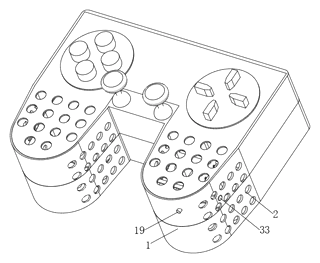
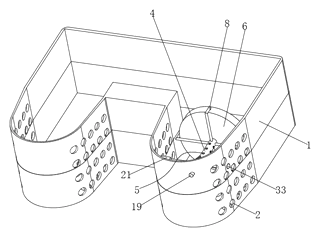
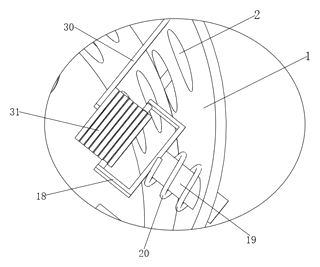
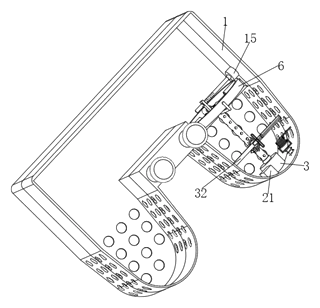
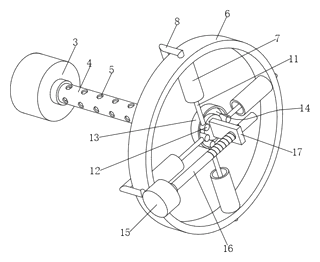
Drawings reproduced from the public patent document for reference.
Production notes
Tooling and process
Injection molding is the primary process for the shell and internal chassis. Multi-cavity molds with high polish finishes are typically required to reduce friction in the gear and piston structures. Pad printing is likely used for branding. Electronics assembly places the rheostat and controller chips onto a PCB that integrates with the motor mounts.
Cost drivers
The number of molds is a significant driver due to the separate components for the shell, pipe, and piston housings. Electronic parts, specifically the dual-motor setup and the custom controller board, add to the bill of materials. Packaging costs may rise if the device is fragile due to protruding massage rods.
Prototyping path
Start with a 3D-printed sample to verify the fit of the gear train and the sliding rod mechanism. Off-the-shelf electronics are typically used to prototype the adaptive airflow logic before designing the custom PCB. Conduct drop and small-parts tests on the functional sample to ensure the massage rod does not break or detach. Finalize with a tooling-ready functional sample.
What we would change before tooling
We would likely simplify the annular groove geometry to reduce mold complexity and improve piston stroke consistency. Adjusting the spring rate for the pressing block might be necessary to ensure the rheostat signal is linear across the grip force range. We would also review the wire routing to prevent pinching between the rotating pipe and stationary chassis.
Common failure points
Shaft and bearing alignment is critical; misalignment can cause gear binding or uneven airflow. Wall thickness and joint design in the piston cylinders affect sealing and longevity. Spring fatigue and rate consistency determine the accuracy of the grip-force sensing over time. Paint wear on the massage rod tip could occur if the material is too soft. Motor mount cracking may result from vibration if the dampening is insufficient.
Frequently asked questions
How does the adaptive airflow work?
The system uses a sensor in the grip handle. When you squeeze harder, a rheostat detects the pressure change. A controller sends a signal to a second motor, which adjusts the piston stroke to push more air through the vents. This ensures stronger cooling when your hands are most likely to sweat.
Does the massage function interfere with button inputs?
No. The massage rod extends from the palm rest area, away from the face buttons and thumbsticks. The patent describes it as pushing against the palm to relieve fatigue, designed to operate alongside standard controls.
Is the noise level acceptable for gaming?
The patent relies on motors and mechanical gears. In most designs, this generates some audible noise. Reducing this requires careful selection of low-noise motors and lubrication of the gear train during the prototyping phase.
How much does the extra mechanism weigh?
The patent does not specify weight. Adding two motors, a pump, and gears significantly increases mass compared to a standard controller. Designers must balance the cooling benefits against player preference for lightweight devices.
Can the airflow be turned off?
Yes. Since the system is electronically controlled by a motor, it can be disabled via software settings or a physical switch, allowing the controller to function as a standard device when ventilation is not needed.
Are replacement parts available?
The internal piston and gear assemblies are custom-molded parts. Replacement availability depends on the manufacturer’s supply chain. Modular design in production could facilitate easier repairs.
Can this design be made and sold in the US?
The patent is in force in China, but the public record shows no US counterpart. Therefore, this specific patent does not restrict manufacturing or sales in the United States. However, other patents in the gaming peripheral field may apply, so a freedom-to-operate check is recommended.
Are you affiliated with the patent owner?
No. IP2M is an independent design and manufacturing service working from the public patent document.
Request a quote
Click Request a Quote below to see our email address - copy it, or open your email app with a ready-made message. Please mention patent CN114534243B in the subject.
Helpful details to include:
- Your company and channel (gaming brand, esports supplier, accessory retailer)
- Feature priority (is the massage function essential, or just airflow?)
- Target weight and dimensions
- Power source (battery capacity, wired vs. wireless)
- Estimated quantity and target price
- Timeline - when you would like samples and the first shipment
You can also reach us at (332) 203-9997.
Page editor: Emily Zhang, Product Editor · IP2M
Last updated November 5, 2026. If something on this page looks wrong, email [email protected] and we will check it against the patent.
Interested in building this?
Tell us your target market, quantity and timeline. We reply with options for prototyping, small-batch runs or volume production.
Send your inquiry to
Please put CN114534243B in the subject line and tell us your company, country, estimated quantity and timeline.
Prefer to talk? Call (332) 203-9997.
More product-ready patents
All Toys & Games patents →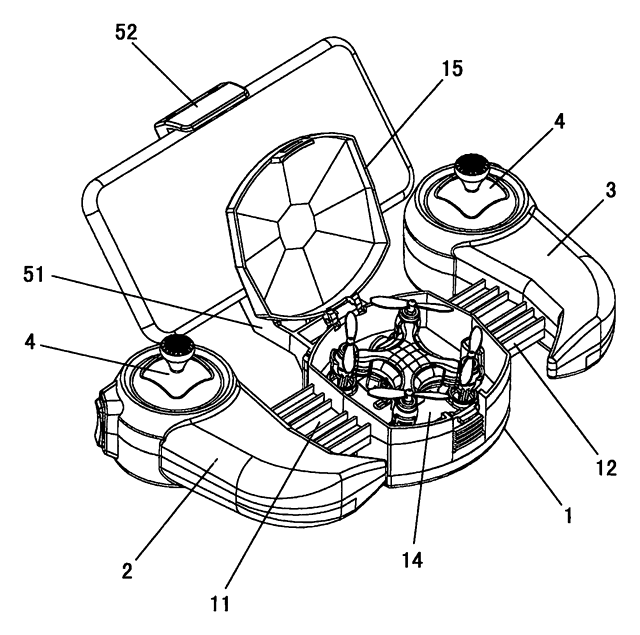
Toys & Games
Stretch-to-Fit Toy Remote with Drone Storage
Toy drone remote with slide-out handles for any hand size, a phone clamp and built-in drone storage.
Patent CN205412243U
Toys & Games
Magnetic Tile Racks for Ultra-Thin Travel Mahjong
Magnetic rack frames that hold ultra-thin mahjong tiles upright and fold into the set's carrying box.
Patent CN207169017U
Toys & Games
X-Braced Square Magnetic Building Tile with Locating-Post Shell
Square magnetic building tile: open X-brace frame, corner-lug magnets, two shells aligned by posts.
Patent CN105963988B
Toys & Games
Card-Thin Magnetic Travel Mahjong and Chess Sets with Magnet Racks
Pocket mahjong and chess sets: thin magnetic-powder tiles, finger magnet picker and fold-out magnetic racks.
Patent CN206896783U
Toys & Games
Inflatable Baby Climbing Mat with a Bumpy Hump and a Ramp Obstacle
Inflatable crawling mat: a bumpy rounded hump and a sloped ramp on a stiffened air base.
Patent CN108905229B
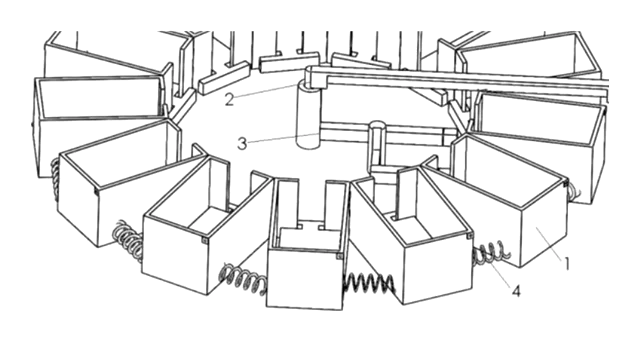
Toys, Games & Puzzles
Ring-Layout Automatic Card Shuffler with Electromagnetic Box Coupling
Ring-layout card shuffler that sweeps stacks between boxes via electromagnetic coupling.
Patent CN209564602U
Browse by category
- Apparel & Accessories (41)
- Baby & Kids (27)
- Bags & Luggage (15)
- Bath & Personal Care (28)
- Car Accessories (23)
- Furniture, Bedding & Storage (21)
- Garden & Outdoor (29)
- Health & Wellness (13)
- Home, Kitchen & Cleaning (44)
- Lighting (22)
- Packaging & Containers (11)
- Pet Products (10)
- Phone & Camera Accessories (8)
- Retail Display (23)
- School, Office & Art (32)
- Sports & Recreation (41)
- Tools & Workshop (50)
- Toys & Games (21)
This page is based on the public patent document CN114534243B, assigned to Shenzhen Siyi Chuangke Electronics Co ltd. IP2M is an independent manufacturing service and is not affiliated with, endorsed by or licensed by the patent owner. Images marked as concept renderings are illustrations, not photos of an existing product. Patent status information is provided for reference only and is not legal advice; confirm freedom to operate for your market before production. Full disclaimer.