At a glance
| Patent number | CN114731996B (application CN202210422210) |
| Type | China invention patent (发明专利) - protects technical solutions relating to a product or process |
| Original title | Garden insect trapping device (一种园林用诱虫装置) |
| Patent owner | Hangzhou West Lake Water Area Management Office |
| Inventors | Xiao Kunlun, Zhao Weifa, Hu Jian, Gong Jiping, Sun Jian |
| Filing date | 2022-04-21 |
| Grant date | 2023-01-31 |
| Status (China) | In force in China until at most 2042-04-21 (if annual fees are paid) |
| Patent family | Chinese filings only - no US, European, Japanese, PCT or other filings listed |
| Cited by | 0 later documents |
| Source | Google Patents (search for CN114731996B) |
What the claims cover, in plain language
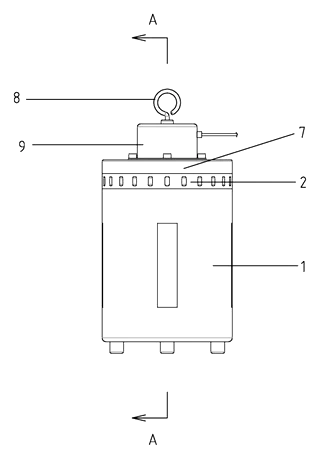
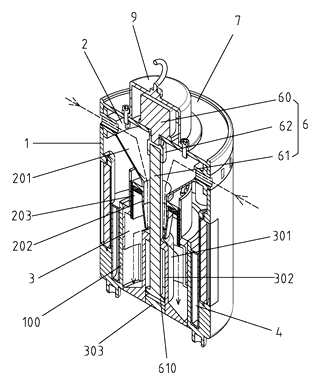
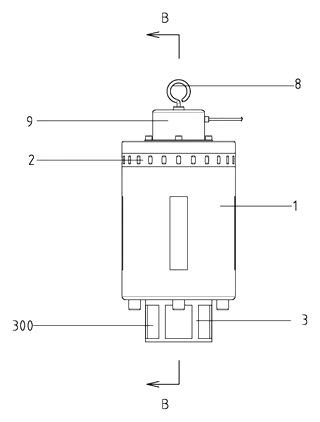
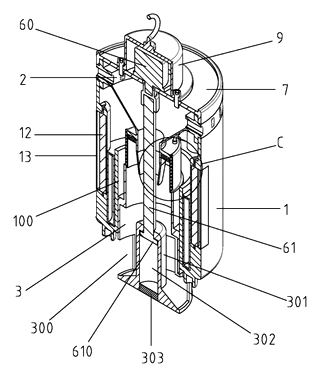
Claim 1 describes the core assembly: a housing with an annular seat at the top containing insect inlet holes. A connecting cylinder sits at the center of the housing’s bottom, opening to the outside. Inside, an insect storage cylinder slides within this connecting cylinder and has discharge notches on its side. A conical guide sleeve extends down from the annular seat into a guide pipe reaching into the storage cylinder. An isolation sleeve surrounds the guide pipe, and the storage cylinder slides over it. A pesticide storage tank connects to the isolation sleeve via a gas guide pipe. An electric lifting mechanism (motor and screw rod) drives the cylinder up and down. The cylinder’s bottom is a cone with a high center and low edges. Friction between the isolation sleeve and cylinder exceeds the screw thread friction, and a limiting block and plug define the lowest position. Damping strips are fixed on the isolation sleeve.
Claim 2 adds a protective cover around the motor, with the lifting ring fixed to its top. Claim 3 specifies an annular microporous ceramic membrane inside the isolation sleeve, featuring an annular groove connected to the gas guide pipe. Claim 4 details the pesticide storage tank as an annular structure on the inner wall of the housing, held by limiting ribs and matching grooves. Claim 5 adds cavities on the housing surface corresponding to the ribs, containing trap lamps covered by light-transmitting plates. Claim 6 describes connecting seats on the housing bottom for detachable support rods ending in ground pins.
This is a simplified reading for orientation only. The legal scope is defined by the exact claim wording in the official Chinese document.
What this means for US production
This patent was filed only in China and is currently in force. Therefore, making or selling this exact design in China needs the owner’s permission. It has no US or other foreign counterpart, so the Chinese patent itself does not restrict manufacturing or sales in the United States.
Two points to settle early:
- Other patents may exist. Outdoor pest control devices, including automated traps and pheromone dispensers, are covered by various US and international patents held by agricultural and pest management companies. A freedom-to-operate (FTO) review focusing on the motorized clearing mechanism, the specific conical guide geometry, and the ceramic membrane diffusion system is recommended before tooling.
- Attractant classification. The pesticide storage tank holds an insect attractant mixed with an insecticide. In the US, the chemical formulation and the device dispensing it may be regulated separately from the hardware itself.
Customization and manufacturing
What can be customized
| Area | Options |
|---|---|
| Housing dimensions | Diameter and height scaled to target capacity and environment |
| Power supply | AC mains via power cord, DC battery pack, or integrated solar panel |
| Attractant tank | Volume adjusted for refill intervals; cartridge vs. liquid reservoir |
| Lure type | Trap lamps (UV/LED wavelength), scent diffusion, or both |
| Control logic | Timer-based lifting cycles, sensor-triggered clearing, or manual switch |
| Mounting hardware | Support rod length, pin shape, or custom brackets for poles/fences |
| Materials | UV-stabilized plastics, stainless steel screw rods, weather-resistant seals |
Things to plan for (US market)
- EPA FIFRA registration - if the device is sold pre-loaded with or specifically marketed for use with a pesticidal substance (including certain insecticides mixed with attractants), the combination may require EPA registration.
- FCC Part 15 - the motor, any electronic controllers, and LED trap lamps must comply with FCC limits for electromagnetic interference if sold in the US.
- UL / ETL listing - if powered by AC mains, the electrical components and enclosure should meet applicable safety standards for outdoor use.
- California Prop 65 - materials used in the housing, wiring, and any chemical attractants must be evaluated for listed substances.
How a project runs
- Inquiry - target pests, deployment environment, power source, and volume requirements.
- Design - scaling the housing, sizing the motor and screw rod, selecting membrane porosity, and engineering the electronics.
- Prototype - 3D-printed or machined samples to test the lifting friction balance, scent diffusion rate, and discharge alignment.
- Pilot run - field testing in outdoor conditions to verify weather sealing, battery life (if applicable), and insect catch rates.
- Production - injection molding for the housing and cylinders, machining for the screw rod, assembly of the motor and electronics, and packaging.
Quantities & timeline
The housing and insect storage cylinder require injection molds sized to the chosen dimensions. The screw rod and coupler need precision machining, while the microporous ceramic membrane involves specialized sintering processes. Electronic components and motors are sourced based on the selected power architecture. Field testing for weather resistance and lure effectiveness takes a significant portion of the development schedule. Send us your target environment, power preference, estimated quantity, and required certifications and we will reply with options.
Patent drawings
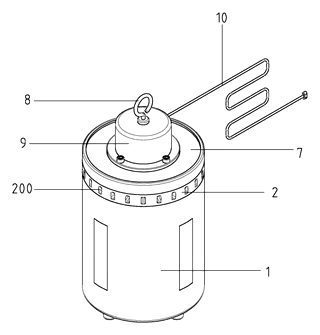
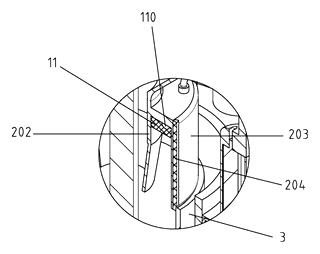
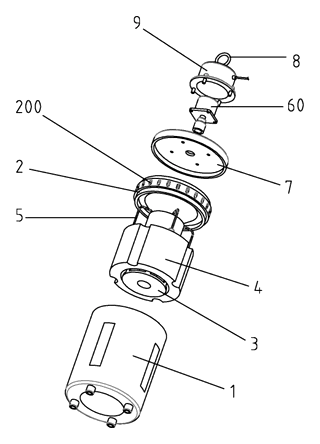
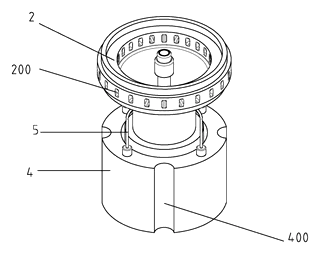
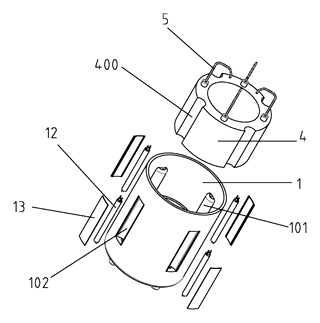
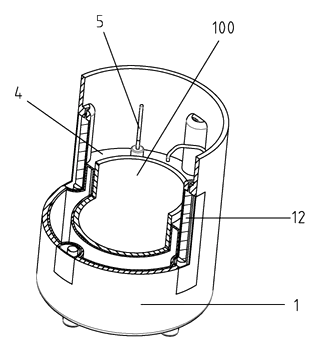
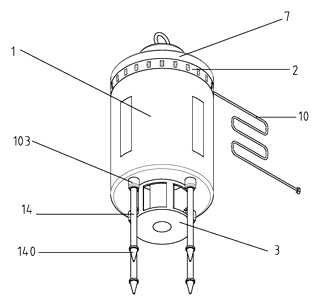
Drawings reproduced from the public patent document for reference.