
Patent CN114797080B
Updated October 31, 2026Ball-Pushing Game Device with Dual-Size Ball Circulation
Traditional ball pushers struggle with mixed-size prizes or require manual sorting. This design automates the process using a dual-circulation system. Small balls slide down a slope onto a pushing disc, falling into a groove with a spiral guide that separates them by size based on diameter versus gap width. Large balls are routed separately to a turntable and loading device. The main control unit manages both streams, feeding balls back to their respective outlets for continuous play.
- China invention patent - active
- No filings outside China
- Arcade & amusement equipment
- Automated ball sorting and circulation
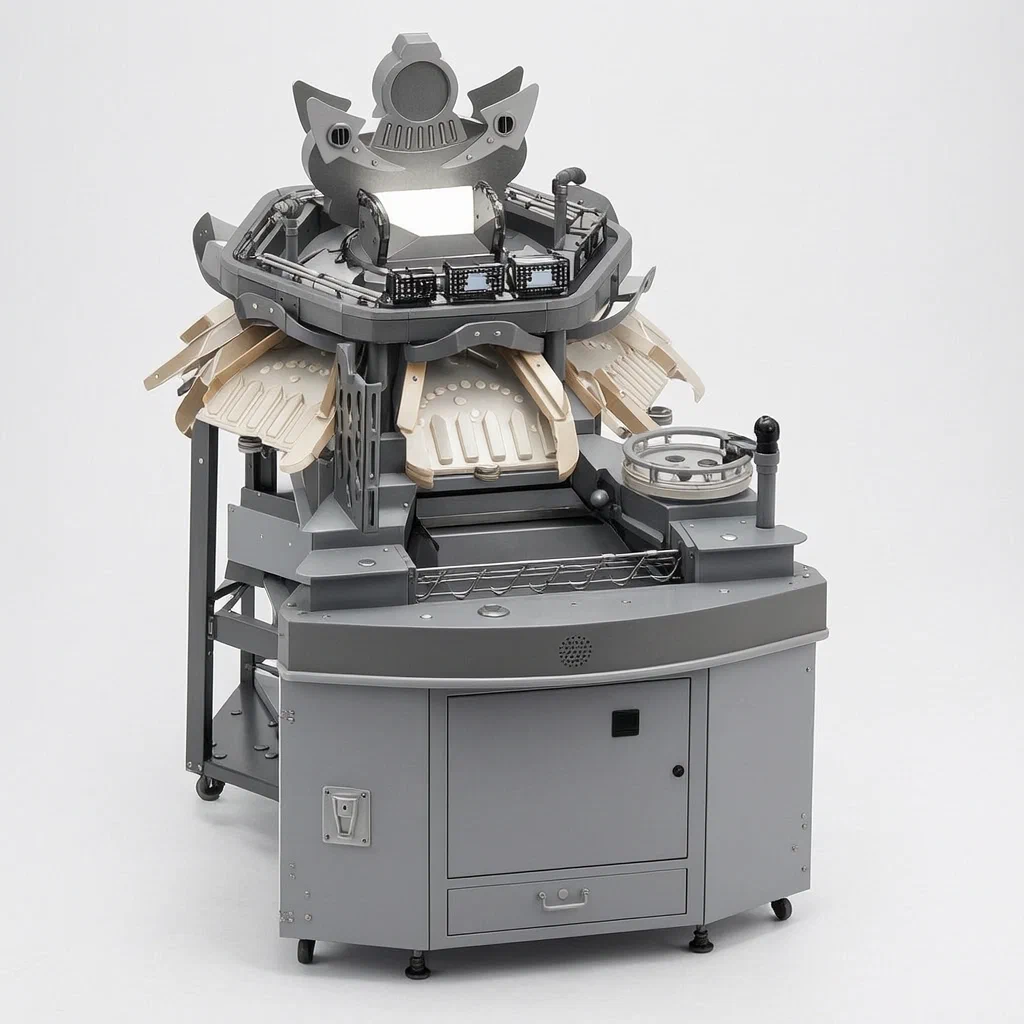
Splat! What let you down?
🎱
Dual-size balls
Separate circulation paths for small and large balls enhance gameplay variety.
🌀
Spiral guide sorting
A spiral rod in the drop groove sorts balls by diameter automatically.
⚙️
Closed-loop feed
Return devices and loaders keep balls circulating without manual refilling.
💡
Integrated lighting
Lamp box above the slope adds visual appeal and prize pool visibility.
Bring this product to market
- ✓ Patent vetted China-only family and legal status checked
- 2 Product brief · now How it works, uses and options written up
- 3 Prototype First samples for buyers to review
- 4 Pilot run Small first batch for launch customers
- 5 Volume production Repeat orders at scale
Buyer interest
– of 100 buyers needed to start prototyping
One click, no sign-up. Each vote is one real visitor, and products with the most interest go to prototyping first.
Build team: no members yet. Need a partner, co-funding or skills to build this? Join and we introduce the team once it forms.
The problem
Standard ball-push machines often rely on single-size balls or require staff to manually separate mixed prizes when balls fall off the platform. This leads to downtime and operational complexity. Furthermore, when multiple ball sizes are used, smaller balls can jam larger mechanisms, or larger balls may block the return paths intended for smaller ones, disrupting the continuous flow needed for high-volume arcade use.
The solution
The device integrates a control table connected to a pushing disc mechanism. Above this sits a slope ball dividing plate and a lamp box. The core innovation lies in the small ball circulation mechanism and big ball circulation mechanism, managed by a central main control mechanism.
Small balls exit from the slope plate onto the pushing disc. When they fall off the front edge, they enter a ball falling groove. Inside this groove is a ball return spiral guide rod. The gap between the rod and the groove wall is designed such that it is smaller than the diameter of the big ball but larger than the small ball. Consequently, small balls fall through the gap into the return path, while big balls are carried by the rotating spiral guide to a separate big ball outlet.
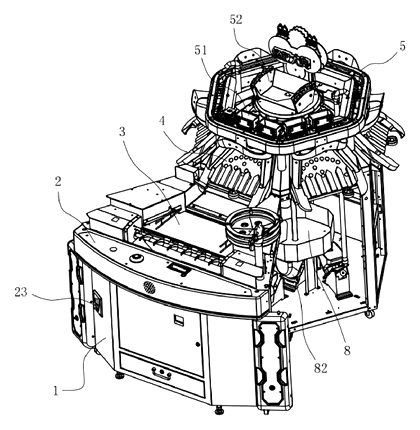
Who it is for
- Arcade equipment manufacturers looking to upgrade standard pushers with automated multi-size ball handling.
- Family entertainment centers wanting games with varied prize types without extra staffing.
- Game developers seeking hardware that supports complex reward structures (e.g., collecting specific sized items).
- OEM buyers needing reliable, self-sustaining mechanical systems for high-traffic venues.
How it works
The main parts
| No. | Part | What it does |
|---|---|---|
| 1 | Machine case | Houses all internal mechanisms. |
| 2 | Control table | Player interface with keys, coin/bill slots. |
| 3 | Pushing disc | Moves balls toward the front edge. |
| 4 | Slope ball dividing plate | Feeds small balls onto the disc. |
| 5 | Lamp box | Lighting and prize pool area above the slope. |
| 6 | Small ball circulation | Feeder, return device, and spiral guide groove. |
| 7 | Big ball circulation | Discharger, turntable, and loader. |
Operating steps
- Play initiation: Players insert coins or bills; the control table triggers the game.
- Ball movement: The pushing disc moves balls forward. Small balls slide down the slope plate onto the disc.
- Falling and Sorting: Balls reach the front edge and fall into the ball falling groove.
- Small balls: Pass through the gap between the spiral guide rod and the wall, entering the small ball return device.
- Big balls: Rest on top of the spiral guide rod. As the rod rotates, it transports these balls to the big ball outlet.
- Recycling:
- Small balls go to the small ball loading device and are sent back up the slope.
- Big balls enter the turntable, then the big ball loading device, which feeds them back to the disc.
- Prize Handling: If balls trigger sensors (like a bell) or enter specific zones, the main controller awards prizes via the bill box or additional mechanisms (train/tipping bucket).
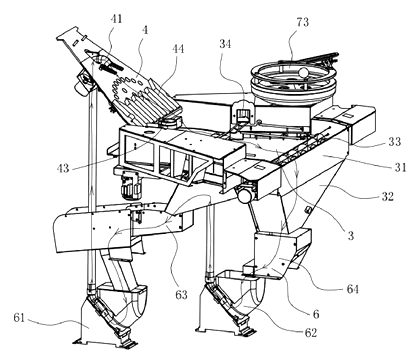
Applications
Family Arcade Centers
Parents and children can play together with mixed-size prizes. The automatic sorting ensures the game keeps running smoothly even with frequent drops, reducing the need for staff to clear jams.
Shopping Mall Kiosks
High-traffic locations benefit from the closed-loop system. Since balls recirculate automatically, operators spend less time refilling machines, allowing for consistent revenue generation throughout the day.
Educational Toy Stores
Demonstrating simple mechanics like spiral guides and gravity-based sorting. The transparent operation of the dual-ball system can engage young players interested in how machines work.
Club and Lounge Entertainment
For adult social spaces, the game offers a skill-based element with varied rewards. The quiet, automated nature fits well in environments where constant staff intervention is undesirable.
Where it is less suitable
- Low-budget home toys: The complexity of dual motors and spiral guides makes this too expensive for simple consumer units.
- Single-prize formats: If a venue only uses one ball size, the added complexity of the big ball circuit is unnecessary overhead.
- Outdoor parks: The precision electronic controls and moving parts require indoor climate-controlled environments to prevent dust and moisture damage.
Frequently asked questions
How does the machine sort the balls?
It uses a physical gap in the return chute. A spiral rod rotates inside the groove. Small balls are smaller than the gap, so they fall through directly. Big balls are too wide to fall through, so they sit on the spiral rod and are pushed sideways to a different exit as the rod turns.
Do I need to refill the balls often?
The design is a closed loop. Balls that fall off the platform are collected and automatically pumped or conveyed back to the starting point. You only need to add balls when you want to increase the total volume or replace worn-out ones.
Can it handle different prize types?
Yes. The patent describes optional modules like a train carriage or tipping bucket connected to the main controller. These can dispense tickets or small prizes when specific conditions (like hitting a bell sensor) are met.
Is the noise level acceptable for indoor use?
The mechanisms use motors and gears. While the patent doesn’t specify decibel levels, industrial-grade bearings and dampened plastic tracks are typically used in prototypes to minimize noise. Actual sound levels depend on the final material choices and motor tuning.
What happens if a ball gets stuck?
The spiral guide is designed to prevent jamming by separating sizes immediately. However, irregularly shaped objects could still cause issues. Regular maintenance involves checking the gap clearance and ensuring the spiral rod rotates freely without debris buildup.
Does it require internet connectivity?
No. The main control mechanism operates locally to manage the motors, sensors, and prize dispensing. Internet connection is only needed if you choose to integrate remote monitoring or cashless payment systems, which are external add-ons.
Can this design be made and sold in the US?
The patent is filed only in China and is active there. It does not restrict sales in the US. However, because arcade mechanics are heavily patented globally, we strongly recommend a freedom-to-operate check to ensure no other US patents cover similar sorting or circulation methods before mass production.
Are you affiliated with the patent owner?
No. IP2M is an independent design and manufacturing service working from the public patent document.
Request a quote
Click Request a Quote below to see our email address - copy it, or open your email app with a ready-made message. Please mention patent CN114797080B in the subject.
Helpful details to include:
- Your company and channel (arcade operator, manufacturer, distributor)
- Ball specifications (diameters for small and large balls)
- Desired capacity (number of balls in circulation)
- Prize features (train, bucket, ticket dispenser needs)
- Estimated quantity and target price
- Timeline - when you would like samples and the first shipment
You can also reach us at (332) 203-9997.
Explore this product
Interested in building this?
Tell us your target market, quantity and timeline. We reply with options for prototyping, small-batch runs or volume production.
Send your inquiry to
Please put CN114797080B in the subject line and tell us your company, country, estimated quantity and timeline.
Prefer to talk? Call (332) 203-9997.
More product-ready patents
All Toys & Games patents →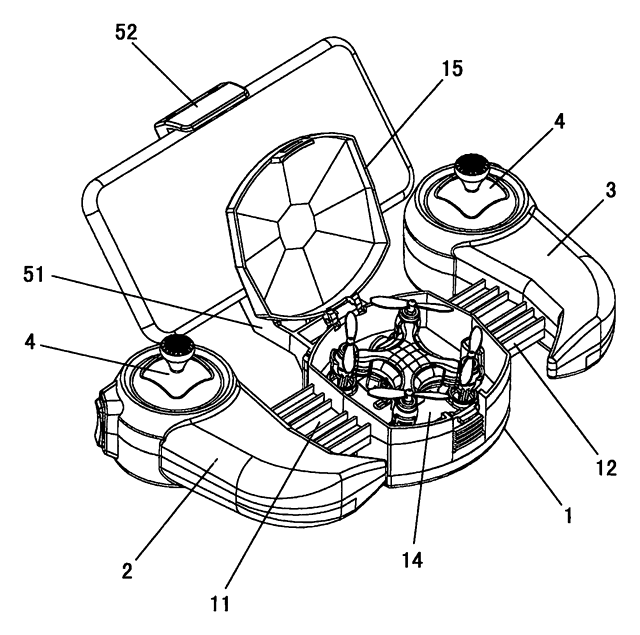
Toys & Games
Stretch-to-Fit Toy Remote with Drone Storage
Toy drone remote with slide-out handles for any hand size, a phone clamp and built-in drone storage.
Patent CN205412243U
Toys & Games
Magnetic Tile Racks for Ultra-Thin Travel Mahjong
Magnetic rack frames that hold ultra-thin mahjong tiles upright and fold into the set's carrying box.
Patent CN207169017U
Toys & Games
X-Braced Square Magnetic Building Tile with Locating-Post Shell
Square magnetic building tile: open X-brace frame, corner-lug magnets, two shells aligned by posts.
Patent CN105963988B
Toys & Games
Card-Thin Magnetic Travel Mahjong and Chess Sets with Magnet Racks
Pocket mahjong and chess sets: thin magnetic-powder tiles, finger magnet picker and fold-out magnetic racks.
Patent CN206896783U
Toys & Games
Inflatable Baby Climbing Mat with a Bumpy Hump and a Ramp Obstacle
Inflatable crawling mat: a bumpy rounded hump and a sloped ramp on a stiffened air base.
Patent CN108905229B
Toys, Games & Puzzles
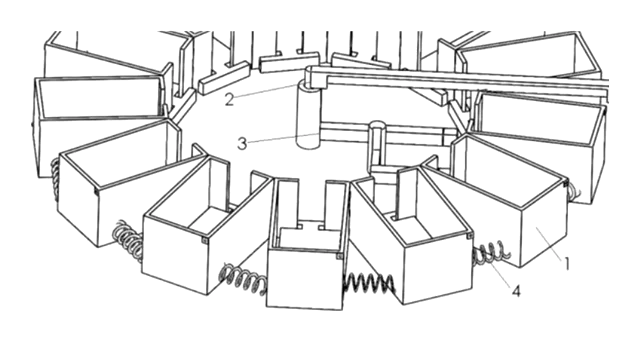
Ring-Layout Automatic Card Shuffler with Electromagnetic Box Coupling
Ring-layout card shuffler that sweeps stacks between boxes via electromagnetic coupling.
Patent CN209564602U
Browse by category
- Apparel & Accessories (25)
- Baby & Kids (18)
- Bags & Luggage (12)
- Bath & Personal Care (18)
- Car Accessories (14)
- Furniture, Bedding & Storage (13)
- Garden & Outdoor (21)
- Health & Wellness (9)
- Home, Kitchen & Cleaning (28)
- Lighting (14)
- Packaging & Containers (7)
- Pet Products (6)
- Phone & Camera Accessories (5)
- Retail Display (15)
- School, Office & Art (21)
- Sports & Recreation (27)
- Tools & Workshop (32)
- Toys & Games (14)
This page is based on the public patent document CN114797080B, assigned to Zhongshan Manyate Automation Technology Co ltd. IP2M is an independent manufacturing service and is not affiliated with, endorsed by or licensed by the patent owner. Images marked as concept renderings are illustrations, not photos of an existing product. Patent status information is provided for reference only and is not legal advice; confirm freedom to operate for your market before production. Full disclaimer.