At a glance
| Patent number | CN114797080B (application CN202210533205) |
| Type | China invention patent (发明专利) - protects method and structure |
| Original title | Ball pushing game device (推球的游戏装置) |
| Patent owner | Zhongshan Manyate Automation Technology Co ltd |
| Inventors | Luo Xuanxiong |
| Filing date | 2022-05-17 |
| Grant date | 2024-11-22 |
| Status (China) | Active - In force in China until at most 2042-05-17 (if annual fees are paid) |
| Patent family | Chinese filings only - no US, European, Japanese, PCT or other filings listed |
| Cited by | 0 later documents |
| Source | Google Patents (search for CN114797080B) |
What the claims cover, in plain language
Claim 1 defines a ball-pushing game device comprising a machine case, control table, pushing disc mechanism, slope ball dividing plate, and lamp box. It specifies two circulation mechanisms: one for small balls and one for big balls. The critical feature is the ball falling groove containing a ball return spiral guide rod. The gap between this rod and the groove wall is smaller than the big ball’s diameter but larger than the small ball’s. This geometry forces small balls to fall through the gap into the return device, while big balls are transported by the rotating spiral guide to a separate big ball outlet and turntable system.
Claims 2-4 describe optional prize mechanisms within the lamp box, including a prize pool, a small train carriage mechanism, and a large tipping bucket mechanism, connected to the main control unit for automated dispensing.
Claim 5 onward details additional triggering elements like bells or sensors that interact with the main control mechanism to award prizes or end games.
This is a simplified reading for orientation only. The legal scope is defined by the exact claim wording in the official Chinese document.
What this means for US production
This patent was filed only in China and is currently active. Making or selling this specific device in China requires the owner’s permission. However, there is no US patent corresponding to this application, so the design itself is not restricted by this specific patent number in the United States.
Two points to settle early:
- Other patents may exist. Arcade game mechanisms, particularly ball pushers and prize distribution systems, are a crowded field with numerous US patents held by major entertainment companies (e.g., ICE, Sega, Nintendo). A freedom-to-operate (FTO) review is essential before tooling to ensure no other US patents cover the spiral sorting logic or the dual-circulation architecture.
- Electromagnetic Compatibility. The device relies heavily on motors, sensors, and a main control board. Ensuring FCC compliance for electronic emissions is a primary engineering hurdle for US market entry.
Customization and manufacturing
What can be customized
| Area | Options |
|---|---|
| Ball Sizes | Diameter ratios for small/large balls must match the spiral guide gap tolerance. |
| Capacity | Volume of the hopper/loading devices determines run-time between refills. |
| Lighting | LED color schemes and intensity for the lamp box and prize areas. |
| Interface | Touchscreen vs. physical buttons; digital bill acceptor integration. |
| Prize Mechanisms | Addition/removal of train carriages or tipping buckets based on desired payout rates. |
| Housing | Acrylic panels, metal casing finishes, and footprint dimensions. |
Things to plan for (US market)
- ASTM F1487 - Standard Consumer Safety Specification for Playground Equipment (if applicable to placement context, though usually arcade-specific standards apply). More relevant is UL 909 (Coin-Operated Amusement Machines) or equivalent electrical safety certifications.
- FCC Part 15 - Mandatory for unintentional radiators (the control electronics and motors).
- Proposition 65 - California warning requirements if lead or phthalates are present in plastics or solder.
- ADA Compliance - Control height and accessibility for players with disabilities.
How a project runs
- Inquiry - Define ball sizes, target capacity, and prize types.
- Design - CAD modeling of the spiral guide gap tolerance and motor torque calculations.
- Prototype - Build functional unit to test sorting efficiency and jam resistance.
- Pilot Run - Cycle testing for thousands of ball drops; electrical safety pre-testing.
- Production - Injection molding for plastic parts, CNC machining for metal guides, assembly of electronics.
Quantities & timeline
The spiral guide rod requires precise machining or molding to maintain the specific gap (L) relative to ball diameters (D). Motor selection depends on the weight of the full hopper. Electronic controllers need custom PCB layouts for the dual-sensor inputs. Certification testing for UL and FCC adds time and should be scheduled before launch. Send us your ball specifications, target capacity, prize features, quantity and target price and we will reply with options.
Patent drawings
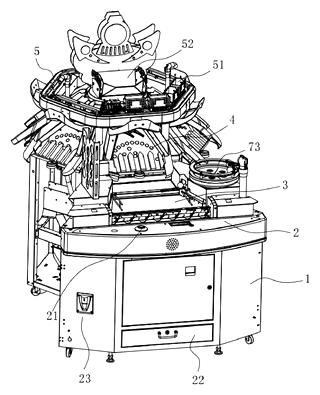
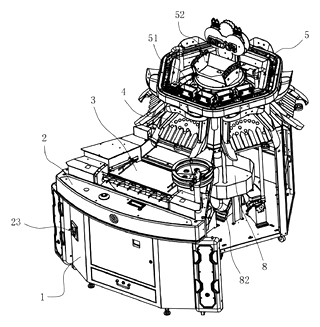
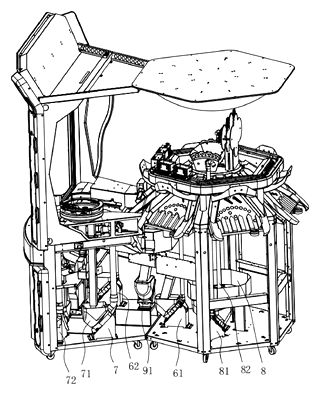
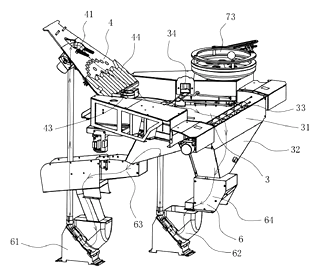
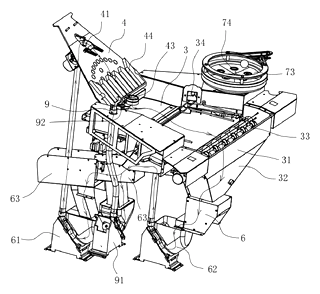
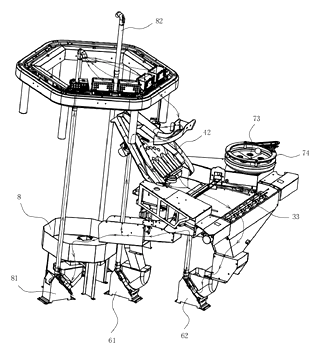
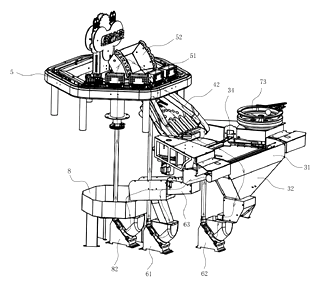
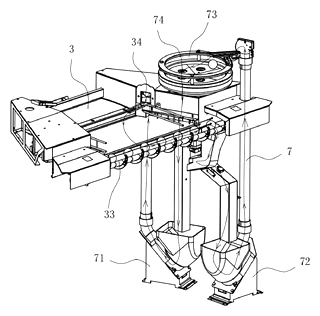
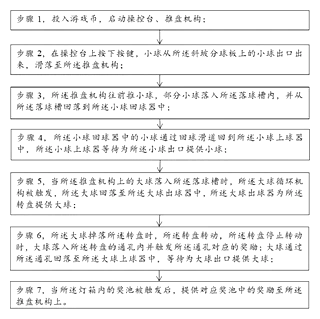
Drawings reproduced from the public patent document for reference.