At a glance
| Patent number | CN114869025B (application CN202210452717) |
| Type | China invention patent (发明专利) - protects method and structure |
| Original title | Automobile safety belt lock tongue (一种汽车安全带锁舌) |
| Patent owner | Zhejiang Songyuan Automotive Safety Systems Co ltd |
| Inventors | Shi Bingjun, Wu Jianan, Du Jicheng, Sun Bo, Zhao Hong |
| Filing date | 2022-04-27 |
| Grant date | 2023-05-05 |
| Status (China) | In force - valid until at most 2042-04-27, provided annual fees are paid |
| Patent family | Chinese filings only - no US, European, Japanese, PCT or other filings listed |
| Cited by | 0 later documents |
| Source | Google Patents (search for CN114869025B) |
What the claims cover, in plain language
Claim 1 defines an automobile safety belt lock tongue with a self-locking slide block slidably arranged on the lock tongue body. The block approaches the holding part of the tongue. An engagement part is on the end surface of the block opposite the holding part, forming a first gap. The block has a stop block; the webbing penetrates the gap, bypasses the stop block, and turns back. The block consists of first and second side plates buckled together. The upper end of the first plate has the engagement part; the second plate has the stop block. Structures on the upper surface of the engagement part and lower surface of the holding part are mutually meshable. When the webbing is drawn, it drives the block toward the holding part via the stop block, reducing the gap until the engagement part meshes with the webbing against the holding part.
Claim 2 specifies that one of the mating surfaces (upper engagement or lower holding) has a tooth-like configuration, while the other has a honeycomb-like configuration.
Claim 3 adds a limit rib on the inner surface of the slide block fitting the body, and an inclined boss on the bolt body side. These interact to limit the travel of the self-locking sliding block.
Claim 4 places a first boss and second boss on the left and right edges of the grip portion to define the angle at which the webbing contacts the holding part.
Claim 5 includes gripping ribs on the outer surfaces of the left and right side end surfaces of the self-locking slider for manual handling.
This is a simplified reading for orientation only. The legal scope is defined by the exact claim wording in the official Chinese document.
What this means for US production
This patent was filed only in China and is currently in force. Making or selling this specific design in China requires the owner’s permission. It has no US or other foreign counterpart.
Two points to settle early:
- Other patents may exist. Automotive restraint systems are a heavily patented field led by major global suppliers (e.g., Autoliv, ZF, Joyson). While this specific self-locking slider mechanism appears unique to this filing, broader concepts of “active locking tongues” or similar webbing management devices may be covered by existing US patents. A freedom-to-operate (FTO) review is strongly recommended before tooling for the US market.
- Regulatory compliance. Seat belt components must meet strict federal motor vehicle safety standards (FMVSS). Any modification to the tongue geometry affects crash test results and certification requirements.
Customization and manufacturing
What can be customized
| Area | Options |
|---|---|
| Material | High-strength steel, aluminum alloy, or engineering plastics for the body and slide block. |
| Surface Treatment | Zinc plating, nickel plating, or powder coating for corrosion resistance. |
| Webbing Width | Standard 48mm or custom widths depending on vehicle application. |
| Engagement Geometry | Tooth pitch and honeycomb depth can be adjusted to match specific webbing materials. |
| Color | Black, grey, or custom colors to match interior aesthetics. |
Things to plan for (US market)
- FMVSS 209 - Seat belt assemblies: covers performance requirements for strength, durability, and labeling.
- FMVSS 210 - Seat belt assembly anchorages: specifies strength tests for anchorage points.
- SAE J2249 - Recommended practice for seat belt webbing and hardware.
- Crash Test Validation - Full vehicle or sled testing is required to certify the component’s performance in real-world impact scenarios.
How a project runs
- Inquiry - Define vehicle platform, webbing specs, and target weight/load class.
- Design - CAD modeling of the tongue body and slide block, FEA analysis for stress distribution.
- Prototype - CNC machining or rapid prototyping of samples for dimensional check.
- Testing - Static pull tests, fatigue cycling, and environmental exposure (salt spray, temp).
- Production - Precision stamping/molding, assembly of side plates, quality inspection.
Quantities & timeline
Tooling for the lock tongue body typically involves progressive dies for steel or injection molds for plastic components. The self-locking slider requires precise alignment of side plates and engagement structures. Certification testing for automotive safety components is time-intensive, often taking several months. Send us your material preference, webbing width, quantity, and target price and we will reply with options.
Patent drawings
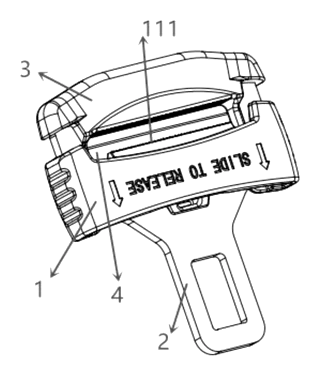
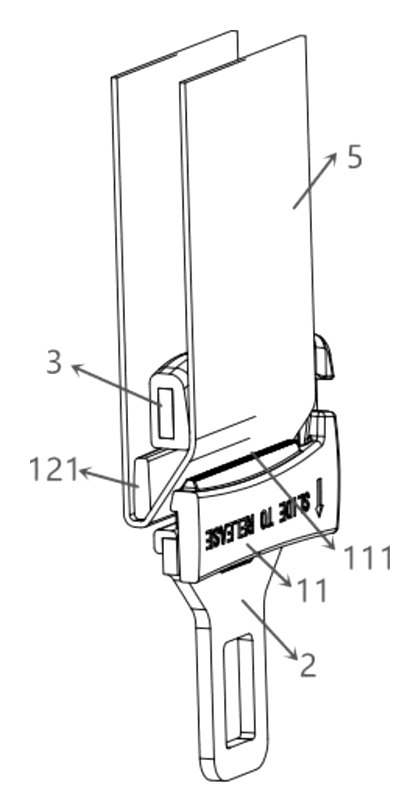
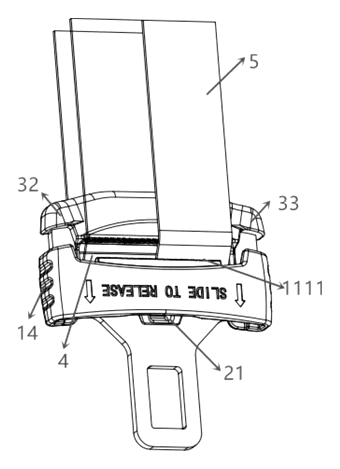
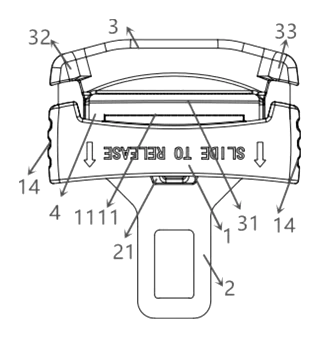
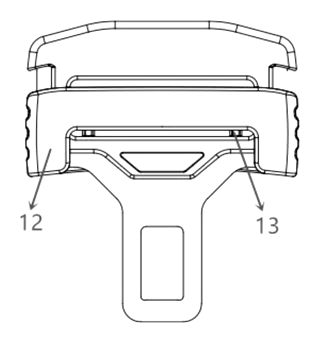
Drawings reproduced from the public patent document for reference.