At a glance
- Patent
- CN115005651B
- Assignee
- Youzhi Technology Shenzhen Co ltd
MoreLess
- Filed
- 2022-06-07
- Granted
- 2024-01-23
- Status
- China invention patent
- Expiry
- In force in China until at most 2042-06-07 (if annual fees are paid)
- Family
- CN115005651B only
- Outside China
- No US or other non-Chinese family member found (checked 2026-11-11)
- CPC
- A47G19/22
Key benefits
🔒
Sliding Internal Lock
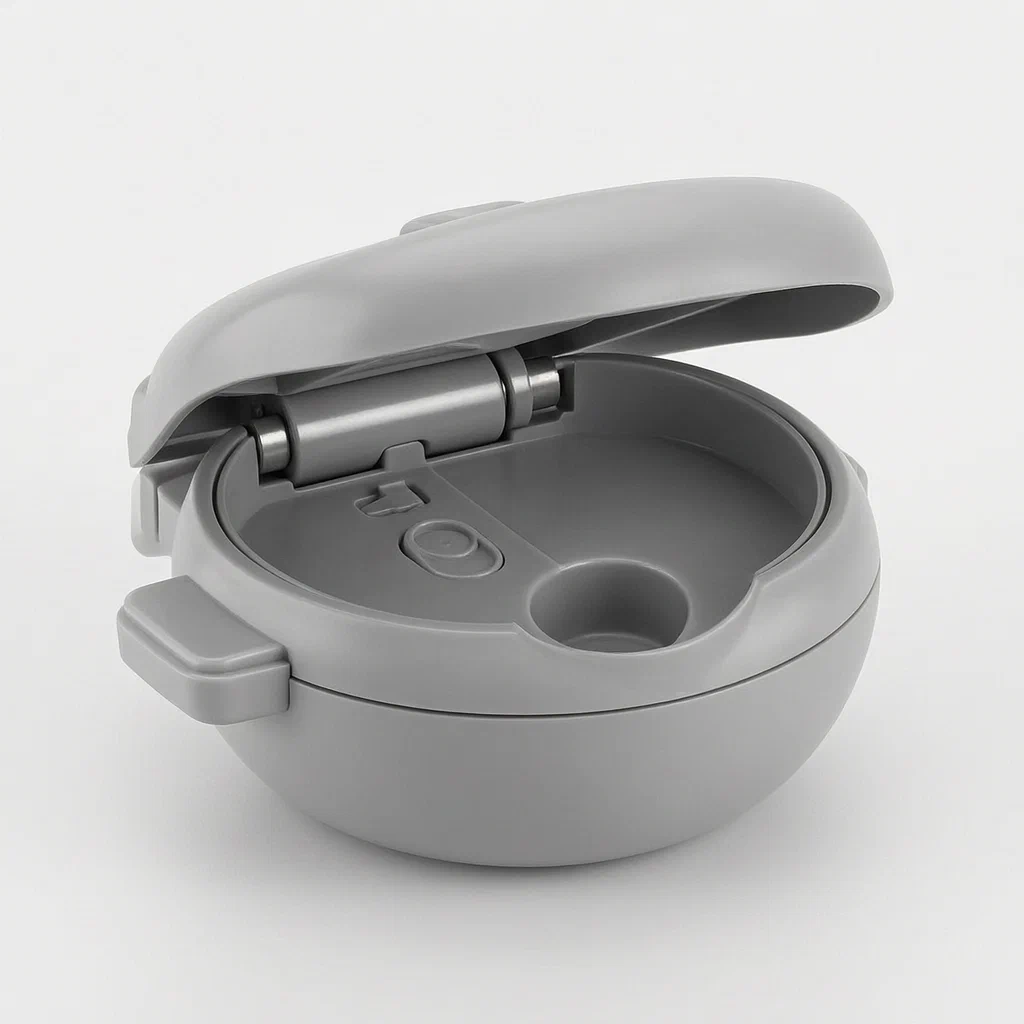
A movable cavity in the base holds a slider that latches the top cover securely closed.
🔄
One-Touch Auto Open
Pushing the handle’s protrusion releases the latch, allowing the elastic hinge to snap the lid open.
🛡️
Child-Safe Handle Lock
An optional pin-and-slide mechanism on the handle prevents accidental opening by children.
💧
Leak-Resistant Seal
A silicone gasket on the top cover presses against the drinking nozzle to stop leaks.
The problem
Many flip-top lids rely on simple friction or weak springs, leading to two common issues: they either pop open accidentally when bumped or require significant force to open while sealed. Additionally, without a positive mechanical lock, users cannot easily tell if the lid is fully secured, creating a risk of spills during transport. For parents, standard lids offer no protection against children opening them unsupervised.
Who it is for
- Travel Mug Brands: Need reliable leak-proof lids that don’t pop open in bags.
- Baby Bottle Manufacturers: Can utilize the optional child-lock feature on the handle.
- Outdoor Gear Companies: Require rugged, one-handed operation for cyclists and hikers.
- Office Drinkware Suppliers: Want premium lids with smooth, automatic opening actions.
Applications
Commuter Travel Mugs
Ideal for coffee cups carried in backpacks. The positive mechanical lock ensures the lid stays shut despite bumps, while the one-push opening allows easy drinking at stops.
Child-Proof Sippy Cups
Using the optional handle lock (Claim 5), parents can slide a pin into a hole to disable the opening mechanism. This prevents toddlers from accidentally spilling drinks or choking on small parts.
Outdoor Hydration Bottles
For hiking or cycling, the robust plastic construction and clear tactile feedback of the push-to-open action allow users to operate the lid with gloves or one hand without looking.
Office Desk Tumblers
Provides a premium feel with silent, smooth automatic opening. The integrated silicone seal keeps hot beverages warm and prevents leaks on desks, protecting electronics.
Where it is less suitable
- Carbonated Beverages: The pressure buildup may resist the elastic opening force or compromise the single-point seal.
- Extreme Heat Sterilization: Silicone elastic members and certain plastics may degrade under high-temperature steam sterilization typical for medical use.
- Very Large Jars: The lever arm required for the sliding lock becomes too long and fragile for wide-mouth containers like large food storage jars.
Business opportunity
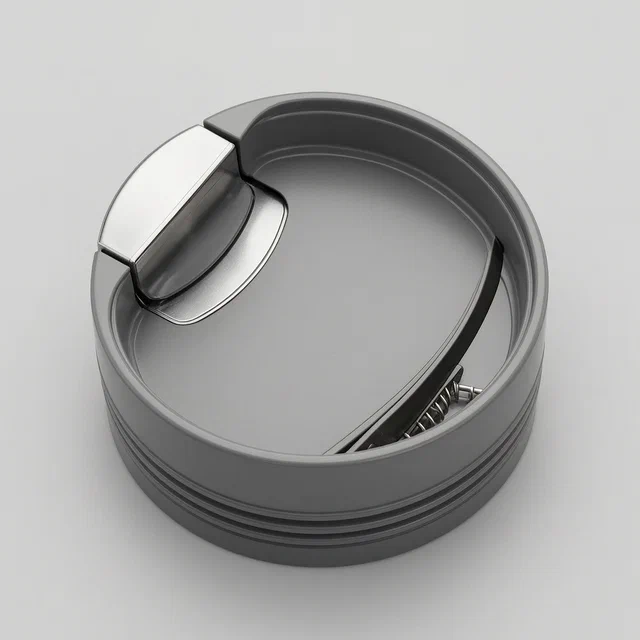
What it becomes commercially. The patent turns a drink lid into a moulded assembly: a bottom cover and a top cover share a hinged rotating shaft, a sliding locking piece sits in a movable cavity, and a clamping hook latches onto it. An elastic piece holds the lock closed and swings the lid open when the handle is pressed. The parts are moulded plastic plus a silicone seal, sold as an original-equipment lid, a replacement lid or an aftermarket accessory.
Who pays. The buyer depends on the channel. Drinkware brands buy against a tool and a launch date; households replacing a lost lid buy on a fitment list and price; promotional buyers buy on landed cost and delivery. All compare the lid with an ordinary press-fit or screw lid that costs less.
What decides the deal. What decides the deal is whether the lid seals, stays shut in a bag and opens with a thumb, then survives drops and washing without the slider jamming. Tooling and assembly cost decide whether a brand pays more for the mechanism.
IP2M grade: Potential Opportunity · medium confidence.
For the wider market — size, segments, buyers and compliance — see the U.S. Tumbler Lids report.
Production and customization
What this means for US production
This patent was filed in China and is currently active. Making or selling this specific design in China requires the owner’s permission. However, the public record shows no US counterpart. Therefore, producing this design in the United States does not infringe this specific Chinese patent, provided no other US patents apply.
Two points to settle early:
- Other patents may exist. Flip-top mechanisms for drinkware are a crowded field with many existing US patents covering various latch, spring, and hinge configurations. A freedom-to-operate (FTO) review is essential before mass production to ensure your specific implementation of the sliding lock and elastic return does not conflict with prior US art.
- Material Compliance. Since this is a food-contact item, the choice of plastics (PP vs ABS) and silicone grades must meet FDA requirements, which varies by supplier and region.
Customization and manufacturing
What can be customized
| Area | Options |
|---|---|
| Material | Food-grade PP, Tritan, or ABS for hard parts; FDA-compliant silicone for seals and springs. |
| Colors | Pantone-matched plastics; matte or glossy finishes. |
| Dimensions | Diameter and height adjusted to fit standard cup molds (e.g., 50mm, 60mm, 80mm necks). |
| Features | Add/remove the child-lock slide (Claims 3-6); integrate straw ports or vent holes. |
| Branding | Pad printing, laser etching, or in-mold labeling on the top cover. |
Things to plan for (US market)
- FDA 21 CFR Parts 177 & 178: All materials contacting food/drink must be compliant. Testing for extractables and leachables is standard.
- Prop 65 (California): Ensure no restricted substances (like certain phthalates or heavy metals) are present in paints or soft plastics.
- Consumer Product Safety Commission (CPSC): If marketed for children under 3, strict testing for small parts and durability is required.
- Lead Time: Injection tooling for multi-part assemblies (base, top, slider, handle) takes 8-12 weeks typically.
How a project runs
- Design Review: Confirm dimensions match your cup body; check FTO.
- Tooling: Create steel molds for the bottom shell, top cover, sliding piece, and handle components.
- Prototyping: T1 samples for fit, function, and seal testing.
- Certification: Submit final materials for FDA/Prop 65 testing.
- Production: Injection molding, silicone molding, assembly, and packaging.
Quantities & timeline
Molds for the complex internal cavity and the sliding lock require precision EDM. Assembly involves snapping the slider into the base and attaching the silicone spring. Send us your target quantity, cup diameter, material preferences, and branding needs and we will reply with options.
Production notes
Tooling and process
Injection molding is the primary process for the rigid plastic components (bottom shell, top cover, sliders). The complexity lies in the movable cavity for the slider, which likely requires a side-action mold or a separate insert to avoid undercut issues. Silicone parts (seals, elastic strips) are produced via compression or transfer molding. Assembly is largely manual or semi-automatic snap-fit.
Cost drivers
Part count is moderate (approx. 8-10 distinct pieces depending on the lock option). The need for precise tolerances in the sliding mechanism drives up mold costs. Material grade (food-safe PP/Tritan) affects raw material pricing. Packaging volume increases due to the bulky nature of assembled lids compared to flat discs.
Prototyping path
Start with 3D-printed bodies to verify the sliding lock engagement and hinge clearance. Use CNC machining for likely critical stress points such as the hook interfaces. Functional samples should typically test the elastic return force and leak resistance over multiple cycles.
What we would change before tooling
We would optimize the wall thickness of the sliding piece to prevent warping during cooling. We might simplify the “avoidance holes” geometry if they complicate the mold ejection. Ensuring the silicone elastic member has consistent durometer hardness is critical for reliable auto-opening.
Common failure points
Thin walls in the slider track may crack after repeated use. The silicone gasket can lose compression set over time, leading to leaks. Hinge bosses may wear out if the pivot point isn’t reinforced. Trapped residue in the narrow gap between the top and bottom covers can cause hygiene issues and sticking.
Full public record: bibliographic data, legal status, claims and drawings.
Frequently asked questions
How does the “one-touch” opening work?+
It relies on a mechanical latch rather than just friction. A sliding piece inside the base hooks onto the top cover, held tight by a silicone spring. When you press the protrusion on the handle, it pushes the sliding piece sideways, releasing the hook. The tension in the spring then instantly flips the lid open.
Is it really leak-proof?+
The patent describes a silicone gasket on the top cover that presses directly against the drinking nozzle. When the lid is locked closed, this creates a seal. However, effectiveness depends on the quality of the silicone and the precision of the mold. We recommend drop tests and pressure tests for each batch.
Does it have a child lock?+
Yes, Claims 3 through 6 describe an optional safety feature. A small pin on the handle can slide into a hole to block the pressing mechanism. This prevents children from activating the push-to-open function, adding a layer of safety for sippy cups or toddler bottles.
What materials are used?+
The structural parts (top, bottom, sliders) are typically made from food-grade plastics like Polypropylene (PP) or Tritan. The elastic member and the sealing gasket are made of silicone (referred to as silica gel in the patent translation). These materials are chosen for their flexibility and safety for food contact.
Why is the lid so tall?+
The height accommodates the internal mechanism. The bottom cover has a “movable cavity” that houses the sliding lock, and the top cover needs space to rotate without hitting the base. This adds bulk compared to simple screw-on lids but enables the automatic opening feature.
Can I use this with any cup?+
No. The bottom cover is designed to attach to specific cup neck diameters (often via threads, as mentioned in Claim 10). You would need custom tooling for the bottom cover interface to match your existing cup molds.
Can this design be made and sold in the US?+
The patent is active in China, but the public record shows no US counterpart. This means the Chinese patent does not restrict sales in the US. However, because flip-top lids are a competitive category, you must conduct a freedom-to-operate (FTO) search to ensure your specific version doesn’t infringe on other existing US patents.
Are you affiliated with the patent owner?+
No. IP2M is an independent design and manufacturing service working from the public patent document.

Page editor: Emily Zhang, Product Editor · IP2M
Last updated November 11, 2026. If something on this page looks wrong, email [email protected] and we will check it against the patent.