
Patent CN115025470B
Updated November 6, 2026Smart Table Tennis Racket with Motion Recognition and Ball Machine Linkage
Traditional ping pong practice requires a partner or a manual ball machine that throws random shots regardless of how you hit them. This disconnect makes it hard to train specific strokes effectively. A smart racket solves this by sensing your movement. Inside the handle or body, inertial measurement units track angular velocity, acceleration, and magnetic orientation. The onboard processor filters out noise and matches your swing pattern against stored 'standard' actions like forehand drives or backhand pushes. Once identified, the racket communicates wirelessly with a ball dispenser. If you swing for a forehand, the machine serves a forehand drill; if you miss the form, it can pause or adjust. This creates an automated coaching loop for players training alone or in groups.
- China invention patent - active
- No filings outside China
- Table tennis equipment
- IMU sensors, wireless comms, algorithmic comparison
Splat! What let you down?
🏓
Motion Recognition
Identifies specific swings like forehand drives via 3-axis sensor data.
🤖
Auto-Linkage
Sends signals to ball machines to serve corresponding drills instantly.
📊
Closed-Loop Training
System compares user action against standard libraries for feedback.
🌐
Multi-User System
Supports networking multiple rackets to a central console for classes.
Bring this product to market
- ✓ Patent review Patent family and legal status reviewed in the relevant jurisdictions.
- 2 Product brief · now How it works, uses and options written up
- 3 Prototype First samples for buyers to review
- 4 Pilot run Small first batch for launch customers
- 5 Volume production Repeat orders at scale
Buyer interest
– of 100 buyers needed to start prototyping
One click, no sign-up. Each vote is one real visitor, and products with the most interest go to prototyping first.
Build team: no members yet. Need a partner, co-funding or skills to build this? Join and we introduce the team once it forms.
Patent Rights & Team Participation
Before joining a development team, participants should ensure they have the necessary rights or authorization to participate in the project.
Participation is generally appropriate where:
- You own the relevant patent rights or have obtained permission or a license from the rights holder.
- The relevant patent rights have expired or have been legally invalidated in the jurisdictions where the planned activities will take place.
- The planned development, manufacturing, and commercialization activities have been independently assessed and do not infringe applicable patent rights in the relevant jurisdictions.
Important: Being located outside a country where a patent is protected does not automatically exempt you from patent infringement risks. Patent rights may apply based on where development, manufacturing, use, sale, or import activities take place.
IP2M does not grant any patent license or authorization through team participation. Joining a project does not provide permission to use, manufacture, or commercialize patented technology.
The problem
Practicing table tennis often relies on a human partner who may not be consistent, or a traditional ball machine that operates on fixed, pre-set intervals regardless of the player’s actual stroke execution. This leads to inefficient training: the player might receive a backhand shot while practicing forehands, or the machine keeps serving even when the player’s form is incorrect. For coaches managing large groups, tracking individual student progress in real-time is difficult without extensive manual observation. There is a need for equipment that recognizes the player’s intended action and adjusts the training environment automatically.
The solution
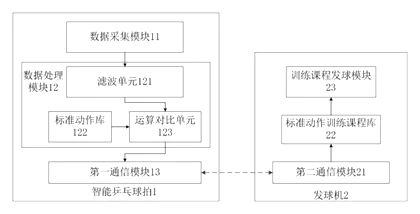
The patent describes an integrated system consisting of three main components: an intelligent racket, a service robot (ball dispenser), and a teaching network.
- Intelligent Racket: Contains a data acquisition module with X/Y/Z triaxial angular velocity, acceleration, and geomagnetic sensors. A data processing module filters this raw data, calculates motion attitude angles and speeds, and compares them against a “standard action library” using Euclidean distance algorithms to identify the swing type (e.g., forehand tap, backhand push).
- Service Robot: Communicates with the racket. It holds a library of training courses. Upon receiving a signal from the racket identifying a specific swing, it executes the corresponding ball dispensing routine.
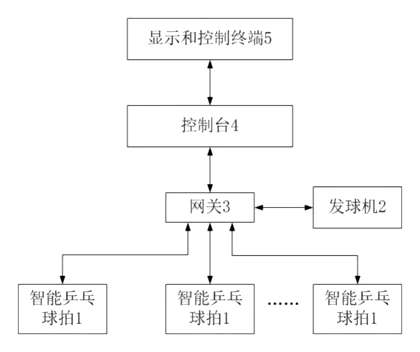
- Teaching System: Connects multiple rackets and robots via a gateway to a console and display terminal. This allows instructors to monitor student performance metrics and control which training mode each racket enters.
Who it is for
- Table Tennis Clubs and Academies: Need scalable solutions to coach many students simultaneously without one-on-one attention for every drill.
- Home Fitness Brands: Selling connected sports equipment that offers interactive training experiences for solo players.
- Educational Institutions: Implementing technology-enhanced physical education programs where objective data on motor skills is required.
- Consumer Electronics Manufacturers: Looking to enter the smart sports niche with hardware that combines mechanical design with software algorithms.
How it works
The main parts
| No. | Part | What it does |
|---|---|---|
| 1 | Intelligent Racket | Body housing sensors and processing chips. |
| 11 | Data Acquisition Module | Captures 3-axis gyro, accel, and mag data. |
| 12 | Data Processing Module | Filters noise, fits motion curves, compares to standards. |
| 121 | Filtering Unit | Removes sensor noise before analysis. |
| 122 | Standard Action Library | Stores reference data for correct swings. |
| 123 | Operation Comparison Unit | Calculates Euclidean distance to match user swing to standard. |
| 13 | First Communication Module | Sends swing ID to the robot/console. |
| 2 | Service Robot | Ball dispenser that receives commands. |
| 21 | Second Communication Module | Receives signals from the racket. |
| 22 | Training Course Library | Stores patterns for ball serving. |
| 23 | Training Course Service Module | Executes the serving pattern. |
| 3 | Gateway | Network bridge between devices and console. |
| 4 | Console | Central controller for data aggregation. |
| 5 | Display Terminal | Interface for users/coaches to see stats. |
Operating Steps
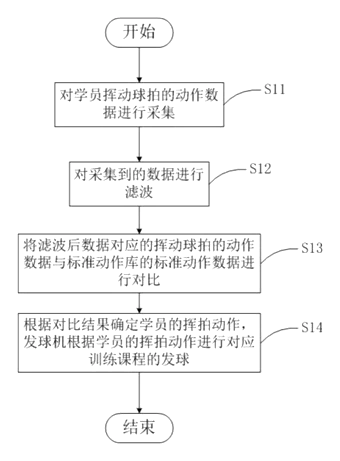
- Swing Detection: The player hits the ball. Sensors in the racket record the movement trajectory.
- Processing: The internal chip filters the data and compares the calculated motion angle/speed against stored “standard” profiles.
- Identification: If the match is within a threshold, the specific action (e.g., “Forehand Drive”) is identified.
- Transmission: The racket sends this identification code via its communication module.
- Response: The service robot receives the code and initiates the next ball serve appropriate for that drill, or the console logs the successful repetition.
Applications
Solo Home Training
A player uses the racket and a compact ball dispenser. The machine adapts the feed speed or spin based on whether the player successfully completes a forehand loop, allowing for self-paced improvement without a partner.
Group Coaching Classes
An instructor sets up multiple stations. Each student has a smart racket linked to a dispenser. The central console displays which students are performing the correct stroke, allowing the coach to intervene only when necessary.
Technique Correction Drills
The system is set to a strict mode. If the racket detects a “backhand push” but the student attempted a “forehand drive,” the dispenser pauses or the display terminal alerts the user, reinforcing proper muscle memory through immediate feedback.
Competitive Warm-ups
Athletes use the system to simulate specific opponent styles. By selecting a course in the library, the racket ensures they are practicing the exact returns needed for the upcoming match, with the machine providing consistent, targeted feeds.
Where it is less suitable
- High-Impact Professional Use: The electronics inside the racket may not withstand the extreme vibrations and impacts of professional tournament play compared to simple wooden/foam blades.
- Outdoor Play: Wireless connectivity and sensitive IMU calibration may struggle in environments with high interference or variable lighting conditions affecting visual aids.
- Low-Cost Entry Level: The requirement for batteries, charging docks, and app connectivity adds complexity and cost over basic rubber paddles.
Patent & Production
At a glance
| Patent number | CN115025470B (application CN202210749351) |
| Type | China invention patent (发明专利) - protects method and structure |
| Original title | Intelligent Table Tennis Bat, Service Robot and Intelligent Table Tennis Teaching System (智能乒乓球拍、发球机及智能乒乓球教学系统) |
| Patent owner | Shanghai Chuangyi Technology Co ltd |
| Inventors | Zhang Haibo, Liu Fuchuan, Zhang Ze, Zhang Wen, Chen Meng |
| Filing date | 2022-06-28 |
| Grant date | 2024-03-08 |
| Status (China) | In force - valid until at most 2042-06-28, subject to payment of annual fees |
| Patent family | Public record shows Chinese filings only - no US, European, Japanese, PCT or other filings listed |
| Cited by | 0 later documents |
| Source | Google Patents (search for CN115025470B) |
What the claims cover, in plain language
Claim 1 - An intelligent table tennis bat comprising a body, a data acquisition module, a data processing module, and a first communication module. The acquisition module gathers triaxial angular velocity, acceleration, and geomagnetic data. The processing module includes a filtering unit, a standard action library, and an operation comparison unit. The comparison unit fits filtered data to obtain motion attitude angles and speeds, then compares these against the standard library using Euclidean distance calculations within a sliding window to identify the swing type. The communication module sends this info to a service robot.
Claim 2 - Specifies that motion attitude angle is derived from integrating angular velocity, speed from integrating acceleration, and geomagnetic data compensates the angle. Claim 3 - Identifies specific motions covered: forward hand tapping, reverse hand pushing, and forward hand rolling. Claim 4 - Describes the service robot with a second communication module, a standard action training course library, and a training course service module that acts on instructions from the bat. Claim 5-6 - Details the interaction loop where the robot dispenses balls corresponding to the identified student swing. Claim 7 - Defines the full teaching system including the bat, robot, gateway, console, and display terminal, allowing multi-user networking and data recording. Claim 8 - Outlines the specific logic flow for a “main attack training course,” checking if the action is normal, and triggering the ball dispenser or an error reminder accordingly.
This is a simplified reading for orientation only. The legal scope is defined by the exact claim wording in the official Chinese document.
What this means for US production
This patent was filed in China and is currently in force. The public record shows no US or other foreign counterpart. Making or selling this specific configuration in China would require the owner’s permission. However, because there is no US patent family member, the public record shows no US counterpart restricting the design in the United States.
Two points to settle early:
- Other patents may exist. Smart sports equipment and ball machine automation are crowded fields with existing IP from major brands (e.g., Butterfly, Stiga, Spinshot). A freedom-to-operate (FTO) review is critical to ensure your implementation of IMU-based swing detection and wireless linkage does not infringe on broader US patents regarding sensor fusion or automated sports training methods.
- Software Liability. The claims rely heavily on algorithmic comparison (Euclidean distance, sliding windows). Ensure your firmware development respects open-source licenses if using libraries for these mathematical operations, as patent protection does not cover copyright of code.
Customization and manufacturing
What can be customized
| Area | Options |
|---|---|
| Sensor Placement | Handle-end cap vs. blade core integration |
| Communication Protocol | Bluetooth Low Energy (BLE), Wi-Fi, or proprietary RF for lower latency |
| Battery Capacity | Depends on usage hours per session; typically Li-ion |
| App Integration | UI/UX for the display terminal; cloud storage for student records |
| Ball Machine Compatibility | API hooks for third-party dispensers vs. proprietary robot |
| Racket Materials | Wood veneer, carbon fiber, or composite bodies to balance weight and durability |
Things to plan for (US market)
- FCC Certification: All wireless modules (Bluetooth/Wi-Fi) must be FCC Part 15 certified for unlicensed radio frequency devices.
- UL/Battery Safety: Lithium-ion batteries should comply with UL 2054 or IEC 62133 standards; shipping requires UN 38.3 testing.
- CPSC Guidelines: While not a toy, general product safety rules apply. Impact resistance and sharp edges on the racket body must meet ASTM D3574 or similar foam/rubber safety standards if applicable to consumer goods.
- Privacy Laws: If the system stores student data (names, performance metrics), compliance with COPPA (for children under 13) and state-level privacy laws (like CCPA) is required.
How a project runs
- Inquiry - Define target user (club vs. home), budget, and feature set.
- Design - Select MCU/Sensor stack, design racket mold for internal cavity, develop firmware for motion recognition.
- Prototype - Build functional samples with off-the-shelf sensors; test swing accuracy and wireless range.
- Pilot Run - Small batch assembly; validate FCC/UL compliance; field test with coaches.
- Production - Injection molding for plastic parts, CNC/machining for frames, PCB assembly, final packaging.
Quantities & timeline
Tooling for the racket body (especially if embedding electronics) requires precision molds to protect components from impact. Firmware development is the longest lead item due to calibration needs. Send us your target price, quantity, and desired features and we will reply with options.
Patent drawings
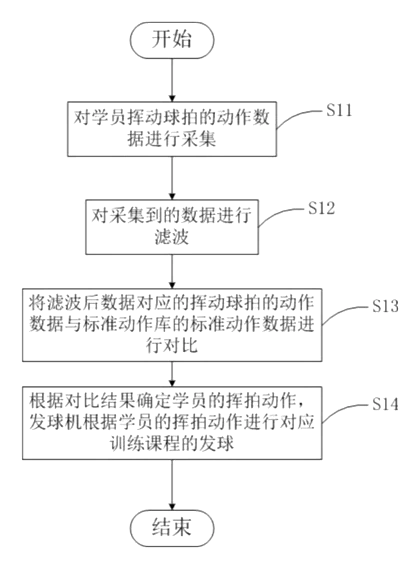
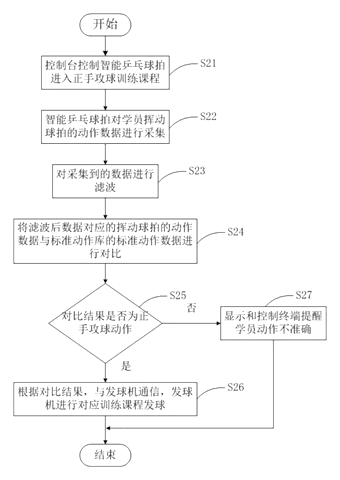
Drawings reproduced from the public patent document for reference.
Production notes
Tooling and process
The racket body likely requires glass-filled nylon injection molding for durable, lightweight shells that can house electronics. Internal brackets may use stamping or aluminum extrusion for rigidity. Assembly typically involves snap-fit mechanisms for quick battery access and screws for securing PCBs.
Cost drivers
Number of molds is typically a primary driver, especially if the racket shape is complex to accommodate sensors. Fastener count affects assembly time. Impact grade material selection increases resin costs but is necessary for longevity.
Prototyping path
Typically, start with 3D-printed parts to verify fitment of the IMU and battery. Move to a machined frame for initial strength tests. Create a functional sample with calibrated firmware to test swing recognition accuracy before committing to tooling.
What we would change before tooling
Ensure the magnet grade and retention of any mounting magnets are specified clearly, as vibration can dislodge weak magnets. Verify that the seam strength and edge finish of molded parts do not interfere with grip comfort.
Common failure points
Cracking under impact is the highest risk for embedded electronics housings. Bolts loosening due to repetitive vibration during play is common. UV degradation may affect external plastics if stored near windows.
Frequently asked questions
How does the racket know what swing I made?
It uses built-in sensors (gyroscope, accelerometer, magnetometer) to capture the movement data. The onboard processor filters this data and compares it against a library of “standard” swing patterns. If your movement matches the profile for a forehand drive, for example, it identifies that action.
Does it work with any ball machine?
The patent describes a dedicated service robot that communicates with the racket. However, the communication protocol could potentially be adapted to work with other machines if they support external triggers, though this would require custom integration.
Is the racket heavy?
Adding electronics and a battery increases weight compared to a standard paddle. Designers typically balance this by using lightweight materials like glass-filled nylon or optimized wood cores. Final weight depends on the specific component choices.
How long does the battery last?
The patent does not specify a duration. Battery life depends on the capacity chosen and how frequently the wireless transmission occurs. Typical designs aim for several hours of continuous play or days of standby.
Can coaches monitor students remotely?
Yes. Claim 7 describes a teaching system where multiple rackets connect via a gateway to a console. This allows a teacher to view real-time data and performance metrics for each student on a display terminal.
What happens if my form is wrong?
According to the patent, if the detected action does not match the expected “normal” action for the selected course, the system can stop the ball dispenser or send a reminder to the display terminal to alert the student.
Can this design be made and sold in the US?
The patent is in force in China, but the public record shows no US counterpart. Therefore, this specific patent does not restrict making or selling the design in the US. However, other US patents in the smart sports or ball machine field may apply, so a freedom-to-operate check is recommended.
Are you affiliated with the patent owner?
No. IP2M is an independent design and manufacturing service working from the public patent document.
Request a quote
Click Request a Quote below to see our email address - copy it, or open your email app with a ready-made message. Please mention patent CN115025470B in the subject.
Helpful details to include:
- Your company and channel (sports club, home fitness brand, educational institution)
- Target user (solo player, group class, competitive athlete)
- Connectivity preference (Bluetooth, Wi-Fi, or wired console link)
- Desired features (app interface, data logging, specific swing types)
- Estimated quantity and target price
- Timeline - when you would like prototypes and mass production
You can also reach us at (332) 203-9997.
Page editor: Emily Zhang, Product Editor · IP2M
Last updated November 6, 2026. If something on this page looks wrong, email [email protected] and we will check it against the patent.
Interested in building this?
Tell us your target market, quantity and timeline. We reply with options for prototyping, small-batch runs or volume production.
Send your inquiry to
Please put CN115025470B in the subject line and tell us your company, country, estimated quantity and timeline.
Prefer to talk? Call (332) 203-9997.
More product-ready patents
All Sports & Recreation patents →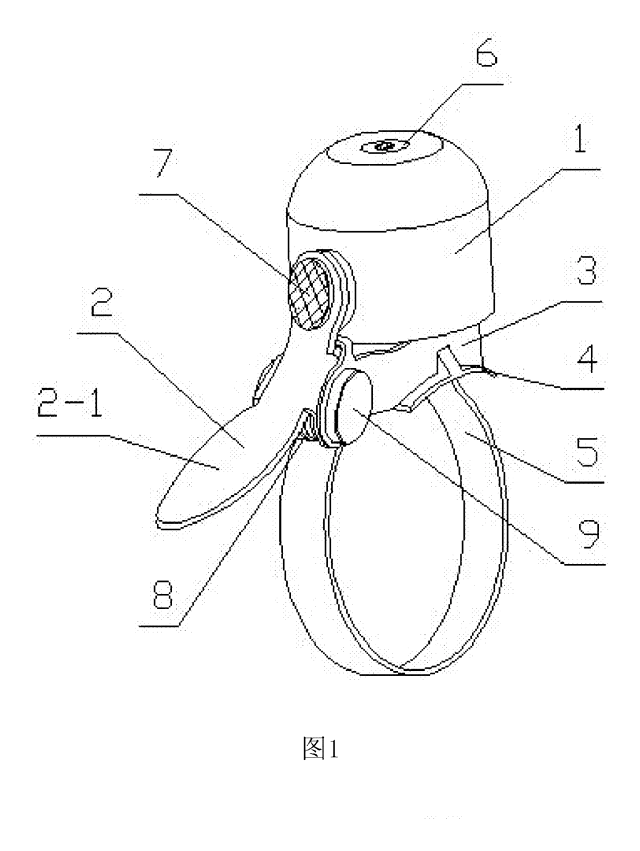
Sports & Recreation
Compact Torsion-Spring Bike Bell
Mini bike bell with a standard torsion spring and a rubber-floated dome - small size, clear tone, quick strap mount.
Patent CN205819384U
Sports & Recreation
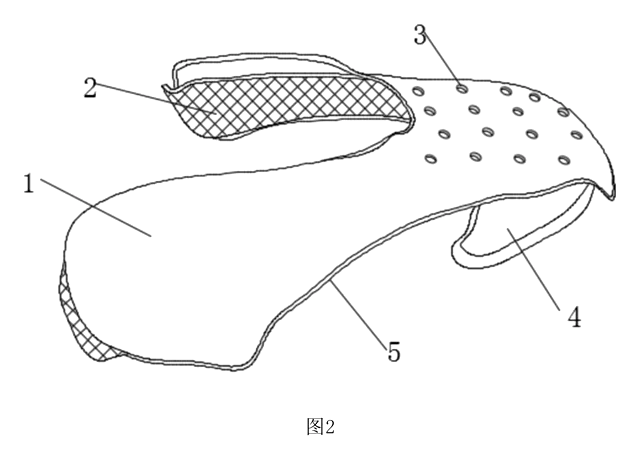
Padded Toe-Box Shield for Sneakers
Ventilated, silicone-lined toe-box insert that supports the front of a sneaker and cushions the toes.
Patent CN209473731U
Sports & Recreation
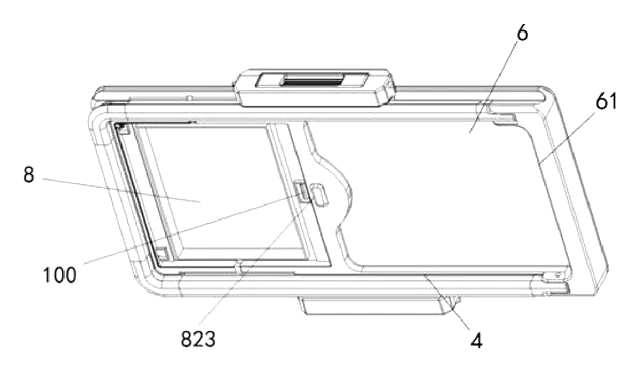
Reversible Fishing Seat-Box Lid with Backrest
Fishing seat-box lid that flips on removable hinge pins: cushion, backrest and storage on one face.
Patent CN208624426U
Sports & Recreation
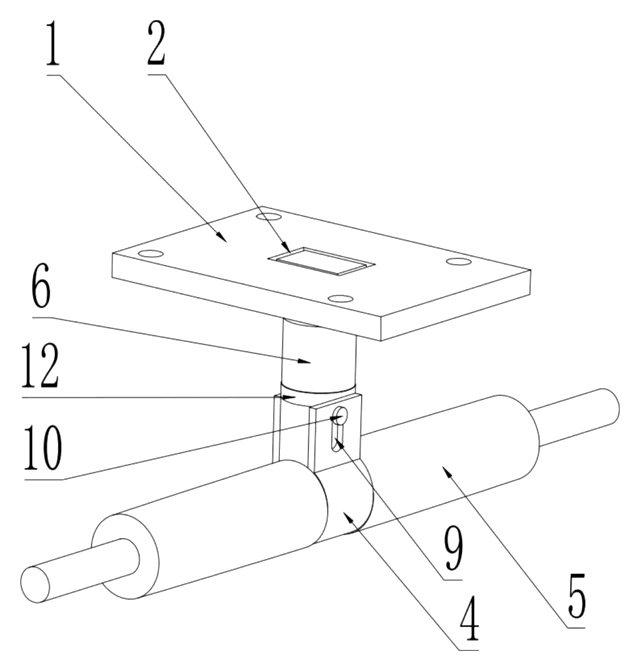
Swivel-Pin Skateboard Truck with Rubber Sleeve
Skateboard truck with a turning center pin, a tilting axle clamp and a rubber sleeve that centers it.
Patent CN216777880U
Sports & Recreation
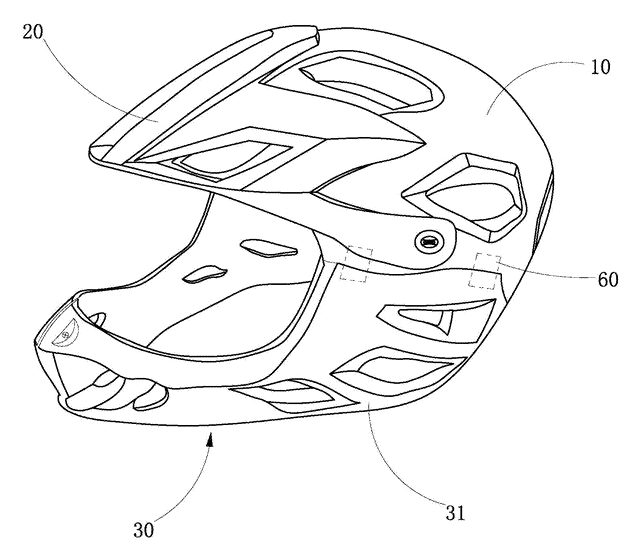
Full-Face Bike Helmet with Magnetic Detachable Chin Bar
Full-face cycling helmet whose chin bar clips on and off with magnetic, latching side connectors.
Patent CN206630067U
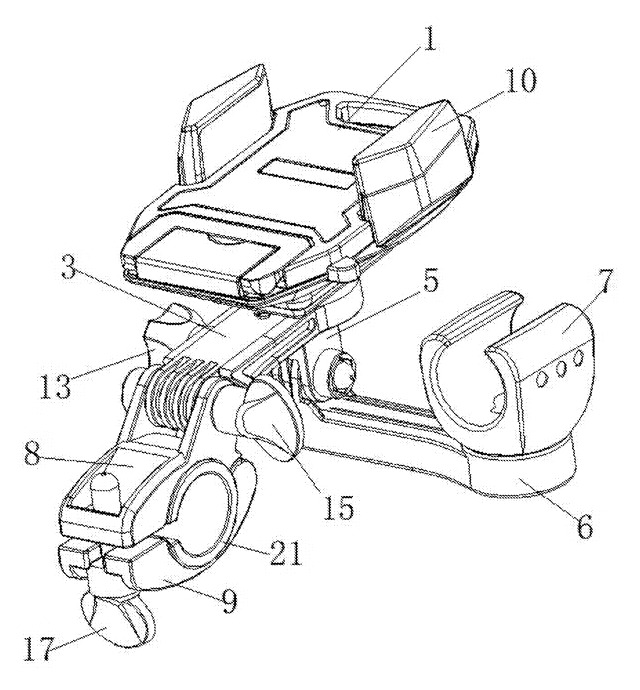
Sports & Recreation
Bike Phone Holder with Built-In Flashlight Clamp
Handlebar mount with a phone cradle on top and a flashlight clamp below, on one arm.
Patent CN206077485U
Browse by category
- Apparel & Accessories (44)
- Baby & Kids (28)
- Bags & Luggage (16)
- Bath & Personal Care (29)
- Car Accessories (23)
- Furniture, Bedding & Storage (23)
- Garden & Outdoor (31)
- Health & Wellness (13)
- Home, Kitchen & Cleaning (47)
- Lighting (22)
- Packaging & Containers (11)
- Pet Products (11)
- Phone & Camera Accessories (9)
- Retail Display (24)
- School, Office & Art (33)
- Sports & Recreation (43)
- Tools & Workshop (51)
- Toys & Games (21)
This page is based on the public patent document CN115025470B, assigned to Shanghai Chuangyi Technology Co ltd. IP2M is an independent manufacturing service and is not affiliated with, endorsed by or licensed by the patent owner. Images marked as concept renderings are illustrations, not photos of an existing product. Patent status information is provided for reference only and is not legal advice; confirm freedom to operate for your market before production. Full disclaimer.