At a glance
| Patent number | CN115091883B (application CN202210805544) |
| Type | China invention patent (发明专利) - protects product structure and method |
| Original title | A nib thickness adjusting structure and electric pencil sharpener (一种笔尖粗细调节结构及电动削笔器) |
| Patent owner | Guangzhou Eagle Technology Development Co ltd |
| Inventors | Chen Zhongheng, Liang Jiwu, Li Changhua |
| Filing date | 2022-07-08 |
| Grant date | 2023-11-24 |
| Status (China) | In force - valid until at most 2042-07-08, subject to annual fee payments |
| Patent family | Chinese filings only - no US, European, Japanese, PCT or other filings listed |
| Cited by | 0 later documents |
| Source | Google Patents (search for CN115091883B) |
What the claims cover, in plain language
Claim 1 defines an electric pencil sharpener comprising a box body, a positioning tube, and a rotary cylinder. Key features include a rotating disc with a knife rest holding a spring-loaded blade, and a bar-shaped rod on the side. The rod has a positioning plate moved by a screw rod to adjust for pencil length. A collecting box is locked by the rod’s position. The rod also interacts with an arc-shaped groove to lock the vertical or horizontal state.
Claim 2 specifies the drive mechanism: a motor connects to a rotating rod with a gear that meshes with a ring gear on the rotary cylinder, covered by a protective shell.
Claim 3 adds a placement plate on top with pencil grooves for storage.
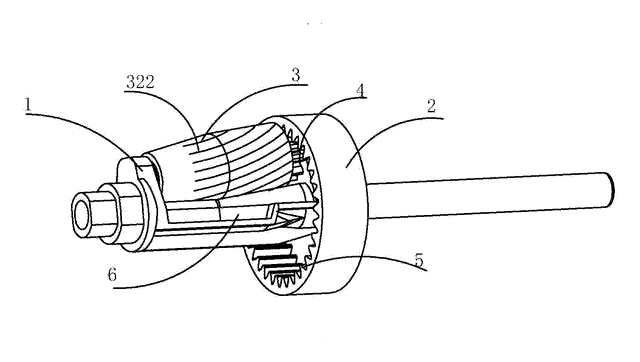
Claims 4-5 describe the nib thickness adjusting structure: a limiting plate and block on the rotating disc, controlled by an adjusting screw, which restricts the movement of the blade’s movable block to determine the sharpness depth.
This is a simplified reading for orientation only. The legal scope is defined by the exact claim wording in the official Chinese document.
What this means for US production
This patent was filed only in China and is currently in force. Making or selling this specific configuration in China requires the owner’s permission. There is no US or other foreign counterpart.
Two points to settle early:
- Other patents may exist. US manufacturers have filed many patents on pencil sharpener gear ratios, blade shapes, and safety interlocks. Before tooling, a freedom-to-operate (FTO) review should cover the specific combination of length adjustment and thickness limiting, so the design does not infringe other active IP in the target market.
- Safety Interlocks. US buyers often require automatic shut-off when the shavings tray is removed. The current design uses a mechanical lock via the bar rod; verifying if this meets UL or CPSIA expectations for child-safe operation is critical.
Customization and manufacturing
What can be customized
| Area | Options |
|---|---|
| Housing Material | ABS or PP injection molding; color options |
| Blade Type | Stainless steel or carbon steel blades; replaceable cartridge designs |
| Adjustment Range | Screw thread pitch for finer length control |
| Thickness Settings | Number of discrete stops vs. continuous screw adjustment |
| Power Source | AC adapter or battery compartment (AA/AAA) |
| Finish | Matte or glossy texture; custom branding printing |
Things to plan for (US market)
- ASTM F963 - Standard Consumer Safety Specification for Toy Safety, if marketed to children under 14.
- UL 982 / UL 1082 - Standards for household appliances and portable electric tools, relevant for motorized sharpeners.
- FCC Part 15 - Electromagnetic interference testing for the motor and electrical components.
- California Prop 65 - Screening of plastics and metals for restricted substances.
How a project runs
- Inquiry - Define target price, volume, and feature set (battery vs. AC).
- Design - Finalize mold flow analysis for housing, gear ratios, and adjustment tolerances.
- Prototype - 3D-printed samples for fit checks; off-the-shelf springs for initial function tests.
- Pilot Run - Cycle testing for blade wear, screw mechanism durability, and motor heat buildup.
- Production - Injection molding, stamping for metal parts, motor assembly, and final packaging.
Quantities & timeline
The housing requires precision injection molds, typically taking 4-6 weeks to build. Metal gears and shafts involve stamping or machining processes. Assembly complexity increases with the dual adjustment mechanisms (length and thickness). Certification testing for safety and EMC usually takes 4-8 weeks. Send us your target quantity, power preference, and aesthetic requirements and we will reply with options.
Production notes
Tooling and process
Injection molding is likely required for the ABS/PP housing to achieve the complex internal ribs for the screw and guide rails. Stamping or powder metallurgy might be used for the gears and blade holders, depending on volume. Motor assembly involves precise alignment of the output shaft with the gear train.
Cost drivers
The number of molds is typically a primary driver, especially if the thickness adjuster requires separate small parts. Spring quality and consistency affect performance, potentially increasing sourcing costs. Additional assembly steps for the sliding positioning plate add labor time. Packaging must protect the protruding bar rod during shipping.
Prototyping path
Start with 3D-printed samples to verify the screw-driven length adjustment mechanism. Use off-the-shelf springs and motors for initial function and cycle tests. Print trials for the housing can check fit before committing to steel tooling.
What we would change before tooling
We would likely simplify the arc-groove locking mechanism if alternative latches provide similar stability. Review wall thicknesses in the housing to prevent cracking near the screw rod interface. Ensure the blade cartridge is easily accessible for replacement to reduce warranty returns.
Common failure points
Hinge fatigue on the bar-shaped rod could cause misalignment over time. Clip spring loss or fatigue may result in inconsistent nib thickness. Sharp edges on the blade or housing joints pose safety risks. Thread engagement issues in the plastic screw rod could strip under repeated adjustment.
Patent drawings
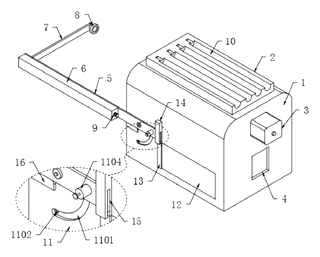
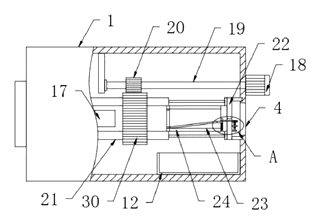
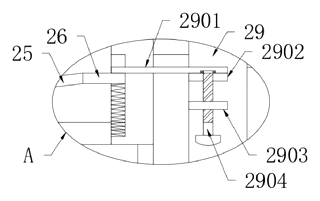
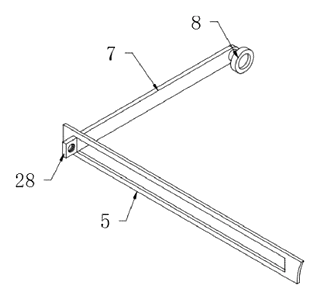
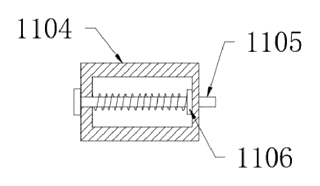
Drawings reproduced from the public patent document for reference.