
Patent CN115127051B
Updated October 28, 2026Truss-Type Foldable Desk Lamp with Longitudinal and Transverse Guide Adjustment
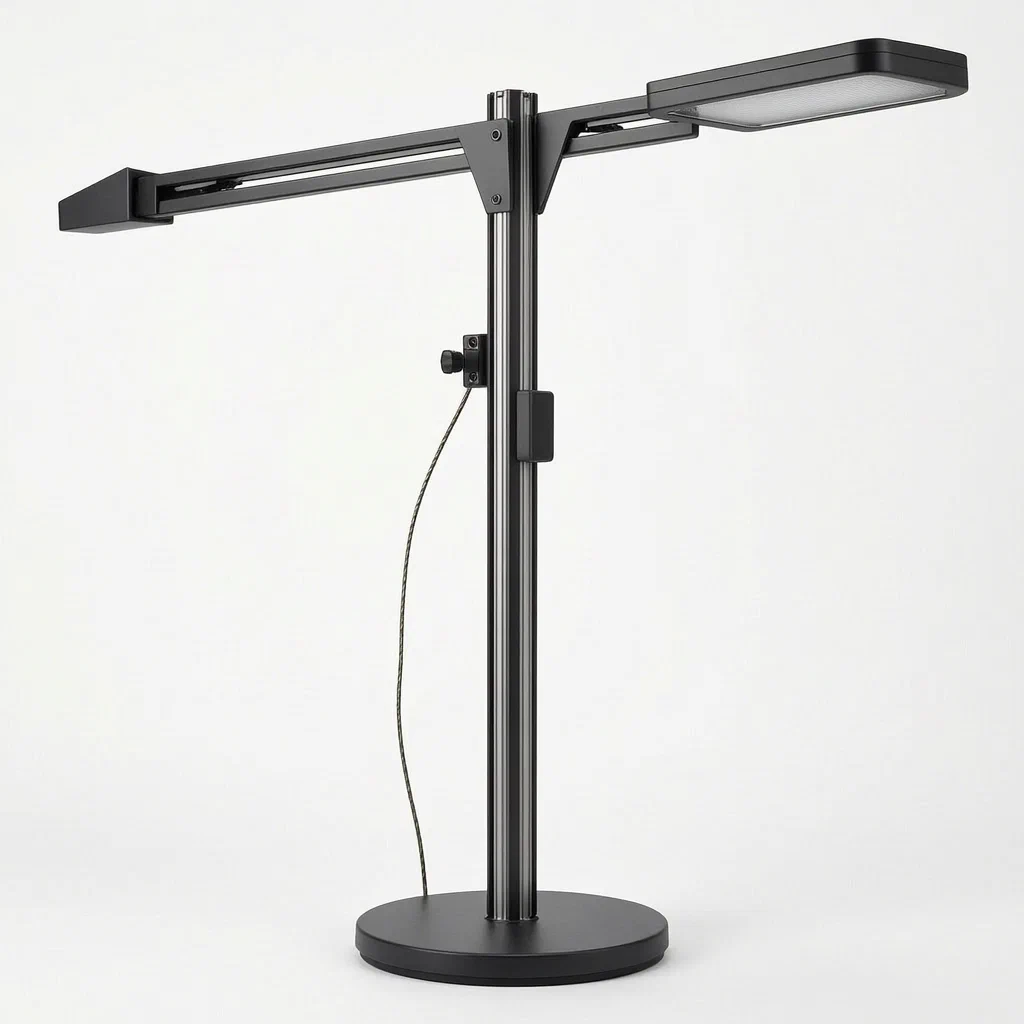
Standard desk lamps often rely on simple friction joints that loosen over time or limit where the light can reach. This design uses a truss framework with separate vertical and horizontal guide devices. The vertical guide slides along a first support rod, balanced by a counterweight linked through a traction rope. The horizontal guide slides along a second support rod, rotating on the vertical slider. An isosceles trapezoid-shaped avoidance hole with two opposing springs keeps the horizontal arm steady. When the user tilts the arm to adjust height, shifting shafts release the friction-based longitudinal lock automatically. A pneumatic transverse locking mechanism holds the horizontal position, released by a driving mechanism on the lampshade. Together, these parts let the lampshade move smoothly in both directions and lock firmly when released.
- China invention patent - in force
- No filings outside China
- Desk & task lighting
- Sliding guides, pneumatic lock, counterweight
Splat! What let you down?
↕️
Dual-axis sliding
The lampshade moves along both a vertical support rod and a horizontal support rod for precise positioning.
⚖️
Counterweight balance
A traction rope links the vertical slider to a counterweight, reducing the effort needed to change height.
🔒
Pneumatic transverse lock
A pneumatic mechanism locks the horizontal arm, released via a driving component on the lampshade.
🔄
Linked unlocking
Tilting the horizontal arm rotates shifting shafts that automatically release the vertical friction lock.
Bring this product to market
- ✓ Patent vetted China-only family and legal status checked
- 2 Product brief · now How it works, uses and options written up
- 3 Prototype First samples for buyers to review
- 4 Pilot run Small first batch for launch customers
- 5 Volume production Repeat orders at scale
Buyer interest
– of 100 buyers needed to start prototyping
One click, no sign-up. Each vote is one real visitor, and products with the most interest go to prototyping first.
Build team: no members yet. Need a partner, co-funding or skills to build this? Join and we introduce the team once it forms.
The problem
Task lamps need to cover a wide area above a desk, but many adjustable arms rely on tight friction joints that wear out, making the lamp droop or shake during adjustment. Reaching different heights and distances usually requires loosening multiple knobs one by one. When the arm is extended far from the base, the center of gravity shifts, causing instability or requiring heavy, bulky bases to compensate. Users also experience jerky movements when releasing a locked joint under tension, which makes fine positioning difficult.
The solution
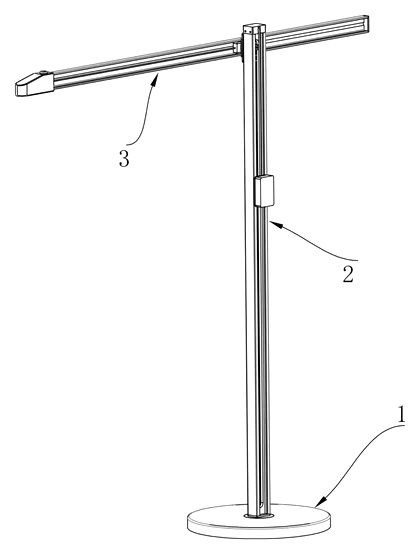
This lamp separates vertical and horizontal movement into two distinct guide devices mounted on a base.
- The longitudinal guide device uses a first support rod pivoting on the base. A first sliding assembly moves along one side, while a counterweight assembly moves along the opposite side, linked by a traction rope.
- A longitudinal locking mechanism uses friction blocks pressed against the inner wall of the first support rod by locking sliders.
- The transverse guiding device features a second support rod carrying the lampshade. A second sliding assembly slides along this rod and rotates on the first sliding assembly.
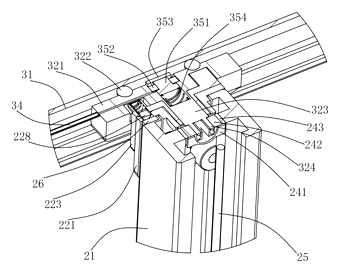
- Inside the second sliding assembly, an isosceles trapezoid-shaped avoidance hole receives a first boss from the vertical slider. Two first springs press against the upper and lower surfaces of this boss to keep the horizontal arm level.
- Tilting the second support rod turns shifting shafts that pull the locking sliders inward, releasing the vertical lock without extra levers.
- A pneumatic transverse locking mechanism secures the horizontal position, operated by a pneumatic unlocking driving mechanism on the lampshade through a telescopic connecting pipe.
Who it is for
- Lighting brands and OEM buyers looking for a task lamp architecture that offers smooth dual-axis adjustment without standard knob-and-clamp joints.
- Office furniture suppliers needing desk lamps that maintain stability across a wide working surface while folding flat for shipping or storage.
- Architectural and drafting equipment distributors serving professionals who require precise, repeatable light positioning over large drawing boards.
- Amazon sellers and e-commerce retailers offering differentiated home-office lighting with mechanical features that stand apart from basic gooseneck models.
How it works
The main parts
| No. | Part | What it does |
|---|---|---|
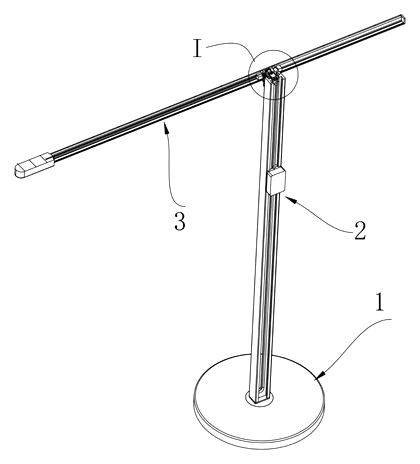
| 1 | Base | Supports the entire lamp structure. |
| 21 | First support rod | Vertical guide rail, rotatably connected to the base. |
| 22 | First sliding assembly | Slides along the first support rod; carries the first boss (224). |
| 23 | Counterweight assembly | Slides on the opposite side of the first support rod to balance the lamp. |
| 24 | Longitudinal locking mechanism | Locking seat (241), locking sliders (242), and friction blocks (243) grip the rod’s inner wall. |
| 25 | Traction rope | Connects the first sliding assembly to the counterweight assembly. |
| 31 | Second support rod | Horizontal guide rail holding the lampshade. |
| 32 | Second sliding assembly | Slides along the second support rod; rotates on the first sliding assembly. Contains the avoidance hole, springs (37), and shifting shafts (324). |
| 33 | Lampshade | Fixed to the end of the second support rod; houses the pneumatic unlocking driving mechanism. |
| 34 | Telescopic connecting pipe | Links the pneumatic unlocking mechanism to the transverse lock. |
| 351-354 | Pneumatic transverse lock | First piston (351), sealing ring (352), second friction block (353), and second spring (354) lock the horizontal position. |
Operating steps
- To lower the lamp: Press down on the second support rod. The rod tilts, compressing one of the first springs. The shifting shafts enter the strip-shaped holes of the locking sliders, pulling the friction blocks away from the first support rod’s inner wall. The first sliding assembly is now free to slide down, assisted by the counterweight moving up via the traction rope.
- To raise the lamp: Apply upward force to the second support rod. The same tilting action releases the longitudinal lock, allowing the user to lift the lamp while the counterweight descends.
- To lock the height: Release the pressure on the second support rod. The first springs push the second sliding assembly back to its neutral angle. The shifting shafts release the locking sliders, and the second spring forces the friction blocks back against the inner wall of the first support rod.
- To adjust horizontally: Actuate the pneumatic unlocking driving mechanism on the lampshade. Air travels through the telescopic connecting pipe to retract the first piston and second friction block, freeing the second sliding assembly to move along the second support rod. Release the mechanism to lock again.
Applications
Home office desks
Users working at computers frequently shift between reading documents and typing. The dual-axis sliding allows the lampshade to move out of the way horizontally or drop closer vertically without unclamping joints, keeping the desk clear.
Drafting and architecture studios
Drafting tables require light to be positioned precisely over specific areas of a large blueprint. The counterweight system lets the user glide the lamp to a new spot with minimal effort, while the friction lock prevents drift once placed.
Workbenches and hobby stations
Model builders and electronics technicians need focused light that stays rigid. The pneumatic transverse lock and the friction-based vertical lock prevent the arm from sagging under vibration or accidental bumps during detailed work.
Retail display counters
Jewelry or watch displays benefit from directed lighting that can be folded flat when the counter is closed. The truss structure folds neatly, and the locking mechanisms ensure the light points exactly at the displayed items during business hours.
Where it is less suitable
- Bedside reading lamps - the mechanical sliding tracks and exposed rods take up more visual space than a simple bedside fixture.
- Outdoor or damp environments - the pneumatic components, springs, and open sliding tracks are designed for indoor use.
- Lowest-cost promotional lighting - the number of machined parts, pneumatic elements, and springs places this in a higher manufacturing tier than basic clip-on lights.
Frequently asked questions
How do the vertical and horizontal adjustments work together?
The lamp uses two separate guide devices. The vertical slider moves up and down a first support rod, while the horizontal slider moves along a second support rod attached to it. Tilting the horizontal arm mechanically releases the vertical lock, allowing height changes. A pneumatic system controls the horizontal sliding lock independently.
What keeps the lamp from falling when I let go?
When you release the horizontal arm, internal springs return it to a neutral angle. This motion disengages the shifting shafts, allowing friction blocks inside the vertical lock to press firmly against the inner wall of the support rod. The pneumatic lock simultaneously holds the horizontal slider in place.
Why is there a counterweight?
A counterweight assembly rides on the back of the vertical rod, connected to the front slider by a traction rope. It offsets the weight of the horizontal arm and lampshade, meaning the user only needs minimal force to raise or lower the light.
What does the pneumatic part actually do?
The pneumatic transverse locking mechanism clamps the horizontal slider to the second support rod using a piston and friction block. Pressing the unlocking driving mechanism on the lampshade sends air through a telescopic connecting pipe to retract the piston, letting you slide the lampshade closer or further away.
Can the lamp fold flat for shipping?
Yes. The patent describes a foldable truss structure. The first support rod rotates on the base, and the horizontal arm can pivot, allowing the entire assembly to collapse into a compact profile for packaging.
Is the light source included in the patent?
The patent focuses entirely on the mechanical truss structure, sliding guides, and locking mechanisms. It mentions that an external lamp body is mounted on the lampshade, but the electrical or optical design of the light itself is left to the manufacturer.
Can this design be made and sold in the US?
The patent was filed only in China and is currently in force there, but no US or other foreign counterpart exists. Therefore, the Chinese patent alone does not restrict manufacturing or selling the lamp in the US. However, because adjustable desk lamps are covered by many other US patents, we recommend a freedom-to-operate check before volume production.
Are you affiliated with the patent owner?
No. IP2M is an independent design and manufacturing service working from the public patent document.
Request a quote
Click Request a Quote below to see our email address - copy it, or open your email app with a ready-made message. Please mention patent CN115127051B in the subject.
Helpful details to include:
- Your company and channel (lighting brand, office supplier, Amazon seller, distributor)
- Target dimensions for maximum height and horizontal reach
- Preferred materials for the frame and sliding parts
- Light source type you plan to integrate (LED module, bulb socket)
- Estimated quantity and target price
- Timeline - when you would like prototypes and the first shipment
You can also reach us at (332) 203-9997.
Explore this product
Interested in building this?
Tell us your target market, quantity and timeline. We reply with options for prototyping, small-batch runs or volume production.
Send your inquiry to
Please put CN115127051B in the subject line and tell us your company, country, estimated quantity and timeline.
Prefer to talk? Call (332) 203-9997.
More product-ready patents
All Lighting patents →
Lighting
Wrist-Worn Flashlight with Click-Lock Angle Adjustment
Rechargeable wrist flashlight whose lamp turns and locks at an angle with a push button.
Patent CN113915544B
Lighting
Self-Folding Desk Lamp That Turns into a Phone Stand
Desk lamp with a shape-memory stem that unfolds when warm and folds into a phone stand.
Patent CN213237087U
Lighting
Ring-Shaped Outdoor Lantern That Lifts Off a Power-Bank Charging Base
Ring lantern with a battery handle that docks in a cone base with its own battery, clamp and charging plug.
Patent CN212408329U
Lighting
LED Flameless Candle with an Outside Flame Shade and Wax Dish Top
Battery LED candle: flame shade stands above a dished wax top, angled LEDs light a printed wick.
Patent CN205424561U
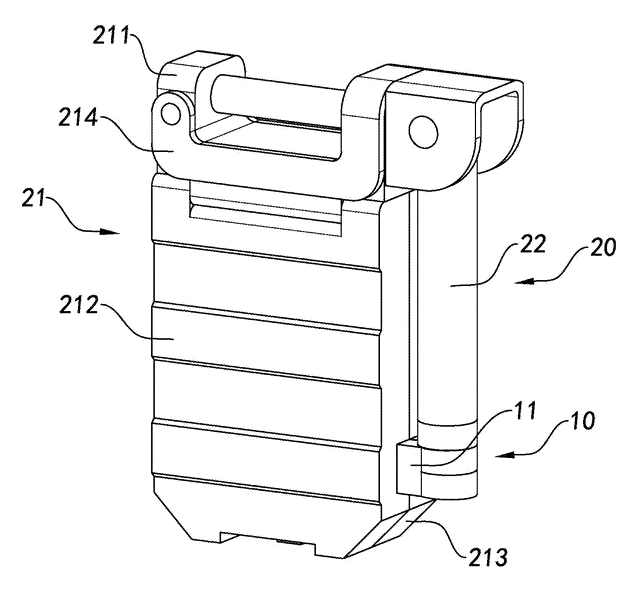
Lighting
Telescoping Tripod Portable Work Light with Fold-In Light Panels
Telescoping tripod work light with dual light panels that fold flat into the base.
Patent CN207298471U
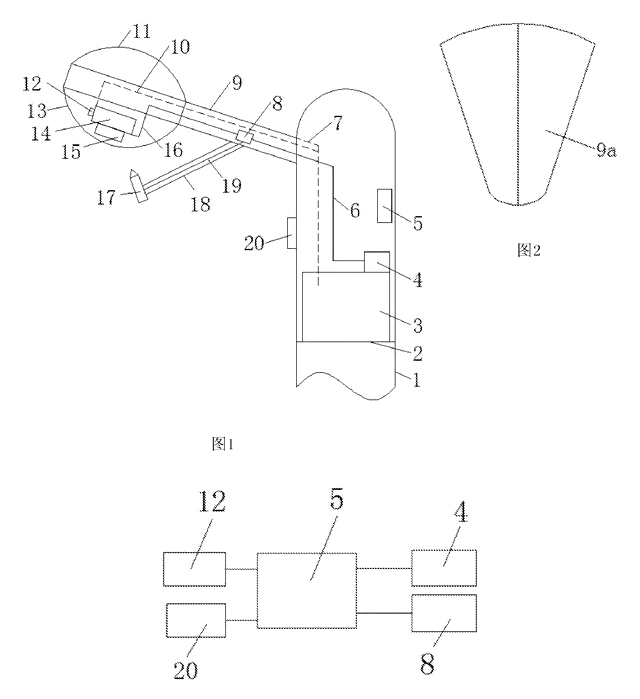
Lighting
Self-Cooling and Self-Cleaning LED Street Light with Rainwater Harvesting
LED street lamp that harvests rain to cool its heat sink and spray-wash the lens automatically.
Patent CN205480639U
Browse by category
- Apparel & Accessories (22)
- Baby & Kids (16)
- Bags & Luggage (9)
- Bath & Personal Care (16)
- Car Accessories (10)
- Furniture, Bedding & Storage (12)
- Garden & Outdoor (18)
- Health & Wellness (8)
- Home, Kitchen & Cleaning (24)
- Lighting (12)
- Packaging & Containers (6)
- Pet Products (6)
- Phone & Camera Accessories (4)
- Retail Display (13)
- School, Office & Art (19)
- Sports & Recreation (25)
- Tools & Workshop (27)
- Toys & Games (12)
This page is based on the public patent document CN115127051B, assigned to Walsun Lighting Huizhou Co ltd. IP2M is an independent manufacturing service and is not affiliated with, endorsed by or licensed by the patent owner. Images marked as concept renderings are illustrations, not photos of an existing product. Patent status information is provided for reference only and is not legal advice; confirm freedom to operate for your market before production. Full disclaimer.