
Patent CN115153211B
Updated October 30, 2026Dressing Table with Rotary Light Compensating Mirror
Standard vanity mirrors are fixed or require awkward manual tilting, and built-in lights often stay on all day, wasting energy and glare. This design solves both issues. A rack-and-pinion system allows the mirror to rotate smoothly left or right with a simple pull of a side handle, returning to center via elastic tension. Proximity sensors detect the user’s presence, automatically switching on the front and side LED strips only when needed. Storage is integrated directly into the base frame, keeping cosmetics organized and out of sight until required.
- China invention patent - active
- No filings outside China
- Bedroom furniture & vanities
- Rack-and-pinion rotation, proximity sensors, LED strips

Splat! What let you down?
🔄
Gear-Driven Rotation
Pull a side rack to rotate the mirror smoothly; elastic ropes return it to center.
💡
Sensor-Controlled Lights
Proximity sensor turns LED strips on when you approach and off when you leave.
📦
Integrated Storage
Sliding frames hold large items; pull-out drawers organize small cosmetics.
🛡️
Manual Light Shield
A screw-driven folding plate blocks light from the sides if desired.
Bring this product to market
- ✓ Patent vetted China-only family and legal status checked
- 2 Product brief · now How it works, uses and options written up
- 3 Prototype First samples for buyers to review
- 4 Pilot run Small first batch for launch customers
- 5 Volume production Repeat orders at scale
Buyer interest
– of 100 buyers needed to start prototyping
One click, no sign-up. Each vote is one real visitor, and products with the most interest go to prototyping first.
Build team: no members yet. Need a partner, co-funding or skills to build this? Join and we introduce the team once it forms.
The problem
Traditional dressing tables often have mirrors that are either fixed at an uncomfortable angle or difficult to adjust manually without smudging the glass. Lighting solutions are frequently static, meaning users must reach for switches, or they remain on continuously, causing unnecessary power consumption and potential glare. Additionally, many vanities lack sufficient, accessible storage for daily-use items, forcing users to keep cluttered piles of cosmetics on the tabletop. These issues reduce convenience and aesthetic appeal, particularly in compact bedroom spaces where functionality must be maximized.
The solution
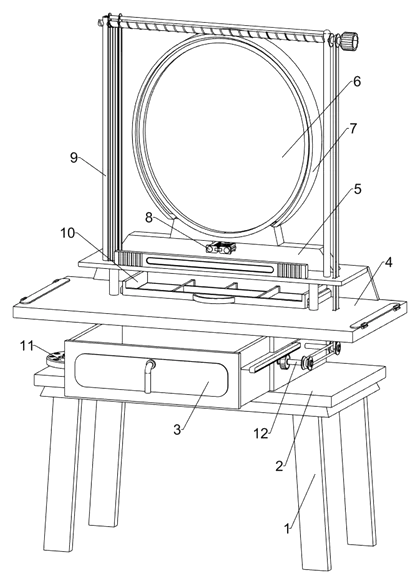
- Support Frame: The base structure holds the entire assembly, connecting the placement rack and fixing frame securely.
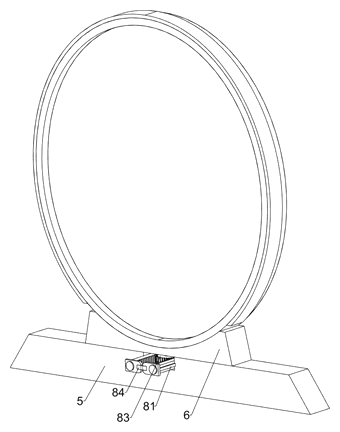
- Rotating Mirror Mechanism: The mirror is mounted on a support frame equipped with a rack-and-pinion system. Two racks slide along the frame, meshing with a central gear attached to the mirror’s pivot rod. Elastic ropes connect the racks to ensure smooth return motion.
- Sensor-Controlled Lighting: LED strips are positioned around the mirror and on the lower fixing frame. A proximity sensor detects the user’s distance, automatically activating or deactivating the lights without manual intervention.
- Integrated Storage System: Large sliding frames within the base accommodate bulky items, while smaller pull-out drawers with handles provide organized space for cosmetics and jewelry.
- Light Shielding Option: A manual mechanism using a lead screw and folding plates allows users to physically block side illumination if preferred, offering control over light distribution.
Who it is for
- Modern Furniture Brands: Companies seeking to differentiate their bedroom collections with smart, functional vanity designs that appeal to tech-savvy consumers.
- E-commerce Sellers: Online retailers who need products with clear visual selling points, such as automatic lighting and adjustable mirrors, to stand out in crowded marketplaces.
- Interior Designers: Professionals specifying custom-built-in wardrobes and dressing areas where integrated lighting and compact storage are critical for space efficiency.
- Hotel Suppliers: Hospitality providers looking for durable, user-friendly vanities that enhance guest experience through hands-free operation and tidy organization.
How it works
The main parts
| No. | Part | What it does |
|---|---|---|
| 1 | Support | Base structure holding the entire unit. |
| 2 | Placement Rack | Main body containing storage frames. |
| 3 | First Placement Frame | Sliding tray for large items with observation window. |
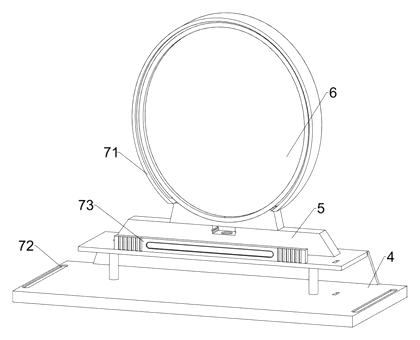
| 4 | Fixing Frame | Supports the mirror and houses side lights/drawers. |
| 5 | Support Frame | Holds the mirror and contains the rotation gears. |
| 6 | Mirror | Reflective surface adjusted by the gear mechanism. |
| 7 | Light Mechanism | Includes first/second LED strips and proximity sensor. |
| 8 | Rotating Mechanism | Racks, gear, rod, and elastic ropes for angle adjustment. |
| 9 | Shielding Mechanism | Folding plates driven by a screw to block light. |
| 10 | Pull Mechanism | Slide rails and second frame for small item storage. |
Operating Steps
- Approach the Vanity: The proximity sensor detects the user within range, automatically switching on the front and side LED strips for optimal illumination.
- Adjust Mirror Angle: To change the viewing angle, pull one of the side racks forward. The rack moves the gear, which rotates the mirror. Release the rack, and the elastic ropes gently return the mirror to its neutral position.
- Access Storage: Slide out the large first placement frame for bulkier items like hairdryers. Pull the smaller drawer handles to access cosmetics and jewelry stored in the second placement frame.
- Modify Lighting: If side glare is unwanted, turn the knob to drive the lead screw, extending the folding shielding plates to cover the side LED strips.
- Depart: When the user leaves the sensor range, the lights automatically turn off, saving energy.
Applications
Bedroom Vanities
Ideal for master bedrooms where users want a sleek, modern look. The automatic lighting eliminates fumbling for switches in dim rooms, and the adjustable mirror accommodates different heights without repositioning the entire unit.
Walk-in Closets
Perfect for enclosed closet spaces where natural light is limited. The integrated storage keeps clothing accessories organized, while the self-contained lighting ensures visibility without needing complex electrical wiring for separate fixtures.
Small Apartment Studios
Suits compact living spaces where multi-functionality is key. The vertical design combines mirror, light, and storage in one footprint, reducing the need for additional shelving or lamps that take up floor space.
Hotel Guest Rooms
Enhances guest satisfaction with intuitive controls. The automatic sensor lighting is convenient, while the organized storage helps guests keep personal items tidy during short stays.
Where it is less suitable
- Industrial Settings: Not designed for heavy-duty use or environments requiring rugged, tool-accessible surfaces.
- Outdoor Use: The electronic components and wooden/metal finishes are intended for indoor climate-controlled environments only.
- Minimalist Fixed Mirrors: Users who prefer traditional, non-adjustable mirrors may find the mechanical complexity unnecessary.
Frequently asked questions
How do the lights turn on?
The dressing table uses a proximity sensor located at the top of the fixing frame. When a person enters the sensing range, the sensor automatically activates the LED strips. When the person leaves the range, the lights turn off. There are no manual switches required for basic operation.
Can I adjust the mirror angle?
Yes. The mirror is mounted on a gear-and-rack system. By pulling the side racks forward, you can rotate the mirror left or right. When released, elastic ropes return the mirror to its original centered position. This allows for precise angle adjustments without touching the glass surface.
What kind of storage does it offer?
The unit includes multiple storage options. A large sliding frame at the bottom holds bulky items like hair tools. Smaller pull-out drawers within the side fixing frame are designed for cosmetics and jewelry. An observation window on the large frame lets you see contents without opening it.
Is the light adjustable?
The brightness and color temperature are typically determined by the chosen LED module. Additionally, a manual shielding mechanism with folding plates can be operated via a knob to block side lighting if you prefer direct frontal illumination only.
Does it require special installation?
It functions as a standalone piece of furniture. It requires a standard power outlet for the LED and sensor system. No hardwiring is necessary unless specified for built-in versions. Ensure the location has adequate ventilation for the electronics.
What materials are used?
The patent describes a metal and wood composite structure. The support and frames are typically steel or aluminum for stability, while the exterior can be finished with wood veneer, laminate, or paint depending on the model configuration.
Can this design be made and sold in the US?
The patent is filed only in China and is currently in force there. It does not restrict manufacturing or sales in the US. However, other US patents may cover similar smart mirror or lighting features. We recommend a freedom-to-operate check before volume production to ensure no conflicts with existing US intellectual property.
Are you affiliated with the patent owner?
No. IP2M is an independent design and manufacturing service working from the public patent document.
Request a quote
Click Request a Quote below to see our email address - copy it, or open your email app with a ready-made message. Please mention patent CN115153211B in the subject.
Helpful details to include:
- Your company and channel (furniture brand, e-commerce seller, hotel supplier, interior designer)
- Dimensions (width, height, depth) and mirror size
- Material preferences (wood type, metal finish, glass style)
- Electronic specs (sensor type, LED color temp, voltage requirements)
- Estimated quantity and target price
- Timeline - when you would like samples and the first shipment
You can also reach us at (332) 203-9997.
Explore this product
Interested in building this?
Tell us your target market, quantity and timeline. We reply with options for prototyping, small-batch runs or volume production.
Send your inquiry to
Please put CN115153211B in the subject line and tell us your company, country, estimated quantity and timeline.
Prefer to talk? Call (332) 203-9997.
More product-ready patents
All Furniture, Bedding & Storage patents →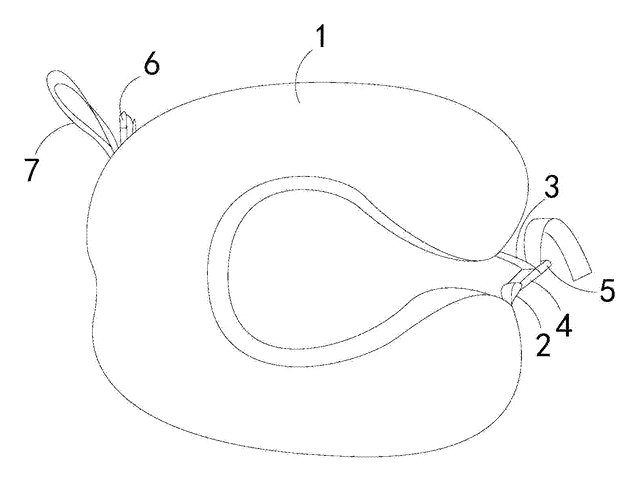
Furniture, Bedding & Storage
Roll-Up Travel Neck Pillow with Buckles
U-shaped travel pillow with a front buckle and a back buckle that holds it rolled up for carrying.
Patent CN206543091U
Furniture, Bedding & Storage
Width-Adjustable Slide Rail for Pull-Out Baskets
Basket slide rail on a slotted, scaled adjusting plate, so one pull-out basket fits several cabinet widths.
Patent CN208909382U
Furniture, Bedding & Storage
Lift-Up Storage Bed with Four-Bar Linkage That Slides the Deck Away from the Headboard
Storage bed deck that rises on four-bar linkages and gas springs, clearing the headboard as it opens.
Patent CN210870645U
Furniture, Bedding & Storage
Self-Leveling, Nesting Table Base with a Torsion-Ring Leg Hub
Four-leg base that self-levels through a torsion-ring hub and nests sideways with flip-top tables.
Patent CN211483640U
Furniture, Bedding & Storage
Rack-and-Pinion Synchronized Drawer Slide with a Folded-In Fixed Rail
Full-extension drawer slide: a pinion between two racks keeps the rails moving in step.
Patent CN206314843U
Furniture & Bedding
Dual-Zone Split-Spring Mattress with Removable Fabric Cover
Half-pocket, half-standard spring mattress sharing one base plate, with a removable cover.
Patent CN208355064U
Browse by category
- Apparel & Accessories (22)
- Baby & Kids (17)
- Bags & Luggage (9)
- Bath & Personal Care (17)
- Car Accessories (10)
- Furniture, Bedding & Storage (13)
- Garden & Outdoor (19)
- Health & Wellness (8)
- Home, Kitchen & Cleaning (26)
- Lighting (12)
- Packaging & Containers (6)
- Pet Products (6)
- Phone & Camera Accessories (4)
- Retail Display (13)
- School, Office & Art (19)
- Sports & Recreation (26)
- Tools & Workshop (29)
- Toys & Games (13)
This page is based on the public patent document CN115153211B, assigned to Jiangxi Woodwork Daren Furniture Co ltd. IP2M is an independent manufacturing service and is not affiliated with, endorsed by or licensed by the patent owner. Images marked as concept renderings are illustrations, not photos of an existing product. Patent status information is provided for reference only and is not legal advice; confirm freedom to operate for your market before production. Full disclaimer.