At a glance
| Patent number | CN115153211B (application CN202210853386) |
| Type | China invention patent (发明专利) - protects method and structure |
| Original title | Dressing table with rotary light compensating mirror (一种带有转动式补光镜的妆台) |
| Patent owner | Jiangxi Woodwork Daren Furniture Co ltd |
| Inventors | Song Lianfang, Guo Huadong, Wang Liusheng, Lai Qianchun |
| Filing date | 2022-07-20 |
| Grant date | 2024-02-20 |
| Status (China) | In force - valid until at most 2042-07-20, provided annual fees are paid |
| Patent family | Chinese filings only - no US, European, Japanese, PCT or other filings listed |
| Cited by | 0 later documents |
| Source | Google Patents (search for CN115153211B) |
What the claims cover, in plain language
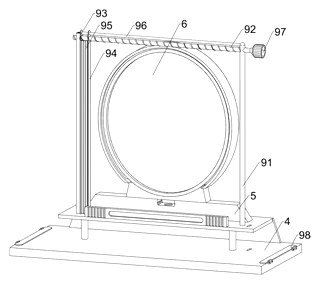
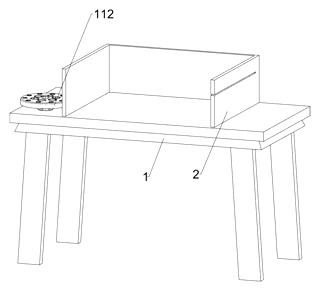
Claim 1 defines a dressing table comprising a support, placement rack, first placement frame, fixing frame, support frame, mirror, and light compensating mechanism. The light mechanism includes first and second LED strips and a proximity sensor installed on the fixing frame top, electrically connected to control illumination based on user distance. A rotating mechanism adjusts the mirror’s irradiation angle, consisting of two first racks sliding on the support frame, a first rotating rod connected to the mirror, a first gear meshing with the racks, and elastic ropes connecting the racks to facilitate return movement.
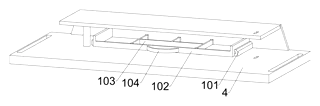
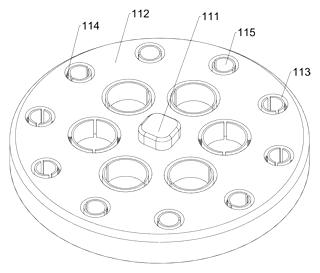
Claim 2 adds details about the shielding mechanism, which uses a first fixing rod, lead screw, fixing plate, sliding plate, folding plate, guide rod, and knob to physically block illumination from specific angles. It also describes the pull mechanism for placing small articles, including slide rails, a second placement frame, baffles, and handles. Furthermore, it specifies a limiting mechanism involving a second rotating rod, placement disc, elastic pieces, and clamping blocks for securing items.
This is a simplified reading for orientation only. The legal scope is defined by the exact claim wording in the official Chinese document.
What this means for US production
This patent was filed only in China and is currently in force. Making or selling this specific design in China requires the owner’s permission. However, since there are no US or other foreign family members, the patent does not directly restrict manufacturing or sales in the United States under this specific IP right.
Two points to settle early:
- Other patents may exist. Smart furniture and vanity lighting are competitive fields. While this specific combination of rack-and-pinion rotation with proximity sensors is patented in China, similar concepts may be covered by other US utility patents regarding motorized mirrors, capacitive touch lighting, or specific storage configurations. A freedom-to-operate (FTO) review is recommended before mass production.
- Electronic Component Sourcing. The design relies on proximity sensors and LED drivers. Ensuring these components meet US safety standards (UL) and electromagnetic compatibility (FCC) is critical, as the patent covers the structural integration but not the certification of the electronics themselves.
Customization and manufacturing
What can be customized
| Area | Options |
|---|---|
| Mirror Size | Width set in design; custom dimensions available |
| Light Color Temp | Warm white, cool white, or tunable RGB LEDs |
| Sensor Type | Infrared proximity or capacitive touch alternatives |
| Materials | Solid wood, MDF, metal frame finishes (matte black, gold, silver) |
| Storage Layout | Number of drawers, divider configurations, lock options |
| Rotation Range | Adjustable stops for left/right tilt limits |
Things to plan for (US market)
- FCC Part 15: The proximity sensor and any wireless modules must comply with electromagnetic interference rules.
- UL Standards: Electrical components (LED drivers, wiring) should meet UL safety standards for household appliances.
- California Prop 65: Warning labels may be required if materials contain specific chemicals (e.g., certain plastics or platings).
- ANSI/BHMA: Hardware durability tests for drawers and hinges if applicable to the storage components.
How a project runs
- Inquiry - Specify dimensions, material preferences, and electronic requirements.
- Design - Finalize CAD models for the rack-and-pinion mechanism and housing.
- Prototype - Build samples to test rotation smoothness, sensor sensitivity, and light uniformity.
- Compliance Check - Conduct FCC and UL preliminary testing on electronics.
- Production - Manufacture frames, install mechanisms, assemble electronics, and quality control.
Quantities & timeline
The rack-and-pinion mechanism requires precision injection molding for gears and extrusion for racks. The electronic assembly involves PCB mounting and sensor calibration. Lead times depend on component sourcing for sensors and LEDs. Send us your dimensions, material specs, electronic preferences, quantity and target price and we will reply with options.
Patent drawings
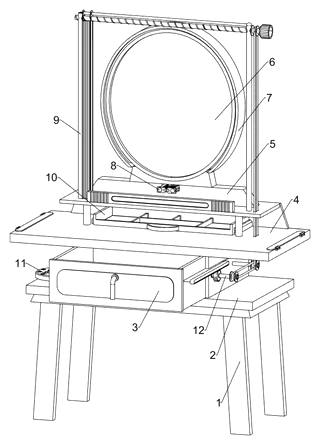
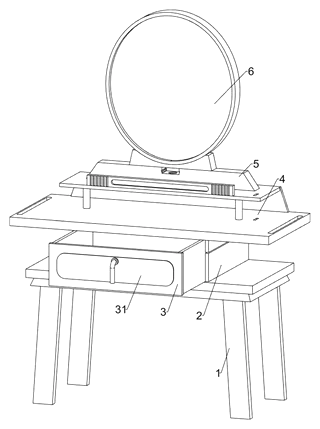
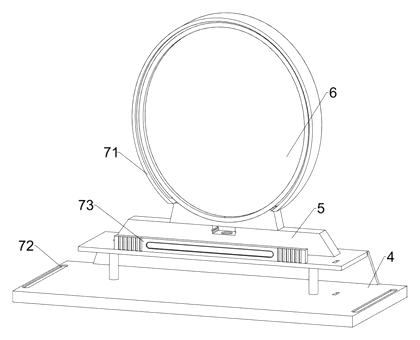
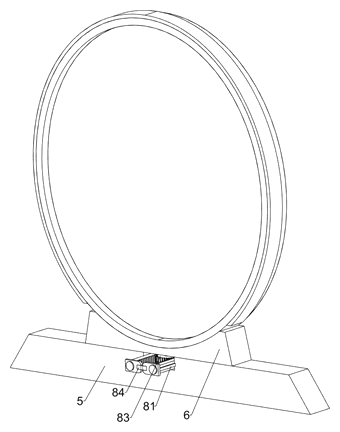
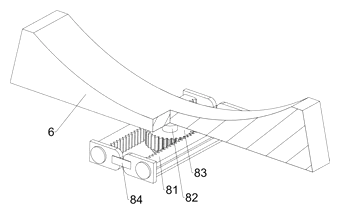
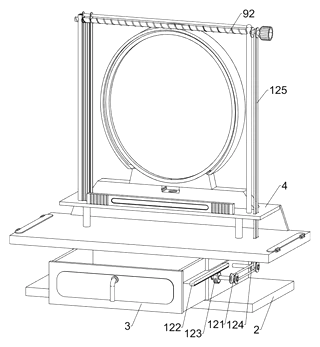
Drawings reproduced from the public patent document for reference.