At a glance
| Patent number | CN115171561B (application CN202210940753) |
| Type | China invention patent - protects product structure and method |
| Original title | A garden advertising sign that can be converted into a seat (一种可转变成座椅的园林用广告指示牌) |
| Patent owner | Shanghai Qiankuo Technology Co.,Ltd. |
| Inventors | Wang Shaoqiao |
| Filing date | 2022-08-06 |
| Grant date | 2023-11-24 |
| Status (China) | In force until at most 2042-08-06 (if annual fees are paid) |
| Patent family | Chinese filings only - no US, European, Japanese, PCT or other filings listed |
| Cited by | 0 later documents |
| Source | Google Patents (search for CN115171561B) |
What the claims cover, in plain language
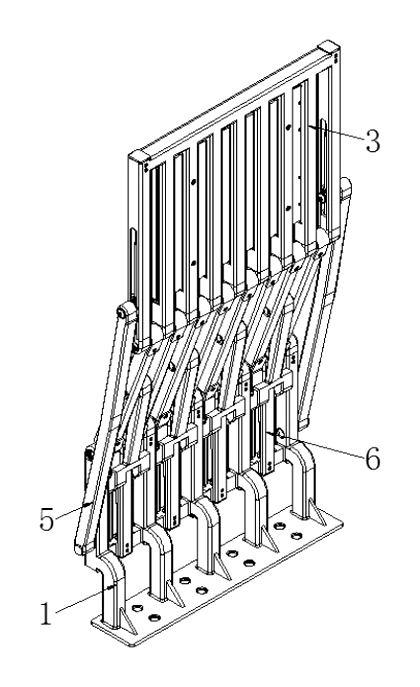
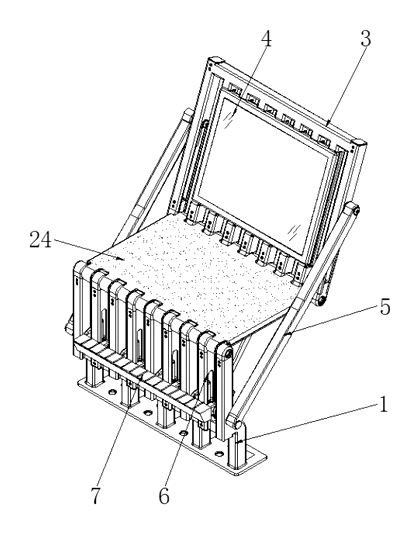
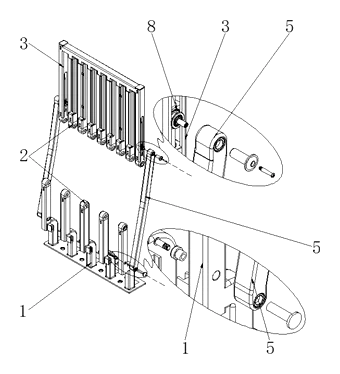
Claim 1 defines a garden advertising sign convertible into a seat. It comprises a bottom rack (1) divided into a buried plate part, a buried square tube part, and a support part. The support part has vertical connecting seats with trapezoidal grooves. A top rack (3) sits above, offset left-right, holding an ad light box (4).
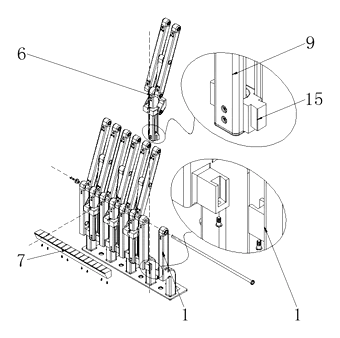
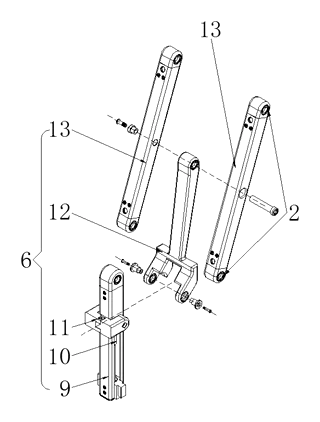
Key mechanical elements include linkage square rods (5) connecting the bottom and top racks, and a push-pull mechanism (6) activated by a foot pedal (7). The mechanism uses a U-shaped movable seat (11) and a push-pull frame (12) to rotate a linked short square tube (13).
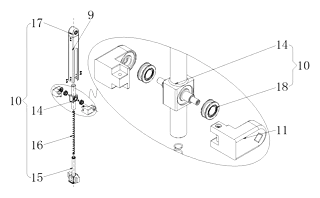
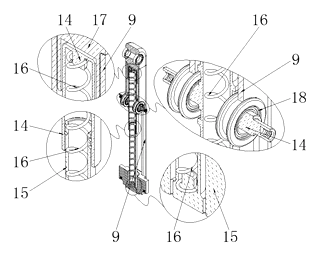
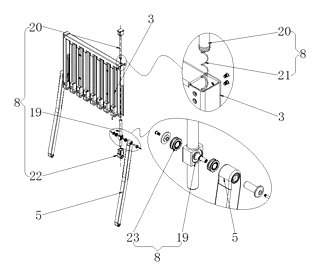
Two reset mechanisms (8 and 10) are described. Each uses a block body inside a tube cavity, shaft columns passing through slide slots, sheaves (grooved wheels), and springs. Claim 1 specifies that the first reset mechanism (8) is in the top rack’s longitudinal tubes, and the second (10) is in the connecting square tube (9) of the push-pull assembly. The interaction of these parts allows the sign to fold into a chair shape under load and spring back to upright when released.
This is a simplified reading for orientation only. The legal scope is defined by the exact claim wording in the official Chinese document.
What this means for US production
This patent was filed only in China and is currently in force there. Making or selling this specific mechanical arrangement in China requires the owner’s permission. Since there is no US counterpart, the patent itself does not restrict making or selling the product in the United States.
Two points to settle early:
- Other patents may exist. Outdoor furniture and convertible structures are competitive fields. While this specific linkage combination appears novel in this filing, broader concepts of “sign-to-seat” conversions or similar mechanical linkages might be covered by other US utility patents. A freedom-to-operate (FTO) review is recommended before mass production.
- Safety Standards. In the US, public seating and playground-like equipment fall under strict safety regulations regarding pinch points and stability. The exposed linkage and moving parts must be evaluated against ASTM standards for public use.
Customization and manufacturing
What can be customized
| Area | Options |
|---|---|
| Frame Material | Galvanized steel, stainless steel, or powder-coated aluminum |
| Sign Panel | Static print, LED light box, or digital screen integration |
| Seat Surface | Wood slats, composite decking, or textured metal plate added to tube (13) |
| Pedal Design | Larger grip area, rubber coating, or concealed housing |
| Base Type | Buried concrete anchor (as per patent) or surface-mounted flange plate |
| Spring Rate | Adjusted for expected user weight range and cycle life |
Things to plan for (US market)
- ASTM F1487 - Standard Consumer Safety Performance Specification for Playground Equipment for Public Use. Even if not a playground, municipal buyers often apply these pinch-point and entrapment criteria to public seating with moving parts.
- ADA Compliance - Americans with Disabilities Act guidelines for outdoor seating, including clear floor space and height requirements.
- Wind Load Ratings - Engineering certification required for tall, thin structures like signboards to prevent tipping in high winds.
- Corrosion Resistance - Salt spray testing (ASTM B117) for coastal or winter-salt environments.
How a project runs
- Concept Review - Confirm dimensions and target user weight.
- Engineering - Finalize linkage geometry and select spring rates.
- Prototyping - Build a functional sample using sheet metal fabrication and off-the-shelf hardware.
- Testing - Cycle testing for durability and load tests for stability.
- Tooling & Production - Create dies for bending tubes and molds for any plastic covers.
Quantities & timeline
Production involves significant sheet metal work. Tubes must be cut, bent, and welded. The complexity lies in the precision of the linkage pivots to ensure smooth resetting. Molds are needed for any injection-molded plastic covers or pedal grips. Send us your quantity, material preference, and graphic requirements and we will reply with options.
Production notes
Tooling and process
Sheet metal fabrication is the primary process, requiring laser cutting for the base plates and press brakes for forming the square tubes and brackets. Assembly fixtures are needed to ensure consistent alignment of the support tubes. Injection molding would likely be used for the pedal grips and protective covers for the spring mechanisms to hide sharp edges.
Cost drivers
The number of parts is typically high due to the multiple linkage rods, sheaves, and reset assemblies. Sheet thickness affects both material cost and the rigidity needed to prevent flexing during use. Surface finish, particularly powder coating for outdoor durability, adds processing time. Packaging volume is significant because the unit is bulky even when disassembled.
Prototyping path
A 3D model and load check are typically the first step to verify the kinematic chain. Fabricate a cut and bent sample using standard steel tubes and bolts. Conduct a flat-pack trial to test assembly ease. Perform load tests to ensure the seat holds weight without permanent deformation of the linkage. Finally, run a tooling pilot to refine the assembly jigs.
What we would change before tooling
The exposed spring mechanisms should be enclosed in molded housings to prevent dirt ingress and improve aesthetics. Foot pedal leverage could be optimized to reduce force during folding. Adding rubber dampers at the stop points would reduce noise and wear on the metal-on-metal contacts.
Common failure points
Insufficient load capacity in the welded joints of the bottom rack is a risk if the steel grade is too low. Tipping could occur if the base is not properly anchored or if the wind load exceeds design specs. Spring fatigue is critical; if the rate consistency varies, the sign may fail to reset fully. Acrylic cracking on the light box lens could happen from UV exposure or impact. Complex flat-pack assembly might lead to misaligned linkages if not pre-assembled correctly.
Patent drawings
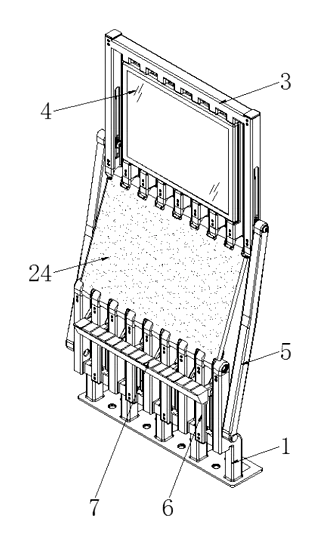
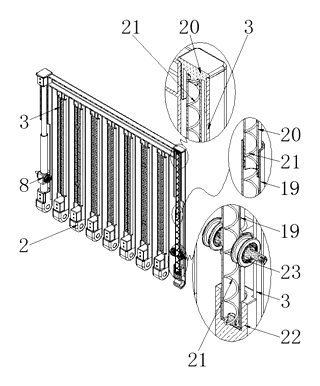
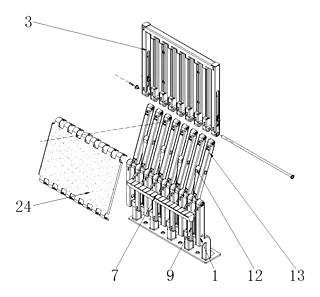
Drawings reproduced from the public patent document for reference.