
Patent CN115177146B
Updated October 30, 2026Rotatable Detachable Cup Lid Connection Structure for Electric Kettles
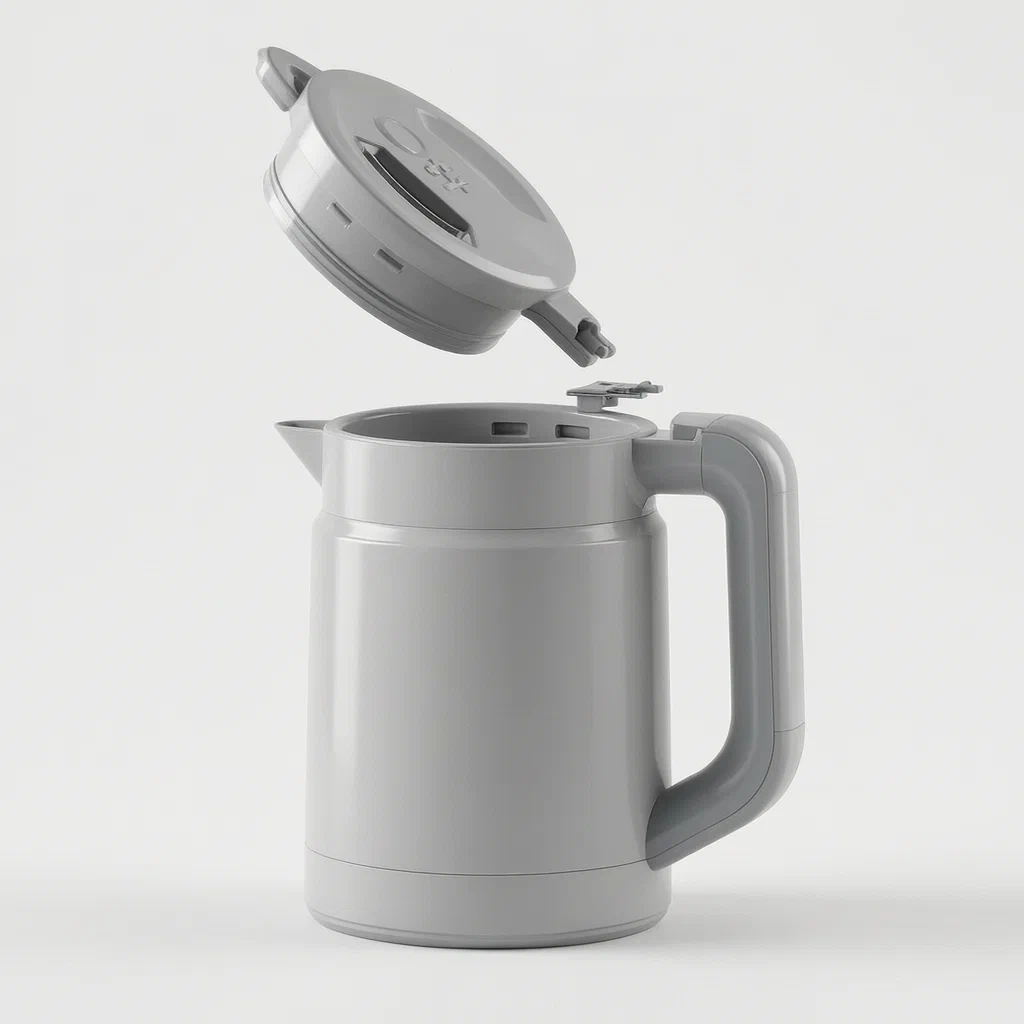
Traditional electric kettle lids are often permanently attached or difficult to remove, trapping steam and residue inside the hinge area. Cleaning becomes awkward, and the kettle body cannot be used independently as a pot or container. This patent describes a rotatable and detachable connection structure where the lid assembly sits between the handle and a handle cover. A spring-loaded guide limit piece forms a channel that accepts the lid's rotating shaft. By pushing the shaft along inclined planes, the elastic clamps deform to allow insertion or removal, securing the lid in place while permitting full detachment when needed.
- China invention patent - active
- No filings outside China
- Small appliance components
- Spring-loaded plastic/metal hybrid mechanisms
Splat! What let you down?
🔄
Rotatable Shaft
The lid pivots on a shaft housed within the handle assembly channel.
🔓
Quick Release
Elastic clamping points deform to allow the lid to slide out completely.
🧼
Easy Cleaning
Full detachment removes hidden residue traps common in fixed hinges.
🍲
Multi-Use Body
Kettle body functions as a standalone vessel when the lid is removed.
Bring this product to market
- ✓ Patent vetted China-only family and legal status checked
- 2 Product brief · now How it works, uses and options written up
- 3 Prototype First samples for buyers to review
- 4 Pilot run Small first batch for launch customers
- 5 Volume production Repeat orders at scale
Buyer interest
– of 100 buyers needed to start prototyping
One click, no sign-up. Each vote is one real visitor, and products with the most interest go to prototyping first.
Build team: no members yet. Need a partner, co-funding or skills to build this? Join and we introduce the team once it forms.
The problem
Most electric kettles feature lids that are either hinged directly to the body or integrated into the handle but not removable. Hinged designs create crevices where mineral deposits and water droplets accumulate, making thorough cleaning difficult. Non-detachable designs prevent the user from using the kettle body as a simple pot or serving vessel without the heavy handle and lid assembly attached. There is a need for a mechanism that secures the lid firmly during boiling but allows it to be separated easily for maintenance and versatile use.
The solution
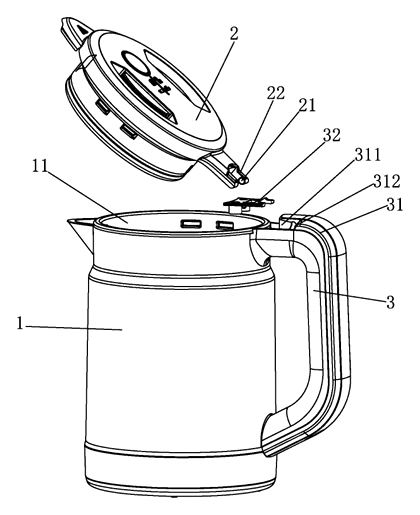
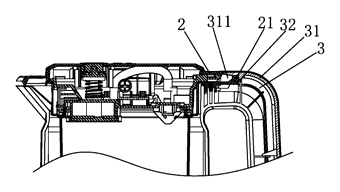
The patent describes a cup cover assembly (2) with a rotating shaft (21) that connects to a kettle body (1) via a handle (3). The handle includes a handle cover (31) and a guide limit spring piece (32). These parts assemble to form an assembly channel (4). One end of the channel is open (42), and the other contains a rotating shaft hole (41). The spring piece features two symmetric clamping points (323) that protrude inward. When the lid’s shaft is pushed through the open end, it travels along guide inclined planes (3231) on the clamping points. The elasticity of the spring piece allows the clamping points to deform outward, expanding the neck size to let the shaft pass into the shaft hole. Once inside, the spring piece returns to its original shape, locking the shaft in place. To remove the lid, the process is reversed: pushing the shaft against guide curved surfaces (3232) forces the clamping points to deform again, releasing the shaft.
Who it is for
- Small Appliance Brands: Companies looking to differentiate their kettles with superior hygiene features and modular usability.
- OEM Manufacturers: Factories producing handles and lid assemblies who need a robust, snap-fit compatible mechanism.
- Outdoor Gear Suppliers: Brands targeting camping or travel markets where equipment must be compact, cleanable, and multi-functional.
- Commercial Kitchen Equipment Makers: Businesses needing durable, easy-to-maintain components for high-volume tea or coffee preparation stations.
How it works
The main parts
| No. | Part | What it does |
|---|---|---|
| 1 | Kettle Body | Main container with a top opening (pot mouth 11). |
| 2 | Cup Cover Assembly | The lid component, featuring the rotating shaft (21). |
| 3 | Handle | Attached to the outside of the kettle body. |
| 31 | Handle Cover | Encloses the mechanism; has clamping blocks (311). |
| 32 | Guide Limit Spring Piece | Elastic component forming the channel walls and locks. |
| 323 | Clamping Points | Protrusions that grip the shaft; have inclined/curved guides. |
| 4 | Assembly Channel | The path formed by the handle, cover, and spring piece. |
| 41 | Rotating Shaft Hole | The final resting position for the lid’s shaft. |
Operating Steps
- Installation: Align the lid’s rotating shaft (21) with the open end (42) of the assembly channel. Push the shaft forward.
- Deformation: As the shaft moves, it contacts the guide inclined planes (3231) on the clamping points (323). The force pushes the elastic spring piece outward, widening the gap.
- Locking: The shaft passes the widest point and enters the rotating shaft hole (41). The spring piece snaps back, causing the clamping points to return to their initial position, holding the shaft securely.
- Usage: The lid rotates around the shaft to open or close the pot mouth. Gravity keeps the lid closed if the center of gravity is offset correctly (Claim 4).
- Removal: Apply pressure to push the shaft backward against the guide curved surfaces (3232). The clamping points deform again, allowing the shaft to slide out of the hole and exit the channel.
Applications
Home Hygiene Maintenance
Users can completely remove the lid from the handle assembly. This eliminates the hard-to-reach hinge areas where mold and mineral scale typically build up, ensuring the entire surface is washable under running water.
Camping and Outdoor Use
When detached, the kettle body acts as a standard pot. Campers can boil water, then remove the electronic lid/handle assembly to pour hot water into cups or use the body for cooking over a fire, provided the body material supports it.
Commercial Tea Stations
In cafes or offices, staff can swap dirty lids for clean ones instantly without unscrewing complex hardware. The quick-release mechanism speeds up turnover time during peak hours.
Product Modularity
Manufacturers can offer different lid styles (e.g., glass, steel, insulated) that all fit the same handle chassis. This reduces tooling costs for new SKUs while offering consumers variety.
Where it is less suitable
- Ultra-Low-Cost Kettles: The additional spring piece and precision molding for the handle cover increase part count and cost compared to simple riveted hinges.
- High-Vibration Industrial Settings: While secure, the elastic nature might be less ideal than rigid screw-fastened lids in environments with constant heavy machinery vibration, though no specific failure data is in the patent.
- Fully Sealed Pressure Cookers: This design relies on a loose fit for rotation and removal; it is not intended for high-pressure sealing applications.
Frequently asked questions
How does the lid stay on without screws?
The design uses a guide limit spring piece made of elastic material. Two clamping points protrude into the assembly channel. When you push the lid’s shaft in, these points bend outward to let the shaft pass, then snap back to lock it in place. It is a friction-and-form fit, not a threaded connection.
Is it difficult to remove the lid?
No. You simply push the lid shaft backward along the channel. The clamping points have curved surfaces designed to deform again under this pressure, releasing the shaft so the lid can be lifted off entirely.
Does the spring wear out over time?
The patent specifies the use of special plastic materials with good rebound performance. Durability depends on the specific polymer chosen (e.g., POM or Nylon) and the number of cycles. In prototyping, we test for fatigue life to ensure the retention force remains adequate after thousands of opens/closes.
Can I wash the whole thing?
Yes. Because the lid detaches completely from the handle and body, there are no hidden hinge crevices. You can rinse the lid, the shaft, and the inner handle cavity separately, which improves hygiene significantly compared to fixed-lid kettles.
Why would I want a detachable lid?
It turns the kettle body into a usable pot. If you are camping or hosting guests, you can remove the electronics-heavy lid/handle assembly and use the body as a simple vessel for pouring or serving, assuming the body construction allows it.
Is this mechanism safe for hot water?
The materials must be selected for heat resistance. Since the patent is for household appliances, the spring piece is positioned within the handle assembly, largely shielded from direct boiling water contact, reducing thermal degradation risks.
Can this design be made and sold in the US?
The patent CN115177146B is in force in China but has no US counterpart. However, similar mechanical concepts may be covered by other US patents held by major appliance brands. We strongly recommend a freedom-to-operate (FTO) review specifically for the spring-loaded shaft channel design before launching in the US market.
Are you affiliated with the patent owner?
No. IP2M is an independent design and manufacturing service working from the public patent document.
Request a quote
Click Request a Quote below to see our email address - copy it, or open your email app with a ready-made message. Please mention patent CN115177146B in the subject.
Helpful details to include:
- Your company and channel (appliance brand, OEM factory, outdoor gear supplier)
- Kettle capacity (e.g., 1.5L, 2L) and lid weight
- Materials preference for the spring piece and handle cover
- Target price per unit
- Estimated quantity and desired sample timeline
- Certification needs (UL, FDA, etc.)
You can also reach us at (332) 203-9997.
Explore this product
Interested in building this?
Tell us your target market, quantity and timeline. We reply with options for prototyping, small-batch runs or volume production.
Send your inquiry to
Please put CN115177146B in the subject line and tell us your company, country, estimated quantity and timeline.
Prefer to talk? Call (332) 203-9997.
More product-ready patents
All Home, Kitchen & Cleaning patents →
Home, Kitchen & Cleaning
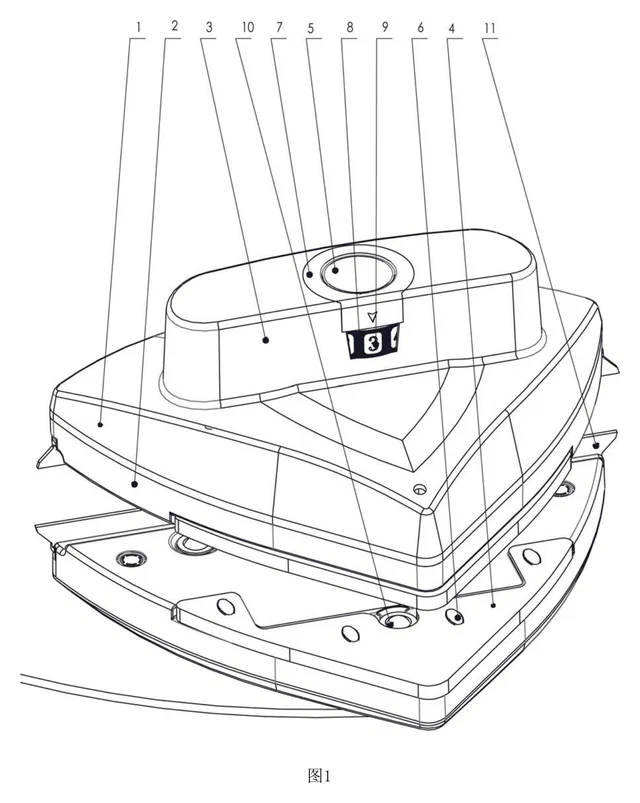
Self-Wringing Flat Mop with Fold-Away Wringer
Flat mop with a built-in wringer that opens only when you wring and folds flat against the pole when you mop.
Patent CN207734114U
Home, Kitchen & Cleaning
Magnetic Double-Sided Window Cleaner with Dial-Set Magnet Strength
Magnetic window cleaner with a sealed, sliding magnet, dial-set strength for different glass thicknesses and a spring-held idle position.
Patent CN209360543U
Home, Kitchen & Cleaning
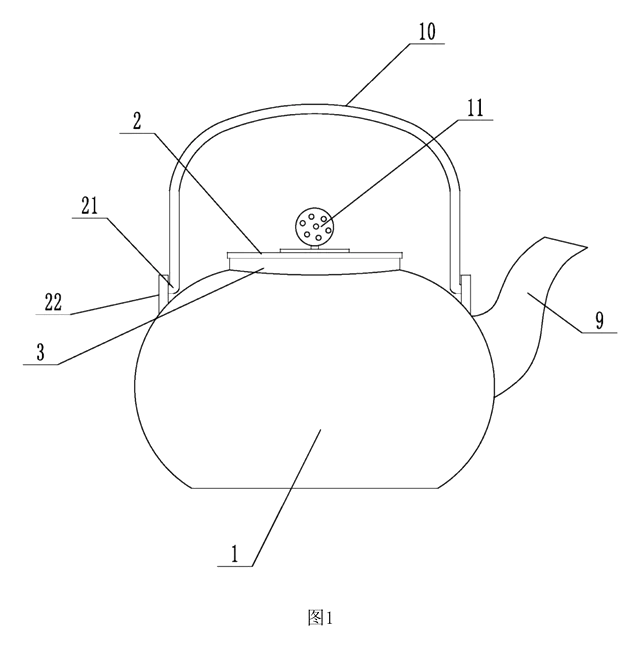
Metal Kettle with Magnetic Lid That Stays On When Pouring
Metal teapot/kettle with a magnet-held lid that does not fall off when pouring, and an insulated, vented lid knob.
Patent CN210540477U
Home, Kitchen & Cleaning
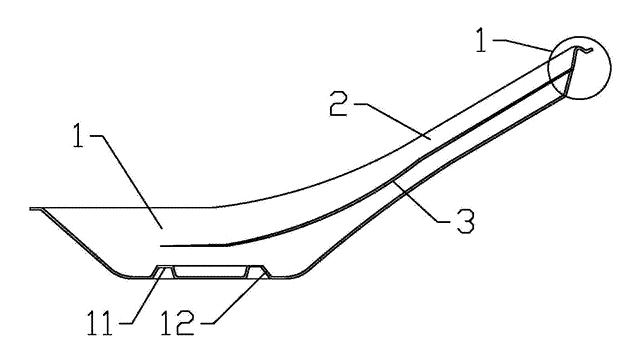
Reinforced Disposable Soup Spoon
Disposable soup spoon with a handle-to-bowl rib, stiffened edges and a ring foot to resist breaking.
Patent CN206964482U
Home, Kitchen & Cleaning
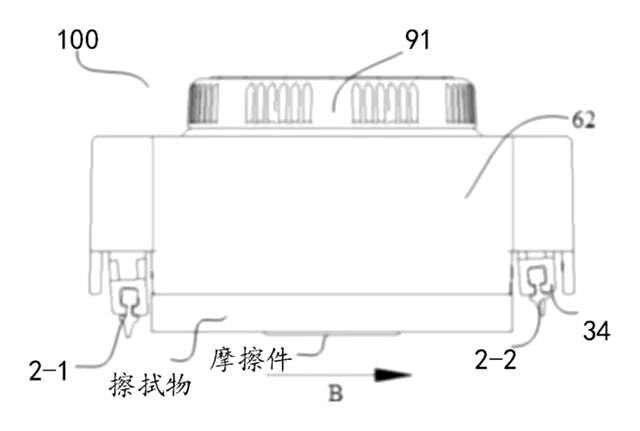
Self-Switching Double-Squeegee Window Cleaner
Cleaning head with two squeegee blades that switch automatically with the direction of movement.
Patent CN212630655U
Home, Kitchen & Cleaning
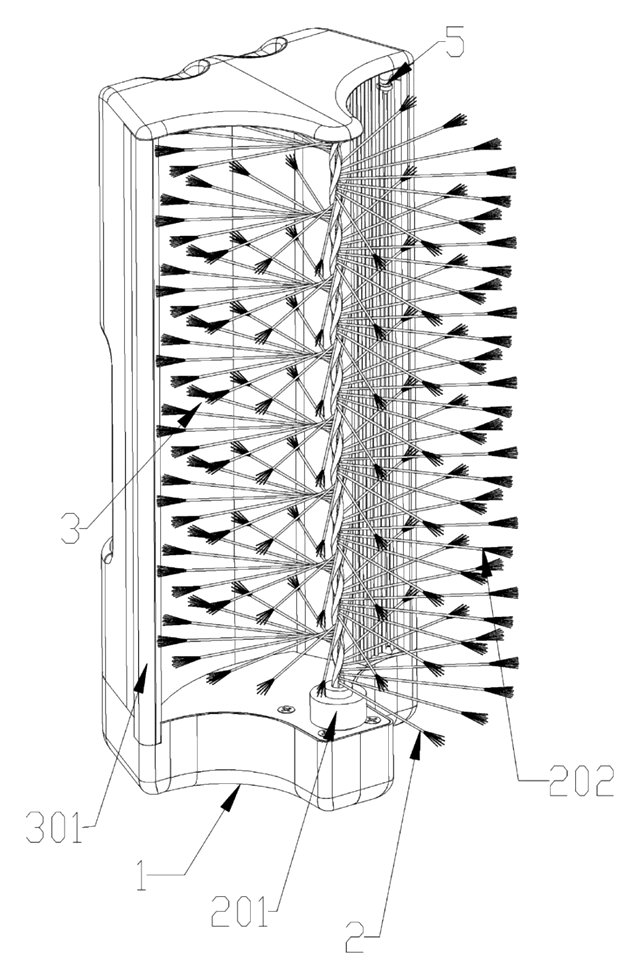
Self-Rinsing Roller Scrub Brush with Dirty-Water Tank
Powered roller brush that rinses and spins its bristles clean inside the body and stores the dirty water.
Patent CN210076909U
Browse by category
- Apparel & Accessories (22)
- Baby & Kids (17)
- Bags & Luggage (9)
- Bath & Personal Care (17)
- Car Accessories (10)
- Furniture, Bedding & Storage (13)
- Garden & Outdoor (19)
- Health & Wellness (8)
- Home, Kitchen & Cleaning (26)
- Lighting (12)
- Packaging & Containers (6)
- Pet Products (6)
- Phone & Camera Accessories (4)
- Retail Display (13)
- School, Office & Art (19)
- Sports & Recreation (26)
- Tools & Workshop (29)
- Toys & Games (13)
This page is based on the public patent document CN115177146B, assigned to Zhejiang Landian Intelligent Technology Co ltd. IP2M is an independent manufacturing service and is not affiliated with, endorsed by or licensed by the patent owner. Images marked as concept renderings are illustrations, not photos of an existing product. Patent status information is provided for reference only and is not legal advice; confirm freedom to operate for your market before production. Full disclaimer.