At a glance
| Patent number | CN115177146B (application CN202210818622) |
| Type | China invention patent (发明专利) - protects technical solutions |
| Original title | Rotatable detachable cup cover connection structure and electric kettle (一种可旋转可拆卸的杯盖连接结构及电水壶) |
| Patent owner | Zhejiang Landian Intelligent Technology Co ltd |
| Inventors | Liu Weidong, Hao Yonghui |
| Filing date | 2022-07-12 |
| Grant date | 2024-06-04 |
| Status (China) | In force - valid until at most 2042-07-12, subject to payment of annual fees |
| Patent family | Chinese filings only - no US, European, Japanese, PCT or other filings listed |
| Cited by | 0 later documents |
| Source | Google Patents (search for CN115177146B) |
What the claims cover, in plain language
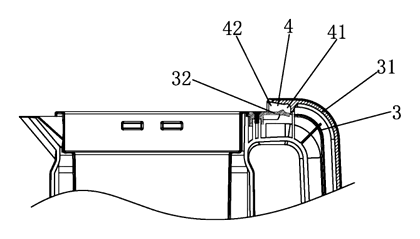
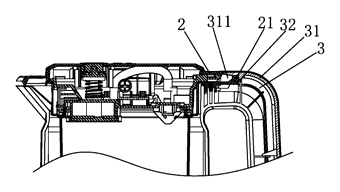
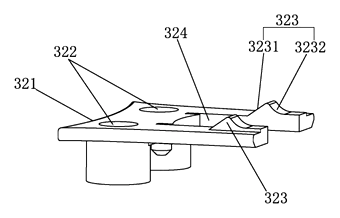
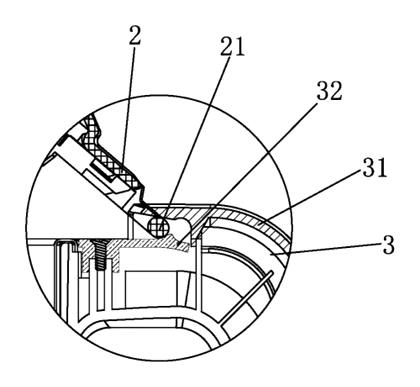
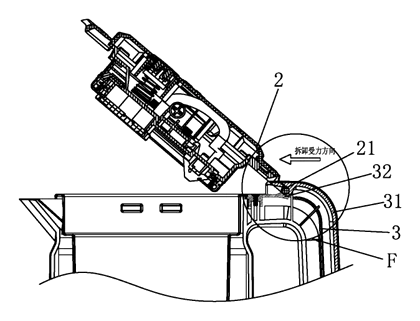
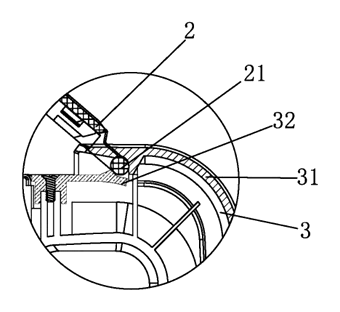
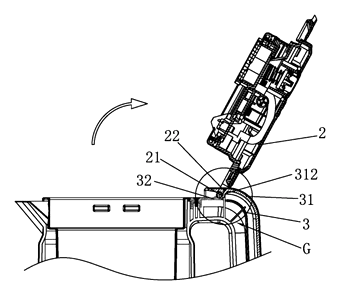
Claim 1 defines a rotatable detachable cup cover connection structure. It comprises a kettle body with a top opening and a cup cover assembly. The key feature is an assembly channel formed by the interaction of the kettle body, a handle, a handle cover, and a guide limit spring piece. The spring piece creates a path with an open end and a rotating shaft hole. The cup cover assembly has a rotating shaft that slides into this hole. The spring piece has two symmetric clamping points that protrude towards the shaft. These points guide the shaft axially into the hole and maintain retention force via elastic contact. The handle cover is secured to the handle, and the clamping groove between the two clamping points interacts with fixtures on the handle cover to define limits.
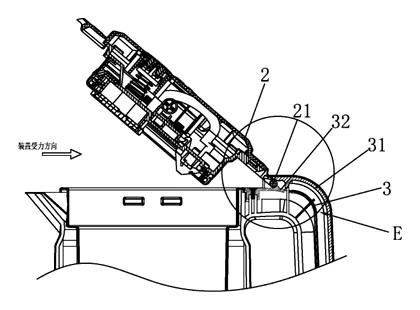
Claims 2-5 refine the geometry: adding guide inclined planes and guide curved surfaces to the clamping points to facilitate the deformation required for insertion and removal. Claim 4 specifies a stop part on the lid and an abutting part on the handle cover to limit rotation angle, ensuring the lid stays closed via gravity when aligned correctly. Claim 5 details the disassembly process involving stress on the curved surfaces.
Claim 6 covers the electric kettle itself incorporating this connection structure.
This is a simplified reading for orientation only. The legal scope is defined by the exact claim wording in the official Chinese document.
What this means for US production
This patent was filed only in China and is currently in force there. It has no US or other foreign counterpart.
Two points to settle early:
- Other patents may exist. Small appliance lid mechanisms are a crowded field. Major US and international appliance manufacturers hold numerous patents on hingeless lids, magnetic closures, and handle-integrated openings. A freedom-to-operate (FTO) review is strictly necessary before importing or selling products using this specific spring-clamp channel design in the US market.
- Material Safety. The patent mentions “special plastic materials” for the spring piece. For US sales, these materials must meet FDA food-contact regulations if they touch water or steam, and UL standards for electrical insulation near heating elements.
Customization and manufacturing
What can be customized
| Area | Options |
|---|---|
| Spring Material | POM, Nylon, or reinforced polymers for heat resistance and fatigue life. |
| Shaft Geometry | Diameter and length adjusted for different lid weights and torque requirements. |
| Channel Profile | Width of the assembly channel to accommodate different handle thicknesses. |
| Stop Mechanism | Angle limits (e.g., 90°, 110°) determined by the abutting part shape. |
| Finish | Matte, glossy, or textured coatings on the handle cover and lid. |
| Integration | Can be adapted for glass, stainless steel, or plastic kettle bodies. |
Things to plan for (US market)
- FDA 21 CFR Part 177 - Indirect food additives: plastics. Any plastic part contacting water/steam must comply.
- UL 1082 - Standard for Household Electric Percolators and Coffee Makers. Covers electrical safety, including handle integrity and lid security.
- California Prop 65 - Screening for lead, cadmium, or phthalates in plastics and metal platings.
- CPSC Rules - General consumer product safety regarding sharp edges or pinch points in the moving mechanism.
How a project runs
- Inquiry - Define kettle volume, lid weight, and target retail price.
- Design - CAD modeling of the spring piece, handle cover, and shaft interface.
- Prototype - 3D printed or soft-tool samples to test insertion/removal force and rotation smoothness.
- Pilot Run - Injection molding tools for plastic parts; stamping/forming for metal handles.
- Production - Mass manufacturing, assembly, and quality control checks for retention strength.
Quantities & timeline
The mechanism requires precision injection molds for the spring piece and handle cover to ensure consistent elastic deformation. Metal handles require stamping dies. Cycle testing for the “detachable” feature is critical to ensure the springs do not fatigue prematurely. Send us your kettle specifications, desired lid materials, and estimated volumes and we will reply with options.
Patent drawings
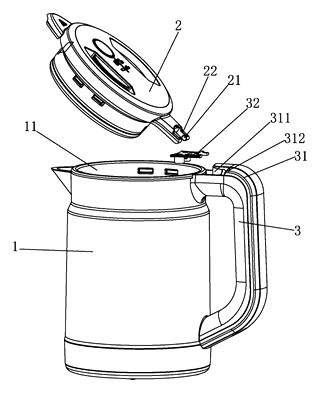
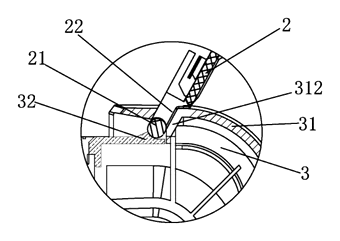
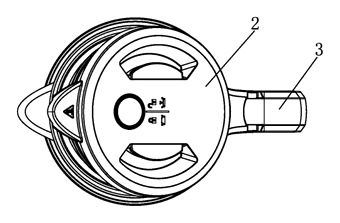
Drawings reproduced from the public patent document for reference.