
Patent CN115363502B
Updated October 27, 2026Automatic Shoe Cleaning Station with Rotating Platform and Four-Step Cycle
Workers entering clean zones from muddy yards spend time scrubbing boots by hand, often leaving caked soil behind. This automatic shoe cleaning device lets the user sit down, place a foot on an arc-shaped support plate, and let the machine run a four-step cycle. A motor-driven rack and gear linkage moves the foot into position while a rotating support column carries the shoe past a mud scraper, a washer, an upper cleaner and a dryer arranged around it. Scraped mud falls into a built-in sludge box inside the hollow mounting platform, keeping the surrounding floor clear. A control terminal on the seat armrest runs the drive parts for each station in sequence.
- China invention patent - in force
- No filings outside China
- Industrial & commercial cleaning
- Motorized rollers, racks, gears and telescopic rods
Splat! What let you down?
🔄
Rotating support column
The seat turns above the platform, carrying the shoe sequentially past four cleaning stations.
🧹
Roller-shaft mud scraper
Parallel roller shafts with axial scraping plates remove heavy soil before washing begins.
🦶
Foot positioning linkage
Telescopic rods and a rack-and-gear train move the arc-shaped support plate to align the sole.
💧
Built-in sludge collection
A sludge box inside the hollow mounting platform catches scraped mud and wash water.
Bring this product to market
- ✓ Patent vetted China-only family and legal status checked
- 2 Product brief · now How it works, uses and options written up
- 3 Prototype First samples for buyers to review
- 4 Pilot run Small first batch for launch customers
- 5 Volume production Repeat orders at scale
Buyer interest
– of 100 buyers needed to start prototyping
One click, no sign-up. Each vote is one real visitor, and products with the most interest go to prototyping first.
Build team: no members yet. Need a partner, co-funding or skills to build this? Join and we introduce the team once it forms.
The problem
Workers moving between outdoor job sites and indoor facilities carry thick mud on their soles. Manual brushing is slow, leaves residue in tread grooves, and drips dirty water across entry floors. In plants, power stations and food-processing areas, tracked-in soil creates slip hazards and contaminates controlled environments. Standalone boot brushes lack a structured sequence, so users skip steps or leave boots wet, tracking moisture inside.
The solution
This device solves the problem by fixing the cleaning sequence into four stations arranged around a central rotating support column. The user sits on a seat at the top of the column, places a foot on an arc-shaped support plate, and operates a control terminal on the armrest.
- Mud removal - a first motor drives parallel roller shafts fitted with scraping plates; spray nozzles underneath rinse the plates as they turn.
- Sole washing - the column rotates the shoe to a dedicated washing station.
- Upper cleaning - a third station addresses the shoe upper, linked mechanically to a sole water removal component.
- Drying - a final station dries the sole before the user stands up.
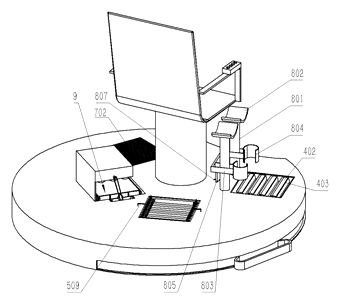
A foot activity auxiliary component uses automatic telescopic rods, a sliding frame, a vertical plate, a sliding rod and a rack-and-gear train (first rack, second rack, first gear, second gear, connecting rods and turntables) to position the foot precisely over the mud removal mechanism. Scraped material drops into a sludge box housed inside the hollow mounting platform.
Who it is for
- Power plant and utility operators who need workers to transition from muddy outdoor yards to clean control rooms without tracking soil.
- Food processing and pharmaceutical facility managers requiring a repeatable, hands-free boot cleaning step before entering hygiene zones.
- Construction and mining site contractors looking for a rugged station at the entrance of temporary offices or break rooms.
- Commercial building janitorial suppliers adding automated entryway equipment to their catalog for warehouses and logistics centers.
How it works
The main parts
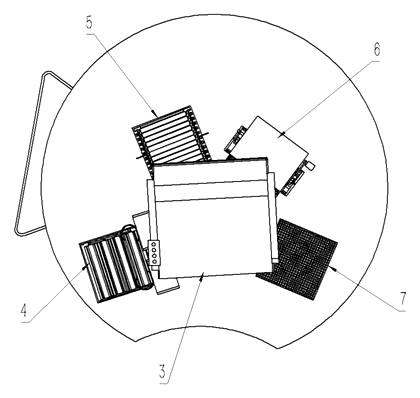
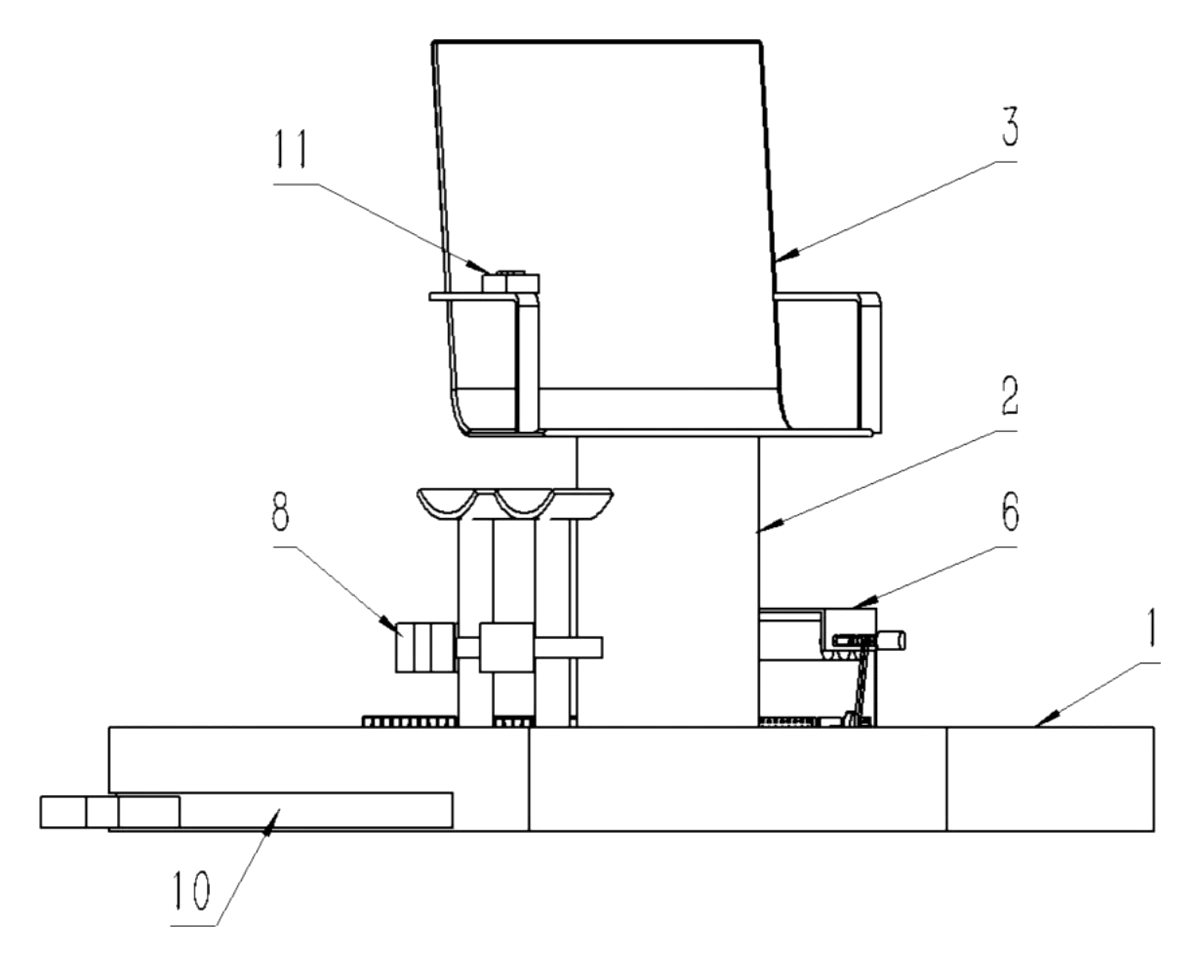
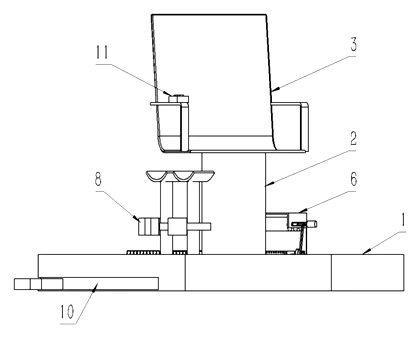
| No. | Part | What it does |
|---|---|---|
| 1 | Mounting platform | Hollow base holding all mechanisms and the sludge box. |
| 2 | Support column | Vertical shaft that rotates to index the shoe between stations. |
| 3 | Seat | Mounted on top of the support column for the user. |
| 4 | Sole mud removing mechanism | First station; scrapes heavy soil from the sole. |
| 5 | Sole washing mechanism | Second station; washes the sole. |
| 6 | Shoe upper cleaning mechanism | Third station; cleans the vamp/upper. |
| 7 | Sole drying mechanism | Fourth station; dries the sole. |
| 8 | Foot activity auxiliary component | Positions the foot using telescopic rods and a gear train. |
| 9 | Sole water removing component | Linked to the upper cleaning mechanism. |
| 10 | Sludge box | Collects mud and water inside the platform. |
| 11 | Control terminal | On the seat armrest; electrically connected to the drive parts. |
| 401 | First mounting frame | Rectangular frame spanning the platform top for the mud remover. |
| 402 | Roller shafts | Parallel shafts rotating at equal intervals. |
| 403 | Scraping plates | Fixed along the roller shafts to scrape the sole. |
| 404, 405 | Drive belts and discs | Connect the roller shafts together. |
| 406 | First motor | Drives one roller shaft coaxially. |
| 407 | Cleaning spray heads | Rinse the scraping plates from below. |
| 801 | Automatic telescopic rods | Raise and lower the arc-shaped support plates. |
| 802 | Arc-shaped support plates | Hold the user’s foot. |
| 803 | Sliding frame | Moves horizontally near the platform top. |
| 804 | Arc-shaped limiting plates | Guide the sliding frame near the mounting frame. |
| 808, 809 | First and second racks | Horizontal toothed bars inside the platform. |
| 811, 812 | First and second gears | Mesh between the two racks to transfer motion. |
| 816 | Turntables | Convert gear rotation into linkage movement. |
Operating steps
- The user sits on the seat (3) and places a foot on the arc-shaped support plate (802).
- Through the control terminal (11), the automatic telescopic rods (801) adjust height while the sliding frame (803) moves horizontally, guided by the vertical plate (805) and sliding rod (806) in the first sliding groove (807).
- The sliding rod drives the first rack (808), which meshes with the first gear (811) and second gear (812) against the fixed second rack (809). The gears turn the connecting rods (813, 814, 815) and turntables (816), linking motion to the roller shafts (402).
- The first motor (406) spins the roller shafts; scraping plates (403) remove mud while spray heads (407) rinse them. Debris falls into the sludge box (10).
- The support column (2) rotates the seat to align the shoe with the sole washing mechanism (5), then the upper cleaning mechanism (6) and finally the sole drying mechanism (7).
Applications
Power generation and utility substations
Maintenance crews walk through gravel yards and switchyards where boots collect heavy clay. Before entering relay rooms or control buildings, workers sit at the station to remove and dry their soles. This keeps sensitive electrical floors free of conductive dirt and moisture.
Food and beverage processing plants
Sanitation rules require clean footwear before entering production areas. The automated sequence ensures every worker follows the same scrape-wash-dry routine. The built-in sludge box prevents runoff from pooling near the entry door.
Construction site field offices
Temporary offices on active earthwork sites see constant mud traffic. A stationed cleaner at the door reduces the need for manual mopping inside. Workers can clean boots quickly during shift changes without bending over low trays.
Pharmaceutical and cleanroom entries
Gowning rooms demand dry, particle-free shoe soles. The drying mechanism completes the cycle so workers do not track water onto tacky mats. The seated design fits into a controlled changing area without rushing.
Agricultural packing houses
Harvest crews bring in field soil that contaminates sorting lines. Placing the device at the packing house threshold stops dirt before it reaches conveyors. The spray heads keep the scraping plates clear of sticky organic matter.
Where it is less suitable
- Residential home entryways - the footprint, motors and plumbing requirements exceed typical household needs.
- Delicate dress shoes - the scraping plates and vigorous washing cycle are designed for work boots and sturdy footwear.
- Portable or vehicle-mounted use - the hollow mounting platform and fixed stations require a stable floor installation.
Frequently asked questions
How does the four-step cycle work?
The user sits on the seat and places a foot on the support plate. A control terminal starts the sequence. The support column rotates to position the shoe over the mud scraper, then the washer, the upper cleaner and finally the dryer, pausing at each station while the respective mechanism operates.
Does the user have to stand up between steps?
No. The entire process happens while the user remains seated. The rotating support column indexes the shoe to each station automatically, so the user simply waits for the cycle to finish.
How is heavy mud handled?
The first station uses parallel roller shafts fitted with scraping plates driven by a motor. As the shafts turn, the plates scrape the sole tread. Spray heads mounted below the frame rinse the plates continuously, and the dislodged mud falls into a sludge box inside the hollow platform.
What powers the foot positioning?
A foot activity auxiliary component uses automatic telescopic rods to raise the support plate. A sliding frame moves horizontally, driving a rack that meshes with gears and connecting rods linked to turntables. This mechanical linkage synchronizes the foot position with the roller shafts.
Where does the wash water go?
The mounting platform is a hollow structure containing a sludge box matched to the mud removing and washing mechanisms. Water and soil collect there. The box can be plumbed to a drain or emptied manually depending on the installation.
Will it fit large work boots?
The arc-shaped support plates and limiting plates guide the foot. Exact maximum boot sizes and weight limits are set in design and confirmed on prototypes to match the intended work environment.
Can the machine run without a water connection?
The spray heads in the mud removing mechanism rely on water. If a plumbed supply is unavailable, a self-contained tank and pump can be integrated during the design phase, to be confirmed in design.
Can this design be made and sold in the US?
The patent was filed only in China and is in force there until at most 2042-09-02 (if annual fees are paid); it has no US counterpart, so it does not restrict making or selling the design in the United States. Related shoe-cleaning equipment may be covered by other US patents - see Patent & Production - so we recommend a freedom-to-operate check before volume production.
Are you affiliated with the patent owner?
No. IP2M is an independent design and manufacturing service working from the public patent document.
Request a quote
Click Request a Quote below to see our email address - copy it, or open your email app with a ready-made message. Please mention patent CN115363502B in the subject.
Helpful details to include:
- Your company and channel (facility operator, janitorial supplier, contractor, distributor)
- Target boot types and approximate daily user count
- Installation space dimensions and available utilities (water, drain, power voltage)
- Material preferences for the platform and frame
- Control interface preference (buttons, screen, badge reader)
- Estimated quantity and target price
- Timeline - when you would like samples and the first shipment
You can also reach us at (332) 203-9997.
Explore this product
Interested in building this?
Tell us your target market, quantity and timeline. We reply with options for prototyping, small-batch runs or volume production.
Send your inquiry to
Please put CN115363502B in the subject line and tell us your company, country, estimated quantity and timeline.
Prefer to talk? Call (332) 203-9997.
More product-ready patents
All Home, Kitchen & Cleaning patents →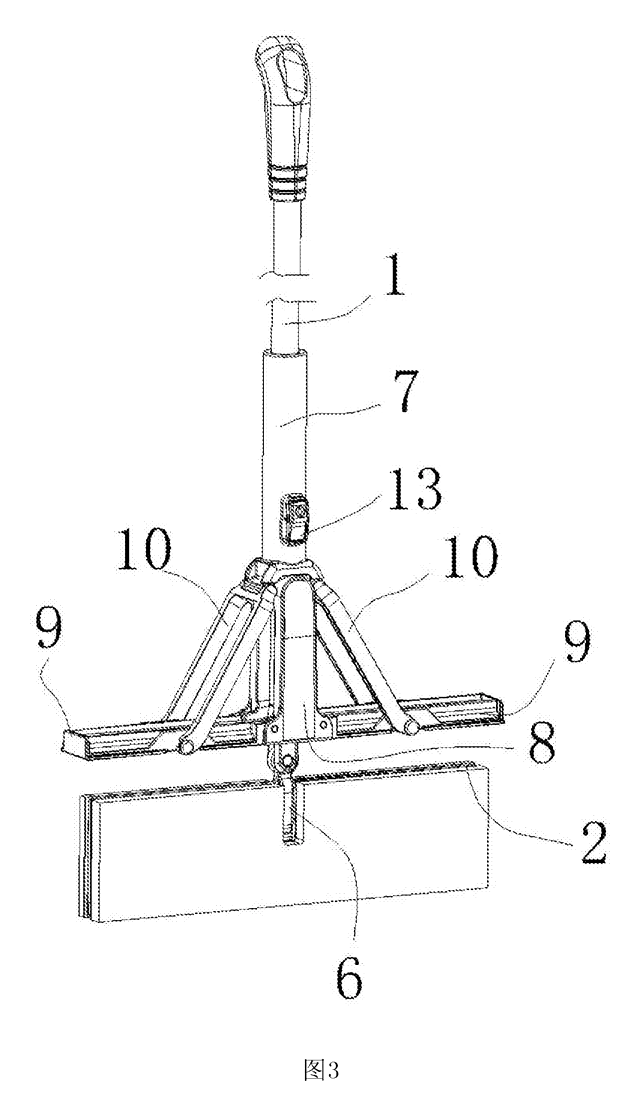
Home, Kitchen & Cleaning
Self-Wringing Flat Mop with Fold-Away Wringer
Flat mop with a built-in wringer that opens only when you wring and folds flat against the pole when you mop.
Patent CN207734114U
Home, Kitchen & Cleaning
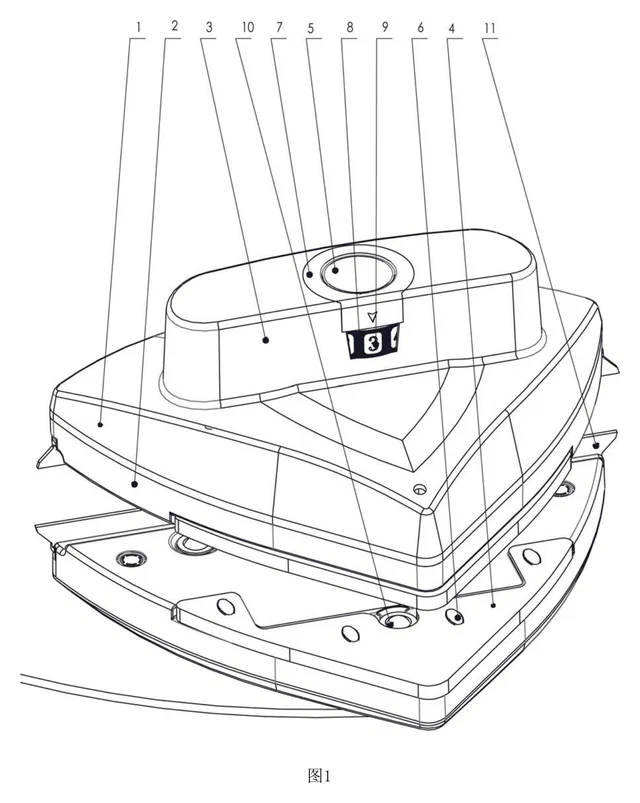
Magnetic Double-Sided Window Cleaner with Dial-Set Magnet Strength
Magnetic window cleaner with a sealed, sliding magnet, dial-set strength for different glass thicknesses and a spring-held idle position.
Patent CN209360543U
Home, Kitchen & Cleaning
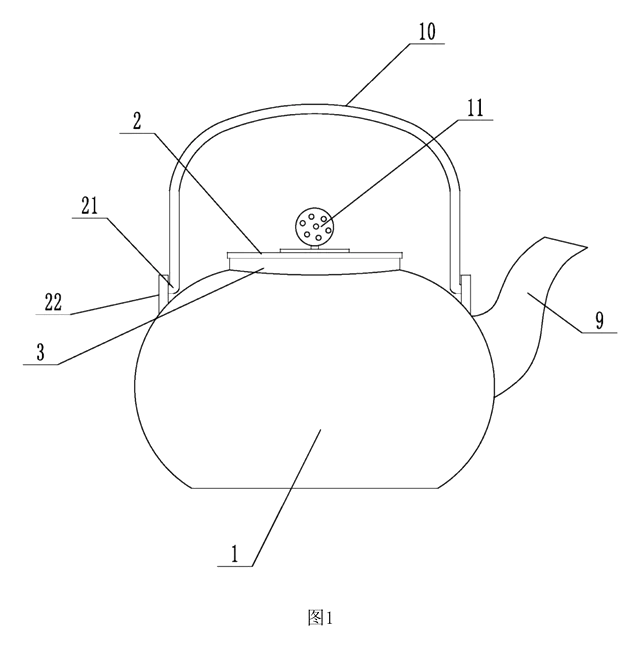
Metal Kettle with Magnetic Lid That Stays On When Pouring
Metal teapot/kettle with a magnet-held lid that does not fall off when pouring, and an insulated, vented lid knob.
Patent CN210540477U
Home, Kitchen & Cleaning
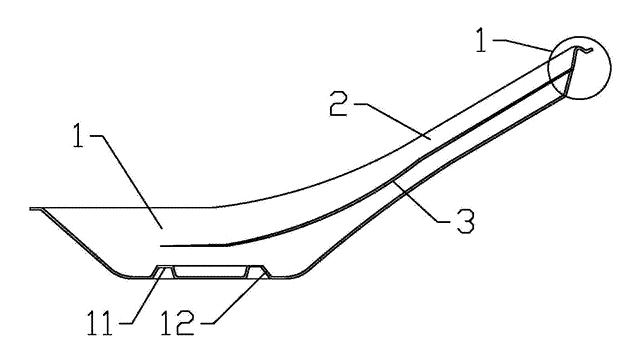
Reinforced Disposable Soup Spoon
Disposable soup spoon with a handle-to-bowl rib, stiffened edges and a ring foot to resist breaking.
Patent CN206964482U
Home, Kitchen & Cleaning
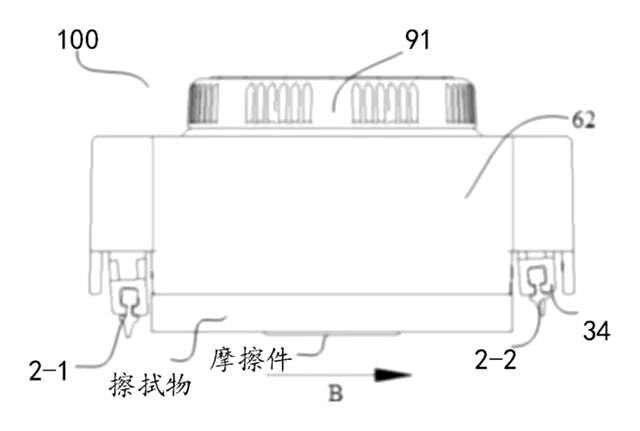
Self-Switching Double-Squeegee Window Cleaner
Cleaning head with two squeegee blades that switch automatically with the direction of movement.
Patent CN212630655U
Home, Kitchen & Cleaning
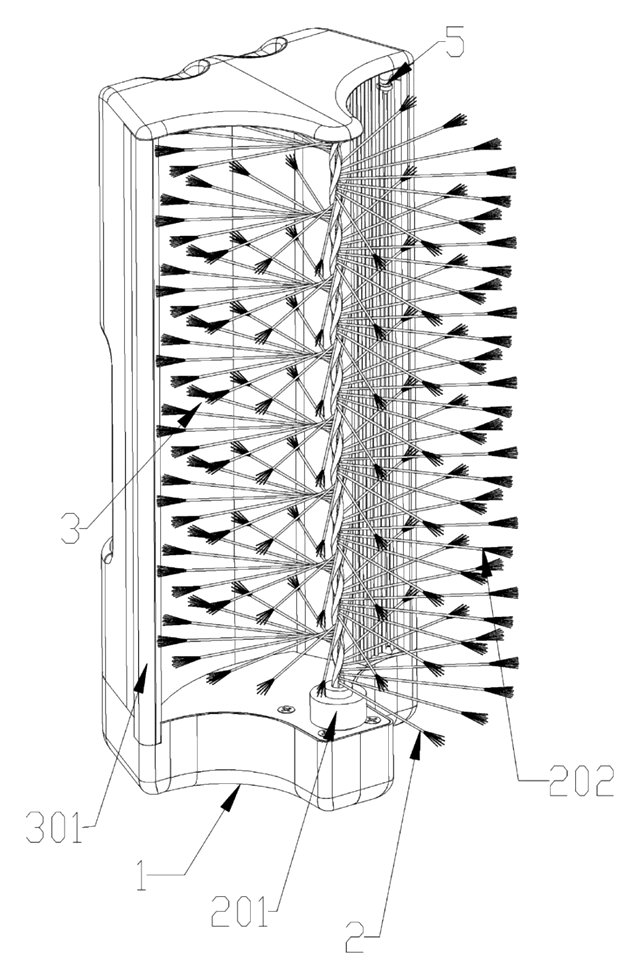
Self-Rinsing Roller Scrub Brush with Dirty-Water Tank
Powered roller brush that rinses and spins its bristles clean inside the body and stores the dirty water.
Patent CN210076909U
Browse by category
- Apparel & Accessories (22)
- Baby & Kids (16)
- Bags & Luggage (9)
- Bath & Personal Care (16)
- Car Accessories (10)
- Furniture, Bedding & Storage (12)
- Garden & Outdoor (18)
- Health & Wellness (8)
- Home, Kitchen & Cleaning (24)
- Lighting (12)
- Packaging & Containers (6)
- Pet Products (6)
- Phone & Camera Accessories (4)
- Retail Display (13)
- School, Office & Art (19)
- Sports & Recreation (25)
- Tools & Workshop (27)
- Toys & Games (12)
This page is based on the public patent document CN115363502B, assigned to Chongqing Panlong Pumped Storage Power Station Co ltd, State Grid Xinyuan Group Co Ltd. IP2M is an independent manufacturing service and is not affiliated with, endorsed by or licensed by the patent owner. Images marked as concept renderings are illustrations, not photos of an existing product. Patent status information is provided for reference only and is not legal advice; confirm freedom to operate for your market before production. Full disclaimer.