At a glance
| Patent number | CN115363502B (application CN202211072814) |
| Type | China invention patent (发明专利) - protects product shape, structure and method |
| Original title | Automatic cleaning device for shoe bodies (一种鞋体自动清理装置) |
| Patent owner | Chongqing Panlong Pumped Storage Power Station Co ltd, State Grid Xinyuan Group Co Ltd |
| Inventors | Han Bo, Li Shizhou, Liu Meng, Yang Yang, Wang Luyao, Deng Zhenghai, Peng Shuang, Wu Hong, Li Ying, Wang Jingyou, Xiong Ruiji |
| Filing date | 2022-09-02 |
| Grant date | 2024-10-25 |
| Status (China) | In force - in force in China until at most 2042-09-02 (if annual fees are paid) |
| Patent family | Chinese filings only - no US, European, Japanese, PCT or other filings listed |
| Cited by | 0 later documents |
| Source | Google Patents (search for CN115363502B) |
What the claims cover, in plain language
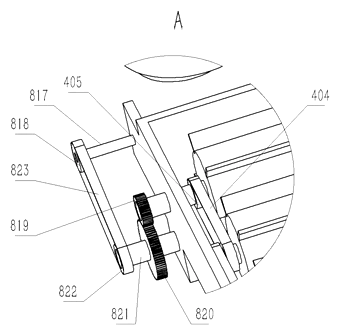
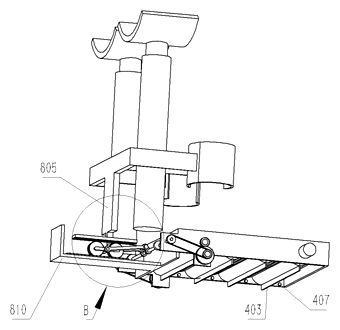
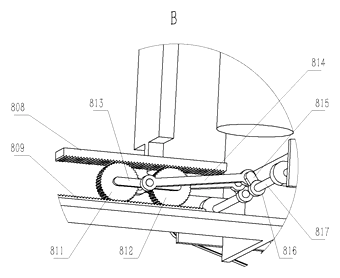
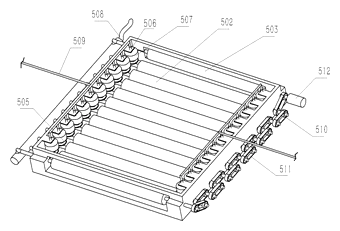
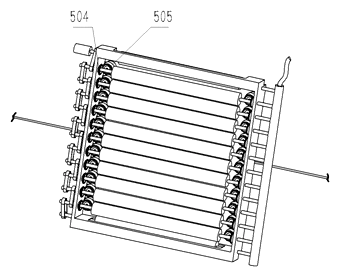
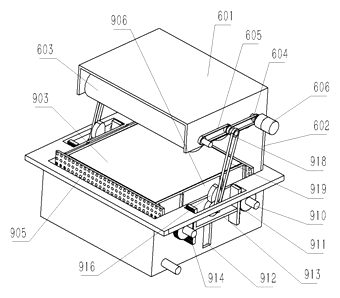
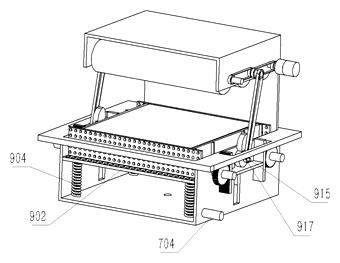
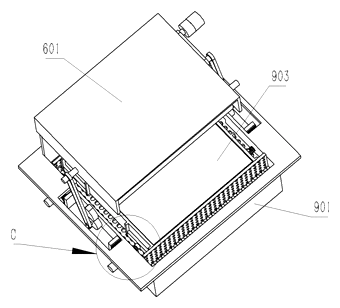
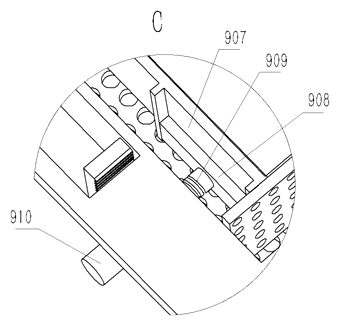
Claim 1 - an automatic shoe cleaning device comprising a horizontally arranged mounting table (1) with cleaning grooves, whose top is rotatably connected to a vertically arranged support column (2) carrying a seat (3) at its top. Near the outer side of the support column, arranged sequentially along its circumferential direction, are a sole mud removing mechanism (4), a sole washing mechanism (5), a vamp cleaning mechanism (6) and a sole drying mechanism (7). The mud removing mechanism is linked to a foot movable auxiliary component (8), and the vamp cleaning mechanism is linked to a sole water removing component (9). The mounting table is hollow. The mud removing mechanism includes a rectangular first mounting frame (401) penetrating the table top, with parallel roller shafts (402) carrying scraping plates (403), interconnected by drive belts (404) and driving discs (405), driven by a first motor (406), with cleaning spray heads (407) below. The foot auxiliary component uses automatic telescopic rods (801) with arc-shaped support plates (802), a sliding frame (803) with limiting plates (804), a vertical plate (805), a sliding rod (806) in a first sliding groove (807), driving a first rack (808) meshed via gears (811, 812) with a fixed second rack (809), connected through connecting rods (813, 814, 815) to turntables (816) on rotating rods (817) carrying transmission discs (818) linked to the roller shafts.
This is a simplified reading for orientation only. The legal scope is defined by the exact claim wording in the official Chinese document.
What this means for US production
This patent was filed only in China and is currently in force there. Because it has no US counterpart, making or selling this device in the United States is not restricted by this specific document. However, making or selling it in China needs the owner’s permission while the patent remains in force.
Two points to settle early:
- Other patents may exist. Automated boot cleaners and shoe washing stations are produced by several companies worldwide, and related mechanisms such as rotary platforms, brush drums and air dryers may be covered by separate US or foreign patents. A freedom-to-operate (FTO) review of the rotating-column layout, the rack-and-gear foot linkage and the four-station sequence is needed before tooling.
- Water and electrical integration. The device combines spray heads, motors and a drying station in a single hollow platform. Waterproofing ratings for the electrical components and drainage connections must be specified early to meet US site requirements.
Customization and manufacturing
What can be customized
| Area | Options |
|---|---|
| Platform size | Overall diameter and height to fit entryway space constraints |
| Seat and column | Seat style, weight capacity, column rotation speed and indexing angles |
| Scraping plates | Plate profile, spacing and material hardness for different boot treads |
| Spray system | Water pressure, nozzle count, filtration and recirculation options |
| Drying mechanism | Air blower capacity, heater wattage or ambient-air-only design |
| Controls | Button panel, touchscreen, RFID badge start or foot-pedal activation |
| Sludge box | Volume, pull-out drawer style or direct-plumb drain connection |
| Materials | Stainless steel or coated carbon steel frames, plastic or rubber guards |
Things to plan for (US market)
- UL 1018 / UL 73 - safety standards for motor-operated appliances and floor treatment machines; required if the unit plugs into mains power.
- NEC (NFPA 70) - wiring methods for equipment combining water sprays and electrical motors in commercial spaces.
- ADA accessibility - if installed in a public or employee entryway, the seat height, controls and foot placement may need to accommodate accessibility guidelines.
- Local plumbing codes - connection of the spray heads and sludge box drain to the building waste line requires backflow prevention and proper trapping.
How a project runs
- Inquiry - define the target boot types, daily user volume, available floor space and utility connections.
- Design - engineer the platform dimensions, rack-and-gear ratios, motor sizing and waterproof enclosures.
- Prototype - build a working unit to test scraping effectiveness, rotation indexing, spray coverage and drying time.
- Pilot run - install at a test site for durability, sludge box capacity and user feedback; run electrical safety tests.
- Production - fabricate platforms, machine roller shafts, mold plastic components, assemble and test each unit.
Quantities & timeline
The hollow mounting platform requires sheet metal welding or casting dies, the roller shafts and scraping plates need machining molds, and the rack-and-gear train requires precision stamping or casting tooling. Electrical certification testing adds time before the first shipment. Send us your space dimensions, daily user volume, utility availability, material preferences, quantity and target price and we will reply with options.
Patent drawings
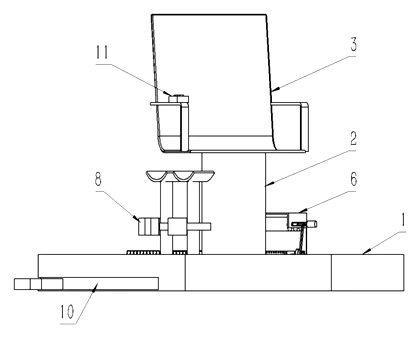
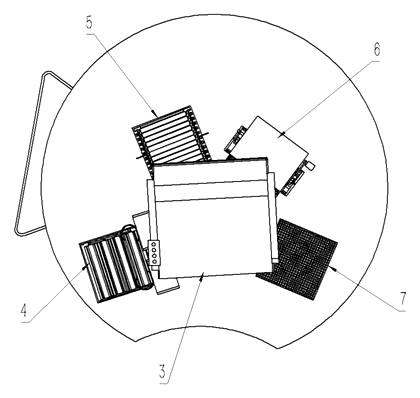
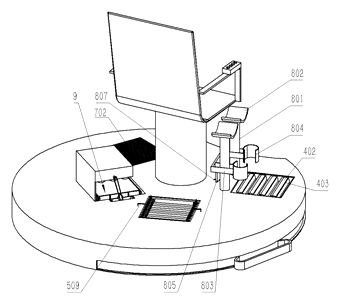
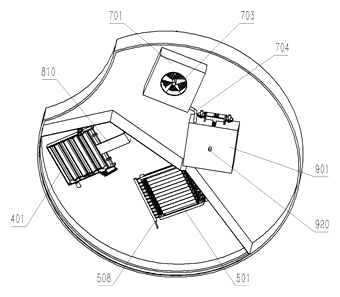
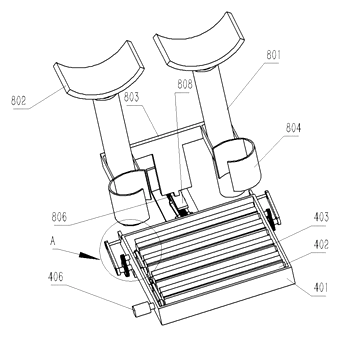
Drawings reproduced from the public patent document for reference.