At a glance
| Patent number | CN115500584B (application CN202211188944) |
| Type | China invention patent (发明专利) - protects product structure and method |
| Original title | Seat belt buckle (安全带锁扣) |
| Patent owner | Guangdong Power Grid Co Ltd; Meizhou Power Supply Bureau of Guangdong Power Grid Co Ltd |
| Inventors | Luo Riteng, Cai Keming, Huang Wenliang, Liang Hong, Chen Zibin, Wu Xiaolang, Chen Hui, Lin Yufeng |
| Filing date | 2022-09-28 |
| Grant date | 2025-03-21 |
| Status (China) | In force - valid until at most 2042-09-28 (assuming annual fees are paid) |
| Patent family | Chinese filings only - no US, European, Japanese, PCT or other filings listed |
| Cited by | 0 later documents |
| Source | Google Patents (search for CN115500584B) |
What the claims cover, in plain language
Claim 1 defines a seat belt buckle with a housing containing a mounting hole and two through holes. It includes an interlocking assembly with two locking elements that move along the Z-axis. Crucially, these elements are mechanically linked: moving one to its locked position drives the other to its unlocked position. Two tensioning members sit below the locking elements. When a locking element is in the locked position, it inserts into the tensioning member, causing the tensioning member to compress the inner ring of the belt hook. When unlocked, the tensioning member releases the hook.
The claim further specifies that the interlocking assembly includes first and second locking plates that rotate. The locking elements have locking steps and unlocking rods. The movement of one element’s unlocking rod pushes the opposing plate, which releases the other element’s locking step, creating the mutual exclusivity of the locked states.
This is a simplified reading for orientation only. The legal scope is defined by the exact claim wording in the official Chinese document.
What this means for US production
This patent was filed only in China and is currently in force. Making or selling products that exactly replicate the specific dual-interlock mechanism described in Claim 1 in China would require permission from the patent owner. Since there are no US patents in this family, the specific mechanism described here is not restricted by this particular patent in the United States.
Two points to settle early:
- Other patents may exist. Fall protection and climbing gear are heavily patented fields globally. Major manufacturers like Petzl, DMM, and Black Diamond hold numerous patents on carabiner gates, auto-locking mechanisms, and dual-lanyard connectors. A freedom-to-operate (FTO) review is essential to ensure your design does not infringe on existing US or international patents regarding “automatic release upon engagement” features.
- Material durability. The patent describes the structure but not specific materials. For US markets, aluminum alloys or stainless steel grades must be selected to meet strength requirements, which may involve different manufacturing processes than those implied by the Chinese description.
Customization and manufacturing
What can be customized
| Area | Options |
|---|---|
| Materials | Anodized aluminum, stainless steel, or high-strength polymer housings. |
| Finish | Matte black, silver, or color-coded buttons for left/right identification. |
| Size | Housing dimensions adjusted to fit standard belt hook diameters (e.g., 10mm, 12mm). |
| Spring Rate | Tensioning member stiffness tuned for glove-friendly operation vs. secure retention. |
| Mounting | Attachment points for webbing straps or rigid bars. |
Things to plan for (US market)
- ANSI Z359.11 - Personal Fall Arrest Systems standard. Connectors must withstand significant static loads (typically 5,000 lbs or more depending on class).
- OSHA 1926.502 - Federal regulations for construction fall protection. Equipment must be certified and inspected.
- ASTM F887 - Standard specification for personal protective equipment for persons working in elevators and other similar vertical shafts (if applicable to niche markets).
- Corrosion Resistance - Salt spray testing (ASTM B117) is common for outdoor electrical utility gear.
How a project runs
- Inquiry - Define load class, material preference, and quantity.
- Design - CAD modeling of the interlocking plates and tolerance analysis for the sliding elements.
- Prototype - CNC machining of housings and stamping of plates for functional testing.
- Pilot run - Mechanical cycling tests (open/close thousands of times) and static load verification.
- Production - Injection molding (for polymer parts), die casting (for metal housings), and assembly with quality checks on the interlock timing.
Quantities & timeline
The precision required for the “unlocking rod” to correctly actuate the “locking plate” demands tight tolerances. Tooling for die-cast housings and stamped steel plates takes several weeks. Certification testing for ANSI standards adds time. Send us your target load rating, material preference, estimated quantity and timeline and we will reply with options.
Patent drawings
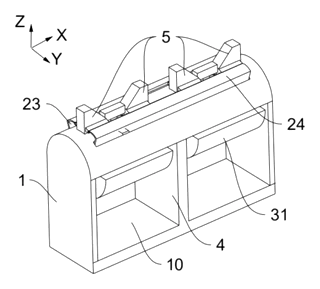
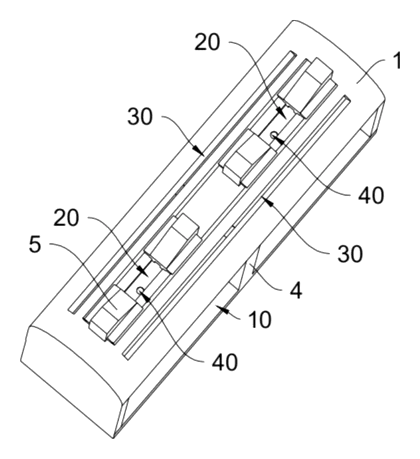
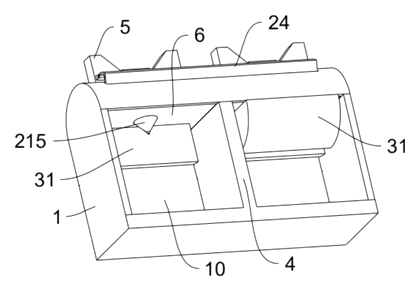
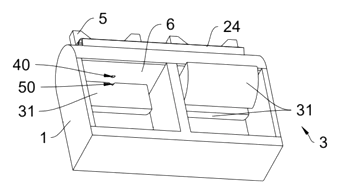
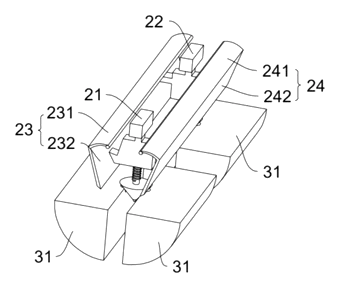
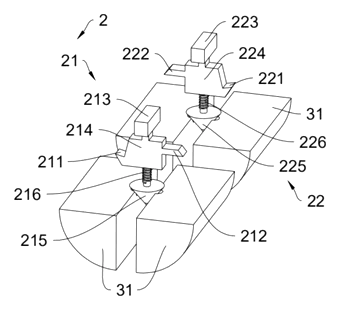
Drawings reproduced from the public patent document for reference.