
Patent CN116077325B
Updated October 31, 2026Adjustable Massager with Longitudinal Reciprocating Mechanism
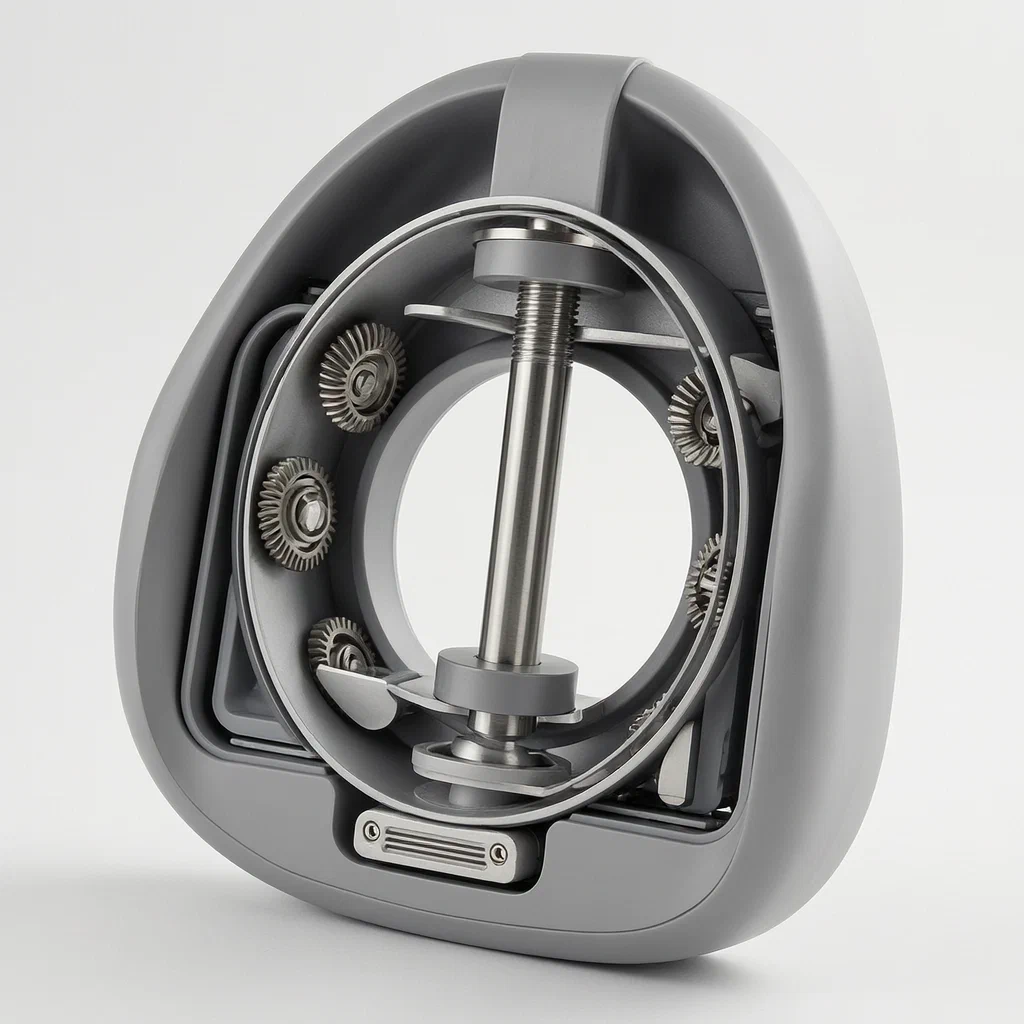
Standard massage pillows vibrate in one spot, leaving adjacent tense muscles untreated. Users often shift the device manually to find relief. This patent describes a mechanical solution: a single motor that changes direction to trigger two distinct behaviors. In forward rotation, the massage heads work locally. In reverse rotation, a threaded guide shaft converts the spin into linear motion, sliding the entire massage assembly up and down. This allows the device to cover a larger surface area automatically, adapting to different neck sizes or fatigue zones without user intervention.
- China invention patent - active
- No filings outside China
- Massage & wellness devices
- Mechanical reciprocation via threaded guide shaft
Splat! What let you down?
🔄
Dual-mode operation
One motor direction for local massage; the opposite direction adds longitudinal sliding.
⚙️
Threaded guide shaft
Crossed left and right-hand threads convert rotation into precise back-and-forth travel.
📏
Wider coverage
The extension portion and sliding assembly increase the effective massage range.
🔩
Simple mechanics
Uses gears and a one-way bearing instead of complex linear actuators or sensors.
Bring this product to market
- ✓ Patent vetted China-only family and legal status checked
- 2 Product brief · now How it works, uses and options written up
- 3 Prototype First samples for buyers to review
- 4 Pilot run Small first batch for launch customers
- 5 Volume production Repeat orders at scale
Buyer interest
– of 100 buyers needed to start prototyping
One click, no sign-up. Each vote is one real visitor, and products with the most interest go to prototyping first.
Build team: no members yet. Need a partner, co-funding or skills to build this? Join and we introduce the team once it forms.
The problem
Most handheld or wearable massagers operate at a fixed position relative to the housing. If the user’s muscle tension spans a broader area—such as the trapezius extending from the neck to the shoulder blade—the device must be manually shifted repeatedly. This interrupts relaxation and requires constant adjustment. Additionally, many devices rely on electronic controls to vary speed or pattern, which can increase cost and complexity. There is a need for a purely mechanical way to expand the treatment zone using existing rotational inputs.
The solution
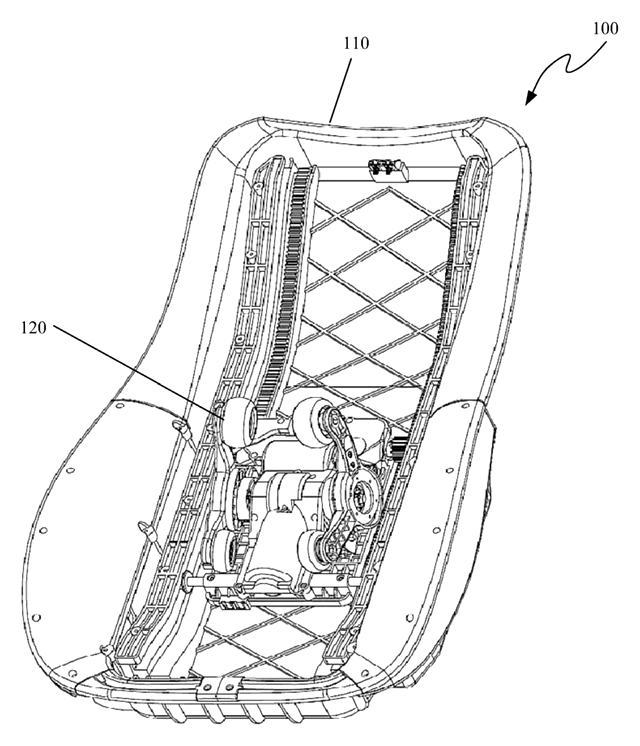
The patent describes a massager housed in a box body containing a movable plate. This plate travels longitudinally along a fixed guide shaft located above it. The key innovation lies in how the movement is triggered.
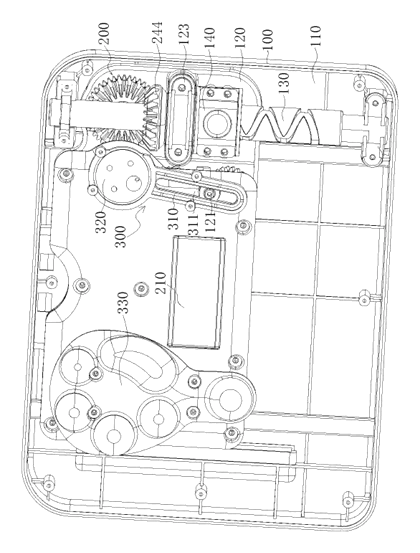
- Guide Shaft Design: The shaft features two intersecting thread grooves: one left-handed and one right-handed. A rotating sleeve rides on this shaft, held in place by a guide block that engages these grooves.
- Driving Assembly: Inside the movable plate sits a motor (driving member) connected to a system of gears. This includes a first gear train (worm and pinion) for the massage heads and a second gear train (bevel gears) linked to the rotating sleeve.
- Mode Switching: A one-way bearing connects the two gear trains. When the motor rotates forward, the bearing locks out the second train, driving only the massage heads. When the motor reverses, the bearing engages, allowing the rotation to drive the bevel gears, which turn the sleeve. As the sleeve turns on the threaded shaft, it forces the entire movable plate—and thus the massage heads—to slide back and forth.
Who it is for
- Personal Care Brands looking for differentiated massage pillows that offer automatic coverage expansion without software updates.
- Ergonomic Product Manufacturers targeting office workers who need hands-free relief for neck and shoulder tension over a wider area.
- Home Appliance OEMs seeking reliable mechanical solutions that avoid the failure points of electronic linear actuators.
- Gift & Novelty Retailers selling compact, self-adjusting wellness devices for travel or desk use.
How it works
The main parts
| No. | Part | What it does |
|---|---|---|
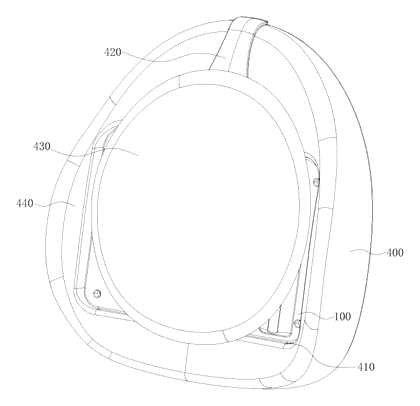
| 100 | Box Body | Encloses the cavity and supports the components. |
| 120 | Movable Plate | Holds the motor and massage mechanisms; slides longitudinally. |
| 130 | Guide Shaft | Fixed shaft with crossed left/right threads guiding the movement. |
| 140 | Rotating Sleeve | Rides on the shaft; translates rotation into linear motion. |
| 200 | Driving Assembly | Motor and gear trains controlling the massage action and sliding. |
| 300 | Massage Mechanism | Symmetrical heads with extension portions for contact. |
| 121 | Fixed Shaft | Connects to the movable plate to stabilize the extension part. |
Operating steps
- Forward Rotation: The user activates the standard mode. The motor spins forward. The first gear train drives the massage heads to rotate or oscillate locally. The one-way bearing prevents the second gear train from moving, so the plate stays still.
- Reverse Rotation: The user switches the motor direction. The first gear train continues to drive the massage heads. Simultaneously, the one-way bearing engages the second gear train. This drives the rotating sleeve along the guide shaft.
- Linear Travel: Because the sleeve follows the threaded grooves, its rotation causes it to move longitudinally. Since the sleeve is attached to the movable plate, the entire massage assembly slides up or down, expanding the treated area.
Applications
Neck and Shoulder Relief
According to the patent, users with tension spanning the neck base and upper shoulders can set the device to scan mode, so both areas receive attention without manual repositioning.
Lower Back Support
According to the patent, when placed against the lumbar region, the reciprocating motion is intended to target specific knots in the erector spinae muscles, covering a vertical strip rather than a single point.
Travel Comfort
Compact enough for carry-on luggage, the automatic adjustment feature lets users relax during long flights without constantly adjusting the pillow’s position against seat turbulence.
Post-Workout Recovery
According to the patent, athletes can use the scanning mode to treat large muscle groups like the quadriceps or calves, with consistent pressure set to apply across the length of the muscle belly.
Where it is less suitable
- Deep Tissue Therapy – The mechanism focuses on coverage area rather than high-pressure percussive force.
- Waterproof Use – The open cavity and threaded shaft design suggests this is not intended for submersion or shower use.
- Silent Operation – Mechanical gear switching may produce audible noise compared to fully enclosed electronic systems.
Frequently asked questions
How does the massage area change size?
The device uses a threaded guide shaft. When you reverse the motor direction, a gear system turns a sleeve that rides along these threads. This physically slides the entire massage head assembly up and down, covering a longer section of your neck or back automatically.
Do I need two motors?
No. The patent describes a single driving member (motor) that works in two states: forward and reverse. A mechanical one-way bearing and gear train allow this one motor to handle both the local massage action and the global sliding movement.
Is the sliding motion quiet?
Mechanical sliding involves gears and threads, which can generate some noise compared to magnetic levitation or pure vibration. However, the design prioritizes simplicity and reliability over silence. Noise levels depend on lubrication and gear quality in the final product.
Can the travel distance be adjusted?
Yes, during manufacturing. The length of the guide shaft and the pitch of the threads determine how far the unit moves. These dimensions are set in design and confirmed on prototypes based on the intended body area coverage.
Does it heat up?
The patent focuses on the mechanical movement system. Heating elements are not described in the core claims. However, such elements can be added to the massage heads in custom versions if requested.
How durable is the threaded shaft?
The shaft is made of metal (typically steel or aluminum alloy) to withstand repeated rotation and linear stress. Wear depends on material hardness and lubrication. Standard industrial lifespan tests apply.
Can this design be made and sold in the US?
The patent is active in China but has no US counterpart. Therefore, the specific mechanical design described here does not infringe on this patent in the US market. However, a freedom-to-operate check is always recommended for massage devices due to the density of other patents in the field.
Are you affiliated with the patent owner?
No. IP2M is an independent design and manufacturing service working from the public patent document.
Request a quote
Click Request a Quote below to see our email address - copy it, or open your email app with a ready-made message. Please mention patent CN116077325B in the subject.
Helpful details to include:
- Your company and channel (personal care brand, appliance manufacturer, gift retailer)
- Desired travel length (how far the massage head should slide)
- Motor preference (standard DC, geared, or silent option)
- Features (heating, remote control, battery capacity)
- Estimated quantity and target price
- Timeline - when you would like samples and the first shipment
You can also reach us at (332) 203-9997.
Explore this product
Interested in building this?
Tell us your target market, quantity and timeline. We reply with options for prototyping, small-batch runs or volume production.
Send your inquiry to
Please put CN116077325B in the subject line and tell us your company, country, estimated quantity and timeline.
Prefer to talk? Call (332) 203-9997.
More product-ready patents
All Health & Wellness patents →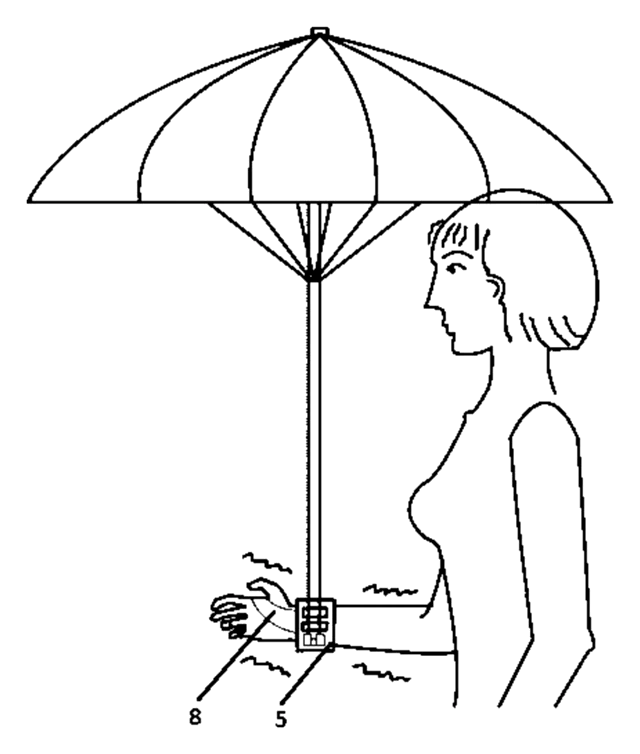
Health & Wellness
Wrist-Mounted Umbrella Stabilizer
Wrist-worn umbrella holder with an anti-shake link; the patent designs it for people with tremor.
Patent CN212545964U
Health & Wellness
Spring-Valve Breath Trainer for Singers
Pocket breath trainer: blow against a spring-loaded valve to practice breath support for singing.
Patent CN207833725U
Health & Wellness
Closed-Loop Nasal Rinse Kit with Collection Bottle
Nasal rinse set: syringe-fed nose plug inside a sealed hood, with used solution drawn into a bottle.
Patent CN208017763U
Health & Wellness
Inflatable Cervical Traction Collar Shaped for a Child's Neck
Child-size three-ring air collar on telescoping shoulder struts, inflated with a hand bulb.
Patent CN208958444U
Massage & Wellness
Pneumatic Multi-Directional Neck Traction Collar
Three-airbag cervical collar that inflates in sequence to guide the head in multiple directions.
Patent CN207202980U
Health & Wellness
Shoulder-Detecting Massage Chair Mechanism with Forked Swing Arms
Massage chair core uses forked swing arms and sensors to detect shoulders and adjust the routine.
Patent CN106618998B
Browse by category
- Apparel & Accessories (23)
- Baby & Kids (18)
- Bags & Luggage (12)
- Bath & Personal Care (18)
- Car Accessories (14)
- Furniture, Bedding & Storage (13)
- Garden & Outdoor (19)
- Health & Wellness (9)
- Home, Kitchen & Cleaning (27)
- Lighting (13)
- Packaging & Containers (7)
- Pet Products (6)
- Phone & Camera Accessories (4)
- Retail Display (15)
- School, Office & Art (20)
- Sports & Recreation (26)
- Tools & Workshop (32)
- Toys & Games (13)
This page is based on the public patent document CN116077325B, assigned to Ningbo Osun Health Care Technology Co ltd. IP2M is an independent manufacturing service and is not affiliated with, endorsed by or licensed by the patent owner. Images marked as concept renderings are illustrations, not photos of an existing product. Patent status information is provided for reference only and is not legal advice; confirm freedom to operate for your market before production. Full disclaimer.