
Patent CN116278465B
Updated October 31, 2026Push-Type Ballpoint Pen with a Pressing Pen Clip Mechanism
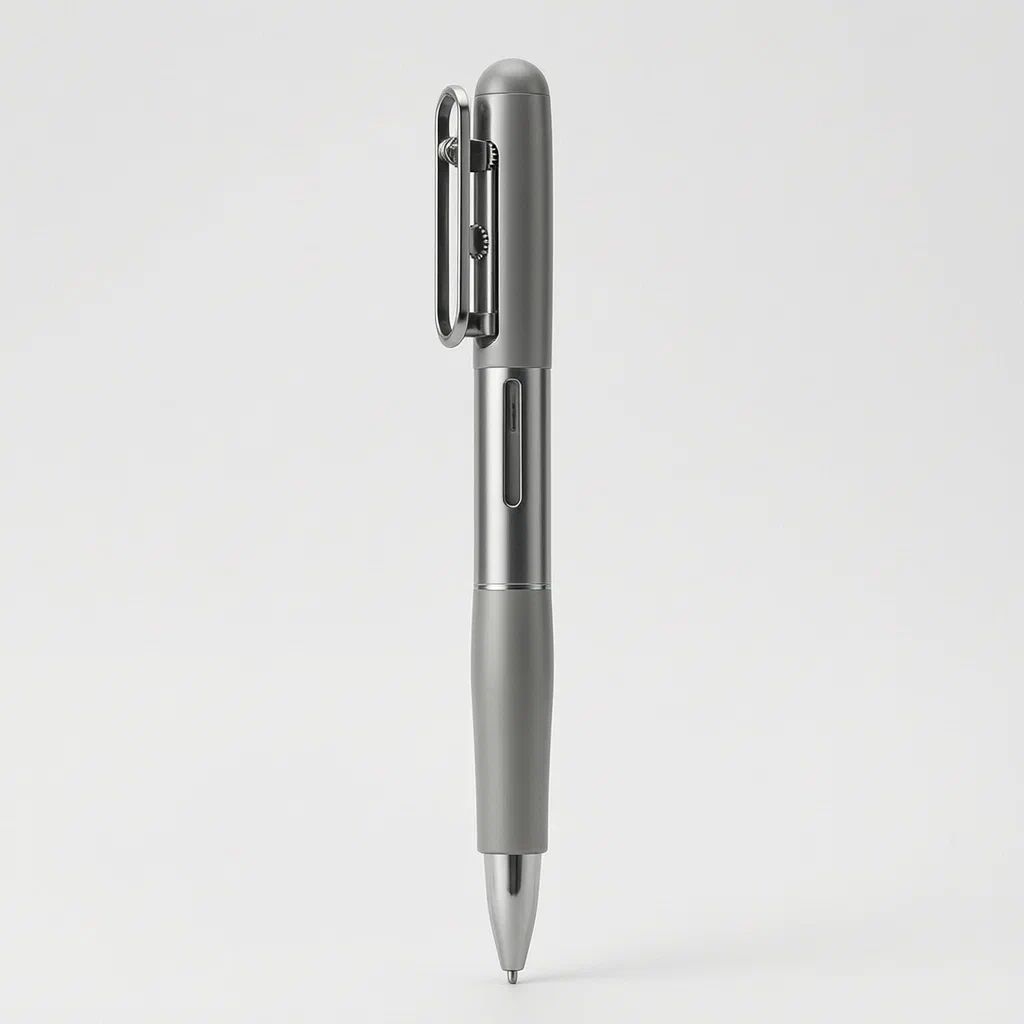
Traditional push pens have a button on top that can be pressed accidentally when the pen is clipped to a pocket or notebook. This design moves the actuation to the pen clip itself. By pressing the lower part of the clip, the user engages a hidden internal gear-and-wheel mechanism within the barrel. This allows the top of the pen to remain free for other features, such as a stylus tip, while ensuring the refill only extends when intentionally manipulated via the clip.
- China invention patent - active
- No filings outside China
- Writing instruments
- Internal gear and wheel drive mechanism
Splat! What let you down?
✏️
Clip Actuation
Pressing the pen clip extends or retracts the refill; no top button required.
⚙️
Hidden Gear Drive
An internal rotating wheel and sliding press wheel mesh to control movement.
🔒
Accidental Prevention
The mechanism is isolated inside the barrel, avoiding false triggers from clipping.
📱
Free Top Space
With no button on top, the cap area can house a stylus or other tools.
Bring this product to market
- ✓ Patent vetted China-only family and legal status checked
- 2 Product brief · now How it works, uses and options written up
- 3 Prototype First samples for buyers to review
- 4 Pilot run Small first batch for launch customers
- 5 Volume production Repeat orders at scale
Buyer interest
– of 100 buyers needed to start prototyping
One click, no sign-up. Each vote is one real visitor, and products with the most interest go to prototyping first.
Build team: no members yet. Need a partner, co-funding or skills to build this? Join and we introduce the team once it forms.
The problem
Standard ballpoint pens typically use a button on the top end to extend and retract the refill. This design has two main issues for professional and student users. First, the button can be pressed accidentally when the pen is clipped into a shirt pocket, notebook cover, or bag, causing the refill to stick out and potentially stain fabric or paper. Second, the presence of a moving button on the top limits the utility of that space. Users often want a stylus tip for tablets or phones integrated into the pen’s top, but the button mechanism occupies the necessary room. Furthermore, traditional snap mechanisms can sometimes jam if debris enters the external button housing.
The solution
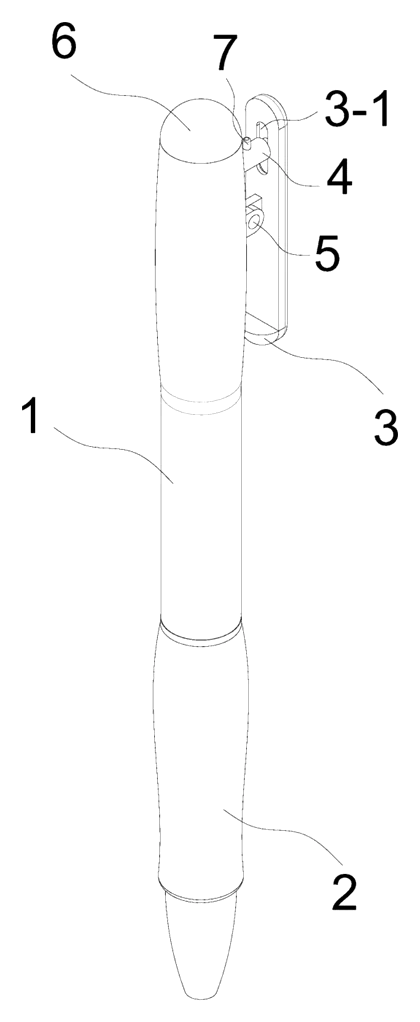
This patent describes a ballpoint pen where the actuation is moved from the top button to the pen clip itself. The core of the solution is an internal transmission system housed within the upper barrel.
- The upper barrel contains a first refill cavity. Inside this cavity, a press wheel slides along a groove in the inner wall.
- A rotating wheel is mounted within the press wheel. These two wheels interact via gear teeth: the rotating wheel has fixed gear teeth that mesh with the press wheel’s gear teeth.
- A trapezoidal push block is slidably connected to the press wheel. This block is attached to a first telescopic rod.
- The first telescopic rod extends through a through-hole in the barrel wall and connects to the pen clip assembly via a second telescopic rod and spring mechanism.
- When the user presses the bottom of the pen clip, it rotates around its connecting shaft. This rotation pulls the second telescopic rod, which compresses the first telescopic rod and moves the trapezoidal push block.
- The push block forces the press wheel to slide. As the press wheel slides, the meshing gears cause the rotating wheel to turn.
- The rotating wheel is positioned to contact the refill. When it turns, it pushes the refill forward (to write) or releases it (to retract), depending on the specific gear engagement state described in the claims.
Who it is for
- Stationery brands looking for differentiated designs that solve common complaints about accidental refill extension.
- Corporate gift suppliers who need pens with clean tops for logo printing or added functionality like styluses.
- Educational supply manufacturers whose products are handled by students who frequently clip pens to notebooks, risking ink stains.
- Tech accessory integrators aiming to combine writing instruments with digital input tools (stylus) without mechanical conflict.
How it works
The main parts
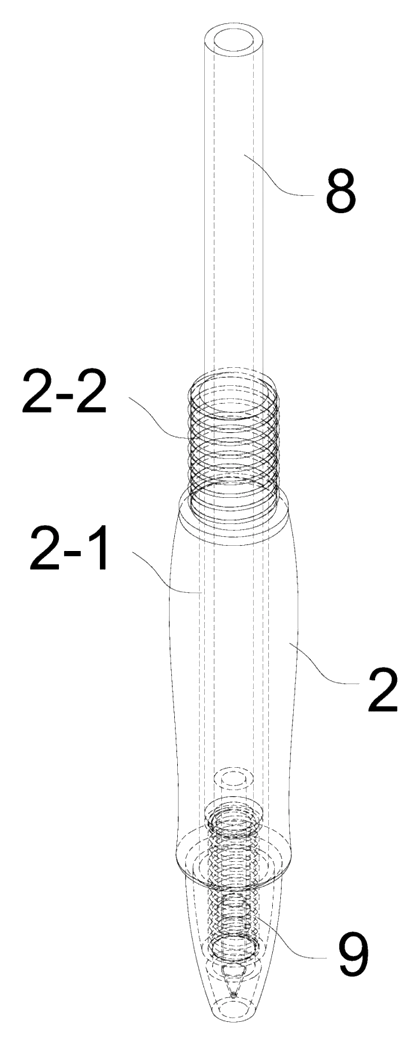
| No. | Part | What it does |
|---|---|---|
| 1 | Upper Barrel | Houses the internal mechanism and refill cavity. |
| 3 | Pen Clip | The external actuator; rotates when pressed. |
| 4 | First Telescopic Rod | Transmits motion from the clip to the internal block. |
| 10 | Rotating Wheel | Meshes with the press wheel; contacts the refill. |
| 11 | Press Wheel | Slides in the barrel groove; driven by the push block. |
| 12 | Trapezoidal Push Block | Converts linear rod motion into wheel sliding/rotation. |
| 8 | Refill | The ink cartridge extended or retracted by the wheel. |
| 13 | Second Telescopic Rod | Connects the clip to the first rod via springs. |
Operating steps
- Initial State: The refill is either extended or retracted based on the last action. The clip is in its resting position.
- Press the Clip: The user applies pressure to the lower part of the pen clip. The clip rotates slightly around its mounting axis.
- Rod Movement: This rotation pulls the second telescopic rod, which acts on the first telescopic rod. The rods move inward/outward relative to each other due to the spring setup.
- Block Activation: The first telescopic rod moves the trapezoidal push block inside the barrel.
- Gear Engagement: The push block slides the press wheel. Because the press wheel and rotating wheel are geared together, the sliding motion causes the rotating wheel to spin.
- Refill Action: The spinning rotating wheel pushes against the refill, causing it to extend further out or click back into the barrel, depending on the gear phase.
Applications
Corporate Gifting
Companies prefer pens where the top surface is flat and unobstructed for laser engraving logos. Since this design removes the top button, the entire cap area is available for branding or adding a touch-screen stylus tip without interfering with the writing mechanism.
Student Notebooks
Students often clip pens to the covers of hardback textbooks or spiral notebooks. Traditional buttons get pressed by the friction of the clip or the angle of insertion, leading to ink smudges on pages or pockets. This clip-actuation ensures the refill stays retracted unless deliberately pressed.
Digital Hybrid Pens
For professionals using tablets alongside notes, a pen with a built-in stylus is valuable. The absence of a protruding button on the top allows for a smooth, continuous body shape, making it easier to integrate a capacitive stylus tip at the very end of the pen without complex dual-mechanism housings.
Retail Display Units
Pens displayed in open racks are subject to handling by many customers. Accidental clicks are less likely because the user must specifically manipulate the clip, rather than just touching the top of the pen. This maintains the “new” look of the display items longer.
Where it is less suitable
- Ultra-low-cost promotional pens: The internal gear and multi-part rod assembly require more precise molding and assembly than simple cam-action pens, increasing unit cost.
- Left-handed specific ergonomic clips: The current clip geometry is standard; specialized ergonomic modifications might interfere with the rotational actuation path.
- Heavy-duty industrial environments: If the clip is subjected to extreme lateral forces unrelated to pressing, the thin telescopic rods may be more susceptible to fatigue than solid-button mechanisms.
Frequently asked questions
How does the clip actually work?
Instead of a button on top, you press the bottom of the pen clip. This rotates the clip slightly, which pulls an internal rod. That rod moves a gear system inside the barrel that pushes the ink refill out or snaps it back in.
Is the clip durable?
The patent describes a spring-loaded telescopic rod system connected to the clip. Durability depends on the plastic grade and mold precision. We recommend testing the clip rotation cycle count during prototyping to ensure it withstands daily use without breaking.
Can I put a logo on the top of the pen?
Yes. Because the mechanism is triggered by the clip, the top of the pen remains free of buttons. This provides a clean, flat surface ideal for laser engraving, pad printing, or even integrating a stylus tip for tablets.
Does this prevent ink stains on clothes?
It helps significantly. Traditional pens often extend the refill accidentally when pushed into a pocket. Since this pen requires deliberate manipulation of the clip to extend, the risk of accidental deployment and subsequent staining is reduced.
What materials are used?
The patent mentions plastic components for the barrel, wheels, and rods, and a metal or plastic clip. Specific material grades (ABS, PC, etc.) are determined during the design phase based on your budget and durability requirements.
Is this a new invention?
The patent was granted in March 2025. It represents a specific structural innovation for clip-based actuation. However, similar concepts may exist in prior art, so we focus on the unique internal gear arrangement described here.
Can this design be made and sold in the US?
The patent is active in China but has no US counterpart. Therefore, you can manufacture and sell this design in the US without infringing this specific patent. However, the stationery industry is heavily patented. We strongly recommend a freedom-to-operate check to ensure your version doesn’t clash with other US patents on clip mechanisms.
Are you affiliated with the patent owner?
No. IP2M is an independent design and manufacturing service working from the public patent document.
Request a quote
Click Request a Quote below to see our email address - copy it, or open your email app with a ready-made message. Please mention patent CN116278465B in the subject.
Helpful details to include:
- Your company and channel (stationery brand, corporate gifter, school supplier)
- Target retail price and estimated annual volume
- Material preferences (recycled plastic, premium ABS, etc.)
- Customization needs (logo placement, stylus integration, color matching)
- Timeline - when you would like samples and the first shipment
You can also reach us at (332) 203-9997.
Explore this product
Interested in building this?
Tell us your target market, quantity and timeline. We reply with options for prototyping, small-batch runs or volume production.
Send your inquiry to
Please put CN116278465B in the subject line and tell us your company, country, estimated quantity and timeline.
Prefer to talk? Call (332) 203-9997.
More product-ready patents
All School, Office & Art patents →
School, Office & Art
Long-Point Sketch Pencil Sharpener
Crank sharpener that cuts only the wood of sketch pencils, leaving a long, round lead about 30 mm long.
Patent CN207241257U
School, Office & Art
Fold-Out Desk Organizer Insert for School Backpacks
Backpack insert that unfolds into a hanging desk organizer for workbooks, stationery and a water bottle.
Patent CN209436546U
School, Office & Art
Smart Pencil Cap That Checks the Point with a Camera
Electronic pencil cap that photographs the point, measures it and reminds you to sharpen.
Patent CN106427302B
School, Office & Art
Expanding Clipboard Folder with Spring-Mounted Hinge and Catch
Hard folder whose spring-mounted hinge and catch let the cover clamp any thickness of paper.
Patent CN105667120B
School, Office & Art
Slide-Action Retractable Pen with a Friction-Loaded Cam That Ignores Gravity
Slide-action retractable pen whose spring-pressed cam latch stays put whichever way the pen is held.
Patent CN217671900U
School, Office & Art
Carousel Business Card Holder with Rolling Card Trays on Twin Ring Tracks
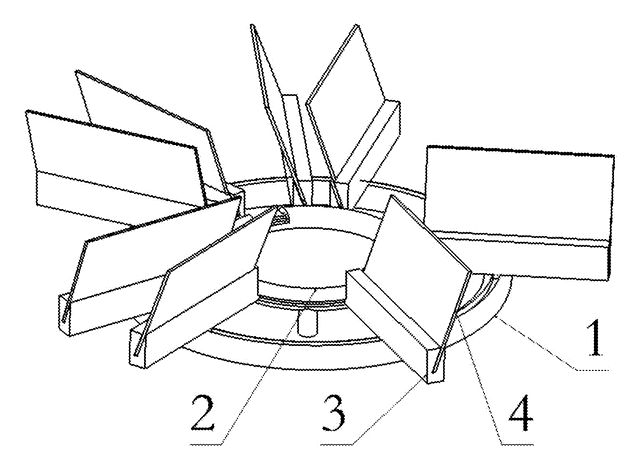
Desk card holder: angled card trays roll on wheels around two concentric ring tracks and lift out.
Patent CN105774300B
Browse by category
- Apparel & Accessories (23)
- Baby & Kids (17)
- Bags & Luggage (12)
- Bath & Personal Care (17)
- Car Accessories (12)
- Furniture, Bedding & Storage (13)
- Garden & Outdoor (19)
- Health & Wellness (8)
- Home, Kitchen & Cleaning (27)
- Lighting (12)
- Packaging & Containers (6)
- Pet Products (6)
- Phone & Camera Accessories (4)
- Retail Display (14)
- School, Office & Art (20)
- Sports & Recreation (26)
- Tools & Workshop (30)
- Toys & Games (13)
This page is based on the public patent document CN116278465B, assigned to Tonglu Baite Stationery Co ltd. IP2M is an independent manufacturing service and is not affiliated with, endorsed by or licensed by the patent owner. Images marked as concept renderings are illustrations, not photos of an existing product. Patent status information is provided for reference only and is not legal advice; confirm freedom to operate for your market before production. Full disclaimer.