At a glance
| Patent number | CN116473399B (application CN202310412551) |
| Type | China invention patent (发明专利) - protects technical solutions and structures |
| Original title | A multi-functional clothing rack with automatic lighting supplementation (一种可自动补光的多功能服装展架) |
| Patent owner | Fujian Anbang Exhibition Co ltd |
| Inventors | Zhong Keqing, Li Guihua, Li Zhongwang |
| Filing date | 2023-04-18 |
| Grant date | 2024-06-11 |
| Status (China) | In force - valid until at most 2043-04-18, subject to payment of annual fees |
| Patent family | Chinese filings only - no US, European, Japanese, PCT or other filings listed |
| Cited by | 0 later documents |
| Source | Google Patents (search for CN116473399B) |
What the claims cover, in plain language
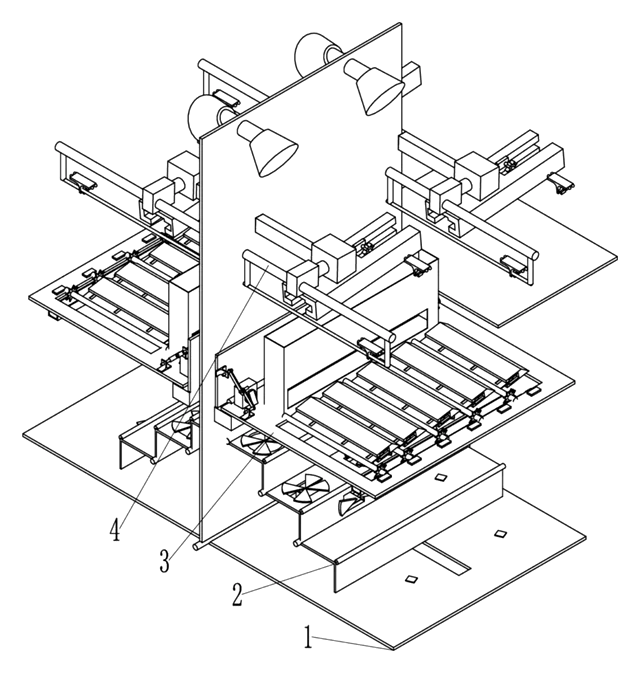
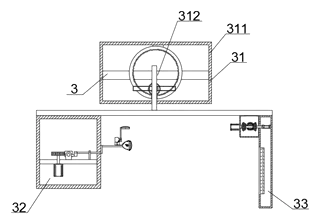
Claim 1 defines a clothing display rack comprising a base rack, a detachable model, and a top adjusting piece. The adjusting piece contains three distinct sub-mechanisms: a lifting mechanism, an angle adjustment mechanism, and a polishing (dimming) mechanism.
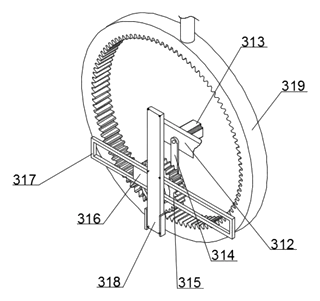
The lifting mechanism uses a first motor connected to a rotating block and gear. This gear meshes with a planetary gear fixed to the shell. As the gear rotates, it drives a sliding block within a groove plate, moving the entire lamp assembly vertically.
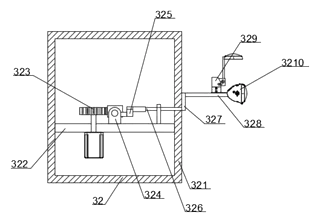
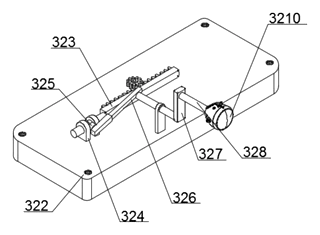
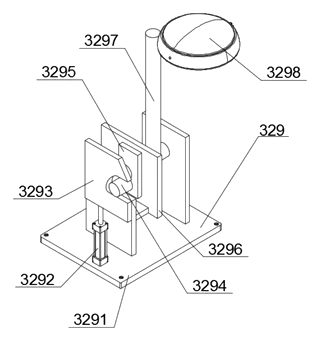
The angle adjustment mechanism includes a second mounting shell with a support plate. A transmission part (motor/gear/toothed plate) drives connecting seats and blocks via rods. These connect to a telescopic rod that pivots a swinging block, thereby changing the lamp’s horizontal orientation.
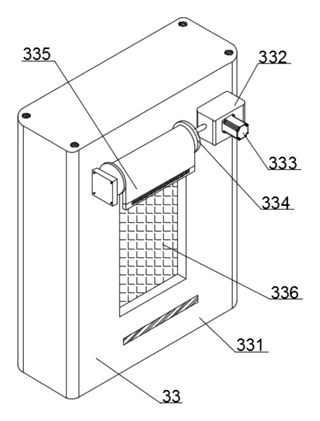
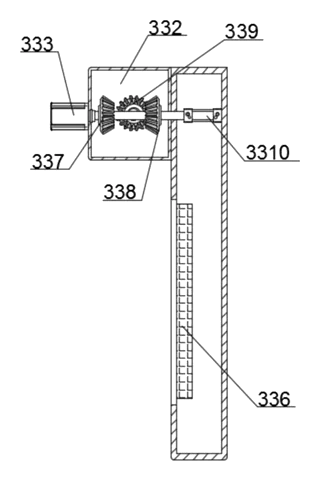
The polishing mechanism features a third mounting shell with a fourth shell inside. A second motor drives a series of bevel gears connected to a winding roller. A warm light cover is wound on the roller. When activated, the gears rotate the roller to extend or retract the cover over the lamp surface, altering the light tone.
This is a simplified reading for orientation only. The legal scope is defined by the exact claim wording in the official Chinese document.
What this means for US production
This patent was filed only in China and is currently in force. Making or selling this specific mechanical configuration in China requires the owner’s permission. However, since there are no corresponding patents in the United States or Europe, the technology itself is not protected in those markets.
Two points to settle early:
- Other patents may exist. While this specific combination of lifting, swinging, and toning mechanisms is unique to this filing, the general field of adjustable retail lighting is crowded. Many US and international companies hold patents on motorized tracks, gimbal-mounted spotlights, and color-tunable LED fixtures. A freedom-to-operate (FTO) review is strongly recommended to ensure your implementation does not infringe on existing US utility patents regarding similar gear-driven adjustment methods.
- Electrical Safety Compliance. Because the device integrates motors and wiring directly into a consumer-facing display stand, strict adherence to US electrical codes is required during the design phase to avoid liability issues.
Customization and manufacturing
What can be customized
| Area | Options |
|---|---|
| Material | Steel, aluminum alloy, or wood veneer for the main rack body |
| Finish | Powder coating, anodizing, or chrome plating for durability and aesthetics |
| Light Source | Compatible with standard E26/E27 bulbs or integrated LED modules |
| Control System | Manual buttons, remote control, or app-based IoT integration |
| Dimensions | Height and width of the rack can be scaled to fit store layouts |
| Cover Material | Choice of diffuser material (glass, plastic, fabric) for the warm light cover |
Things to plan for (US market)
- UL 153 / ANSI C82.1 - Standard for portable luminaires and lamps. Since the light fixture is attached to furniture, it must meet safety standards for insulation, grounding, and heat dissipation.
- NEC (National Electrical Code) - Wiring within the stand must comply with local building codes for permanent installations if hardwired, or cord-and-plug rules if mobile.
- FCC Part 15 - If the control system uses wireless signals (Bluetooth/Wi-Fi), the electronics must pass FCC certification for electromagnetic interference.
- Proposition 65 - California requirements for warning labels if certain materials or solder types are used in the electronics or finishes.
How a project runs
- Inquiry - Define target dimensions, load capacity, and desired automation level.
- Design - Engineer the gear ratios for smooth movement and select appropriate motors for quiet operation.
- Prototype - Build functional samples to test lifting precision, swing stability, and light tone transition.
- Certification Prep - Submit prototypes for UL/FCC testing and refine designs based on feedback.
- Production - Mass manufacture metal frames, mold plastic gear components, assemble electronics, and perform final QA.
Quantities & timeline
Manufacturing involves precision machining for gears, injection molding for housings, and skilled assembly for the electrical components. Tooling costs are moderate due to the custom gear shapes. Certification testing typically adds 8-12 weeks to the timeline. Send us your target dimensions, motor specifications, quantity, and budget range and we will reply with options.
Patent drawings
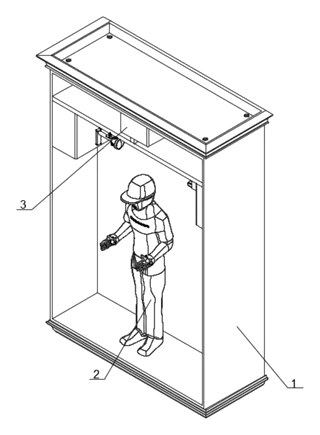
Drawings reproduced from the public patent document for reference.