At a glance
| Patent number | CN116906875B (application CN202310837781) |
| Type | China invention patent - protects product method and structure |
| Original title | Garden mosquito-repellent lamp (一种园林驱蚊照明灯) |
| Patent owner | Wuhan Jinyeyun Landscape Technology Co ltd |
| Inventors | Cai Shaoshuo, Xia Jin, Pan Yao, Hou Bingyu, Deng Xinxing, Huang Cun, Li Yong, Cai Tongjun, Hu Yuanqiang, Wan Yunyi |
| Filing date | 2023-07-10 |
| Grant date | 2024-04-12 |
| Status (China) | In force - valid until at most 2043-07-10, provided annual fees are paid |
| Patent family | Chinese filings only - no US, European, Japanese, PCT or other filings listed |
| Cited by | 0 later documents |
| Source | Google Patents (search for CN116906875B) |
What the claims cover, in plain language
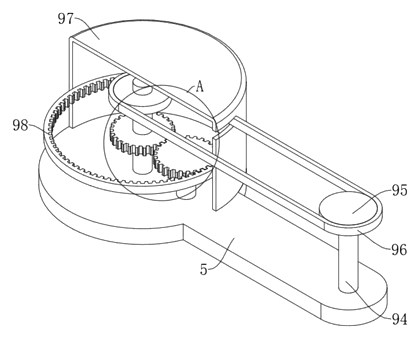
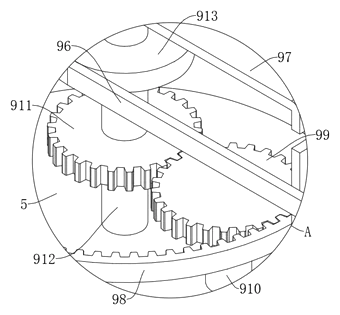
Claim 1 defines a garden lamp comprising a mounting base, a fixing seat, and a vertical pole that rotates relative to the seat. A motor-driven rotating assembly inside the seat turns the pole. A connecting plate attaches to the top of the pole, supporting a lamp holder and body. Crucially, the claim specifies an insect repellent assembly attached to the connecting rod, consisting of rotating plates and shafts driven by a belt-and-gear transmission linked to the main rotation. It also includes a cleaning assembly connected to the rod, featuring a bidirectional screw rod and a mounting ring with cleaning cotton that moves along the lamp body.
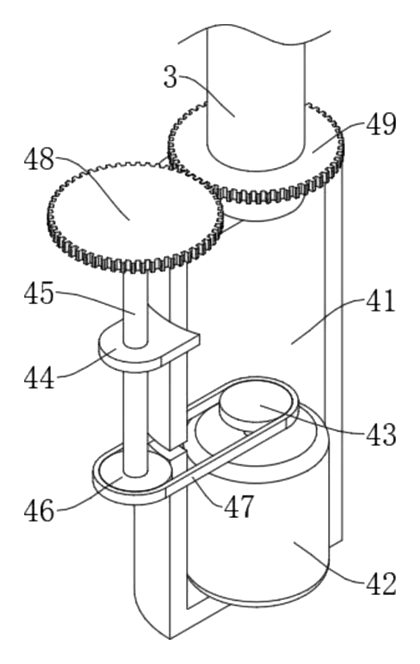
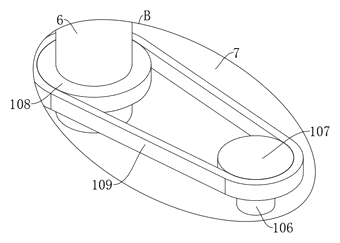
Claims 2-3 detail the specific drive train: a motor in the base drives a first belt and wheel system, which connects to a driving rod and gear pair to rotate the vertical pole.
Claim 4 limits the width of the insect repellent plate to ensure it fits within the clearance between the rotating shaft and the lamp holder edge.
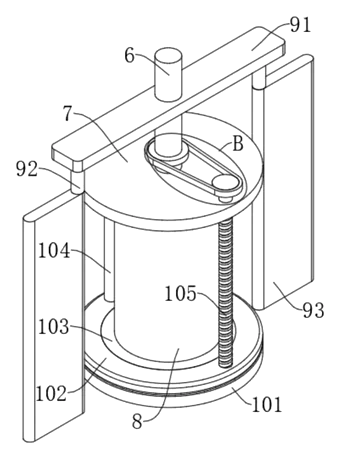
Claim 5 elaborates on the cleaning assembly, specifying the bidirectional screw rod, guide rods, and the linkage to the connecting rod.
Claims 6-7 describe the transmission details for the cleaning mechanism, involving a third belt, wheels, and the interaction between the screw rod and the guide bars to enable vertical movement of the cleaning ring.
This is a simplified reading for orientation only. The legal scope is defined by the exact claim wording in the official Chinese document.
What this means for US production
This patent was filed only in China and is currently in force. Making or selling this specific configuration in China requires the owner’s permission. Since there are no US patents in this family, the patent itself does not restrict manufacturing or sales in the United States.
Two points to settle early:
- Other patents may exist. Outdoor lighting with mechanical movement or self-cleaning features is a competitive field. Companies like Philips Hue, Sengled, or traditional landscape lighting manufacturers may hold US patents on similar rotational or cleaning mechanisms. A freedom-to-operate (FTO) review is strongly recommended before tooling to ensure your specific implementation doesn’t infringe on existing US IP.
- Mechanical Complexity. The integration of three distinct moving systems (main rotation, repellent plates, cleaning wiper) driven by one motor creates significant engineering challenges regarding reliability and waterproofing. Simplifying the drive train or separating the functions may be necessary for viable US market products.
Customization and manufacturing
What can be customized
| Area | Options |
|---|---|
| Light Source | LED modules, color temperature (2700K-6500K), CRI ratings |
| Materials | Aluminum alloy for heat dissipation, UV-stabilized plastics for moving parts |
| Sealing | IP65 vs. IP67 ratings depending on environmental exposure |
| Drive System | Motor speed, gear ratios, belt types (rubber vs. reinforced) |
| Repellent Mechanism | Plate size, shape, and material; optional replaceable repellent pads instead of pure airflow |
| Cleaning Media | Type of cotton/fiber used in the wiper ring; replacement intervals |
Things to plan for (US market)
- UL Listed / ETL Certified: Mains-powered outdoor lighting fixtures must meet UL 1598 (Luminaires) or UL 8750 (LED Equipment) standards. Mechanical moving parts add complexity to certification.
- IP Rating Testing: IEC 60529 testing for ingress protection (dust/water) is critical given the exposed moving joints and cleaning mechanisms.
- FCC Part 15: If the unit includes wireless control (Bluetooth/Wi-Fi) for smart features, FCC certification is required.
- Energy Star: Optional but beneficial for residential markets; requires strict efficacy and power factor metrics.
How a project runs
- Inquiry - Define target lumens, rotation speed, and desired IP rating.
- Design - Engineer the gear/belt layout to minimize friction and wear; select materials resistant to UV and moisture.
- Prototype - Build functional units to test the synchronization of rotation, repellent airflow, and cleaning stroke.
- Pilot Run - Conduct accelerated life testing (ALT) for motors and bearings; verify sealing integrity after thousands of cycles.
- Production - Injection molding for housings, die-casting for structural bases, PCB assembly, and final mechanical assembly.
Quantities & timeline
Tooling for injection molded plastic gears and aluminum die-cast bases takes 8-12 weeks. Motor and sensor sourcing adds lead time. Certification testing (UL/IP) can take 6-10 weeks. Send us your target lumens, IP rating, quantity, and timeline and we will reply with options.
Production notes
Tooling and process
Injection molding is likely required for the complex gear and belt pulley shapes to ensure smooth meshing. Die-cast aluminum typically forms the main structural pole and base housing for rigidity and heat dissipation. Motor assembly involves integrating the rotor/stator with custom mounting brackets. Screws and snap-fits are common for joining the lamp body to the holder, though adhesive may be used for lens sealing.
Cost drivers
Heat sink size typically impacts material costs significantly for high-lumen LEDs. Driver quality affects reliability, especially with variable loads from the motor. IP sealing complexity rises with the number of moving penetrations in the housing. Battery cells are not mentioned in the patent, but a solar variant would add cell capacity as a major driver.
Prototyping path
Prototyping typically starts with 3D-printed housings to validate the kinematic chain of the three coupled systems. Use off-the-shelf drivers and motors initially. Thermal tests are essential to check if the enclosed motor overheats during continuous rotation. Create IP samples to verify water tightness at the rotating joint interfaces before committing to steel tooling.
What we would change before tooling
The patent’s reliance on a single motor for three functions risks mechanical failure propagation. We would consider decoupling the cleaning motor or simplifying the repellent plates to reduce part count. Shaft and bearing alignment tolerances should be tightened in the CAD model to prevent binding. Wall thicknesses on plastic gears may need adjustment to resist fatigue cracking under cyclic load.
Common failure points
Water ingress at the seal is the highest risk due to the rotating pole interface. Heat buildup in the base can degrade motor insulation and plastic gears. Flicker at low dimming may occur if the LED driver is poorly matched to the system. Motor mount cracking could result from vibration imbalance in the rotating assembly. Thread engagement on fasteners may loosen over time.
Patent drawings
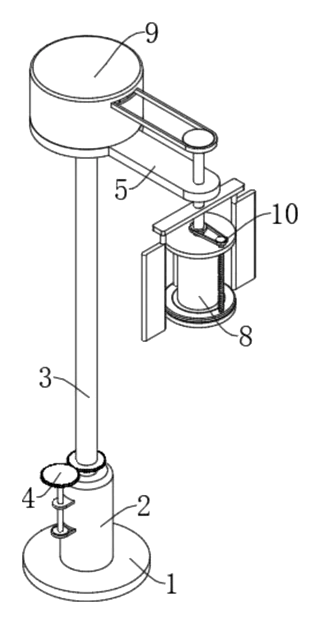
Drawings reproduced from the public patent document for reference.