
Patent CN117099759B
Updated November 3, 2026Hanging Insect Egg Control UV Plant Lamp with Automated Height Adjustment
Static hanging lights often miss pests hiding under dense foliage or pose risks to workers moving through the greenhouse. This patent describes a dynamic solution: a hanging UV lamp that automatically adjusts its height on a rope and tilts its beam. By combining vertical movement with angled illumination, it targets insect eggs on upper branches more precisely. Integrated proximity sensors ensure the UV light turns off when people approach, preventing accidental exposure during farm operations.
- China invention patent - in force
- No filings outside China
- Greenhouse pest control
- Short-wave UV, automated height and tilt
Splat! What let you down?
🔼
Auto Height Adjustment
A rope collector and rotary drive lift or lower the lamp to target different crop layers.
📐
Pitching Illumination
A motorized lamp holder tilts the UV panel to direct light at specific angles.
🛡️
Personnel Safety
Human body sensors automatically pause UV emission when workers approach.
🔗
Composite Rope Feed
Power and signal travel through a flexible rope that also supports the weight.
Bring this product to market
- ✓ Patent vetted China-only family and legal status checked
- 2 Product brief · now How it works, uses and options written up
- 3 Prototype First samples for buyers to review
- 4 Pilot run Small first batch for launch customers
- 5 Volume production Repeat orders at scale
Buyer interest
– of 100 buyers needed to start prototyping
One click, no sign-up. Each vote is one real visitor, and products with the most interest go to prototyping first.
Build team: no members yet. Need a partner, co-funding or skills to build this? Join and we introduce the team once it forms.
The problem
In commercial greenhouses, controlling insect eggs is critical for crop health. Traditional fixed-position UV lamps struggle to reach eggs hidden under dense canopy layers or high branches. If the lamp is too low, it wastes energy irradiating empty space; if too high, it may not deliver sufficient intensity to upper leaves. Furthermore, manual adjustment of hanging lights is labor-intensive and dangerous if workers must climb ladders near electrical equipment. There is also a significant safety risk: standard UV lamps do not always detect human presence, potentially exposing workers to harmful short-wave ultraviolet radiation during maintenance or harvesting hours.
The solution
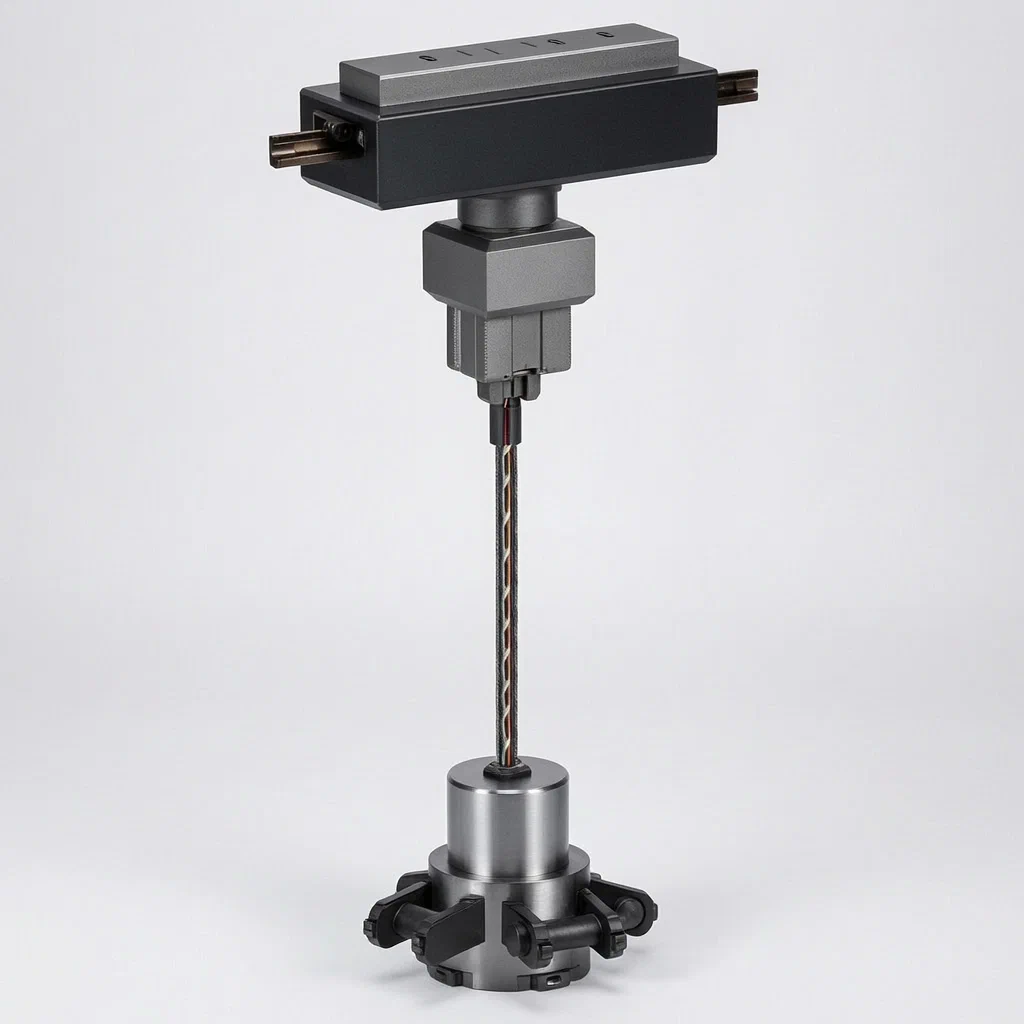
The patent describes a hanging type insect egg plant lamp that solves these issues through automation and sensing.
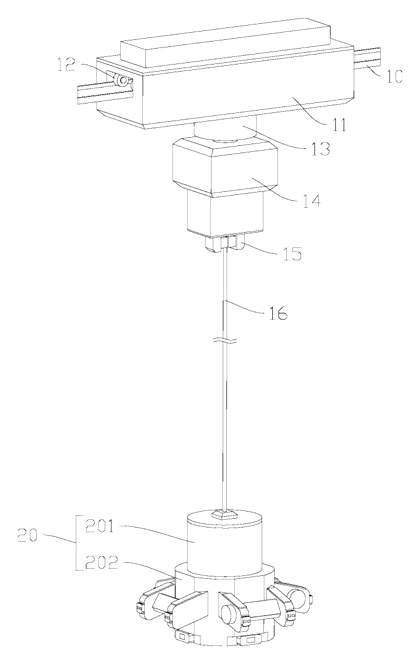
- A truss provides the overhead mounting structure.
- An electric appliance box hangs from the truss via a roller crawling device, allowing horizontal movement along the rail.
- Below the box, a rotary driving device connects to a rope collector. This mechanism winds or unwinds a composite rope to adjust the vertical height of the lamp.
- The combined lamp body is suspended by this rope. The rope contains internal wires wrapped in a protective sheath, carrying both power and communication signals.
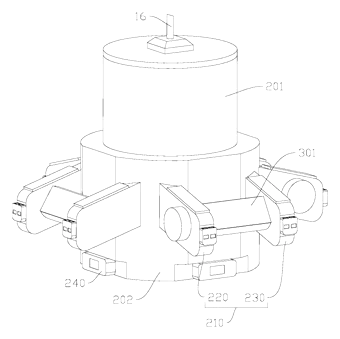
- The lamp body consists of an electric appliance barrel connected to a mounting barrel.
- A connecting assembly links the mounting barrel to the lamp holder. This assembly includes a first and second connecting arm.
- Inside the first arm, a driving motor and angle sensor control the tilt (pitch) of the lamp holder, directing the UV light precisely.
- A short-wave ultraviolet lamp board sits in a recess on the top face of the holder, covered by a light-transmitting plate.
Who it is for
- Commercial Greenhouse Operators: Large-scale growers who need to manage pest populations without increasing labor costs for manual light adjustments.
- Agri-Tech Integrators: Companies building smart farming systems that require automated hardware components capable of responding to environmental sensors.
- Research Institutions: Facilities studying the effects of specific UV wavelengths and intensities on plant growth and pest mortality, requiring precise control over light direction and distance.
- Equipment Manufacturers: OEMs looking to differentiate their lighting products by adding automated positioning and safety features that standard static lamps lack.
How it works
The main parts
| No. | Part | What it does |
|---|---|---|
| Truss | Overhead Support | Provides the structural anchor for the entire system. |
| Electric Box | Control Hub | Houses the main drive plate, power supply, and communication module. |
| Roller Device | Horizontal Movement | Allows the unit to crawl along the truss if needed. |
| Rotary Drive | Vertical Control | Powers the rope collector to raise or lower the lamp. |
| Composite Rope | Power & Lift | Carries electrical current and data while supporting the lamp’s weight. |
| Lamp Holder | Light Source Mount | Holds the UV panel and pivots for directional aiming. |
| Driving Motor | Tilt Control | Adjusts the angle of the lamp holder based on commands. |
| Angle Sensor | Feedback | Measures the current tilt position of the lamp holder. |
| Human Body Sensor | Safety Stop | Detects approaching people to turn off the UV light. |
Operating steps
- Positioning: The system uses the rope collector to set the lamp at a specific height corresponding to the crop layer being treated.
- Aiming: The driving motor rotates the lamp holder to a preset angle. The angle sensor confirms the position.
- Irradiation: The short-wave UV lamp board emits light. The control system can cycle through “pitching modes,” rotating the light across different angles to cover wider areas.
- Safety Monitoring: The human body sensor continuously scans the area below. If a person enters the zone, the system immediately cuts power to the UV lamp and logs the event.
- Resumption: Once the person leaves or a manual resume signal is received, the system restarts the irradiation cycle.
Applications
Dense Canopy Management
In crops with thick foliage, such as tomatoes or cucumbers, insects often lay eggs on upper leaves. The ability to raise the lamp and tilt the beam allows the UV light to penetrate deeper into the canopy, targeting eggs that fixed low-hanging lights would miss.
Labor-Saving Maintenance
Instead of workers climbing ladders to adjust hanging lights, the operator sets parameters via a remote terminal. The lamp moves itself to new heights for different growth stages, reducing physical labor and improving worker safety by minimizing time spent at height.
Precision Research Trials
Agronomists testing UV efficacy need consistent distances and angles. This system’s automated height and pitch controls allow for repeatable experiments where variables like distance-to-crop and incident angle are strictly managed by software.
Nighttime Pest Control
Since UV lamps can be harmful to humans, they are typically run at night. The integrated sensors provide an extra layer of security, ensuring that if a worker enters the greenhouse unexpectedly during an operation window, the light shuts off instantly to prevent eye or skin damage.
Where it is less suitable
- Open Field Agriculture: This design relies on a truss and hanging structure, making it unsuitable for outdoor open fields where wind loads and lack of overhead support make suspension impractical.
- Low-Ceiling Grow Rooms: The vertical travel range requires sufficient headroom between the truss and the crop canopy; very short plants in low rooms may not benefit from the height adjustment feature.
- Non-UV Sensitive Pests: The patent specifically addresses insect eggs using short-wave UV. It is not described as effective against adult flying insects or soil-borne larvae that require different control methods.
Frequently asked questions
How does the lamp adjust its height?
The lamp hangs from a rope collector driven by a rotary driving device inside the main box. The system can wind or unwind the composite rope to raise or lower the lamp body. This allows the UV light to be positioned at the optimal distance from the crop canopy, whether you are treating seedlings or mature plants.
Is it safe for workers?
Yes, the patent describes multiple safety layers. A human body sensor detects when a person approaches the lamp. If triggered, the system automatically turns off the short-wave ultraviolet lamp board and pauses operation. Additionally, the lamp is typically operated at night or when the greenhouse is empty, further reducing exposure risks.
Can I control it remotely?
The system includes a communication plate in the main box. While the patent mentions “third party lighting control,” this implies the hardware is designed to accept external commands. You can likely integrate it with farm management software to schedule irrigation, height changes, and light cycles remotely.
What happens if the lamp gets too close to the plants?
The patent includes a proximity sensor. If the distance between the lamp and the leaves is less than or equal to 5 cm, the system activates a “short-distance mode.” In this mode, the lamp simultaneously pitches and rotates its beam. This prevents concentrated UV exposure on a single spot, which could damage the crop, while still maintaining coverage.
Does it work for all crops?
It is designed for greenhouse crops with identifiable canopy layers. Because the height and angle are adjustable, it can adapt to various plant structures. However, for very tall trees or crops with irregular shapes, the specific programming of the pitching angles would need to be customized.
How durable is the rope?
The composite rope is constructed with layers: a fiber woven cloth outer layer, a rubber protective middle layer, and an electromagnetic shielding inner layer around the wires. This design aims to protect the electrical conductors from wear, moisture, and UV degradation while maintaining flexibility for winding.
Can this design be made and sold in the US?
The patent CN117099759B is filed only in China and is currently in force there. It does not have any US or international counterparts. Therefore, this specific patent does not block you from manufacturing or selling this design in the United States. However, because automated agricultural equipment is a crowded field, we recommend a freedom-to-operate check to ensure no other US patents cover similar motion-control or safety-interlock technologies.
Are you affiliated with the patent owner?
No. IP2M is an independent design and manufacturing service working from the public patent document.
Request a quote
Click Request a Quote below to see our email address - copy it, or open your email app with a ready-made message. Please mention patent CN117099759B in the subject.
Helpful details to include:
- Your company and channel (greenhouse operator, agri-tech integrator, research facility)
- Greenhouse dimensions (height, span length)
- Crop type and canopy density
- Quantity of units required
- Integration needs (existing farm software, power availability)
- Timeline - when you would like prototypes and pilot installations
You can also reach us at (332) 203-9997.
Explore this product
Interested in building this?
Tell us your target market, quantity and timeline. We reply with options for prototyping, small-batch runs or volume production.
Send your inquiry to
Please put CN117099759B in the subject line and tell us your company, country, estimated quantity and timeline.
Prefer to talk? Call (332) 203-9997.
More product-ready patents
All Garden & Outdoor patents →
Garden & Outdoor
2-in-1 Parent & Child Umbrella
Full-size umbrella with a nested smaller umbrella on top - a rotating decorative layer that detaches into a kid-size umbrella.
Patent CN205611962U
Garden & Outdoor
Wire-Mesh Tree Root & Trunk Guard Against Rodents
Three-part wire-mesh guard that protects the roots and lower trunk of young trees from burrowing and gnawing animals.
Patent CN206808261U
Garden & Outdoor
Adjustable-Angle Tree Support Prop
Tree prop with a pinned base, angle-locking hinge, twist-adjust tube and a locking trunk ring.
Patent CN208370491U
Garden & Outdoor
Self-Renewing Glue-Roller Mosquito Trap
UV insect trap with a glue roller that re-coats itself and scrapes the catch into a tray - no glue boards.
Patent CN217038569U
Garden & Outdoor
Cam-Lock Telescopic Pole for Garden Power Tools
Telescopic pole for garden power tools with cam-lever locks and a spring-button, tear-drop head socket.
Patent CN205812889U
Garden & Outdoor
Mosquito Fan That Listens for Mosquitoes Before It Sprays
Fan with a scanning microphone dish that mists repellent only when it hears mosquitoes.
Patent CN208708542U
Browse by category
- Apparel & Accessories (36)
- Baby & Kids (25)
- Bags & Luggage (15)
- Bath & Personal Care (25)
- Car Accessories (21)
- Furniture, Bedding & Storage (19)
- Garden & Outdoor (27)
- Health & Wellness (12)
- Home, Kitchen & Cleaning (40)
- Lighting (20)
- Packaging & Containers (10)
- Pet Products (9)
- Phone & Camera Accessories (7)
- Retail Display (21)
- School, Office & Art (30)
- Sports & Recreation (37)
- Tools & Workshop (46)
- Toys & Games (19)
This page is based on the public patent document CN117099759B, assigned to Yonglin Electronics Co Ltd. IP2M is an independent manufacturing service and is not affiliated with, endorsed by or licensed by the patent owner. Images marked as concept renderings are illustrations, not photos of an existing product. Patent status information is provided for reference only and is not legal advice; confirm freedom to operate for your market before production. Full disclaimer.