At a glance
| Patent number | CN117099759B (application CN202311073279) |
| Type | China invention patent (发明专利) - protects product shape, structure, and method |
| Original title | A hanging type insect egg plant lamp (一种吊装式除虫卵植物灯) |
| Patent owner | Yonglin Electronics Co Ltd |
| Inventors | Qiu Guoliang, Ye Zhichao, Lin Qicheng |
| Filing date | 2023-08-23 |
| Grant date | 2024-03-26 |
| Status (China) | In force - valid until at most 2043-08-23 (assuming annual fees are paid) |
| Patent family | Chinese filings only - no US, European, Japanese, PCT or other filings listed |
| Cited by | 0 later documents |
| Source | Google Patents (search for CN117099759B) |
What the claims cover, in plain language
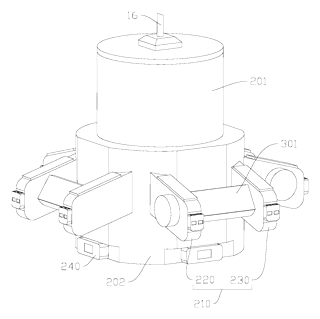
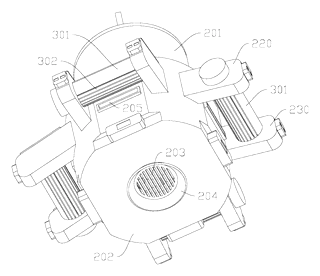
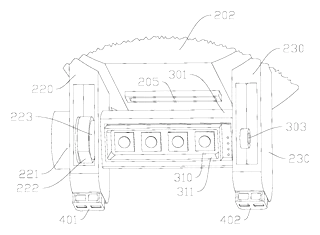
Claim 1 defines the core mechanical and electrical architecture. It specifies an electric appliance box mounted on a truss via a roller crawling device. The box contains a rotary driving device connected to a rope collector. A composite rope (containing wires and a protective sheath) suspends the combined lamp body. The lamp body has an electric appliance barrel and a mounting barrel. Crucially, the lamp holder is attached via a connecting assembly with two arms. One arm houses a driving motor and angle sensor to pivot the holder, while the other provides rotational support. A short-wave UV lamp board is installed in the holder’s recess.
Claims 2-3 add sensory capabilities: a body sensor on the mounting barrel to detect humans, and proximity/UV radiation sensors on the connecting arms to measure distance to plants and ambient UV levels.
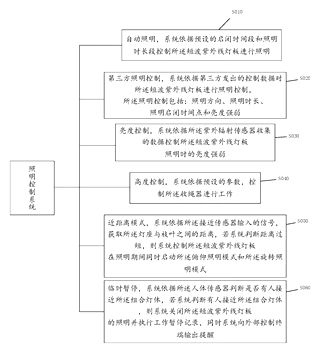
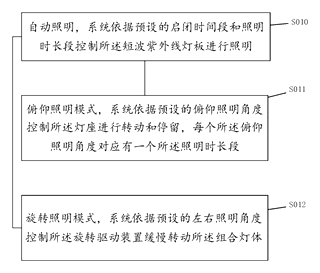
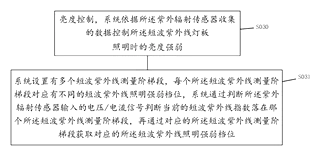
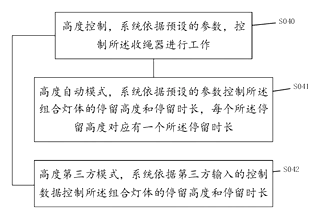
Claim 4 outlines the lighting control system, detailing modes for automatic timing, pitching (tilting), rotating, third-party control, brightness adjustment based on sensor feedback, and height adjustment.
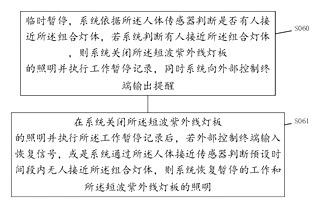
Claims 5-6 specify safety logic: a “short-distance mode” that triggers combined pitching and rotation if the lamp is too close to leaves (<5 cm), and a “suspend mode” that turns off UV when a person is detected.
Claims 7-10 describe structural details: the rope fixing device, the layered construction of the composite rope (fiber cloth, rubber, shielding), and the heat dissipation system involving a fan and horn-shaped air inlet shield.
This is a simplified reading for orientation only. The legal scope is defined by the exact claim wording in the official Chinese document.
What this means for US production
This patent was filed only in China and is currently in force. Therefore, manufacturing or selling this specific configuration within China requires permission from the patent owner. However, since there are no US or foreign counterparts, the patent does not restrict production or sales in the United States based on this document alone.
Two points to settle early:
- Other patents may exist. Agricultural lighting and automated greenhouse systems are competitive fields with many existing patents covering UV sterilization, robotic movers, and sensor integration. A freedom-to-operate (FTO) review is recommended to ensure your implementation does not infringe on other US patents regarding similar motion control or safety interlock mechanisms.
- Component sourcing. The specific combination of a rope-collector lifting mechanism with a pitched UV head is unique here, but standard motors, sensors, and UV LEDs are commodity items. Ensure your chosen components meet the durability requirements described (outdoor/greenhouse humidity).
Customization and manufacturing
What can be customized
| Area | Options |
|---|---|
| Truss Length | Standard spans (e.g., 2m, 4m) or custom lengths for different greenhouse bays. |
| Rope Material | Reinforced polymer or steel-core composites depending on load capacity. |
| UV Spectrum | Short-wave UV (UVC) intensity and wavelength tuning based on target pest species. |
| Control Interface | Integration with existing farm management software via Wi-Fi, Zigbee, or cellular modules. |
| Sensor Suite | Addition of temperature/humidity sensors or camera modules for advanced monitoring. |
| Finish | Powder-coated aluminum or stainless steel for corrosion resistance in humid environments. |
Things to plan for (US market)
- UL 8750 - Standard for LED equipment used in lighting applications. Critical for electrical safety certification.
- OSHA Regulations - Workplace safety standards regarding exposure to UV radiation. The automatic shut-off feature described in the patent helps comply with these rules, but documentation is required.
- FCC Part 15 - If the communication plate uses wireless transmission (Wi-Fi, Bluetooth), it must meet FCC electromagnetic interference limits.
- IP Rating - Greenhouse environments are wet. Enclosures should likely meet IP65 or higher to protect electronics from moisture and dust.
How a project runs
- Inquiry - Define greenhouse dimensions, crop types, and desired automation level.
- Design - Select motor sizes, rope tensile strength, and UV array specifications.
- Prototype - Build functional units for field testing of height adjustment and safety stops.
- Pilot Run - Install in a controlled section of a greenhouse to validate durability and pest reduction effectiveness.
- Production - Mass manufacture extrusions, mold plastic housings, assemble electronics, and integrate ropes.
Quantities & timeline
Tooling for injection-molded parts (lens covers, sensor housings) takes 8-12 weeks. Aluminum extrusion dies are faster. Electronic component lead times vary by supplier. Send us your greenhouse layout, quantity requirements, and target price and we will reply with options.
Production notes
Tooling and process
Likely processes include aluminum extrusion for the truss and arms, and UV-stabilized injection molding for the lamp housing and lens covers to withstand long-term exposure. PCB assembly is required for the control boards.
Cost drivers
UV grade materials for the lens and rope sheath are likely critical cost factors due to degradation resistance needs. Corrosion protection coatings for metal parts in humid greenhouses also add to the bill of materials.
Prototyping path
Typically, prototyping starts with 3D-printed parts for fit checks of the motor and sensor mounts. Use a coated tube sample to test the sliding mechanism. Proceed to a functional sample with real UV LEDs and sensors for safety validation before tooling.
What we would change before tooling
We would likely consider simplifying the sewing of the rope sheath layers, or switching to a single molded sleeve to reduce assembly complexity. Verify the motor assembly torque margins to prevent stalling under heavy rope loads.
Common failure points
Water ingress in electronics is a primary risk given the greenhouse environment. UV degradation of the rope and external plastics must be tested rigorously. Shaft and bearing alignment in the tilting mechanism can fail if tolerances are loose, causing jittery aiming.
Patent drawings
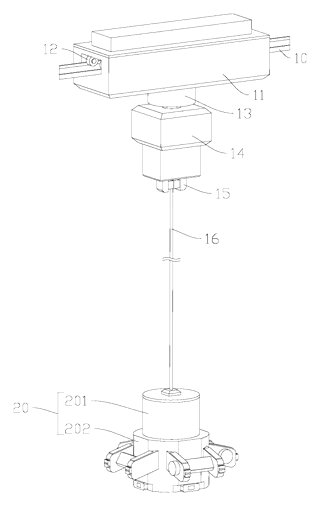
Drawings reproduced from the public patent document for reference.