
Patent CN117643410B
Updated October 30, 2026Adjustable Shoulder Strap Connecting Seat for Backpacks
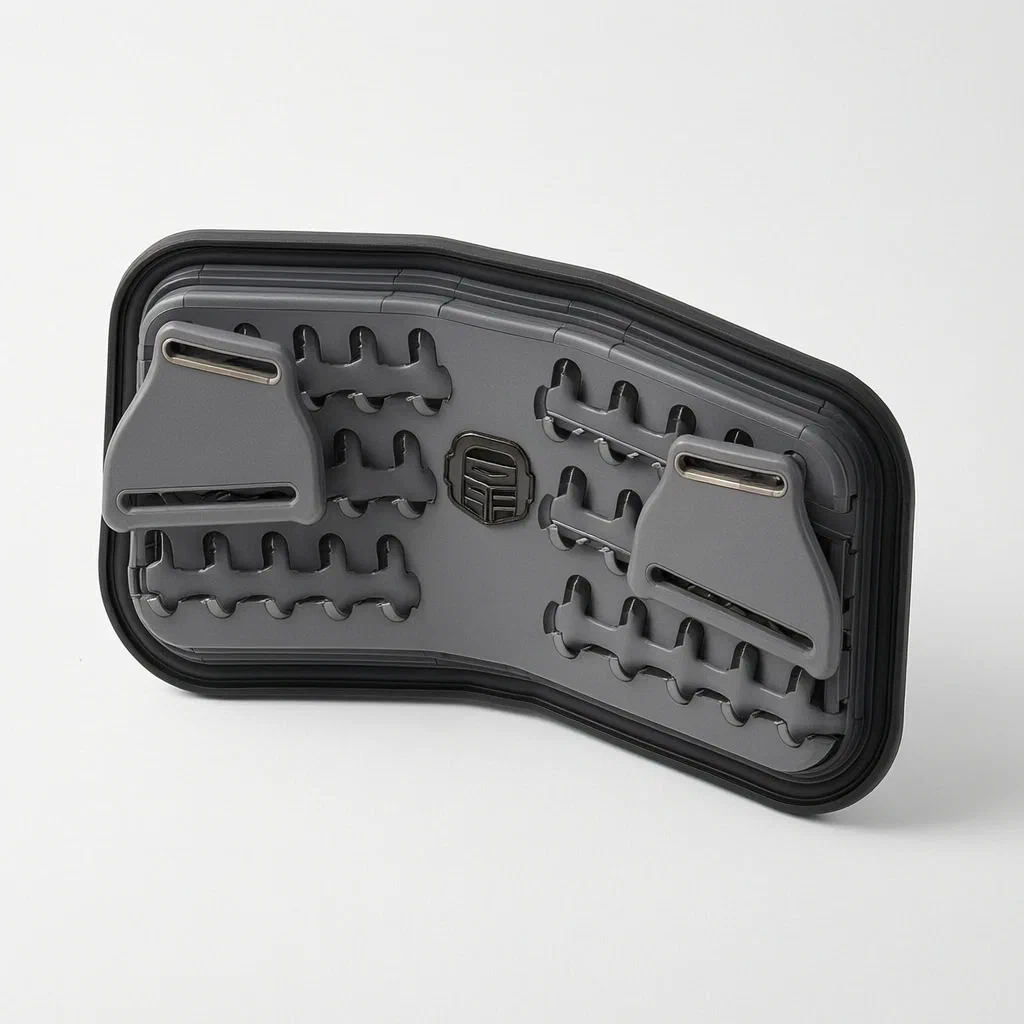
Most backpacks fix the shoulder straps at a set width on the back panel, which means the straps sit too far apart or too close together depending on the wearer's shoulders. This adjustable connecting seat solves that problem with a sliding buckle mechanism. A first seat body attaches to the shoulder strap and carries one or more buckles. A second seat body mounts to the backpack and holds a connecting groove with several clamping grooves spaced across the bag's width. An adjusting groove links all the clamping grooves together. To change the strap position, the user pushes the buckle down into the adjusting groove, slides it sideways to the desired clamping groove, and releases it. The buckle snaps into place, held by arc-shaped limiting protrusions on the groove walls. If the buckle is disengaged completely, it drops into a positioning groove below rather than falling out of the seat.
- China invention patent - in force
- No filings outside China
- Bags & backpacks hardware
- Sliding buckle width adjustment
Splat! What let you down?
↔️
Width adjustment
Multiple clamping grooves let the user shift the strap connection point across the backpack width.
🔗
Sliding buckle
The buckle moves along an adjusting groove to reach any clamping position without being detached.
⬇️
Gravity positioning
When released from a clamping groove, the buckle drops into a lower positioning groove instead of falling out.
🛡️
Limiting protrusions
Arc-shaped bumps on opposite groove walls hold the buckle securely once engaged.
Bring this product to market
- ✓ Patent vetted China-only family and legal status checked
- 2 Product brief · now How it works, uses and options written up
- 3 Prototype First samples for buyers to review
- 4 Pilot run Small first batch for launch customers
- 5 Volume production Repeat orders at scale
Buyer interest
– of 100 buyers needed to start prototyping
One click, no sign-up. Each vote is one real visitor, and products with the most interest go to prototyping first.
Build team: no members yet. Need a partner, co-funding or skills to build this? Join and we introduce the team once it forms.
The problem
On a standard backpack, the points where the shoulder straps attach to the top of the back panel are sewn or riveted in a fixed position. Wearers with narrow shoulders find the straps slipping outward, while those with broader shoulders feel the straps cutting inward. Changing the strap spacing usually requires unthreading webbing through ladder locks or removing hardware entirely, which takes time and risks dropping small parts on the ground. For brands selling a single bag size to a wide range of body types, this fixed geometry limits comfort and increases return rates.
The solution
This design uses a two-part connecting seat mounted between the shoulder strap and the backpack body.
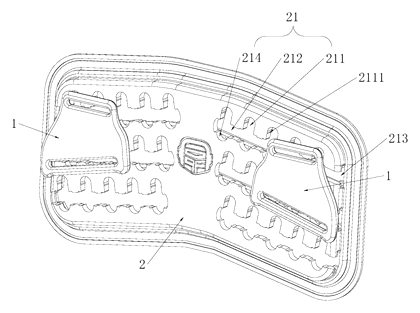
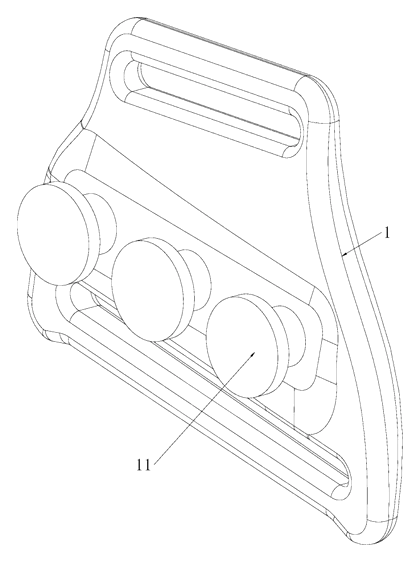
- A first seat body (1) attaches to the shoulder strap (4) and carries at least one buckle (11).
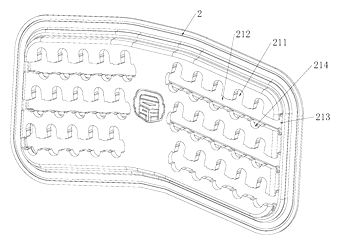
- A second seat body (2) attaches to the backpack main body (3) and contains a connecting groove (21).
- Inside the connecting groove, multiple clamping grooves (211) are arranged side by side along the width direction of the bag.
- An adjusting groove (212) runs horizontally below the clamping grooves and connects all of them.
- The buckle slides along the adjusting groove and snaps upward into any chosen clamping groove.
- Positioning grooves sit below the adjusting groove; if the buckle leaves a clamping groove, gravity pulls it down into a positioning groove so it stays inside the seat.
- A mounting opening at the end of the adjusting groove allows the buckle to be inserted or removed during assembly.
Who it is for
- Backpack brands that want a single bag model to fit a wider range of shoulder widths without producing multiple sizes.
- Tactical and outdoor gear makers whose users wear heavy loads and need precise strap placement over clothing layers or body armor.
- School bag manufacturers looking for a quick-adjust feature so children can change strap spacing as they grow.
- Amazon private-label sellers seeking a functional hardware detail to differentiate their bags in search results and product images.
How it works
The main parts
| No. | Part | What it does |
|---|---|---|
| 1 | First seat body | Connects to the shoulder strap; holds the buckle. |
| 11 | Buckle | Slides in the adjusting groove and locks into a clamping groove. |
| 2 | Second seat body | Mounts to the backpack main body; houses the grooves. |
| 21 | Connecting groove | The cavity containing the clamping, adjusting and positioning grooves. |
| 211 | Clamping grooves | Spaced along the bag width; receive the buckle. |
| 2111 | Limiting protrusions | Arc-shaped bumps on opposite walls of the clamping groove that hold the buckle. |
| 212 | Adjusting groove | Runs below the clamping grooves, linking them for horizontal buckle travel. |
| 3 | Backpack main body | The bag itself. |
| 4 | Shoulder strap | Attaches to the first seat body. |
Adjusting the strap width
- Push the buckle down from its current clamping groove into the adjusting groove below it.
- Slide the buckle sideways along the adjusting groove until it aligns with the desired clamping groove.
- Release or push up so the buckle enters the new clamping groove. The arc-shaped limiting protrusions on the two opposite side walls press against the buckle to keep it seated.
- If the buckle is fully disengaged, it drops by gravity into a positioning groove located directly beneath the adjusting groove. This prevents it from sliding out through the mounting opening at the end of the track.
Applications
Daily commuter backpacks
Commuters carry bags over suits, jackets, or thin shirts depending on the season. A fixed strap width often causes the straps to slide off narrow shoulders when wearing smooth fabrics. The sliding buckle lets the wearer pull the straps closer together in seconds before boarding a train.
Hiking and trekking packs
Hikers frequently add or remove insulation layers, changing their effective shoulder width. Instead of re-threading webbing at a rest stop, the user presses the buckle down, shifts it along the adjusting groove, and locks it into the next clamping groove to match the bulkier profile.
School bags for growing children
Children’s shoulder widths change noticeably over a few school years. Parents can move the strap connection outward as the child grows, extending the useful life of a single backpack size without needing tools or replacement parts.
Tactical and duty gear
Personnel wearing vests or plate carriers need the shoulder straps positioned precisely to avoid interference with equipment. The multiple clamping grooves provide exact lateral spacing, and the limiting protrusions on both side walls prevent the buckle from shifting under heavy dynamic loads.
Travel and airline carry-ons
Travelers switch between carrying a bag on one shoulder, wearing it normally, or attaching it to a suitcase handle. Quick width adjustment helps center the load when transitioning between carrying styles in busy terminals.
Where it is less suitable
- Ultralight frameless packs - the second seat body adds structure and weight that ultralight designs aim to eliminate.
- Bags with continuous webbing suspension - systems where the strap is a single piece of webbing wrapping around the bag do not use a discrete top attachment point.
- Soft drawstring sacks - there is no rigid back panel to mount the second seat body securely.
Frequently asked questions
How does the strap width change without removing the buckle?
The buckle sits in a clamping groove on the second seat body. To move it, the user pushes the buckle down into the adjusting groove that runs beneath all the clamping grooves, slides it sideways to the new position, and lets it rise into the next clamping groove. The buckle never leaves the seat during this process.
What keeps the buckle from sliding out of the seat entirely?
A mounting opening exists at the end of the adjusting groove for initial assembly. Below the adjusting groove are positioning grooves aligned under each clamping groove. If the buckle is pushed out of a clamping groove, gravity pulls it down into a positioning groove, blocking its path toward the mounting opening.
How is the buckle locked in place once adjusted?
Each clamping groove has limiting protrusions on its walls. The patent describes these protrusions as arc-shaped in cross-section. When the buckle enters the groove, the protrusions on two opposite side walls press against it to hold it in position.
Can the strap height be adjusted as well?
The patent describes an embodiment where multiple connecting grooves are arranged sequentially along the height direction of the backpack body. The buckle can be placed in any of these rows, providing both width and height adjustment. Exact spacing is set in design.
What materials are used for the seats and buckle?
The patent text does not specify materials. For production, injection-molded engineering plastics such as POM, nylon or polycarbonate blends are typically selected based on load requirements and confirmed on prototypes.
How much weight can this connection support?
The patent does not list a load rating. The number of buckles per seat, the depth of the clamping grooves and the material thickness determine the working load, which must be verified through testing during development.
Is it possible to have more than one buckle per strap?
Yes. The patent describes using at least two buckles arranged along the width direction of the backpack body, with each buckle engaging its own corresponding clamping groove to improve connection stability.
Can this design be made and sold in the US?
The patent was filed only in China and is currently in force there (until at most 2043-11-30, if annual fees are paid). It has no US counterpart, so it does not restrict manufacturing or sales in the United States. However, backpack harness hardware may be covered by other US patents - see Patent & Production - so we recommend a freedom-to-operate check before volume production.
Are you affiliated with the patent owner?
No. IP2M is an independent design and manufacturing service working from the public patent document.
Request a quote
Click Request a Quote below to see our email address - copy it, or open your email app with a ready-made message. Please mention patent CN117643410B in the subject.
Helpful details to include:
- Your company and channel (backpack brand, outdoor gear maker, school bag manufacturer, Amazon seller)
- Target bag type and intended user (adult, child, tactical)
- Number of width positions (clamping grooves) and whether height adjustment is needed
- Preferred materials or load expectations
- Estimated quantity and target price
- Timeline - when you would like samples and the first shipment
You can also reach us at (332) 203-9997.
Explore this product
Interested in building this?
Tell us your target market, quantity and timeline. We reply with options for prototyping, small-batch runs or volume production.
Send your inquiry to
Please put CN117643410B in the subject line and tell us your company, country, estimated quantity and timeline.
Prefer to talk? Call (332) 203-9997.
More product-ready patents
All Bags & Luggage patents →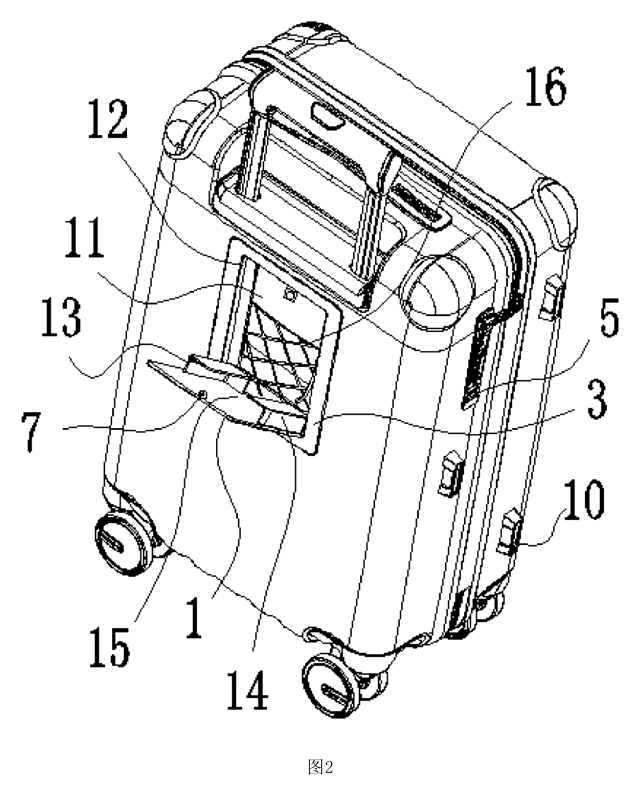
Bags & Luggage
Quick-Access Luggage with Fold-Down Back Compartment
Hard-shell suitcase with a fold-down compartment in the back panel for phone, passport and power bank - no need to open the case.
Patent CN210076793U
Bags & Luggage
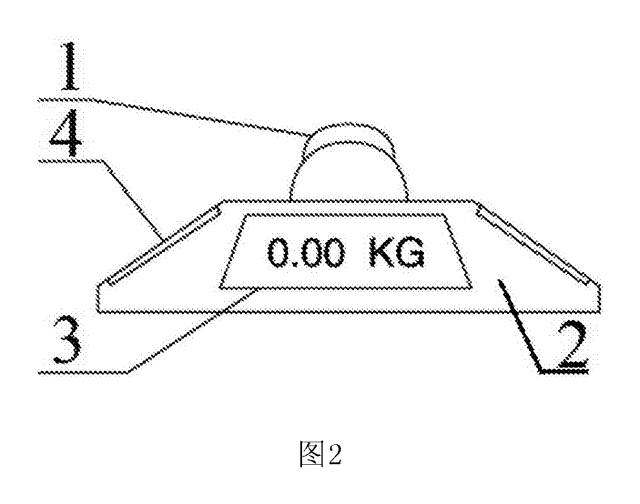
Luggage Handle with Built-In Scale
Suitcase carry handle with a built-in weighing sensor and display - lift the bag and read its weight.
Patent CN206670777U
Bags & Luggage
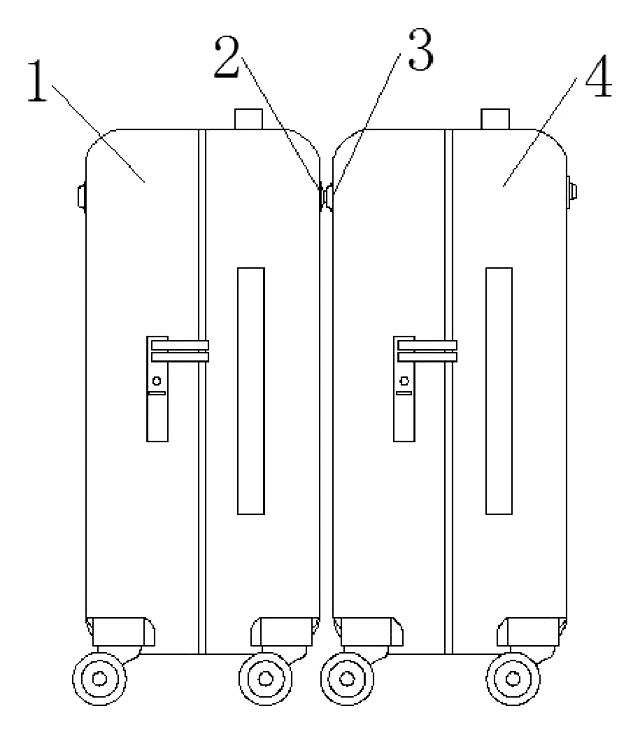
Snap-Together Luggage Connector
Stud-and-socket snap built into suitcases so two cases lock together and roll with one hand.
Patent CN209862619U
Bags & Luggage
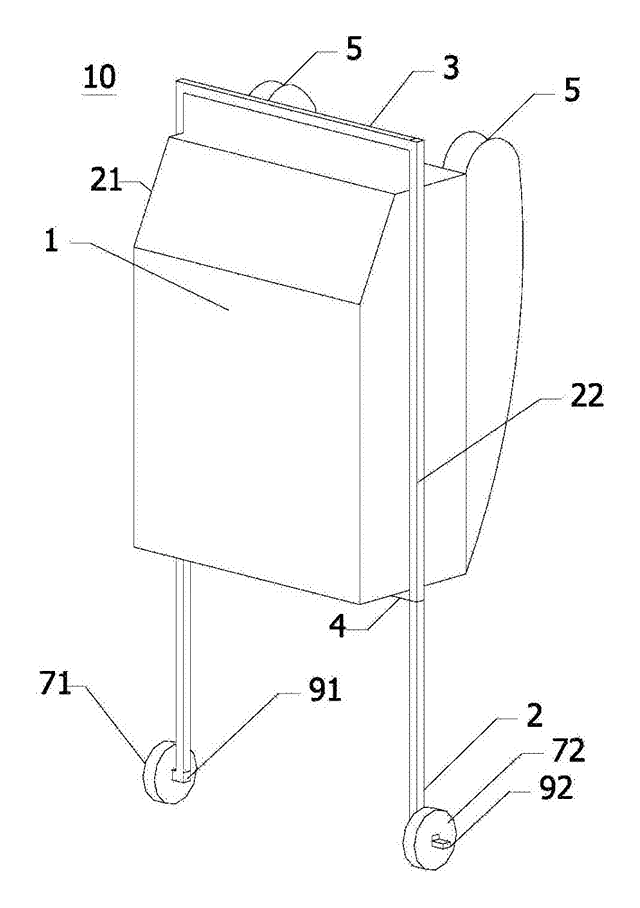
Side-Rail Rolling Backpack with Raised Wheels
Rolling backpack with pull rails on the sides, not the back, and rails that lower the wheels.
Patent CN207733803U
Bags & Luggage
Backpack with Removable Body-Shaped Inner Frame
Backpack with a lift-out inner frame shaped to the back that spreads the load to the back and hips.
Patent CN216534262U
Bags & Luggage
Hard-Shell Luggage Case with a Built-In Lift Table
Hard-shell luggage with a telescopic rod and desktop that rises from the lid.
Patent CN107485137B
Browse by category
- Apparel & Accessories (22)
- Baby & Kids (16)
- Bags & Luggage (9)
- Bath & Personal Care (16)
- Car Accessories (10)
- Furniture, Bedding & Storage (12)
- Garden & Outdoor (18)
- Health & Wellness (8)
- Home, Kitchen & Cleaning (24)
- Lighting (12)
- Packaging & Containers (6)
- Pet Products (6)
- Phone & Camera Accessories (4)
- Retail Display (13)
- School, Office & Art (19)
- Sports & Recreation (25)
- Tools & Workshop (27)
- Toys & Games (12)
This page is based on the public patent document CN117643410B, assigned to Guangzhou Letopo Industrial Technology Co ltd. IP2M is an independent manufacturing service and is not affiliated with, endorsed by or licensed by the patent owner. Images marked as concept renderings are illustrations, not photos of an existing product. Patent status information is provided for reference only and is not legal advice; confirm freedom to operate for your market before production. Full disclaimer.