At a glance
| Patent number | CN117643410B (application CN202311648873) |
| Type | China invention patent (发明专利) - protects product shape, structure and method |
| Original title | Adjustable shoulder strap connecting seat and knapsack (一种可调式肩带连接座及背包) |
| Patent owner | Guangzhou Letopo Industrial Technology Co ltd |
| Inventors | Feng Lina |
| Filing date | 2023-11-30 |
| Grant date | 2024-04-30 |
| Status (China) | In force in China until at most 2043-11-30 (if annual fees are paid) |
| Patent family | Chinese filings only - CN202311648873 |
| Cited by | 0 later documents |
| Source | Google Patents (search for CN117643410B) |
What the claims cover, in plain language
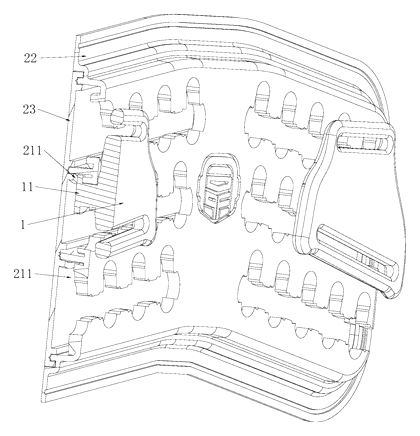
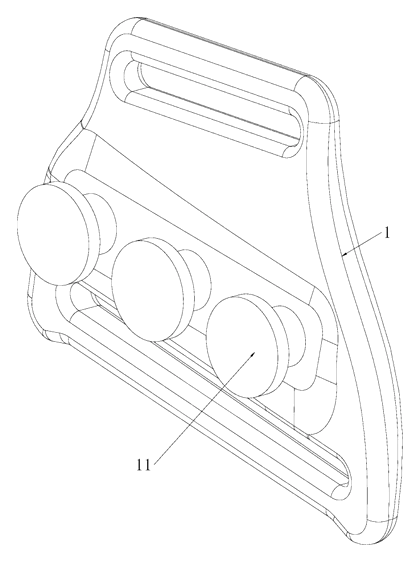
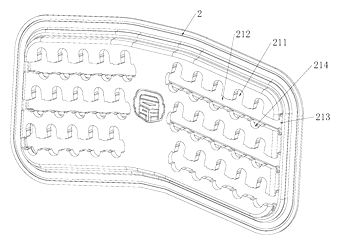
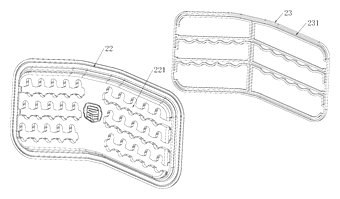
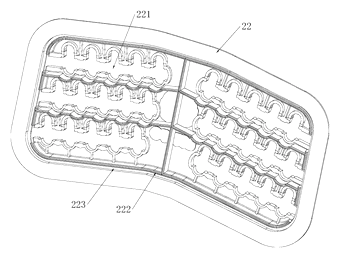
Claim 1 - an adjustable shoulder strap attachment mount with a first seat body holding a buckle and a second seat body for the backpack. The second seat body has a connecting groove containing multiple clamping grooves spaced along the bag’s width, an adjusting groove below them linking the clamping grooves, and a mounting opening at the end of the adjusting groove for buckle entry and exit. Positioning grooves sit below the adjusting groove, aligned one-to-one under the clamping grooves; when the buckle leaves a clamping groove, gravity pulls it down into a positioning groove to block it from exiting the mounting opening.
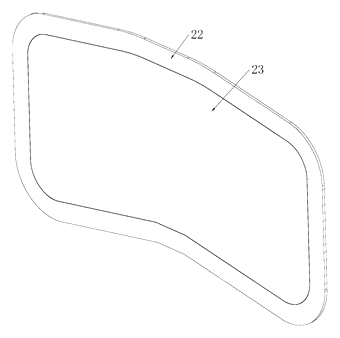
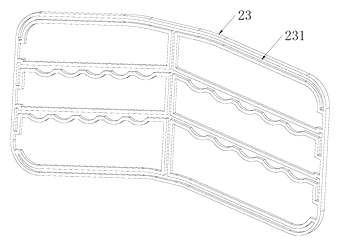
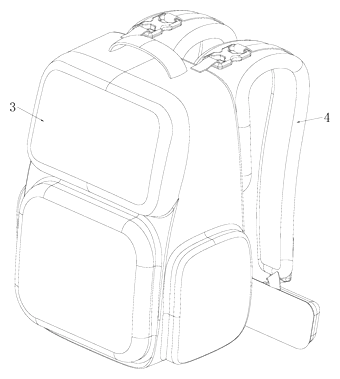
Claim 2 - a limiting protrusion on the wall of the clamping groove abuts the buckle when engaged. Claim 3 - limiting protrusions are on two opposite side walls of the clamping groove. Claim 4 - at least two buckles are arranged along the width direction, each engaging a corresponding clamping groove. Claim 5 - multiple connecting grooves are stacked along the height direction of the backpack, allowing vertical adjustment as well. Claim 6 - the connecting groove is inclined. Claim 7 - the second seat body comprises a top plate with a connecting hole and a bottom plate joined behind it to enclose the connecting groove. Claim 8 - a backpack comprising the backpack body, shoulder strap and the mount of claims 1-7.
This is a simplified reading for orientation only. The legal scope is defined by the exact claim wording in the official Chinese document.
What this means for US production
This patent was filed only in China and is currently in force there. It has no US or other foreign counterpart. Because it is active in China, making or selling this exact connecting seat design in China needs the owner’s permission.
Two points to settle early:
- Other patents may exist. Backpack harness systems, strap adjusters and load-bearing hardware are covered by numerous US and international patents from major luggage and outdoor brands. A freedom-to-operate (FTO) review of the sliding buckle, groove arrangement and gravity-positioning mechanism is needed before tooling for the US market.
- Material strength and fatigue. The limiting protrusions and buckle endure repeated sliding and load cycles. Material selection and wall thickness must be confirmed on prototypes to ensure the buckle does not wear through the groove edges under the expected pack weight.
Customization and manufacturing
What can be customized
| Area | Options |
|---|---|
| Number of clamping grooves | Determines the number of width positions available |
| Groove spacing | Set in design to match target shoulder-width ranges |
| Buckle count per seat | One, two or more buckles along the width direction |
| Vertical adjustment | Multiple connecting grooves stacked by height (per claim 5) |
| Materials | Injection-molded plastics such as POM, nylon or PC/ABS blends |
| Mounting method | Sewn tabs, rivets or screws through the top plate connecting hole |
| Color and finish | Molded-in color, matte or textured surfaces |
Things to plan for (US market)
- CPSC 16 CFR 1500 / ASTM F963 - if the backpack is marketed for children 12 and under, the connecting seat must pass small-parts, sharp-edge and mechanical hazard tests.
- California Proposition 65 - plastic resins and colorants must be screened for listed chemicals.
- CPSIA lead and phthalate limits - apply to children’s products; substrate and surface coating testing required.
How a project runs
- Inquiry - target bag type, number of width positions, load expectations and quantity.
- Design - CAD modeling of the first and second seat bodies, groove profiles, buckle geometry and limiting protrusions.
- Prototype - 3D-printed or soft-tooled samples to verify buckle travel, gravity drop into positioning grooves and retention force.
- Pilot run - injection-molded parts assembled onto test bags for cycle testing and load checks.
- Production - steel mold fabrication, injection molding, secondary finishing and assembly.
Quantities & timeline
The first and second seat bodies require precision injection molds, with core pins for the narrow adjusting and positioning grooves. Cycle testing to validate the limiting protrusions under load takes most of the development phase. Certification tests for children’s bags add further time. Send us your bag dimensions, target number of width positions, material preference, estimated quantity and intended user age group and we will reply with options.
Patent drawings
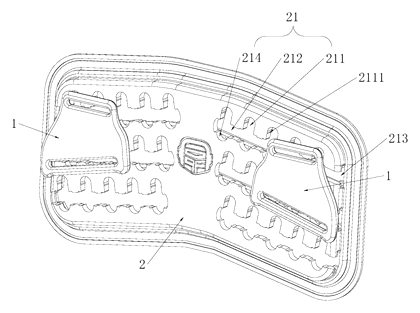
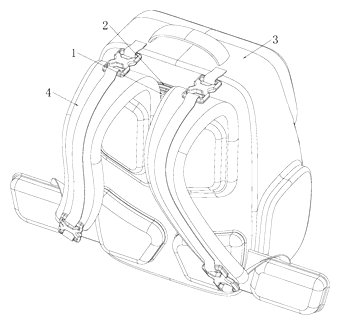
Drawings reproduced from the public patent document for reference.