At a glance
| Patent number | CN118155512B (application CN202410325695) |
| Type | China invention patent (发明专利) - protects product shape, structure and method |
| Original title | Novel lightweight curtain screen (一种新型轻量化帘幕屏) |
| Patent owner | Jiangsu Hongguang Display Technology Co ltd |
| Inventors | He Dong, Chi Wen, Wu Guangkui, Fang Zhaozhong |
| Filing date | 2024-03-21 |
| Grant date | 2024-09-03 |
| Status (China) | In force - In force in China until at most 2044-03-21 (if annual fees are paid) |
| Patent family | Chinese filings only - no US, European, Japanese, PCT or other filings listed |
| Cited by | 0 later documents |
| Source | Google Patents (search for CN118155512B) |
What the claims cover, in plain language
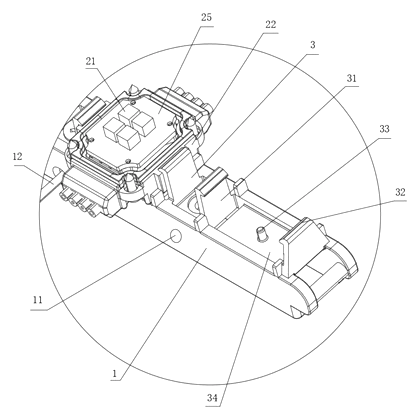
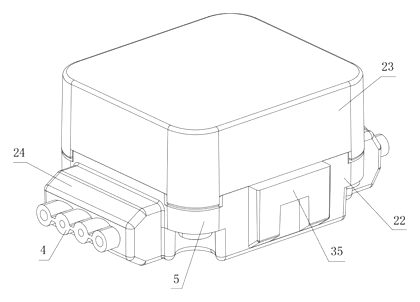
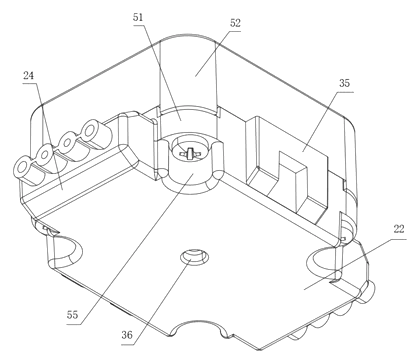
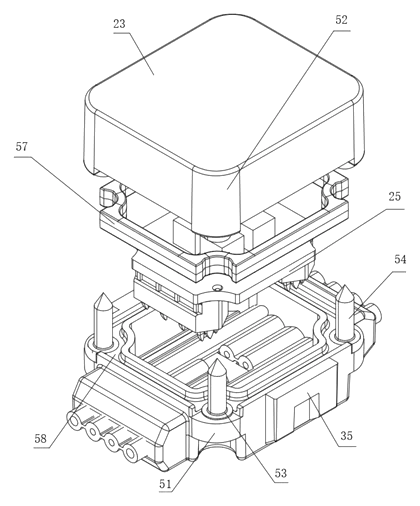
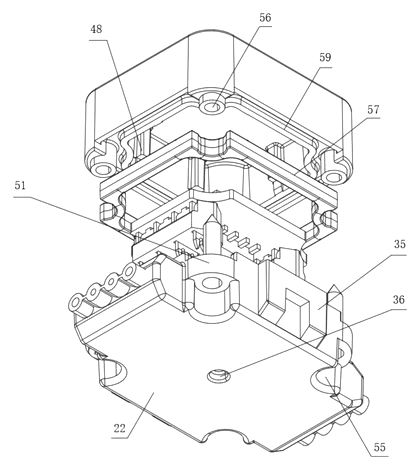
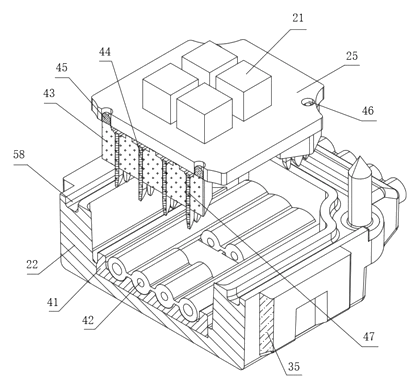
Claim 1 - a novel lightweight curtain screen comprising multiple connecting clamping strips (1) with equidistant limit holes (11) on their side faces, through which connecting ropes (12) are threaded. Multiple lamp point monomers (2) sit on the upper side of each strip. Each monomer includes a lower shell (22) and a clamping mechanism (3) joining it to the strip. The clamping mechanism uses groups of parallel second support plates (31) fixed on the strip, each group having stop bodies (32) at the inner upper ends. Fixing plates (35) on the lower shell snap behind the stop bodies. A first limit groove (34) on the strip slidingly fits the lower shell, and a limit column (33) in that groove fits a second limit groove (36) on the shell. A first support plate (25) inside the lower shell carries a wire-binding puncture mechanism (4) at its lower end. An upper shell (23) sits on the lower shell, with a sealing connection mechanism (5) between them. The sealing mechanism includes a sealing ring (57), arc-shaped holes (55) at opposite corners of both shells, connecting blocks (51) and connecting bodies (52) in those holes joined by screws (54) passing through through-holes (53) into thread grooves (56). A mating groove (58) on the lower shell receives a mating plate (59) to align the seal.
Claim 2 - the upper end of the first support plate (25) carries an LED (21), and the puncture mechanism establishes electrical contact with it.
This is a simplified reading for orientation only. The legal scope is defined by the exact claim wording in the official Chinese document.
What this means for US production
This patent was filed only in China and is currently in force there. It has no US or other foreign counterpart. However, because it remains active in China, making or selling this exact curtain screen structure in China needs the owner’s permission. Manufacturing outside China for sale in markets where no counterpart exists is not restricted by this document alone.
Two points to settle early:
- Other patents may exist. LED curtain screens and modular display structures are covered by numerous patents worldwide from various display manufacturers. Although no foreign patents cite this specific document, a freedom-to-operate (FTO) review covering the puncture-contact method, clip-on module retention, and rope-linked strip structure is recommended before committing to tooling.
- Electrical safety of puncture contacts. The piercing copper sheets create a permanent electrical path when the shells are pressed together. Insulation displacement reliability over temperature cycles and vibration must be verified during prototyping.
Customization and manufacturing
What can be customized
| Area | Options |
|---|---|
| Strip length and spacing | Cut to project width; limit hole spacing sets vertical resolution |
| Module size | Lower and upper shell dimensions scaled to LED package |
| LED type | Color, brightness and package selected per application |
| Connecting rope material | Steel wire, Kevlar or polymer cord depending on tensile load |
| Shell material | Injection-molded polycarbonate, ABS or other engineering plastics |
| Sealing ring profile | Material hardness and cross-section set in design for target IP rating |
| Wire gauge | Sized for current draw across the strip length |
Things to plan for (US market)
- UL 8750 - Standard for Safety for LED Equipment; covers the LED modules, drivers and wiring methods including insulation-displacement contacts.
- FCC Part 15 - Electromagnetic compatibility for digital devices; large LED arrays can radiate noise if wiring and grounding are not controlled.
- NFPA 70 (National Electrical Code) - Installation rules for outdoor and indoor signage, including conductor sizing and overcurrent protection.
- California Prop 65 - Plastics, solders (if any) and metal alloys screened for listed substances.
How a project runs
- Inquiry - screen dimensions, pixel pitch, brightness, environment and quantity.
- Design - strip profiles, shell molds, puncture copper sheet geometry, rope selection and driver layout.
- Prototype - injection-molded sample shells assembled to test clipping force, puncture contact resistance and sealing compression.
- Pilot run - environmental testing including water ingress, thermal cycling and vibration on a sample panel.
- Production - mold fabrication, strip extrusion or machining, wire harness preparation, module assembly and packing.
Quantities & timeline
The lower and upper shells require precision injection molds, and the connecting clamping strips need extrusion dies or machining fixtures per length. Puncture copper sheets are stamped. Certification tests such as UL listing and FCC evaluation run after pilot samples pass internal validation. Send us your screen dimensions, pixel pitch, brightness target, environment, quantity and timeline and we will reply with options.
Patent drawings
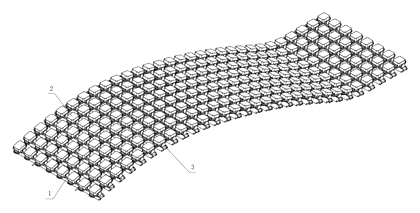
Drawings reproduced from the public patent document for reference.