
Patent CN118167961B
Updated November 1, 2026Desk Lamp with Adjustable Light-Emitting Angle via Sliding Prism Sheet
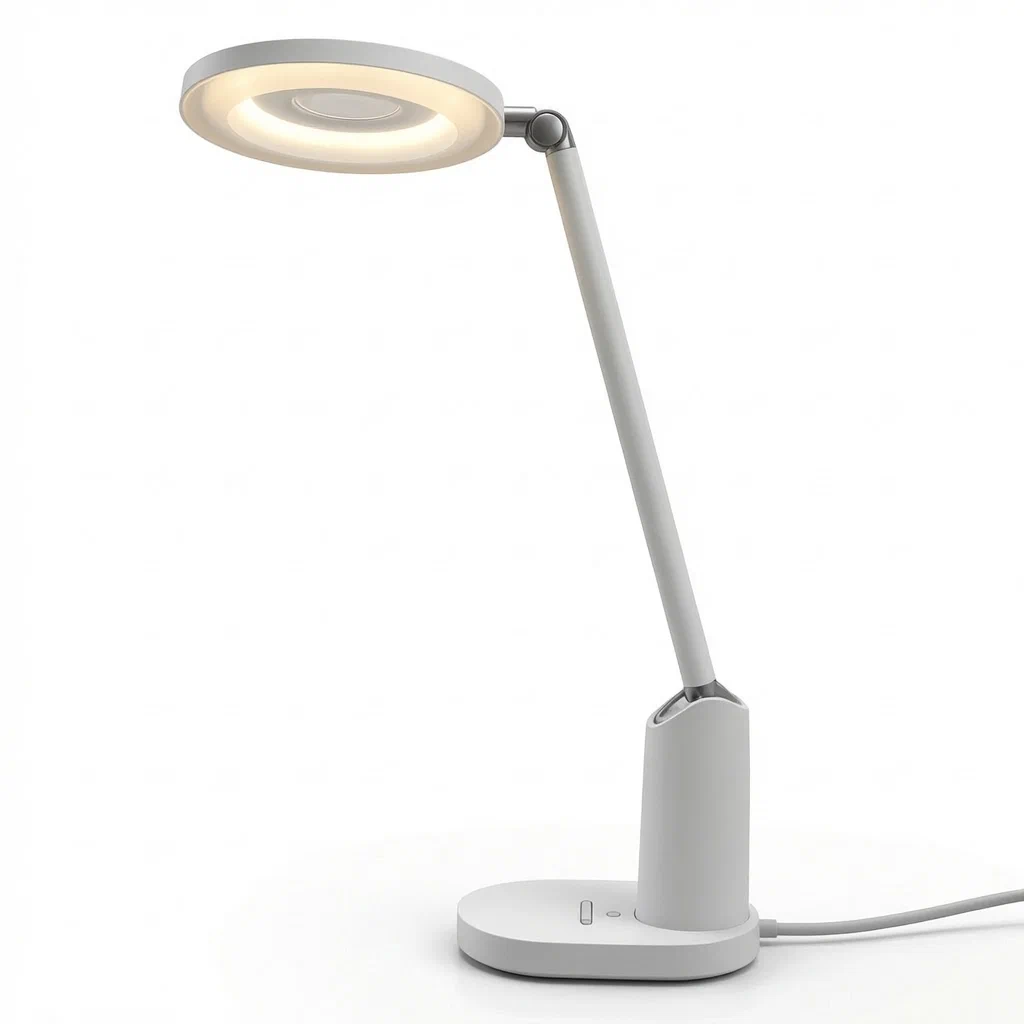
Slim desk lamps often suffer from uncontrolled light spread. When the prism sheet is fixed at the outermost layer, it concentrates light but cannot easily reduce the emission angle, leading to glare on walls or disturbance to family members sleeping nearby. This design solves the issue by placing the prism sheet in a sliding track between the light guide plate and the diffusion film. The prism sheet features arc-shaped curved surfaces with specific geometric parameters (initial included angle 135-175 degrees) that interact with the gap distance to precisely refract light rays. This allows the lamp to adjust its effective light-emitting angle dynamically, ensuring focused task lighting without spilling unwanted brightness into the room.
- China invention patent - active
- No filings outside China
- LED lighting & optics
- Sliding prism sheet for angle adjustment
Splat! What let you down?
💡
Sliding Prism Control
The prism sheet moves between the light guide and diffusion films to change the light angle.
📐
Geometric Refraction
Arc-shaped prism surfaces with specific angles (135-175°) refract light based on gap distance.
🌙
Glare Reduction
Prevents wide-angle spill that disturbs sleepers or causes eye fatigue during night use.
🔩
Modular Assembly
Optical stack fits inside a sleeve within the lamp housing; supports heat dissipation.
Bring this product to market
- ✓ Patent vetted China-only family and legal status checked
- 2 Product brief · now How it works, uses and options written up
- 3 Prototype First samples for buyers to review
- 4 Pilot run Small first batch for launch customers
- 5 Volume production Repeat orders at scale
Buyer interest
– of 100 buyers needed to start prototyping
One click, no sign-up. Each vote is one real visitor, and products with the most interest go to prototyping first.
Build team: no members yet. Need a partner, co-funding or skills to build this? Join and we introduce the team once it forms.
The problem
Modern desk lamps are trending toward thinner, lighter designs. However, achieving uniform brightness in a slim profile is difficult. Traditional solutions place LEDs around the perimeter and use a light guide plate to distribute light inward. This often results in uneven brightness, with hotspots near the edge and dimmer areas in the center, causing glare and visual fatigue. Some designs add a prism sheet at the very front to concentrate light, but this fixes the emission angle. If the angle is too wide, light spills onto adjacent furniture or wakes up sleeping family members. If it is too narrow, the usable workspace is limited. There is a need for a mechanism that allows the light-emitting angle to be adjusted after assembly or during use, without adding significant bulk.
The solution
The patented lamp uses a multi-layer optical stack housed within a slim lamp cap. The core innovation is the placement and movement of the prism sheet. Instead of being fixed at the outermost surface, the prism sheet is positioned between the light guide plate and the diffusion film. It is slidably connected, meaning its distance from the diffusion film can be changed.
The prism sheet itself has a first light-emitting surface with multiple adjacent grooves. These grooves have inclined surrounding side surfaces and bottom surfaces. Crucially, the side surfaces are arc-shaped curved surfaces. The geometry is defined by an initial included angle a (between 135° and 175°), a curvature radius R, and a distance L between the prism and the diffusion film. The relationship follows the formula $R = \pi \cdot L / k$ (where k is a constant). By sliding the prism sheet to change L, the refraction path of the light rays is altered, allowing the final output angle to be tuned.
Who it is for
- Consumer Electronics Brands: Companies launching premium, thin-profile desk lamps that differentiate through superior optical control and reduced glare.
- Amazon Sellers: Private label brands looking for unique selling points like “adjustable beam angle” to compete against standard fixed-angle lamps.
- Office Furniture Manufacturers: Suppliers needing integrated task lighting that can be calibrated for different desk depths and ambient conditions.
- Educational Product Makers: Creators of study lamps for children, where controlling spill light to avoid disturbing siblings or parents is a key feature.
How it works
The main parts
| No. | Part | What it does |
|---|---|---|
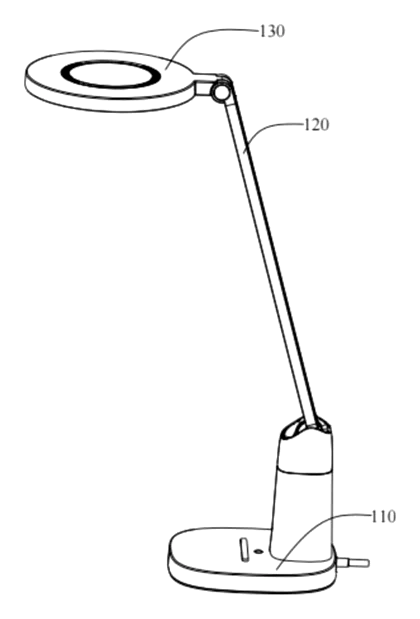
| 110 | Base | Anchors the lamp; houses power components. |
| 120 | Lamp Post | Hinged connection between base and cap. |
| 131 | Housing | Outer shell of the lamp cap; hinged to post. |
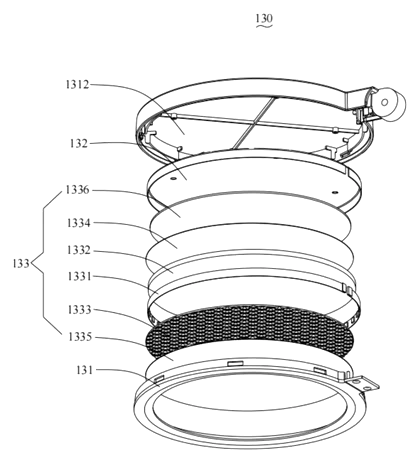
| 132 | Sleeve | Inner cylinder supporting the optical module; aids heat dissipation. |
| 1331 | Annular Lamp Belt | Flexible strip with LED beads arranged in a circle. |
| 1332 | Light Guide Plate | Cylindrical plate that receives radial light from LEDs. |
| 1333 | Prism Sheet | Slides between guide and diffusion; refracts light via arc-grooves. |
| 1334 | Reflecting Film | Positioned behind the guide plate to bounce light forward. |
| 1335 | Diffusion Film | Front layer that softens and spreads the final output. |
Operating steps
- Light Generation: The annular LED belt emits light radially inward toward the cylindrical light guide plate.
- Guidance: The light guide plate captures the light and directs it outward. The reflecting film ensures no light is lost backward.
- Refraction Adjustment: The prism sheet is positioned at a specific distance L from the diffusion film. As light passes through the arc-shaped grooves of the prism, it is refracted.
- Angle Control: Changing the position of the prism sheet alters the effective refraction angle. A smaller gap may widen the beam; a larger gap may narrow it (depending on specific tuning).
- Diffusion: The light exits through the diffusion film, creating a uniform glow with the selected angular spread.
Applications
Nighttime Study Areas
Students studying late at night benefit from a narrower beam angle that illuminates their book without casting bright reflections on walls or waking up a roommate sharing the room.
Shared Workspaces
In open-plan offices or home desks shared by two people, adjustable angles allow one user to focus light strictly on their monitor or documents, minimizing glare for the person sitting next to them.
Reading Nooks
For bedside reading, the lamp can be set to a wider, softer angle that fills the immediate area without harsh shadows, reducing eye strain during long reading sessions.
Product Photography Staging
Small-scale photographers using desk lamps for product shots can adjust the light spread to create specific shadow effects or even illumination on small objects, offering more control than fixed-angle bulbs.
Where it is less suitable
- High-Bay Industrial Lighting: This design is optimized for close-range task lighting; it lacks the intensity and throw required for large warehouse spaces.
- Outdoor Weatherproof Use: The patent describes an indoor desk lamp structure; it does not specify sealing methods for rain or dust resistance typical of outdoor fixtures.
- Fixed-Angle Commercial Installations: In retail displays where light direction never changes, the added mechanical complexity of the sliding prism may increase cost unnecessarily compared to static optics.
Frequently asked questions
How does the light angle actually change?
The lamp uses a prism sheet that sits between the light guide and the front diffusion film. This sheet is mounted on a slider. When you move the sheet closer to or further from the diffusion film, the angle at which the light rays hit the curved grooves changes. This refracts the light differently, narrowing or widening the beam that exits the lamp.
Does this fix the glare issue in thin lamps?
Yes. Thin lamps often have bright spots near the LEDs and dark centers. The cylindrical light guide plate helps distribute the light evenly. The prism sheet then focuses this uniform light into a controllable angle, preventing the harsh spill light that causes glare on walls or eyes.
Can I automate the angle adjustment?
The patent describes a slidable connection, which implies manual movement. However, the mechanism can be adapted for motorized control (e.g., using a small stepper motor to push the prism sheet) if specified during the design phase. This would allow app-based or remote-control angle changes.
Is the prism sheet fragile?
The prism sheet is typically made from durable optical plastics like PMMA or PC. It is protected inside the housing by the diffusion film and the outer shell. The sliding mechanism should be designed with low-friction rails to prevent wear over thousands of cycles.
What is the typical beam angle range?
The patent does not specify exact degree outputs, but the geometry (135-175° included angle on the prism) suggests a range suitable for task lighting, likely adjustable from a focused spot (approx. 30-40°) to a wider flood (approx. 60-90°). Final specs depend on the specific lens and LED combination chosen.
How does it compare to rotating heads?
Rotating heads physically aim the entire light source. This design keeps the lamp head stationary and changes the shape of the light cone internally. This is cleaner aesthetically and allows for a slimmer profile since there is no bulky gimbal mechanism required for aiming.
Can this design be made and sold in the US?
The patent was filed only in China and is in force there. It does not restrict making or selling in the US. However, because optical adjustment mechanisms are common, we recommend a freedom-to-operate check to ensure no other US patents cover similar sliding prism implementations.
Are you affiliated with the patent owner?
No. IP2M is an independent design and manufacturing service working from the public patent document.
Request a quote
Click Request a Quote below to see our email address - copy it, or open your email app with a ready-made message. Please mention patent CN118167961B in the subject.
Helpful details to include:
- Your company and channel (consumer electronics brand, Amazon seller, office furniture supplier)
- Target beam angle range (min/max degrees)
- Lumens and Color Temperature (CCT) preferences
- Physical dimensions (head diameter, total height)
- Control method (manual slider, motorized, or fixed preset)
- Estimated quantity and target price
- Timeline - when you would like samples and the first shipment
You can also reach us at (332) 203-9997.
Explore this product
Interested in building this?
Tell us your target market, quantity and timeline. We reply with options for prototyping, small-batch runs or volume production.
Send your inquiry to
Please put CN118167961B in the subject line and tell us your company, country, estimated quantity and timeline.
Prefer to talk? Call (332) 203-9997.
More product-ready patents
All Lighting patents →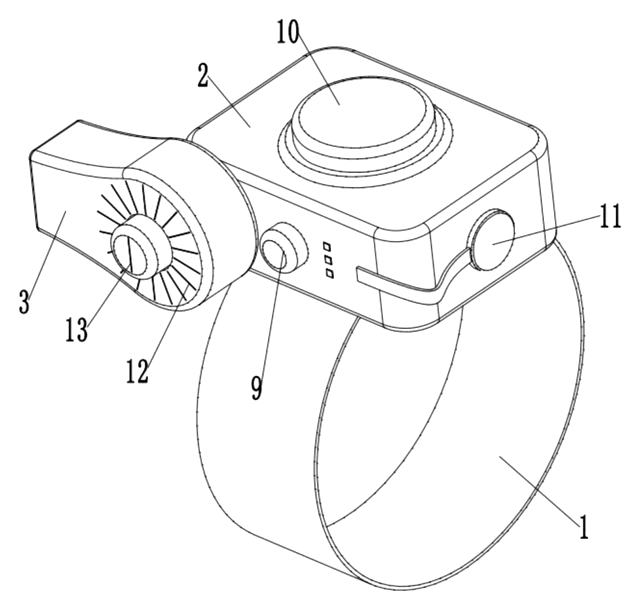
Lighting
Wrist-Worn Flashlight with Click-Lock Angle Adjustment
Rechargeable wrist flashlight whose lamp turns and locks at an angle with a push button.
Patent CN113915544B
Lighting
Self-Folding Desk Lamp That Turns into a Phone Stand
Desk lamp with a shape-memory stem that unfolds when warm and folds into a phone stand.
Patent CN213237087U
Lighting
Ring-Shaped Outdoor Lantern That Lifts Off a Power-Bank Charging Base
Ring lantern with a battery handle that docks in a cone base with its own battery, clamp and charging plug.
Patent CN212408329U
Lighting
LED Flameless Candle with an Outside Flame Shade and Wax Dish Top
Battery LED candle: flame shade stands above a dished wax top, angled LEDs light a printed wick.
Patent CN205424561U
Lighting
Telescoping Tripod Portable Work Light with Fold-In Light Panels
Telescoping tripod work light with dual light panels that fold flat into the base.
Patent CN207298471U
Lighting
Self-Cooling and Self-Cleaning LED Street Light with Rainwater Harvesting
LED street lamp that harvests rain to cool its heat sink and spray-wash the lens automatically.
Patent CN205480639U
Browse by category
- Apparel & Accessories (28)
- Baby & Kids (20)
- Bags & Luggage (12)
- Bath & Personal Care (21)
- Car Accessories (16)
- Furniture, Bedding & Storage (15)
- Garden & Outdoor (21)
- Health & Wellness (10)
- Home, Kitchen & Cleaning (32)
- Lighting (15)
- Packaging & Containers (8)
- Pet Products (7)
- Phone & Camera Accessories (5)
- Retail Display (16)
- School, Office & Art (22)
- Sports & Recreation (30)
- Tools & Workshop (36)
- Toys & Games (15)
This page is based on the public patent document CN118167961B, assigned to Shenzhen Deled Led Co ltd. IP2M is an independent manufacturing service and is not affiliated with, endorsed by or licensed by the patent owner. Images marked as concept renderings are illustrations, not photos of an existing product. Patent status information is provided for reference only and is not legal advice; confirm freedom to operate for your market before production. Full disclaimer.