
Patent CN118179006B
Updated October 27, 2026Educational Jigsaw Puzzle with Built-In Storage Box and Gear-Driven Release
Jigsaw puzzles for children often come in flimsy cardboard boxes that split at the seams, leaving pieces scattered across the floor. This design solves that problem by building the storage directly into the puzzle case. It uses two plastic shells connected by a hinge chain. When you open the second shell, the hinge rods turn a gear inside the first shell. That gear moves a rack, which pulls an inserting block out of a slot on a hidden storage box. A compressed spring then pushes the box out automatically, ready for play. When you close the case, the hinge rods reverse the gear, sliding the rack back so the inserting block locks the storage box securely inside. Magnets keep the playing plate steady, textured contact strips stop the case from sliding on the table, and a partition plate helps sort the pieces by size or shape.
- China invention patent - in force
- No filings outside China
- For home, board-game, club and teaching use
- Plastic shells, hinge chain, gear and rack mechanism
Splat! What let you down?
⚙️
Gear-driven release
Opening the shells turns a gear that moves a rack, releasing the inserting block so the storage box slides out.
📦
Built-in storage
A storage box with a partition plate holds the puzzle pieces inside the first shell when closed.
🧲
Magnetic placing plate
Magnets inside the shell hold a placing plate steady during assembly.
🛑
Anti-slip base
Multiple coarse contact strips on the bottom of the first shell keep it from sliding on tables.
Bring this product to market
- ✓ Patent vetted China-only family and legal status checked
- 2 Product brief · now How it works, uses and options written up
- 3 Prototype First samples for buyers to review
- 4 Pilot run Small first batch for launch customers
- 5 Volume production Repeat orders at scale
Buyer interest
– of 100 buyers needed to start prototyping
One click, no sign-up. Each vote is one real visitor, and products with the most interest go to prototyping first.
Build team: no members yet. Need a partner, co-funding or skills to build this? Join and we introduce the team once it forms.
The problem
Standard jigsaw puzzles rely on separate cardboard or thin plastic boxes to hold the pieces. These boxes wear out quickly, lids pop off during transport, and pieces scatter when a child carries the game from one room to another. Parents and teachers spend time gathering lost fragments instead of focusing on the activity. Additionally, loose boxes take up extra space on small desks or play tables, and without a built-in sorting method, organizing pieces by color or edge becomes tedious for younger players.
The solution
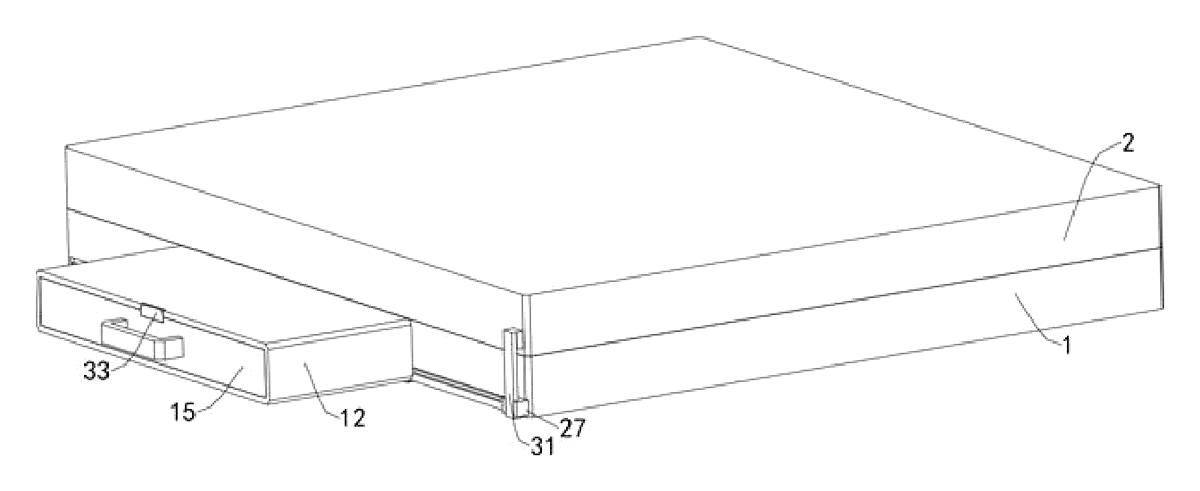
This educational jigsaw puzzle integrates the storage container directly into the game housing using a mechanical linkage.
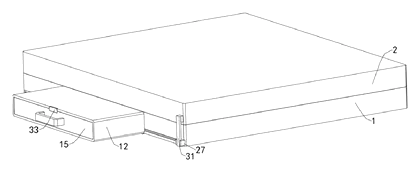
- A first shell (1) and a second shell (2) are connected by a hinge chain (3).
- Square grooves (4) at the left and right ends hold a first hinge rod (5) and a second hinge rod (6).
- Opening the second shell rotates the hinge rods, turning a gear (7) inside the first shell.
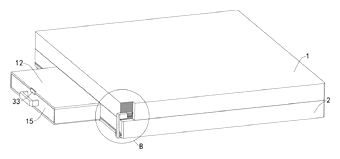
- The gear drives a convex rack (9) along a first fixed groove (8), pulling an inserting block (11) out of a slot (17) on a storage box (15).
- A first spring (13) pushes a push plate (14), sliding the storage box out of a fixed box (12) for access.
- Closing the shells reverses the gear, returning the inserting block into the slot to lock the storage box back inside.
Who it is for
- Toy brands for home use looking for a self-contained puzzle set that keeps pieces organized without extra packaging.
- Board-game clubs needing durable, easy-to-reset puzzle kits for group sessions where quick setup matters.
- Early-childhood teaching suppliers providing classroom materials where students must pack away their own workstations independently.
- Wholesalers of plastic toys seeking a product with a visible mechanical action that stands out on retail shelves.
How it works
The main parts
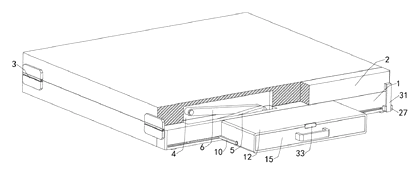
| No. | Part | What it does |
|---|---|---|
| 1 | First shell | Base housing containing the gear, rack, and fixed box. |
| 2 | Second shell | Top cover hinged to the first shell. |
| 3 | Hinge chain | Connects the two shells. |
| 4 | Square grooves | Housings at the ends of the shells for the hinge rods. |
| 5, 6 | Hinge rods | Link the shells; rod I connects to the gear. |
| 7 | Gear | Fixed to hinge rod I; converts rotation into linear motion. |
| 8 | First fixed groove | Guide track for the convex rack. |
| 9 | Convex rack | Meshes with the gear; slides inside the fixed groove. |
| 10 | First moving rod | Connects the rack to the inserting block outside the shell. |
| 11 | Inserting block | Locks into the storage box slot when closed. |
| 12 | Fixed box | Outer housing for the storage box. |
| 13 | First spring | Pushes the push plate to eject the storage box. |
| 14 | Push plate | Transfers spring force to the storage box. |
| 15 | Storage box | Holds the puzzle pieces; slides in and out. |
| 17 | Slot | Recess on the storage box for the inserting block. |
| 18 | Placing plate | Surface for assembling the puzzle. |
| 19, 20, 21 | Magnets | Hold the placing plate in position. |
| 34 | Contact strips | Coarse strips on the bottom to prevent slipping. |
Operating steps
- Open the puzzle - Rotate the second shell (2) upward. The hinge rods (5, 6) pivot inside the square grooves (4).
- Release the box - The first hinge rod (5) turns the gear (7). The gear pushes the convex rack (9) along the first fixed groove (8). The first moving rod (10) pulls the inserting block (11) out of the slot (17).
- Eject the storage - Freed from the inserting block, the compressed first spring (13) pushes the push plate (14), sliding the storage box (15) out of the fixed box (12). Take out the pieces.
- Play - Assemble the pieces on the placing plate (18), held steady by the magnets (19, 20, 21). The contact strips (34) keep the first shell from sliding.
- Pack up - Place the pieces back into the storage box (15), organized by the partition plate (16). Slide the box back into the fixed box (12), compressing the first spring (13) until the slot (17) aligns with the inserting block (11).
- Close and lock - Fold the second shell (2) down. The hinge rods reverse the gear (7), pushing the rack (9) back. The inserting block (11) re-enters the slot (17), locking the storage box inside.
Applications
Home playrooms
Children playing at home often leave puzzle pieces scattered on the floor. This design stores all fragments inside the case itself, allowing parents to keep the play area tidy. The automatic box release makes it easy for young hands to start playing without struggling with tight lids.
Board-game clubs
Clubs running multiple tables need games that reset quickly between sessions. Staff simply fold the second shell closed, and the gear mechanism locks the storage box back inside automatically. This reduces cleanup time compared to sorting pieces into separate bags or trays.
Classroom teaching
Teachers use jigsaw puzzles to develop spatial reasoning in early education. Students can manage their own materials because the mechanical release requires no adult assistance. The partition plate inside the storage box helps children practice sorting skills before they begin assembly.
Travel and transport
Taking puzzles on trips usually risks losing pieces when boxes open in transit. The inserting block locks the storage box firmly inside the first shell whenever the lid is closed. The coarse contact strips also prevent the case from sliding around on car seats or tray tables.
Where it is less suitable
- Large-format floor puzzles - this design relies on a compact shell and internal box, intended for tabletop sizes rather than oversized floor mats.
- Wooden heirloom puzzles - the mechanism uses plastic shells, hinge chains, and molded gears, which differ from traditional wooden puzzle construction.
- Digital or screen-based games - this is a physical, mechanical toy for tactile play, not a software application.
Frequently asked questions
How does the storage box pop out automatically?
When you open the second shell, the hinge rods turn a gear inside the first shell. The gear pushes a rack, which pulls an inserting block out of a slot on the storage box. Once the block clears the slot, a compressed spring pushes a plate against the box, sliding it out of its housing.
Does closing the lid lock the box again?
Yes. Folding the second shell down reverses the hinge rods and the gear. This pushes the rack back, forcing the inserting block to re-enter the slot on the storage box. The box is then held securely inside the first shell.
What keeps the puzzle pieces in place during play?
A placing plate sits inside the first shell, held by magnets. The patent describes a first magnet in the placing plate and second and third magnets in the shell that connect to it. This keeps the assembly surface steady while children work.
Will the puzzle slide around on a table?
The bottom of the first shell has multiple contact strips with a coarse surface. These are evenly distributed to provide friction and prevent the case from shifting during use.
How many pieces can the storage box hold?
The patent does not specify a piece count. The capacity depends on the dimensions of the storage box and the thickness of the puzzle pieces, which are set in design and confirmed on prototypes.
Can the puzzle pieces be sorted inside the box?
The storage box contains a partition plate. This divides the interior space, allowing pieces to be grouped before the box is pushed back into the fixed housing.
What materials are used for the shells and gears?
The patent does not list specific plastics. Materials such as ABS or PP for the shells and POM or nylon for the gear and rack are typically selected during engineering based on durability and molding requirements.
Can this design be made and sold in the US?
The patent was filed only in China and is currently in force there until at most 2044-05-14 (if annual fees are paid). Because there is no US counterpart, this specific patent does not restrict making or selling the design in the United States. However, similar mechanical toy mechanisms may be covered by other US patents - see Patent & Production - so we recommend a freedom-to-operate check before volume production.
Are you affiliated with the patent owner?
No. IP2M is an independent design and manufacturing service working from the public patent document.
Request a quote
Click Request a Quote below to see our email address - copy it, or open your email app with a ready-made message. Please mention patent CN118179006B in the subject.
Helpful details to include:
- Your company and channel (toy brand, wholesaler, teaching supplier, board-game club distributor)
- Target age group and intended piece count
- Shell dimensions or desired assembled puzzle size
- Material preferences for the shells and internal gears
- Estimated quantity and target price
- Timeline - when you would like prototypes and the first shipment
You can also reach us at (332) 203-9997.
Explore this product
Interested in building this?
Tell us your target market, quantity and timeline. We reply with options for prototyping, small-batch runs or volume production.
Send your inquiry to
Please put CN118179006B in the subject line and tell us your company, country, estimated quantity and timeline.
Prefer to talk? Call (332) 203-9997.
More product-ready patents
All Toys & Games patents →
Toys & Games
Stretch-to-Fit Toy Remote with Drone Storage
Toy drone remote with slide-out handles for any hand size, a phone clamp and built-in drone storage.
Patent CN205412243U
Toys & Games
Magnetic Tile Racks for Ultra-Thin Travel Mahjong
Magnetic rack frames that hold ultra-thin mahjong tiles upright and fold into the set's carrying box.
Patent CN207169017U
Toys & Games
X-Braced Square Magnetic Building Tile with Locating-Post Shell
Square magnetic building tile: open X-brace frame, corner-lug magnets, two shells aligned by posts.
Patent CN105963988B
Toys & Games
Card-Thin Magnetic Travel Mahjong and Chess Sets with Magnet Racks
Pocket mahjong and chess sets: thin magnetic-powder tiles, finger magnet picker and fold-out magnetic racks.
Patent CN206896783U
Toys & Games
Inflatable Baby Climbing Mat with a Bumpy Hump and a Ramp Obstacle
Inflatable crawling mat: a bumpy rounded hump and a sloped ramp on a stiffened air base.
Patent CN108905229B
Toys, Games & Puzzles
Ring-Layout Automatic Card Shuffler with Electromagnetic Box Coupling
Ring-layout card shuffler that sweeps stacks between boxes via electromagnetic coupling.
Patent CN209564602U
Browse by category
- Apparel & Accessories (22)
- Baby & Kids (16)
- Bags & Luggage (9)
- Bath & Personal Care (16)
- Car Accessories (10)
- Furniture, Bedding & Storage (12)
- Garden & Outdoor (18)
- Health & Wellness (8)
- Home, Kitchen & Cleaning (24)
- Lighting (12)
- Packaging & Containers (6)
- Pet Products (6)
- Phone & Camera Accessories (4)
- Retail Display (13)
- School, Office & Art (19)
- Sports & Recreation (25)
- Tools & Workshop (27)
- Toys & Games (12)
This page is based on the public patent document CN118179006B, assigned to Fujian Maestro Artware Co ltd, Shantou Maoyuan Plastic Co ltd. IP2M is an independent manufacturing service and is not affiliated with, endorsed by or licensed by the patent owner. Images marked as concept renderings are illustrations, not photos of an existing product. Patent status information is provided for reference only and is not legal advice; confirm freedom to operate for your market before production. Full disclaimer.