
Patent CN118418893B
Updated November 5, 2026Quick-Release Trunk Storage Box with Adjustable Frame
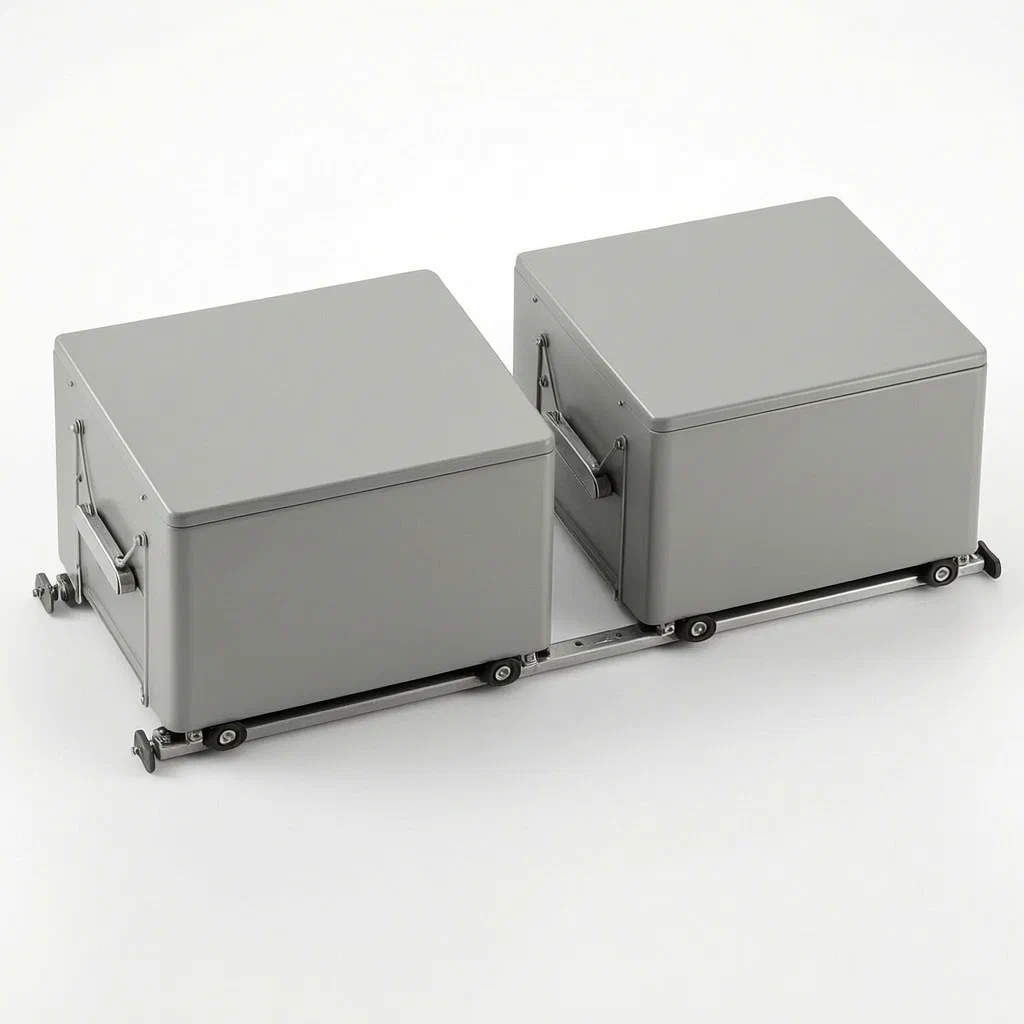
Standard trunk organizers often slide around during turns or hard braking, damaging contents and creating noise. This design solves that by anchoring the storage box to a rigid, adjustable frame. The frame clamps to the vehicle sides using rollers and screw-adjusted plates, while the box snaps into the frame. A simple pull-handle releases the lock, letting users remove the box for transport elsewhere. The mechanical linkage ensures the box stays put even when the car rocks or stops abruptly.
- China invention patent - active
- No filings outside China
- Automotive interior accessories
- Mechanical quick-release, adjustable frame
Splat! What let you down?
🔒
Tool-Free Lock
A pull-cord mechanism retracts locking blocks, allowing quick removal of the box.
📏
Adjustable Frame
The fixed frame expands or contracts to fit various trunk widths using rollers and screws.
🛡️
Anti-Slip Design
Elastic pads and limit plates keep the frame stable against vehicle walls during braking.
⚙️
Pulley System
Internal pulleys reduce the force needed to operate the release handle.
Bring this product to market
- ✓ Patent review Patent family and legal status reviewed in the relevant jurisdictions.
- 2 Product brief · now How it works, uses and options written up
- 3 Prototype First samples for buyers to review
- 4 Pilot run Small first batch for launch customers
- 5 Volume production Repeat orders at scale
Buyer interest
– of 100 buyers needed to start prototyping
One click, no sign-up. Each vote is one real visitor, and products with the most interest go to prototyping first.
Build team: no members yet. Need a partner, co-funding or skills to build this? Join and we introduce the team once it forms.
Patent Rights & Team Participation
Before joining a development team, participants should ensure they have the necessary rights or authorization to participate in the project.
Participation is generally appropriate where:
- You own the relevant patent rights or have obtained permission or a license from the rights holder.
- The relevant patent rights have expired or have been legally invalidated in the jurisdictions where the planned activities will take place.
- The planned development, manufacturing, and commercialization activities have been independently assessed and do not infringe applicable patent rights in the relevant jurisdictions.
Important: Being located outside a country where a patent is protected does not automatically exempt you from patent infringement risks. Patent rights may apply based on where development, manufacturing, use, sale, or import activities take place.
IP2M does not grant any patent license or authorization through team participation. Joining a project does not provide permission to use, manufacture, or commercialize patented technology.
The problem
Most trunk organizers rely on friction mats or straps to stay in place. These methods often fail under dynamic conditions: sharp turns, sudden braking, or uneven roads can cause the organizer to slide, tip over, or shift position. This not only disorganizes stored items but can also damage the vehicle’s interior lining or create rattling noises. Furthermore, traditional hard-shell cases usually require screws or complex brackets for installation, making them difficult to remove when the user needs to access the full trunk space or take the case out for use elsewhere. There is a need for a storage solution that remains securely anchored during transit but allows for immediate, tool-free detachment.
The solution
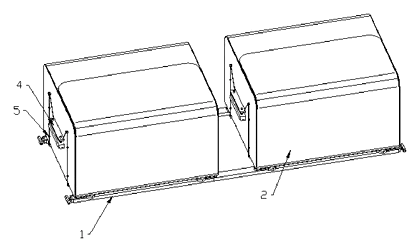
The patented system separates the storage function from the mounting function. It consists of two main components: a fixed frame (1) and a storage box (2).
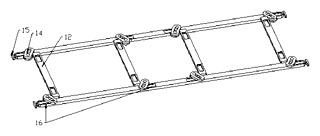
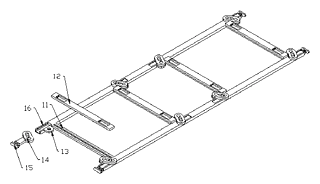
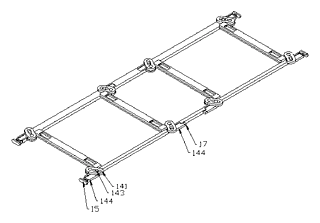
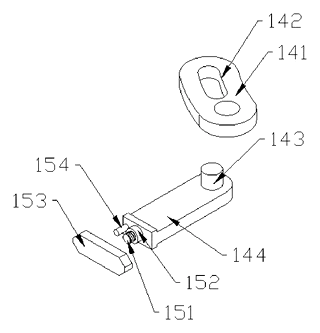
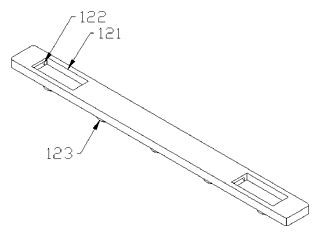
- The fixed frame installs directly onto the vehicle’s trunk floor or walls. It features mounting plates (12) equipped with rollers (123) and limit plates (144). These plates move within slotted holes (11), allowing the frame’s width to be adjusted. An adjusting piece (15) with a threaded rod pushes the plates outward, pressing them against the car’s inner structure. Elastic pads (17) provide cushioning and grip between the moving parts and the frame body.
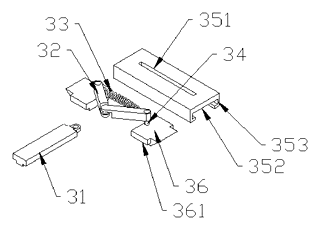
- The storage box sits on top of this frame. Its base contains a locking piece (3) with spring-loaded locking blocks (36). When the box is pressed down, these blocks snap into locking grooves (122) on the frame’s mounting plates, securing the box in place.
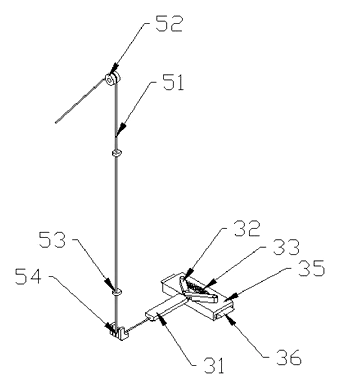
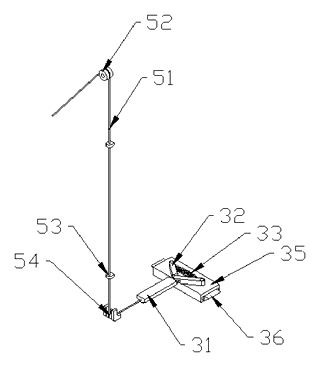
- To remove the box, the user presses a control handle (4) on the side of the box. This action pulls a pull rope (51) routed through pulleys (52, 54). The rope connects to a pull plate (31) inside the locking mechanism. Pulling the plate rotates connecting rods, which retract the locking blocks from the grooves. Once retracted, the box lifts off freely.
Who it is for
- Auto Accessory Brands: Companies looking to differentiate their product line with a secure, mechanical mounting solution rather than passive rubber mats.
- OEM Suppliers: Manufacturers seeking aftermarket-compatible interior organization units that require no drilling or permanent modification to the vehicle.
- Wholesalers & Distributors: Buyers who need a product where the box can be detached from the frame for shipping and storage.
- Fleet Operators: Businesses needing durable cargo management for service vans or ride-share vehicles where equipment must remain stationary during aggressive driving conditions.
How it works
The main parts
| No. | Part | Function |
|---|---|---|
| 1 | Fixed Frame | Anchors the system to the vehicle; adjustable width. |
| 2 | Storage Box | Holds cargo; carries the locking and release mechanisms. |
| 3 | Locking Piece | Engages/disengages the box from the frame via blocks (36). |
| 4 | Control Handle | User interface to trigger the release mechanism. |
| 5 | Connecting Piece | Rope (51) and pulleys (52, 54) transmitting force from handle to lock. |
| 12 | Mounting Plate | Slides in frame slots; holds the locking groove (122). |
| 15 | Adjusting Piece | Threaded rod and block to tighten frame against car walls. |
| 17 | Elastic Pad | Cushions and grips the moving plate assembly. |
Operating Steps
- Installation: Place the fixed frame in the trunk. Turn the adjusting pieces (15) to extend the mounting plates (12) until they press firmly against the vehicle’s side walls. The rollers (123) allow smooth sliding during adjustment.
- Mounting the Box: Align the storage box (2) over the frame. Press down. The locking blocks (36) compress inward due to springs and then pop up into the locking grooves (122) on the mounting plates. The box is now locked.
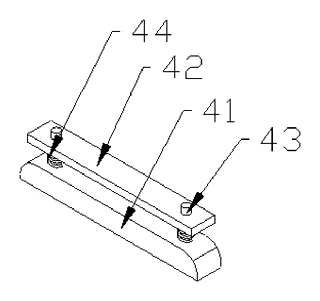
- Removal: Grip the handle (41) and press the plate (42) downward. This pulls the rope (51) through the pulleys. The rope moves the pull plate (31), which rotates the connecting rods (32). These rods pull the locking blocks (36) back into the moving grooves (352), releasing them from the frame. Lift the box out.
Applications
Daily Commuter Vehicles
Drivers often carry groceries, gym bags, or work supplies that roll around in the footwell. This organizer keeps items contained in the trunk area, preventing them from sliding forward into the cabin during stops. The quick-release feature allows users to easily take the entire box out if they need to load larger items like furniture or sports equipment, simply by unhooking it from the frame.
Ride-Sharing and Taxis
For professional drivers, keeping the rear passenger area clear of clutter is essential. The fixed frame provides a dedicated storage zone for driver essentials (documents, chargers, snacks) that does not encroach on passenger legroom. Since the box detaches instantly, drivers can remove it at the end of a shift to prevent theft or to clean the trunk thoroughly, without unscrewing any hardware.
Family SUVs and Minivans
Families frequently switch between carrying passengers and large cargo loads like strollers or camping gear. Traditional bolt-in organizers are cumbersome to remove. This system allows parents to pop the storage box out in seconds when they need to fold down seats for bulky items, then reinstall it just as quickly when returning to daily school runs. The adjustable frame accommodates the varying widths of different SUV models.
Service Vans and Fleet Vehicles
Technicians and delivery drivers need small tools and parts organized but accessible. The rigid frame prevents the container from shifting during rapid acceleration or hard braking, protecting fragile components inside. The modular nature means the van owner can swap out different sized boxes (e.g., a deep bin for bottles, a shallow tray for papers) on the same installed frame, adapting to the day’s workload.
Where it is less suitable
- Vehicles with irregular trunk floors: If the trunk floor is heavily contoured or lacks flat vertical surfaces for the frame to clamp against, the adjustable mounting plates may not achieve sufficient stability.
- Very heavy industrial loads: While the frame is robust, extremely high-weight applications might require direct bolting to the chassis rather than friction-based clamping against interior panels.
- Permanent installations: Users who never intend to remove the organizer might find simpler, lower-cost bolt-on trays more economical, as the quick-release mechanism adds complexity.
Patent & Production
At a glance
| Patent number | CN118418893B (application CN202410881105) |
| Type | China invention patent (发明专利) - protects method and structure |
| Original title | Automobile Luggage Compartment Storage Box (一种汽车行李舱储物盒) |
| Patent owner | Ningbo Qingshanqing Auto Parts Co ltd |
| Inventors | Zhao Lirong, Chu Danhong, Hua Liang, Ma Junfei |
| Filing date | 2024-07-03 |
| Grant date | 2024-09-27 |
| Status (China) | In force - valid until at most 2044-07-03, provided annual fees are paid |
| Patent family | Public record shows Chinese filings only - no US, European, Japanese, PCT or other filings listed |
| Cited by | 0 later documents |
| Source | Google Patents (search for CN118418893B) |
What the claims cover, in plain language
Claim 1 defines a storage box system comprising a box (2) and a fixed frame (1). The box has a closure/locking piece (3) that connects quickly to the frame. A control piece (4) on the box side is linked to the closure via a connecting piece (5), specifically a pull rope (51). The frame includes mounting plates (12) with rollers (123) that sit in slotted holes (11). The mounting plates have locking grooves (122). The frame ends have limiting plates (144) connected to rotating plates (141) via movable rods, and adjusting pieces (15) with threaded rods to tighten the assembly. Elastic pads (17) are placed between moving parts.
Claim 2 details the locking piece (3): it has a mounting block (35) with symmetrical moving grooves (352) containing locking blocks (36). A pull plate (31) connects to these blocks via hinged connecting rods (32).
Claim 3 specifies that the locking blocks slide in sliding grooves (353) and are biased by a first spring (33) between the connecting rods.
Claim 4 describes the control piece (4): a handle (41) and pressing plate (42) with a guide rod (43) and second spring (44) for reset.
Claim 5 adds pulley I (52) and pulley II (54) to route the pull rope, reducing effort.
Claim 6 includes an auxiliary block (53) with holes to guide and stabilize the pull rope.
This is a simplified reading for orientation only. The legal scope is defined by the exact claim wording in the official Chinese document.
What this means for US production
This patent was filed in China and is currently in force. Making or selling this specific design in China requires the owner’s permission. However, the public record shows no US counterpart or foreign family members. Therefore, this specific Chinese patent does not restrict manufacturing or sales in the United States.
Two points to settle early:
- Other patents may exist. Automotive interior organizers and quick-release mounting systems are a competitive field with numerous existing US patents covering similar latching mechanisms, friction mounts, and adjustable frames. A freedom-to-operate (FTO) review is strongly recommended before tooling to ensure the specific combination of the pull-cord lock and roller-clamp frame does not infringe on other US intellectual property.
- Material Safety. Components used in vehicle interiors must meet strict flammability standards (such as FMVSS 302 in the US). The choice of plastics and elastic materials for the frame and box must be verified against these regulations.
Customization and manufacturing
What can be customized
| Area | Options |
|---|---|
| Frame Width Range | Adjust slot lengths and roller positions to fit compact cars vs. large SUVs/trucks. |
| Box Dimensions | Depth, height, and internal dividers tailored to target market cargo types. |
| Locking Force | Spring rates for the locking blocks can be tuned for easier engagement or higher security. |
| Materials | ABS or PC for structural parts; TPE or silicone for elastic pads and grips. |
| Finish | Textured matte black, carbon fiber pattern, or custom colors to match vehicle interiors. |
| Handle Design | Ergonomic shape of the control lever and pressing plate. |
Things to plan for (US market)
- FMVSS 302: Flammability of interior materials. All plastic and rubber components must pass burn rate tests.
- REACH / Prop 65: Chemical compliance for plastics and adhesives used in the assembly.
- Durability Testing: Cycle testing for the pull-cord mechanism to ensure the rope and pulleys do not wear out after repeated use.
- Temperature Resistance: Materials must withstand extreme cabin temperatures (-40°C to +85°C) without warping or losing elasticity.
How a project runs
- Inquiry - Define target vehicle segments, box size, and quantity.
- Design - CAD modeling of the frame adjustability and lock mechanism; material selection.
- Prototype - 3D printed functional samples for fit check in actual vehicles.
- Validation - Heat cycling, vibration testing, and latch durability checks.
- Production - Injection molding of parts, assembly of springs/ropes, packaging.
Quantities & timeline
Molds for the frame sections and box shell are required. The complexity lies in the multi-part locking assembly and the adjustable rail system. Lead times depend on mold fabrication and certification testing. Send us your target vehicle list, desired box dimensions, estimated quantity and we will reply with options.
Patent drawings
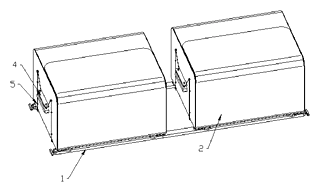
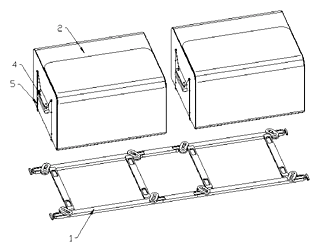
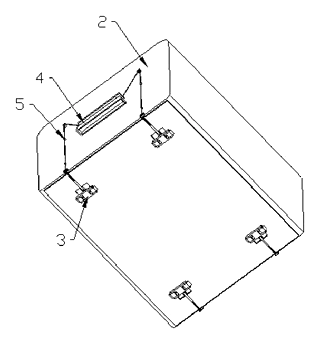
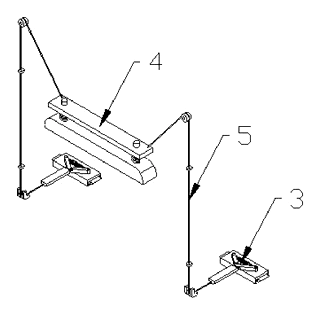
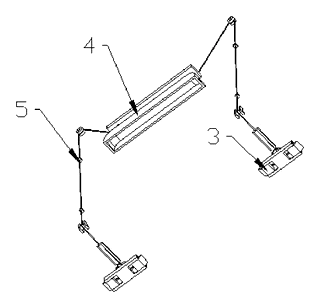
Drawings reproduced from the public patent document for reference.
Production notes
Tooling and process
Injection molding is likely the primary process for the plastic components of both the box and the frame. Steel molds will be needed for the complex geometry of the locking pieces and mounting plates. Assembly typically involves inserting springs and connecting rods, followed by threading the pull rope through the pulleys. Screws or press-fit joints may be used to secure the handle and auxiliary blocks.
Cost drivers
Tooling complexity is typically significant due to the multiple moving parts in the lock and adjuster. Material grade matters; heat-resistant plastics are required to survive cabin temperatures. Adhesive quality is critical if bonding is used for decorative trims or labels. Packaging must protect the delicate rope and pulley assemblies during shipping.
Prototyping path
We would typically start with 3D-printed fit checks in representative vehicles to verify the frame’s adjustability range. Create functional samples to test the pull-cord mechanism’s ease of use. Conduct heat-cycle tests on prototype units to check for deformation. Only proceed to tooling after validating the latch durability.
What we would change before tooling
We would likely refine the tolerance fits for the locking blocks to prevent jamming. The rope routing could be optimized to reduce friction losses. Wall thicknesses in stress areas of the frame should be reviewed to balance weight and strength. Ensuring the elastic pads provide consistent grip across temperature ranges is key.
Common failure points
Deformation in high cabin heat can warp the plastic frame, affecting the fit. Adhesive failure might occur if glue is used for trim pieces exposed to UV and heat. Rattle at joints is a risk if tolerances are too loose. Poor fit at gaps between the box and frame can look unprofessional. Suction loss is not applicable here, but spring fatigue could weaken the auto-lock feature over time.
Frequently asked questions
How does the quick-release work?
You press a handle on the side of the storage box. This pulls a cord connected to internal locking blocks. As you press, the blocks retract from the frame’s grooves, allowing you to lift the box straight out. No tools are needed.
Will it fit my car?
The frame is adjustable. It uses sliding plates with rollers that can be widened or narrowed using screw knobs to match the distance between your trunk’s side walls. It is designed to fit standard sedan, SUV, and minivan trunks, but very narrow or irregularly shaped trunks might not accommodate the minimum width.
Does it slide around while driving?
No. The frame itself is clamped tightly against the vehicle’s interior walls using elastic pads and pressure from the adjusting screws. The box locks mechanically into the frame. This dual-anchor system prevents movement during braking or turning.
Is it difficult to install initially?
Installation takes minutes. You place the empty frame in the trunk, push it to one side, and turn the knobs to expand the plates until they grip the opposite wall. Then you drop the box into place. It requires no drilling or adhesive.
Can I wash the box?
Yes. Since the box detaches completely from the frame, you can take it out and clean it separately. The materials are typically plastic, so they can be wiped down or rinsed, depending on the specific resin used in production.
What happens if the rope breaks?
The rope is routed through pulleys to reduce tension. In normal use, it should last many years. If replacement is needed, the design allows access to the rope channel, though it may require partial disassembly of the handle cover. We recommend checking the rope condition periodically.
Can this design be made and sold in the US?
The patent was filed in China and is currently in force there. The public record shows no US counterpart. Therefore, this specific Chinese patent does not restrict manufacturing or sales in the US. However, other US patents may cover similar locking or mounting mechanisms, so a freedom-to-operate review is advised before mass production.
Are you affiliated with the patent owner?
No. IP2M is an independent design and manufacturing service working from the public patent document.
Request a quote
Click Request a Quote below to see our email address - copy it, or open your email app with a ready-made message. Please mention patent CN118418893B in the subject.
Helpful details to include:
- Your company and channel (auto accessory brand, fleet supplier, retailer)
- Target vehicle types (sedan, SUV, truck) and approximate trunk width ranges
- Desired box dimensions (length, width, height)
- Material preferences (color, texture, special requirements like fire resistance)
- Estimated quantity and target price
- Timeline - when you would like samples and the first shipment
You can also reach us at (332) 203-9997.
Page editor: Emily Zhang, Product Editor · IP2M
Last updated November 5, 2026. If something on this page looks wrong, email [email protected] and we will check it against the patent.
Interested in building this?
Tell us your target market, quantity and timeline. We reply with options for prototyping, small-batch runs or volume production.
Send your inquiry to
Please put CN118418893B in the subject line and tell us your company, country, estimated quantity and timeline.
Prefer to talk? Call (332) 203-9997.
More product-ready patents
All Car Accessories patents →
Car Accessories
Car Headrest Pillow with Ratchet Side Wings and Push-Button Reach
Post-mounted car headrest pillow with ratchet side wings and a push-button forward adjustment.
Patent CN212195197U
Car Accessories
Hard-Shell Rooftop Tent That Doubles as a Cargo Box
Roof box whose hard frames lift on gas struts into a tent with door and skylight, and fold back for luggage.
Patent CN206327275U
Car Accessories
Headlamp-to-Bumper Adapter Bracket That Sets Gap and Flush in Three Directions
Molded bracket under the headlamp: support blocks and snap teeth locate the bumper flange for an even gap.
Patent CN216580316U
Car Accessories
Infant Car Seat with a Load-Bearing Base That Wraps the Carrier
Infant car seat whose base has a backrest and swing-up side rails, so the carrier can be lighter.
Patent CN206383856U
Car Accessories
Retractable Side Impact Protection Block for Child Car Seats
Retractable side-impact block for child seats: springs out to provide side-impact buffering, folds flat.
Patent CN207028930U
Car Accessories
Rain-Deflecting Side Mirror with a Pivoting Air-Guide Plate
Side mirror with a top air duct and folding guide plate that directs airflow across the glass.
Patent CN207345672U
Browse by category
- Apparel & Accessories (41)
- Baby & Kids (26)
- Bags & Luggage (15)
- Bath & Personal Care (27)
- Car Accessories (22)
- Furniture, Bedding & Storage (21)
- Garden & Outdoor (29)
- Health & Wellness (12)
- Home, Kitchen & Cleaning (44)
- Lighting (21)
- Packaging & Containers (11)
- Pet Products (10)
- Phone & Camera Accessories (8)
- Retail Display (22)
- School, Office & Art (31)
- Sports & Recreation (40)
- Tools & Workshop (49)
- Toys & Games (20)
This page is based on the public patent document CN118418893B, assigned to Ningbo Qingshanqing Auto Parts Co ltd. IP2M is an independent manufacturing service and is not affiliated with, endorsed by or licensed by the patent owner. Images marked as concept renderings are illustrations, not photos of an existing product. Patent status information is provided for reference only and is not legal advice; confirm freedom to operate for your market before production. Full disclaimer.