At a glance
| Patent number | CN118560401B (application CN202411022456) |
| Type | China invention patent (发明专利) - protects product shape, structure and method |
| Original title | Electronic equipment carrier, vehicle cockpit and vehicle (电子设备承载机构、车辆驾驶舱以及车辆) |
| Patent owner | BYD Co Ltd |
| Inventors | Gao Qi, Zhuo Zhiliang, Liu Yuanyuan, Fu Yanfang, Yu Qibing |
| Filing date | 2024-07-29 |
| Grant date | 2024-12-10 |
| Status (China) | In force in China until at most 2044-07-29 (if annual fees are paid) |
| Patent family | Chinese filings only - CN118560401B |
| Cited by | 0 later documents |
| Source | Google Patents (search for CN118560401B) |
What the claims cover, in plain language
Claim 1 - An electronic equipment bearing mechanism comprising a tray, a base, and a driving assembly. The tray sits on the base to hold a device. The driving assembly is mounted on the base and connected to the tray to drive it to lift along a first direction; the tray is accommodated in the base when lowered. The driving assembly includes a driving part, a driving bracket, and a supporting piece. The bracket rotates around a rotation axis along a second direction. The bracket has a drive shaft and a first end plate with a first arc-shaped groove whose distance from the rotation axis gradually increases from one end to the other. The supporting piece has a first support rod rotatably connected to the tray at one end and inserted into the groove at the other.
Claim 2 - The axis of the drive shaft coincides with the rotation axis. Claim 3 - Adds a second end plate with a second arc-shaped groove and a second support rod inserted into it. Claim 4 - The first and second end plates are parallel and perpendicular to the rotation axis; the grooves are parallel; the support rods are straight and coaxial. Claim 5 onward - Covers multiple driving brackets spaced along a third direction, driven synchronously by a linkage piece connected between them.
This is a simplified reading for orientation only. The legal scope is defined by the exact claim wording in the official Chinese document.
What this means for US production
This patent was filed only in China and is currently in force in China until at most 2044-07-29 (if annual fees are paid). Making or selling this exact mechanism in China needs the owner’s permission. It has no US or other foreign counterpart.
Two points to settle early:
- Other patents may exist. Motorized vehicle phone holders and retractable dashboard mechanisms are actively patented by various automotive suppliers globally. Even though no foreign patents cite this specific Chinese filing, a freedom-to-operate (FTO) review covering the arc-groove lifting logic and linkage synchronization is necessary before US production.
- Motor integration and noise. The patent mentions a motor or rotary cylinder but does not specify torque or speed. Selecting a motor that lifts the tray smoothly without excessive noise or vibration requires parameters to be set in design and confirmed on prototypes.
Customization and manufacturing
What can be customized
| Area | Options |
|---|---|
| Tray dimensions | Sized for specific phone widths and case thicknesses (to be confirmed in design) |
| Base footprint | Shaped to fit specific dashboard cutouts or aftermarket console modules |
| Materials | Plastics for the tray and base; metal or reinforced polymer for the shafts and rods |
| Driving part | DC motor, stepper motor, or rotary cylinder depending on power availability |
| Surface finish | Textured, painted, or wrapped to match vehicle interior trim |
| Linkage setup | Single bracket for compact units or multiple linked brackets for wider trays |
Things to plan for (US market)
- FMVSS 201 (Occupant Protection in Interior Impact) - any component added to the dashboard or console must not create hazardous impact points for passengers.
- FCC Part 15 - if the driving part uses an electronic motor controller or wireless charging integration, it must comply with FCC rules for unintentional radiators.
- California Prop 65 - plastics, paints, and lubricants used in the mechanism must be screened for listed chemicals.
- CISPR 25 EMC testing - automakers usually require this for in-vehicle electronics such as the lifting motor drive and the optional wireless charging connector.
How a project runs
- Inquiry - target vehicle platform, tray size, actuation speed, and quantity.
- Design - CAD modeling of the base, tray, arc-groove geometry, and linkage kinematics.
- Prototype - 3D printed or CNC machined samples to verify the lifting path and clearances.
- Pilot run - injection molding of test tools, motor integration, and cycle testing.
- Production - full tooling, assembly line setup, quality checks, and packaging.
Quantities & timeline
The base and tray require injection molds, while the drive shaft, end plates, and support rods may need CNC machining or die casting depending on material choices. The arc-shaped grooves demand precise tolerances to ensure smooth lifting without binding. Cycle life testing and motor calibration take significant development time. Send us your target vehicle model, tray dimensions, preferred actuation method, estimated quantity and timeline and we will reply with options.
Patent drawings
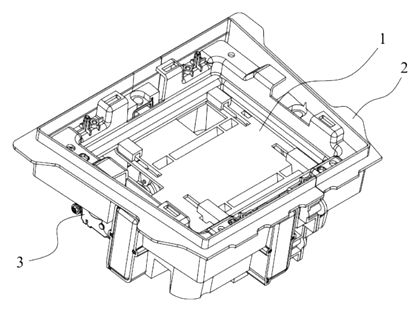
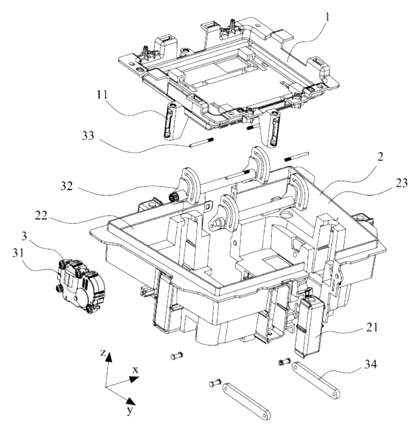
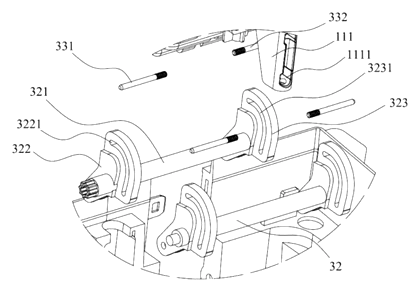
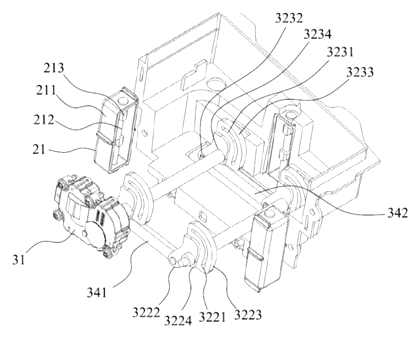
Drawings reproduced from the public patent document for reference.