
Patent CN118927187B
Updated November 1, 2026Auxiliary Tool for Downlight Protection Plate Installation
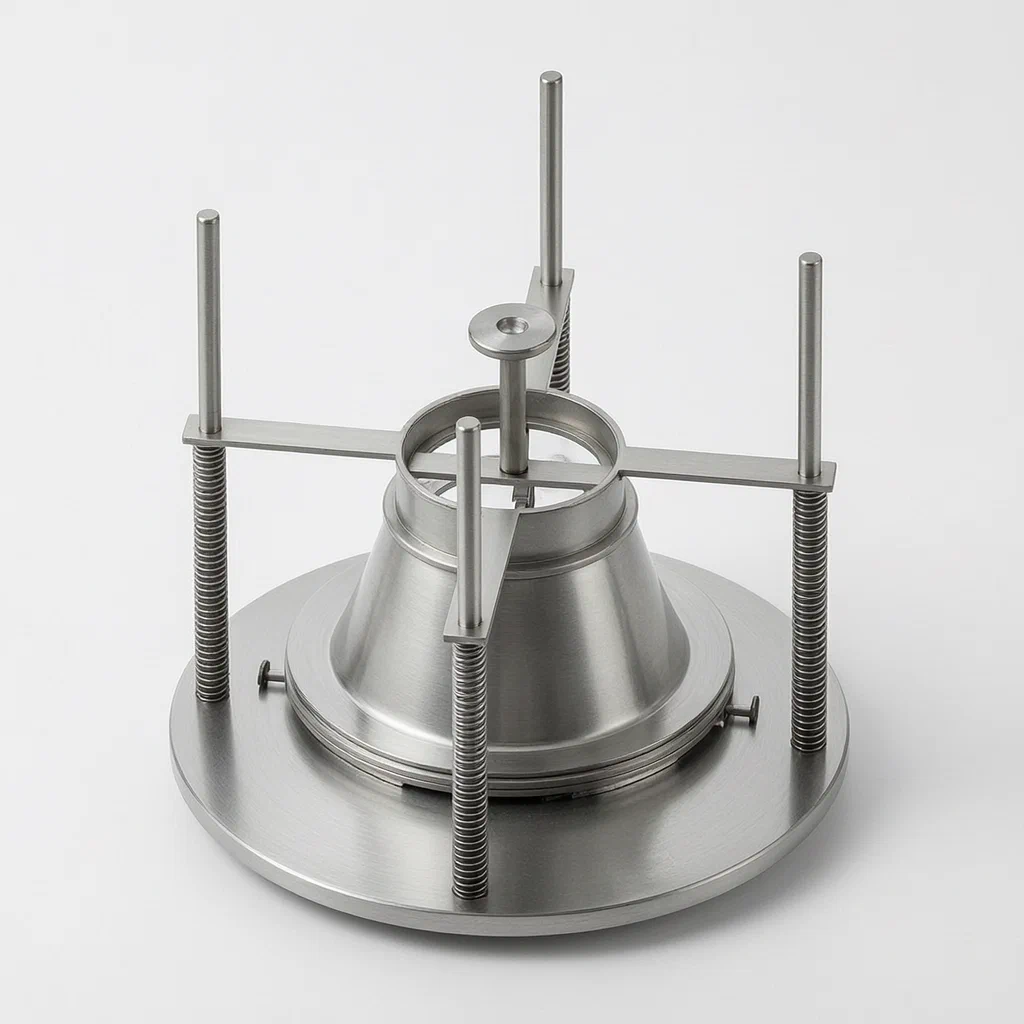
Installing snap-fit protection plates on downlights is tricky: misalignment causes edge wear, uneven seating, and slow manual work. This auxiliary tool solves it by providing a dedicated jig that centers both the plate and the housing simultaneously. It uses a rotating top ring to drive radial push plates for perfect concentricity, and a spring-loaded vertical lift to hold the lamp barrel steady. By ensuring the protective piece and lamp housing are aligned before the final snap-fit, it prevents damage to the plastic edges and speeds up the assembly process significantly.
- China invention patent - active
- No filings outside China
- Lighting assembly tools
- Mechanical centering and spring-loaded positioning
Splat! What let you down?
🎯
Concentric Centering
Rotating top ring drives radial sliders to perfectly align the protection plate.
⬆️
Vertical Housing Lift
Spring-loaded displacement plates hold the lamp barrel securely above the plate.
🛡️
Edge Protection
Precise alignment prevents scraping and wear on the plastic protection piece edges.
⚙️
Efficient Assembly
Simultaneous alignment steps reduce manual trial-and-error during snap-fitting.
Bring this product to market
- ✓ Patent vetted China-only family and legal status checked
- 2 Product brief · now How it works, uses and options written up
- 3 Prototype First samples for buyers to review
- 4 Pilot run Small first batch for launch customers
- 5 Volume production Repeat orders at scale
Buyer interest
– of 100 buyers needed to start prototyping
One click, no sign-up. Each vote is one real visitor, and products with the most interest go to prototyping first.
Build team: no members yet. Need a partner, co-funding or skills to build this? Join and we introduce the team once it forms.
The problem
Assembling downlights often involves snapping a circular protection plate onto the internal clips of the lamp housing. If the plate is not perfectly centered relative to the housing, the snap-fit tabs bind against the plastic edges. This causes visible scratches, weakens the structural integrity of the plate, and forces workers to manually adjust the position repeatedly. In high-volume manufacturing or tight-space installations, this misalignment slows down the process and increases defect rates. Standard hand tools do not provide a stable reference point for both components simultaneously.
The solution
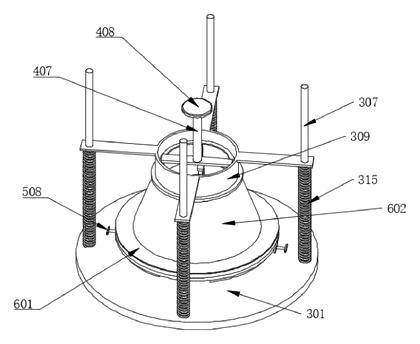
- Positioning Base: The tool uses a circular positioning plate with a central placing platform. The downlight’s protection plate rests flat on this platform.
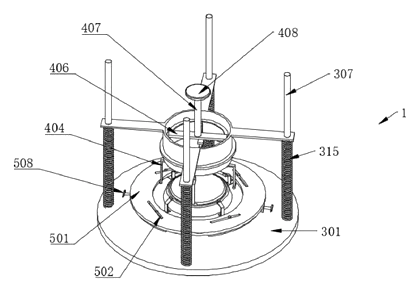
- Radial Centering: A rotating top ring contains key slots that engage sliding columns. As the ring turns, it drives cross-sliders outward via push plates, pressing them evenly against the outer edge of the protection plate to center it.
- Housing Support: Vertical guide rods allow displacement plates to move up and down. These plates connect to a central tube that supports the lamp housing barrel.
- Spring Return: Return springs between the displacement plates and the base ensure the central tube lowers gently once the housing is placed, maintaining contact without excessive force.
- Alignment Interface: The central tube has a fitting ring that matches the diameter of the lamp housing barrel, ensuring the two parts remain coaxial during the snap-in operation.
Who it is for
- Lighting Fixture Manufacturers: Companies producing recessed downlights that need consistent, fast assembly lines for snap-fit components.
- Contractors and Electricians: Professionals who install large numbers of downlights and require tools to prevent damaging fixtures during field assembly.
- Quality Control Teams: Inspectors who need to verify concentric alignment of protection plates and housings before packaging.
- Aftermarket Parts Suppliers: Brands selling replacement lenses or guards that must fit existing downlight models precisely.
How it works
The main parts
| No. | Part | What it does |
|---|---|---|
| 1 | Auxiliary Component | The entire jig structure. |
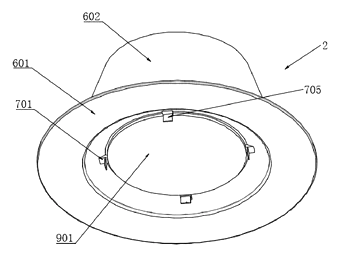
| 2 | Downlight Body | The product being assembled (housing + plate). |
| 3 | Positioning Piece | Circular base with placing platform and guide rods. |
| 4 | Pressing Piece | Mechanism that applies pressure to secure parts. |
| 5 | Centering Piece | Rotating ring that drives radial alignment. |
| 6 | Lamp Housing Barrel | The cylindrical part of the light fixture. |
| 7 | Sliding Pieces | Tabs on the housing that receive the protection plate. |
| 8 | Elastic Pieces | Clips inside the housing that snap onto the plate. |
| 9 | Protective Piece | The lens or guard being installed. |
| 301 | Positioning Circular Plate | Main base surface. |
| 302 | Placing Platform | Holds the protective piece from below. |
| 305 | Cross Sliders | Move radially to push the plate. |
| 306 | Shaped Push Plates | Contact points for centering the plate. |
| 307 | Guide Vertical Rods | Allow vertical movement of the housing support. |
| 309 | Central Tube | Supports the lamp housing barrel. |
| 315 | Return Springs | Provide gentle downward force on the support. |
Operating Steps
- Place the Plate: The worker sets the protective piece (9) onto the placing platform (302) of the positioning piece (3).
- Rotate to Center: The operator turns the rotating top ring (501). This action moves the cross sliders (305) outward through the key slots (502), causing the shaped push plates (306) to press against the sides of the protective piece, aligning it concentrically with the tool’s axis.
- Lift the Housing: The displacement plates (308) slide up the guide rods (307), raising the central tube (309). The lamp housing barrel (6) is placed over the central tube, supported by its fitting ring (318).
- Lower and Snap: The displacement plates are released. The return springs (315) pull the central tube down, bringing the housing barrel into contact with the centered protective piece. The elastic pieces (8) inside the housing snap onto the protective piece (9) without rubbing against the edges because they are already aligned.
Applications
Factory Assembly Lines
On production lines, workers can pre-center multiple units quickly. The tool eliminates the guesswork of aligning the lens, reducing cycle time per unit and minimizing rejected parts due to cosmetic scratches on the plastic guard.
Field Installation Kits
Electricians carrying this compact jig can assemble complex downlights on-site. It ensures that when they snap the cover onto the trim, it sits flush and even, which is critical for aesthetic lighting in retail or residential spaces where visibility of the fixture is high.
Prototype and Testing
Design engineers use the tool to test new housing geometries. By forcing concentric alignment, they can isolate whether fit issues are caused by the mold dimensions or by operator error, speeding up the iteration process for new lighting models.
Repair and Replacement
When replacing a broken lens on an existing fixture, the tool helps remove the old part and install the new one without damaging the internal clips. It provides a stable frame to hold the housing while the technician works on the small snap-fit details.
Where it is less suitable
- Non-Cylindrical Fixtures: The design relies on circular centering; square or rectangular downlights would require different slider configurations.
- Very Large Housings: The scale of the positioning plate may be too small for industrial floodlights or large ceiling panels.
- Automated Robotic Cells: While useful for manual stations, integrating this specific mechanical linkage into a fully automated robot arm might require significant custom adaptation compared to simpler vacuum pick-and-place systems.
Frequently asked questions
How does the tool center the protection plate?
The tool uses a rotating top ring connected to cross-sliders. When you turn the ring, the sliders move outward symmetrically. Attached push plates then press against the sides of the protection plate, forcing it into the exact center of the positioning platform.
Does it work for all downlight sizes?
The patent shows one tool configuration with fixed dimensions for the central tube and placing platform. For a different downlight series, the tool geometry would need to be scaled or adapted during design. Send us your fixture and protection plate dimensions and we will confirm what is feasible.
Will the tool scratch the plastic parts?
No. The pushing surfaces are designed to make smooth contact. Because the centering happens before the snap-fit, the plastic protection plate does not rub against the metal housing clips during insertion, which prevents the edge wear seen in manual assembly.
Is it difficult to operate?
It is simple. Place the plate, rotate the knob to center it, place the housing on the lift, and release the lift so the springs bring the housing down to snap onto the plate. Training takes minutes.
Can I buy just the spare parts?
Yes. Components like the return springs, cross-sliders, and the central tube are modular. We can supply these as replacements if wear occurs after heavy industrial use.
What materials is the tool made of?
The patent describes mechanical structures but does not limit materials. For production, aluminum alloy is typical for the base and tubes for strength, while POM or nylon is used for sliders and push plates to reduce friction and noise.
Can this design be made and sold in the US?
The patent is currently in force in China but has no US counterpart. This means you cannot manufacture or sell this specific tool in China without permission. In the US, you are generally free to make and sell it, provided you check for any other US patents covering similar assembly jigs. We recommend a freedom-to-operate search for the US market.
Are you affiliated with the patent owner?
No. IP2M is an independent design and manufacturing service working from the public patent document.
Request a quote
Click Request a Quote below to see our email address - copy it, or open your email app with a ready-made message. Please mention patent CN118927187B in the subject.
Helpful details to include:
- Your company and channel (lighting manufacturer, distributor, contractor supply)
- Downlight specifications (diameter, height, snap-fit type)
- Quantity needed for initial batch
- Material preference (aluminum, plastic, mixed)
- Timeline - when you need prototypes or first shipment
You can also reach us at (332) 203-9997.
Explore this product
Interested in building this?
Tell us your target market, quantity and timeline. We reply with options for prototyping, small-batch runs or volume production.
Send your inquiry to
Please put CN118927187B in the subject line and tell us your company, country, estimated quantity and timeline.
Prefer to talk? Call (332) 203-9997.
More product-ready patents
All Tools & Workshop patents →
Tools & Workshop
Rolling Tool Box with Telescoping Step Ladder
Telescoping A-frame ladder with an attached rolling tool box that slides to your working height.
Patent CN206290197U
Tools & Workshop
Folding 3-Handle Wrench Multi-Tool
Folding three-handle wrench multi-tool with magnetic screwdriver bits, saw, file and bottle opener.
Patent CN205290875U
Tools & Workshop
Rolling Auto-Repair Tool Cabinet with Built-In Lights
Lockable rolling tool cabinet for car repair with interior lights, a lubricant tray, parts drawers and a tool bay.
Patent CN205989314U
Tools & Workshop
Wide-Opening Folding Bolt Cutter
Bolt cutter with linked, gear-meshing handles that open up to 190° and fold in half for storage.
Patent CN207206226U
Tools & Workshop
Nail-Holding Hammer with Fold-Out Drivers
Hammer with a nail-holding T-slot in the head and fold-out drivers stored in the handle.
Patent CN205254927U
Tools & Workshop
Modular Wrench with Screw-On Heads
Wrench handle with a three-way threaded hub for screw-on adjustable and hex heads, plus a pipe sleeve.
Patent CN206216564U
Browse by category
- Apparel & Accessories (28)
- Baby & Kids (20)
- Bags & Luggage (12)
- Bath & Personal Care (21)
- Car Accessories (16)
- Furniture, Bedding & Storage (15)
- Garden & Outdoor (21)
- Health & Wellness (10)
- Home, Kitchen & Cleaning (32)
- Lighting (15)
- Packaging & Containers (8)
- Pet Products (7)
- Phone & Camera Accessories (5)
- Retail Display (16)
- School, Office & Art (22)
- Sports & Recreation (30)
- Tools & Workshop (36)
- Toys & Games (15)
This page is based on the public patent document CN118927187B, assigned to Suzhou Rongwen Kubai Lighting System Co ltd. IP2M is an independent manufacturing service and is not affiliated with, endorsed by or licensed by the patent owner. Images marked as concept renderings are illustrations, not photos of an existing product. Patent status information is provided for reference only and is not legal advice; confirm freedom to operate for your market before production. Full disclaimer.