
Patent CN205325538U
Updated October 25, 2026Modular Open-End Wrench with Detachable Jaw Heads for Tight Spaces
Plumbing nuts hidden behind basins and inside hollow fixtures defeat standard wrenches because the head is permanently fixed to the shank at one angle. This modular design separates the gripping jaw, the extension rod, and the turning handle into three pieces that connect with square connection blocks. You pick the jaw width that matches the fastener, choose whether the rod enters the handle from the side or from the end for straight-line access into a hollow tube, and slide the jaw's bayonet socket over the nut to turn it.
- China utility model - lapsed
- No filings outside China
- Hand tools & plumbing
- Detachable modular construction
Splat! What let you down?
🔧
Swappable jaw heads
Interchangeable open-end jaws in about seven widths slide onto the rod via a square connection block.
↩️
Dual-angle handle
Mount the rod in a side hole for lateral leverage or an end hole for straight-line access into hollow tubes.
📐
Arc and straight jaws
Choose an arc-shaped jaw to clear surrounding pipes or a horizontal straight jaw to save space.
✋
Tapered comfort grip
A tapered knob with anti-slip ridges fits over the handle for secure turning in wet environments.
Bring this product to market
- ✓ Patent vetted China-only family and legal status checked
- 2 Product brief · now How it works, uses and options written up
- 3 Prototype First samples for buyers to review
- 4 Pilot run Small first batch for launch customers
- 5 Volume production Repeat orders at scale
Buyer interest
– of 100 buyers needed to start prototyping
One click, no sign-up. Each vote is one real visitor, and products with the most interest go to prototyping first.
Build team: no members yet. Need a partner, co-funding or skills to build this? Join and we introduce the team once it forms.
The problem
Standard open-end wrenches have a fixed head welded or forged to the shank at a single angle. When a nut sits deep inside a hollow fixture, behind a sink basin, or next to protruding pipes, the fixed geometry prevents the jaws from reaching the fastener. Carrying a full set of fixed wrenches adds weight, yet none may fit the specific angle needed in a cramped installation cavity. According to the patent, the objective is a simple, portable, disassemblable structure that adapts to different nut sizes and narrow embedded positions.
The solution
- The handle (12) features two distinct mounting points: a first installing hole (121) drilled through its sidewall for lateral torque, and a second installing hole formed inside a raised projection (123) at the handle’s end for axial alignment.
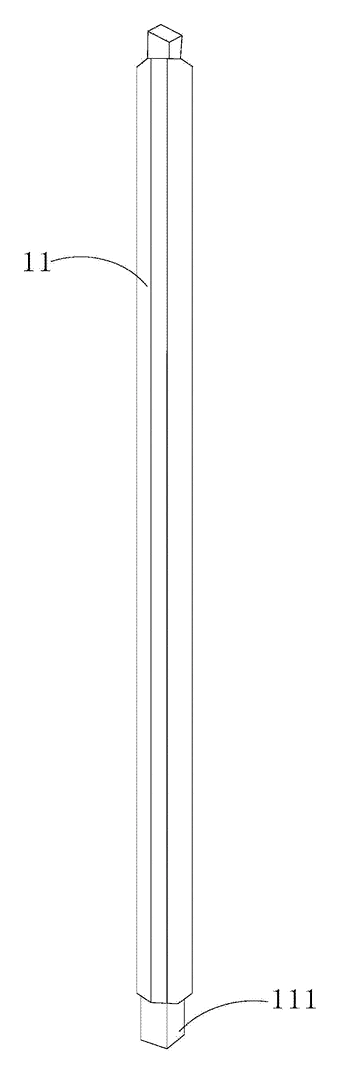
- A connecting rod (11) carries square connection end blocks (111) at both its inner and outer ends. These blocks plug into the chosen handle hole and into the jaw head, connecting the parts detachably.
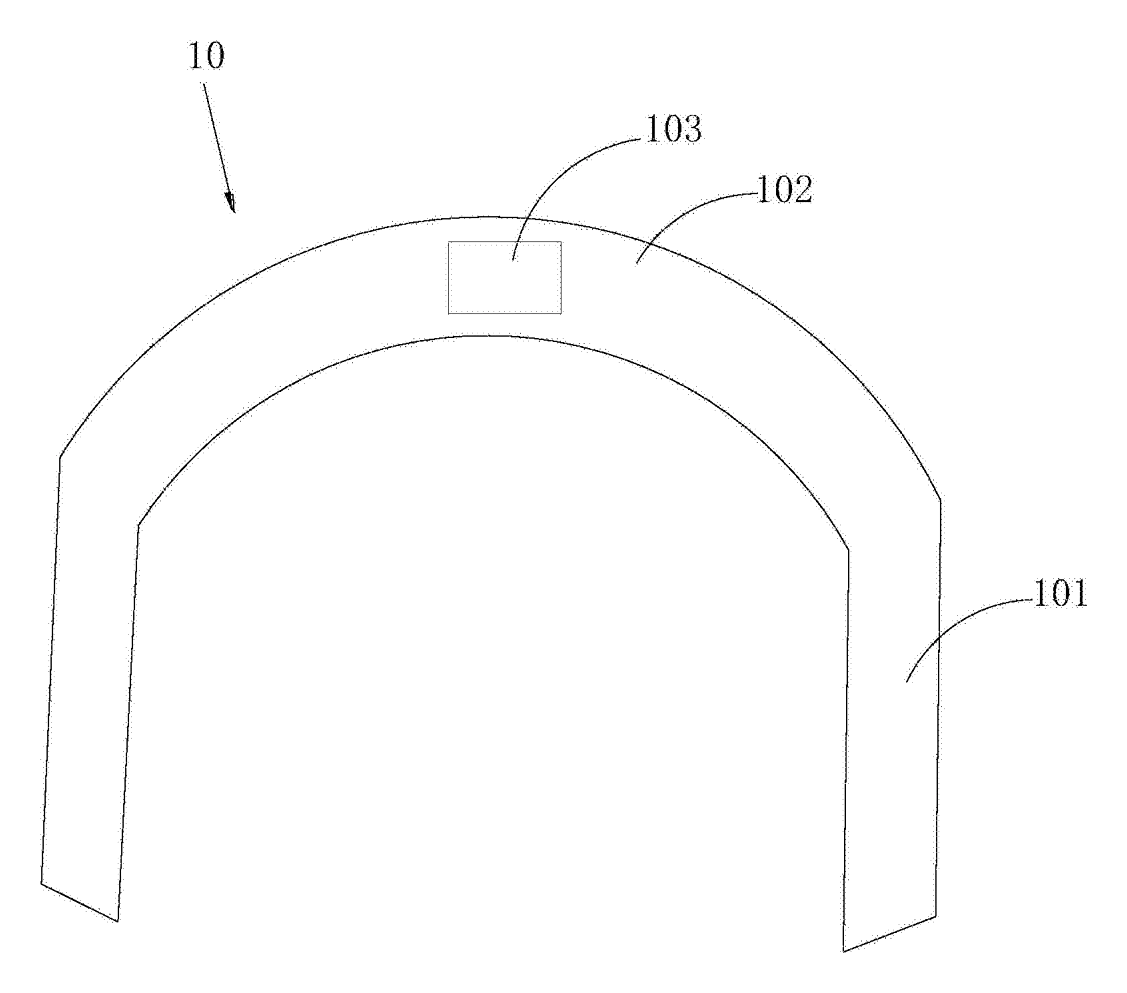
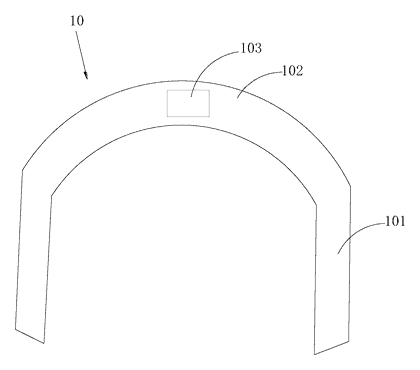
- The fastener jaw (10) comes in multiple sizes—about seven specifications based on bayonet socket width. Two snap arms (101) stand perpendicular to the jaw body, creating an open bayonet socket that receives a nut or screw head.
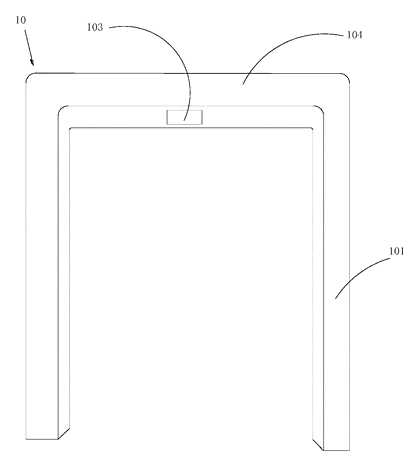
- For crowded pipe areas, an arc-shaped segment (102) jaw curves away from obstacles. For broken bolts inside hollow objects, a horizontal segment (104) jaw keeps the profile flat.
- A tapered knob (122) with anti-slip veins sleeves over the handle to improve grip during manual turning.
Who it is for
- Plumbing hardware brands looking to add a specialized basin wrench alternative to their retail catalogs, targeting homeowners who struggle with faucet mounting nuts.
- Professional maintenance contractors servicing HVAC units, water heaters, and commercial restrooms where fasteners hide behind panels and inside tubular frames.
- Automotive aftermarket tool suppliers offering mechanics a compact kit for reaching suspension or engine bay nuts blocked by hoses and brackets.
- Industrial equipment manufacturers bundling a dedicated service tool with machinery that uses recessed fasteners in hollow structural members.
How it works
The main parts
| No. | Part | What it does |
|---|---|---|
| 10 | Fastener jaw | Grips the nut; available in arc (102) or horizontal (104) shapes. |
| 101 | Snap arms | Two perpendicular arms forming the bayonet socket around the fastener. |
| 103 | Connecting hole | Receives the outer end block of the rod. |
| 11 | Connecting rod | Transmits torque from handle to jaw; adjustable insertion depth. |
| 111 | Connection end blocks | Square plugs at both rod ends for detachable connection. |
| 12 | Handle | Provides grip and houses the mounting holes. |
| 121 | First installing hole | Sidewall hole for lateral leverage. |
| 123 | Projection | Raised boss at the handle end containing the second installing hole. |
| 122 | Tapered knob | Slip-on grip with anti-slip veins. |
Assembly and use steps
- Select the jaw size matching the target nut or bolt head width from the available specifications.
- Insert the rod’s outer end block (111) into the jaw’s connecting hole (103). The square shape connects them.
- Choose the handle angle: plug the rod’s inner end block into the first installing hole (121) on the sidewall for lateral leverage, or into the projection’s hole (123) for straight-line access down a hollow tube. Adjust the insertion depth in the projection as needed.
- Place the bayonet socket over the fastener until the snap arms (101) flank the nut.
- Turn the handle to rotate the rod and jaw together, loosening or tightening the fastener.
- Disassemble the three modules for storage or swap the jaw for a different size.
Applications
Under-sink faucet installation
Plumbers replacing single-cold or hot-and-cold taps must reach mounting nuts trapped between the basin bottom and the wall. The side-mounted rod provides the lateral swing needed in this shallow cavity, while the bayonet socket slides onto the nut without requiring vertical clearance above the threaded stud.
Hollow structural frame assembly
When assembling tubular metal furniture or roll cages, fasteners often sit inside the hollow profiles. Inserting the rod axially through the handle’s end projection allows the jaw to reach deep into the tube, and the adjustable insertion depth sets the exact reach required for each joint.
Broken bolt extraction in confined engines
A bolt snapped flush inside a blind hole leaves no room for standard pliers. The horizontal segment jaw keeps the tool profile minimal, sliding its snap arms over the remaining stub to apply extraction torque where bulkier tools collide with adjacent engine block castings.
Water heater element replacement
Heating elements secured by large flange nuts sit behind insulation jackets and wiring harnesses. Swapping to a larger jaw specification accommodates the wide nut, and the arc-shaped jaw curves around protruding pipes that would otherwise block a straight wrench head.
Appliance repair and maintenance
Washing machine pump housings and dishwasher circulation motors use fasteners tucked behind plastic shrouds. The modular nature lets technicians carry one handle and rod with several small jaws instead of a heavy ring spanner set, navigating tight appliance interiors efficiently.
Where it is less suitable
- High-torque automotive lug nuts - the detachable square blocks are designed for plumbing and light mechanical tasks, not the extreme forces required for wheel lug removal.
- Precision instrument calibration - the bayonet socket lacks the fine tolerance control of dedicated pin spanners used on optical or laboratory collars.
- Continuous production line use - pneumatic or electric drivers outperform manual modular wrenches for repetitive assembly tasks involving hundreds of identical fasteners daily.
Frequently asked questions
How do the jaw heads attach to the rod?
Each jaw head has a connecting hole that accepts a square connection end block on the outer tip of the connecting rod. The square profile connects the jaw to the rod, yet allows the user to pull it off and swap sizes without tools.
Why are there two holes in the handle?
The first hole is drilled through the sidewall, allowing the handle to be turned laterally for leverage. The second hole runs axially through a raised projection at the handle’s end, aligning the rod straight with the handle to reach into hollow tubes or deep cavities.
How many jaw sizes does the patent mention?
The patent describes about seven different specifications, distinguished primarily by the width of the bayonet socket between the two snap arms to accommodate various nut and bolt head sizes. Exact metric or imperial dimensions are to be confirmed in design.
What is the difference between the arc and horizontal jaws?
The arc-shaped jaw curves outward, providing clearance when working near adjacent pipes or rounded obstacles that would block a flat tool. The horizontal segment jaw maintains a straight, low-profile geometry, which takes up less space inside narrow hollow objects.
Can this wrench handle high torque?
The patent focuses on reach and modularity rather than specifying torque ratings. The square end blocks transmit force, but the safe working limit depends entirely on the chosen steel grade, heat treatment, and block dimensions established during engineering.
Is the tapered grip removable?
Yes, the tapered knob sleeves over the outside of the handle. It features anti-slip veins to improve grip, especially useful in wet plumbing environments, and can be left off or replaced with a custom overmold during production.
Can this design be made and sold in the US?
The patent was filed only in China and has lapsed, so it does not restrict the design in the US or in China. Hand tool mechanisms may be covered by other US patents - see Patent & Production - so we recommend a freedom-to-operate check before volume production.
Are you affiliated with the patent owner?
No. IP2M is an independent design and manufacturing service working from the public patent document.
Request a quote
Click Request a Quote below to see our email address - copy it, or open your email app with a ready-made message. Please mention patent CN205325538U in the subject.
Helpful details to include:
- Your company and channel (tool brand, plumbing supplier, automotive distributor, industrial manufacturer)
- Target jaw sizes and fastener types you need to cover
- Material and finish preferences (e.g., chrome vanadium with chrome plating)
- Handle grip style (tapered knob, TPR overmold, bare metal)
- Estimated quantity and target price
- Timeline - when you would like prototypes and the first shipment
You can also reach us at (332) 203-9997.
Explore this product
Interested in building this?
Tell us your target market, quantity and timeline. We reply with options for prototyping, small-batch runs or volume production.
Send your inquiry to
Please put CN205325538U in the subject line and tell us your company, country, estimated quantity and timeline.
Prefer to talk? Call (332) 203-9997.
More product-ready patents
All Tools & Workshop patents →
Tools & Workshop
Rolling Tool Box with Telescoping Step Ladder
Telescoping A-frame ladder with an attached rolling tool box that slides to your working height.
Patent CN206290197U
Tools & Workshop
Folding 3-Handle Wrench Multi-Tool
Folding three-handle wrench multi-tool with magnetic screwdriver bits, saw, file and bottle opener.
Patent CN205290875U
Tools & Workshop
Rolling Auto-Repair Tool Cabinet with Built-In Lights
Lockable rolling tool cabinet for car repair with interior lights, a lubricant tray, parts drawers and a tool bay.
Patent CN205989314U
Tools & Workshop
Wide-Opening Folding Bolt Cutter
Bolt cutter with linked, gear-meshing handles that open up to 190° and fold in half for storage.
Patent CN207206226U
Tools & Workshop
Nail-Holding Hammer with Fold-Out Drivers
Hammer with a nail-holding T-slot in the head and fold-out drivers stored in the handle.
Patent CN205254927U
Tools & Workshop
Modular Wrench with Screw-On Heads
Wrench handle with a three-way threaded hub for screw-on adjustable and hex heads, plus a pipe sleeve.
Patent CN206216564U
Browse by category
- Apparel & Accessories (22)
- Baby & Kids (16)
- Bags & Luggage (9)
- Bath & Personal Care (16)
- Car Accessories (10)
- Furniture, Bedding & Storage (12)
- Garden & Outdoor (18)
- Health & Wellness (8)
- Home, Kitchen & Cleaning (24)
- Lighting (12)
- Packaging & Containers (6)
- Pet Products (6)
- Phone & Camera Accessories (4)
- Retail Display (13)
- School, Office & Art (19)
- Sports & Recreation (25)
- Tools & Workshop (27)
- Toys & Games (12)
This page is based on the public patent document CN205325538U, assigned to Individual. IP2M is an independent manufacturing service and is not affiliated with, endorsed by or licensed by the patent owner. Images marked as concept renderings are illustrations, not photos of an existing product. Patent status information is provided for reference only and is not legal advice; confirm freedom to operate for your market before production. Full disclaimer.